LLM Pulse Review 2026
LLM Pulse is an AI search visibility tracker that monitors how ChatGPT, Perplexity, Gemini, Google AI Mode, and other LLMs mention your brand. Track prompts weekly, analyze citations and sentiment, benchmark against competitors, and get content recommendations to improve your AI search presence. Used by 500+ brands including Swiss Marketplace Group and Voicemod.
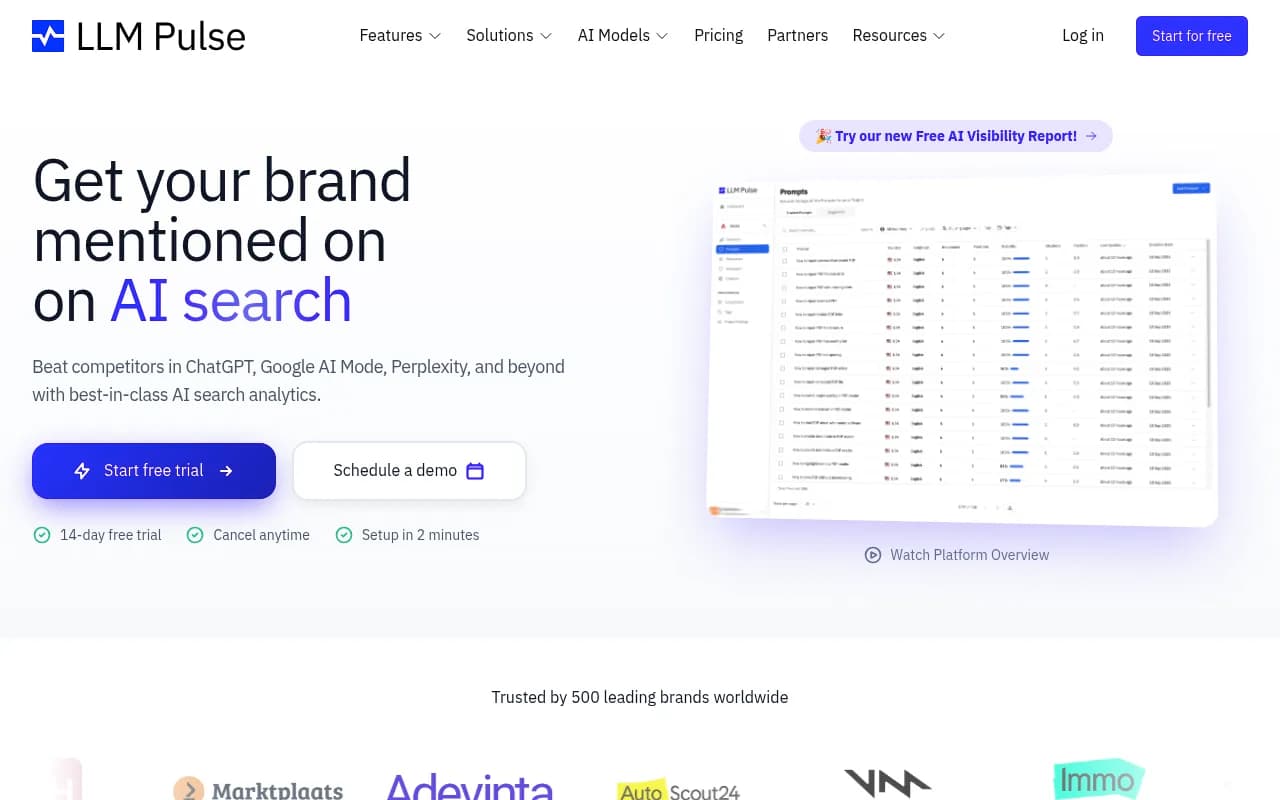
Summary: What You Need to Know About LLM Pulse
- Core function: AI search monitoring platform that tracks brand mentions across ChatGPT, Perplexity, Gemini, Google AI Mode, and AI Overviews -- weekly prompt tracking with visibility scoring and citation analysis
- Best for: Marketing teams and brands who need basic AI visibility monitoring but don't require advanced optimization features or daily tracking
- Strengths: Clean interface, Looker Studio integration, competitive pricing (€49/mo starter plan), white-label options for agencies, unlimited team members on all plans
- Limitations: Weekly tracking only (no daily option except enterprise), reports of platform bugs and missing functionality, lacks content generation and optimization tools that competitors offer, no crawler log analysis or traffic attribution
- Bottom line: A functional monitoring-only tool that shows you where you stand in AI search but doesn't help you improve it -- consider alternatives like Promptwatch if you need actionable optimization features alongside tracking
LLM Pulse launched in 2024 as an AI search visibility tracker designed to help brands understand how large language models like ChatGPT, Perplexity, and Google's AI products mention and recommend them. The platform is built around a simple premise: millions of people now ask AI chatbots instead of using traditional search engines, and brands need to know what those AI models are saying about them. LLM Pulse positions itself as "your radar in the world of generative AI" -- a monitoring dashboard that tracks key prompts over time and surfaces how AI sources reference your brand.
The company claims 500+ brands as customers, including Swiss Marketplace Group, Voicemod, Casa Batlló, and Adevinta/Marktplaats. It's a European product (pricing in euros, testimonials heavily from Spanish and Swiss companies) competing in the rapidly growing Generative Engine Optimization (GEO) and AI search visibility space.
Prompt Tracking & Monitoring
The core feature is prompt tracking -- you define a list of questions or queries relevant to your brand (e.g. "best project management tools for startups", "top CRM software for small business"), and LLM Pulse queries ChatGPT, Perplexity, Gemini, Google AI Mode, and Google AI Overviews with those prompts on a weekly basis. It captures the full AI response, extracts brand mentions, identifies citations, and tracks changes over time. You can monitor up to 40 prompts on the Starter plan (€49/mo), 100 on Growth (€99/mo), or 300 on Scale (€299/mo). Each prompt generates one AI response per week per model -- so 40 prompts means 200 total responses weekly across 5 models.
The platform includes an AI prompt suggestion feature that analyzes "real search behavior" to surface questions your customers actually ask AI models. This helps you avoid tracking irrelevant prompts, though the specifics of how this data is sourced aren't detailed on the site. Compared to competitors like Promptwatch (which provides prompt volume estimates, difficulty scores, and query fan-outs based on 880M+ citations analyzed), LLM Pulse's prompt discovery feels less robust.
Visibility Score & Benchmarking
LLM Pulse calculates a visibility score that measures your share of AI recommendations across tracked prompts. You can benchmark this score against competitors -- the platform allows 5 competitors per project on Starter, 10 on Growth, 15 on Scale. The competitive landscape view shows who AI recommends when customers ask specific questions, letting you see whether you're winning or losing mindshare in AI-generated responses. This is presented as a heatmap-style comparison, though the depth of competitor analysis appears limited compared to platforms like Promptwatch (which offers detailed competitor citation breakdowns and prompt-level win/loss tracking).
Citation & Source Analysis
The platform identifies which sources AI models cite when mentioning your brand or competitors. You can see if your own content gets cited, or if third-party sites, Reddit threads, or competitor pages are shaping the narrative. LLM Pulse also tracks app store citations specifically, which is useful for mobile app developers. However, it lacks the granular source analysis found in more advanced platforms -- no Reddit-specific insights, no YouTube tracking, no detailed breakdown of which exact pages or domains dominate citations in your category.
Sentiment Analysis
LLM Pulse analyzes the sentiment of AI responses to determine if models are praising, criticizing, or neutrally describing your brand. The goal is to catch negative framing or misinformation before it spreads to customers. You can see the exact words AI uses to describe you, which helps spot inaccuracies or missed opportunities. This is a standard feature across most AI visibility platforms, and LLM Pulse's implementation appears straightforward -- sentiment tagging on responses with no advanced NLP breakdowns or tone analysis.
Content Optimization & Recommendations
The platform claims to provide "AI-powered content recommendations to improve how you appear in LLM responses" and promises to "close the loop" on optimization. However, based on the website and user reports, this feature is underdeveloped compared to competitors. LLM Pulse does not include built-in content generation tools, answer gap analysis, or detailed optimization playbooks. It shows you what AI says about you, but doesn't actively help you create content that will improve your visibility. This is a critical gap -- platforms like Promptwatch offer AI writing agents that generate articles grounded in citation data, prompt volumes, and competitor analysis, turning insights into action. LLM Pulse stops at insights.
Data Exports & Integrations
All plans include data exports (CSV, Excel) and a Looker Studio connector, which is a strong point for teams that want to build custom dashboards or integrate AI visibility data into existing reporting workflows. The platform also offers an API and MCP (Model Context Protocol) support on enterprise plans, making it developer-friendly for teams that need programmatic access. However, there's no mention of Google Search Console integration, server log analysis, or traffic attribution features that would connect AI visibility to actual website traffic and revenue.
AI Models Covered
LLM Pulse tracks 5 AI models on all plans: ChatGPT, Perplexity, Gemini, Google AI Mode, and Google AI Overviews. Enterprise plans add DeepSeek and Grok. This is fewer models than some competitors -- Promptwatch covers 10+ models including Claude, Meta AI, Mistral, and Copilot on standard plans. The lack of Claude coverage is notable given its growing adoption among enterprise users.
White Label & Agency Features
LLM Pulse offers white-label options and agency-specific plans with volume discounts, dedicated support, and test projects. The platform is used by agencies like t2ó and has a dedicated partner program. This makes it a viable option for agencies that want to resell AI visibility tracking under their own brand, though the lack of optimization features limits its value as a full-service GEO solution.
Platform Stability & User Experience
User reports indicate the platform can be buggy and lacks some expected functionality. The interface is clean and modern, but there are gaps in feature completeness -- for example, no daily tracking option outside of enterprise plans, limited prompt discovery tools, and missing optimization workflows. The team appears responsive (testimonials mention fast implementation of feedback), but the product feels like it's still maturing compared to more established competitors.
Who Is LLM Pulse For?
LLM Pulse is best suited for marketing teams and brand managers at mid-sized companies (50-500 employees) who need basic AI visibility monitoring and don't require daily tracking or advanced optimization features. It's a good fit for European brands (pricing in euros, strong European customer base) and agencies that want a white-label monitoring solution to resell to clients. It works for teams that already have content creation workflows in place and just need visibility data to inform their strategy.
It's NOT ideal for SEO teams or content marketers who need actionable optimization tools, brands that require daily tracking to catch rapid changes in AI responses, or companies that want to connect AI visibility to traffic and revenue metrics. If you're looking for a platform that helps you actually improve your AI search presence (not just monitor it), you'll likely outgrow LLM Pulse quickly.
Pricing & Value
Pricing is competitive: Starter at €49/mo (€40.83/mo annual, 1 project, 40 prompts), Growth at €99/mo (€82.50/mo annual, 2 projects, 100 prompts), Scale at €299/mo (€249.17/mo annual, 5 projects, 300 prompts). All plans include unlimited team members, Looker Studio connector, and sentiment analysis. 14-day free trial, no credit card required. Annual billing saves 17%. Enterprise plans are custom priced and add daily tracking, custom models, SSO, white label, and up to 100k tracked prompts.
Compared to competitors: LLM Pulse is cheaper than Promptwatch (which starts at $99/mo but includes content generation, crawler logs, and optimization tools), roughly on par with Otterly.AI ($29-$489/mo for monitoring-only), and more affordable than enterprise-focused platforms like Profound or AthenaHQ. The value proposition depends on whether you need monitoring alone (LLM Pulse is fine) or monitoring plus optimization (Promptwatch or similar is better).
Strengths
- Affordable entry point: €49/mo starter plan is accessible for small teams testing AI visibility tracking
- Looker Studio integration: Strong data export and custom reporting capabilities
- White-label options: Good fit for agencies that want to resell under their own brand
- Unlimited team members: No per-seat pricing makes it easy to onboard entire marketing teams
- Clean interface: Modern, straightforward UI that's easy to navigate
Limitations
- Weekly tracking only: No daily option except on enterprise plans, which means you miss rapid changes in AI responses
- Monitoring-only platform: Lacks content generation, answer gap analysis, and optimization workflows that competitors offer
- Limited model coverage: Only 5 models on standard plans (no Claude, Meta AI, Mistral, Copilot)
- Platform bugs reported: User feedback indicates stability issues and missing functionality
- No traffic attribution: Can't connect AI visibility to actual website traffic or revenue
- Weak prompt discovery: Prompt suggestion feature is less robust than competitors with volume/difficulty data
Bottom Line
LLM Pulse is a functional AI search monitoring tool that does one thing reasonably well: it shows you what ChatGPT, Perplexity, and Google's AI products say about your brand. If you need basic visibility tracking, competitive benchmarking, and sentiment analysis at an affordable price, it's worth testing. The Looker Studio integration and white-label options are strong points for agencies and data-driven teams.
However, it's a monitoring-only platform in a market where the leaders are building end-to-end optimization solutions. You'll see where you're invisible, but you won't get much help fixing it. No content generation, no answer gap analysis, no crawler logs, no traffic attribution -- just dashboards and data exports. For brands serious about improving their AI search presence (not just tracking it), platforms like Promptwatch offer a more complete solution that turns insights into action. LLM Pulse is a decent starting point, but you'll likely need more as your AI visibility strategy matures.
Best use case in one sentence: European marketing teams that need affordable, white-labelable AI visibility monitoring and already have content creation workflows in place.
Tags:
Similar and alternative tools to LLM Pulse