Key Takeaways
- LLM Pulse has transparent pricing starting at €49/mo while Airefs hides pricing behind sales calls -- a major friction point for small teams
- LLM Pulse tracks 10+ AI models (ChatGPT, Perplexity, Gemini, Google AI Mode, DeepSeek, Grok, Claude, Copilot, Meta AI, AI Overviews) while Airefs focuses primarily on ChatGPT and Perplexity
- Airefs emphasizes content strategy and "showing up in the right places" (Reddit, LinkedIn, G2, YouTube) while LLM Pulse focuses on prompt tracking and citation analysis
- LLM Pulse offers a 14-day free trial vs Airefs' 7-day trial, giving you more time to evaluate
- Both tools are monitoring-focused -- neither offers built-in content generation or optimization workflows to actually fix visibility gaps
- LLM Pulse has 500+ customers including Swiss Marketplace Group and Voicemod, while Airefs claims 100+ teams but doesn't name specific brands
Overview
LLM Pulse
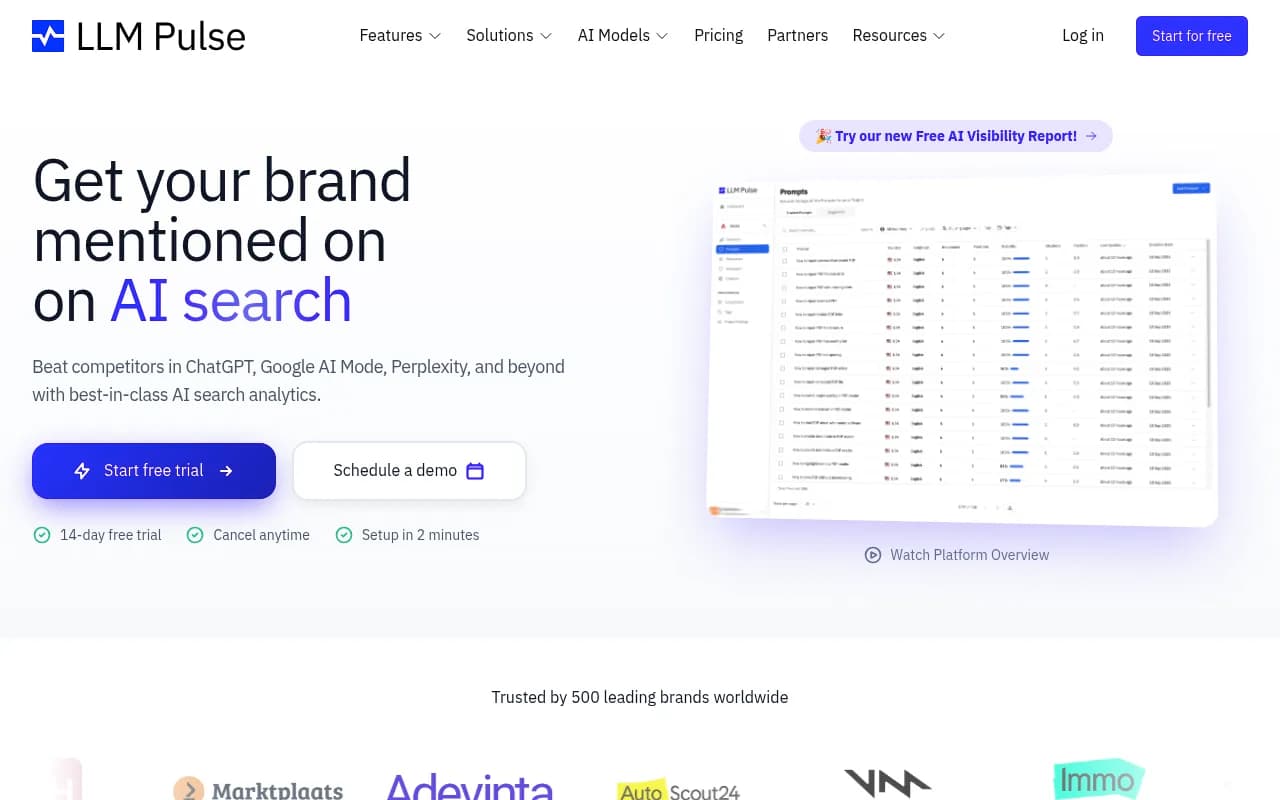
LLM Pulse positions itself as "your radar in the world of generative AI." It tracks how ChatGPT, Perplexity, Gemini, Google AI Mode, and other LLMs mention your brand across prompts you define. The platform runs weekly checks on your key prompts, measures visibility scores, citation rates, sentiment, and share of voice against competitors. You get AI-powered content recommendations to improve your presence, though these are suggestions rather than a full content creation workflow. Used by 500+ brands, it's one of the more established players in the AI visibility tracking space.
Airefs
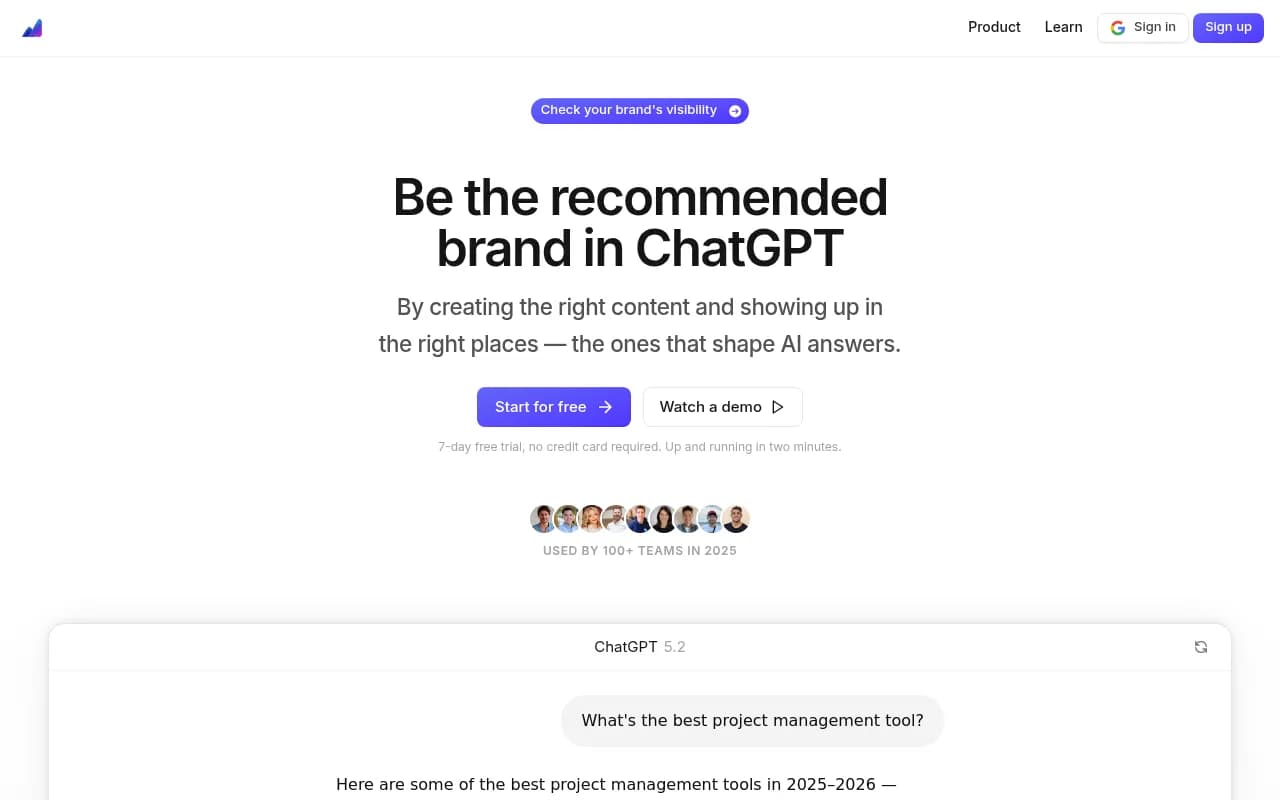
Airefs takes a slightly different angle. Instead of just tracking whether you appear in AI answers, it emphasizes understanding where those answers come from -- Reddit threads, LinkedIn posts, G2 reviews, YouTube videos, Quora answers. The pitch is that your website alone won't get you cited; you need to "show up in the right places" that shape AI responses. Airefs tracks competitor mentions, identifies which content influences AI answers, and helps you create strategic content to become the recommended brand. The platform claims 100+ teams as customers but keeps specifics vague. Pricing is hidden, which immediately raises friction for anyone who wants to evaluate cost before booking a demo.
Side-by-Side Comparison
| Feature | LLM Pulse | Airefs |
|---|---|---|
| Starting price | €49/mo (Starter) | Hidden (requires sales call) |
| Free trial | 14 days | 7 days |
| AI models tracked | 10+ (ChatGPT, Perplexity, Gemini, Google AI Mode, AI Overviews, DeepSeek, Grok, Claude, Copilot, Meta AI) | Primarily ChatGPT, Perplexity |
| Prompt tracking | ✓ Weekly, exact prompts you define | ✓ Keyword-based with auto-generated prompts |
| Citation analysis | ✓ Shows which sources AI cites | ✓ Identifies influential content (Reddit, LinkedIn, G2, YouTube) |
| Competitor benchmarking | ✓ Share of voice, visibility scores | ✓ Competitor mention tracking |
| Sentiment analysis | ✓ | Not mentioned |
| Content recommendations | ✓ AI-powered suggestions | ✓ Strategic content guidance |
| Content generation | ✗ | ✗ |
| Setup time | 2 minutes | 2 minutes |
| Customer count | 500+ brands | 100+ teams |
| Named customers | Swiss Marketplace Group, Voicemod | None publicly listed |
| Annual billing discount | 17% | Unknown |
AI model coverage
LLM Pulse wins decisively here. It tracks 10+ AI models including ChatGPT, Perplexity, Gemini, Google AI Mode, AI Overviews, DeepSeek, Grok, Claude, Copilot, and Meta AI. Some models (DeepSeek, Grok, Claude, Copilot, Meta AI) are marked as "Enterprise" tier, meaning you need a higher plan to access them. But the breadth is there.
Airefs focuses primarily on ChatGPT and Perplexity. The website mentions "AI search" broadly but doesn't list specific models beyond those two. If you care about how Gemini or Google AI Mode represents your brand, Airefs doesn't appear to track that.
Verdict: LLM Pulse covers more ground. If you want comprehensive AI model monitoring, it's the clear pick.
Prompt tracking approach
LLM Pulse uses exact prompts you define. You tell it "best CRM for startups" or "top project management tools for remote teams," and it tracks those specific queries weekly. This gives you control over what gets monitored, but it also means you need to know which prompts matter. The platform doesn't seem to auto-discover related prompts or suggest new ones based on what competitors are ranking for.
Airefs uses a keyword-based approach with auto-generated prompts. You give it keywords, and it generates relevant prompts to track. This could save time if you don't want to manually brainstorm every query, but it also means less control over exactly what gets tracked. The website emphasizes tracking "important user questions" but doesn't clarify how it determines importance.
Verdict: LLM Pulse gives you precision; Airefs gives you convenience. Pick based on whether you want control or automation.
Citation and source analysis
Both tools analyze which sources AI models cite, but they frame it differently.
LLM Pulse shows you citation rates (what percentage of responses cite your brand), which sources AI trusts in your space, and whether your content gets cited vs competitors. The focus is on measuring your citation presence and spotting gaps.
Airefs goes deeper into where those citations come from. It explicitly tracks Reddit threads, LinkedIn posts, G2 reviews, YouTube videos, and Quora answers -- the "right places" that shape AI responses. The platform shows you which pages and content types influence AI answers, with the idea that you should create content on those platforms, not just your website.
Verdict: Airefs has a more strategic angle here. If you want to understand the content ecosystem that feeds AI models, it's more explicit about that. LLM Pulse tracks citations but doesn't emphasize the platform-specific strategy as much.
Competitor benchmarking
LLM Pulse offers share of voice metrics, visibility scores, and competitor comparison. You can see which competitors get recommended instead of you and track how your visibility changes over time relative to them. The dashboard shows competitor performance across different AI models.
Airefs tracks competitor mentions and shows you which competitors appear in AI answers for your target prompts. The website mentions "understand which ones get recommended instead of you -- and why," suggesting it provides reasoning or context. But details are sparse.
Verdict: Both tools cover the basics. LLM Pulse has more explicit metrics (share of voice, visibility scores). Airefs promises to explain "why" competitors win but doesn't show enough to verify that claim.
Content recommendations and optimization
LLM Pulse provides "AI-powered content recommendations to improve how you appear in LLM responses." The website doesn't clarify what form these take -- are they topic suggestions? Keyword gaps? Specific content briefs? It's positioned as the third step in their workflow (Track → Analyze → Optimize), but the details are vague.
Airefs emphasizes "creating the right content, in the right places." The pitch is that you need to show up on Reddit, LinkedIn, G2, YouTube, and Quora -- not just your website. The platform identifies which content influences AI answers and guides you to create strategic content on those platforms. Again, specifics are light.
Neither tool offers built-in content generation. You get suggestions or guidance, but you're still writing the content yourself. If you want a platform that actually generates optimized articles for you, tools like Promptwatch include AI writing agents that create content grounded in citation data and prompt volumes.

Verdict: Both tools stop at recommendations. Airefs has a clearer strategic framework (create content on third-party platforms), but neither automates the actual content creation.
Pricing
| Plan | LLM Pulse | Airefs |
|---|---|---|
| Starter/Entry | €49/mo | Hidden |
| Growth/Mid | €99/mo | Hidden |
| Scale/High | €299/mo | Hidden |
| Free trial | 14 days | 7 days |
| Annual discount | 17% | Unknown |
LLM Pulse has transparent pricing: €49/mo for Starter, €99/mo for Growth, €299/mo for Scale. Annual billing saves 17%. The website doesn't break down what's included in each tier, but at least you know the cost upfront.
Airefs hides pricing entirely. You get a 7-day free trial, but after that, you need to contact sales. This is a red flag for small teams or solo marketers who want to evaluate cost before investing time in a demo. Hidden pricing usually signals higher price points or complex custom deals.
Verdict: LLM Pulse wins on transparency. Airefs' hidden pricing is a friction point that will turn off budget-conscious buyers.
User interface and setup
Both platforms claim 2-minute setup. LLM Pulse's dashboard (visible in screenshots) shows a clean overview with visibility scores, citation rates, and prompt tracking. The interface looks straightforward -- you can see your tracked prompts, competitor performance, and detailed AI responses.
Airefs' screenshots show a similar layout: tracked prompts, competitor mentions, citation sources. The design looks modern and uncluttered. One screenshot shows "Top Pages" and "Crawler %" metrics, suggesting it tracks which pages on your site AI crawlers visit -- a feature LLM Pulse doesn't explicitly mention.
Verdict: Both interfaces look clean and functional. Airefs might have an edge on crawler tracking, but we'd need to test both to say for sure.
Customer base and social proof
LLM Pulse lists 500+ brands as customers and names two: Swiss Marketplace Group and Voicemod. The website shows a grid of client logos (though they're generic placeholders in the HTML, not actual logos). Still, 500+ customers and named brands signal traction.
Airefs claims 100+ teams and shows testimonial photos with names (Ruben, Anthony, Lillian, Alex, Paul, Jennifer, Tom, Thibault, Kiyan). But it doesn't name any companies. The website mentions that Resend, Tally, Vercel, and DataFast use Airefs for traffic/signups, but those are presented as case study stats, not endorsements. It's unclear if those brands are actual customers or just examples.
Verdict: LLM Pulse has more credible social proof. Airefs' testimonials feel less concrete without company names.
Pros and cons
LLM Pulse pros
- Transparent pricing starting at €49/mo
- Tracks 10+ AI models (most comprehensive coverage)
- 14-day free trial (longer than Airefs)
- 500+ customers with named brands
- Exact prompt tracking gives you control
- Annual billing discount (17%)
LLM Pulse cons
- Content recommendations are vague -- unclear what form they take
- No built-in content generation
- Doesn't emphasize third-party platforms (Reddit, LinkedIn, G2) as explicitly as Airefs
- Prompt discovery seems manual (you define prompts yourself)
Airefs pros
- Strong focus on third-party platforms (Reddit, LinkedIn, G2, YouTube, Quora)
- Keyword-based prompt generation could save time
- Emphasizes strategic content placement, not just tracking
- Potentially tracks AI crawler activity on your site
Airefs cons
- Hidden pricing (major friction for small teams)
- Shorter free trial (7 days vs 14)
- Limited AI model coverage (primarily ChatGPT, Perplexity)
- Vague customer proof (no named brands)
- Content recommendations are still just suggestions, not automated creation
Who should pick which tool
Pick LLM Pulse if:
- You want transparent pricing and need to know costs upfront
- You care about tracking multiple AI models (Gemini, Google AI Mode, DeepSeek, Grok, Claude, etc.)
- You prefer exact prompt control over auto-generated queries
- You want a longer free trial to evaluate (14 days)
- You value established social proof (500+ customers, named brands)
Pick Airefs if:
- You're willing to do a sales call to learn pricing
- You only care about ChatGPT and Perplexity (the two dominant AI search engines)
- You want a platform that emphasizes third-party content strategy (Reddit, LinkedIn, G2, YouTube)
- You prefer keyword-based tracking with auto-generated prompts
- You're comfortable with less transparent customer proof
Consider Promptwatch if:
- You want to go beyond monitoring and actually fix visibility gaps with built-in content generation
- You need Answer Gap Analysis to see which prompts competitors rank for but you don't
- You want AI crawler logs to understand how ChatGPT, Claude, and Perplexity discover your content
- You need page-level tracking and traffic attribution to connect visibility to revenue
Final verdict
LLM Pulse is the safer pick for most teams. Transparent pricing, broader AI model coverage, longer free trial, and more credible social proof make it the default choice. If you're a small team or solo marketer evaluating AI visibility tools for the first time, LLM Pulse gives you everything you need without friction.
Airefs has a compelling strategic angle -- the emphasis on Reddit, LinkedIn, G2, and YouTube is smart, because that's where AI models pull a lot of their citations. But hidden pricing and limited AI model coverage hurt its case. If you're a larger team with budget flexibility and you specifically want to optimize your presence on third-party platforms, Airefs might be worth a demo. For everyone else, LLM Pulse is the clearer path.
Both tools are monitoring-focused. They'll show you where you're invisible, but they won't generate the content to fix it. If you want a platform that closes the loop from tracking to content creation, look at tools that include AI writing agents and Answer Gap Analysis -- that's where the real optimization happens.