Summary
- AI citations determine which brands get discovered in ChatGPT, Perplexity, and other answer engines—traditional search rankings no longer guarantee visibility
- Only 30% of brands maintain consistent citations across consecutive AI responses, making one-off checks misleading
- Citation tracking requires monitoring retrieval (whether your content was considered), usage (whether it shaped the answer), and attribution (whether you got credited)
- Share of Intent reveals which competitors dominate AI recommendations for real buyer questions in your category
- Structured content, strong authority signals, and accessible site architecture drive citation probability—but citations remain unreliable enough that visibility without accuracy becomes a brand risk
Your brand can rank on page one of Google and still vanish from the answers buyers get from ChatGPT, Perplexity, and Gemini.
More people now research products through AI tools before they open a browser tab. AI answer engines summarize options, compare vendors, and recommend solutions long before a visitor reaches your website. Yet most marketing teams have no reliable way to see how AI platforms represent their brand—or whether they cite your sources at all.
Visibility shifts fast. Research found only 30% of brands stayed visible from one answer to the next, and just 20% held presence across five consecutive runs. That volatility makes one-off checks misleading. Citation tracking gives you a clearer signal and a baseline you can improve.
This guide explains how LLMs decide which sources to cite, how to measure citation provenance credibly, and how to track your presence against competitors in a practical, repeatable way.
Why citation attribution matters in AI answer engines
AI answer engines shape buyer perceptions earlier than any landing page. When a prospect asks, "What's the best project management tool for remote teams?" the response builds a shortlist instantly.
If your brand appears with accurate, positive context, you earn consideration. If a competitor appears instead, you lose the deal before you knew it existed. If the AI hallucinates facts about your product, you inherit a reputation problem you can't easily fix.
Citations are now a primary discovery surface. Gartner forecasts that traditional search engine volume will drop 25% by 2026 as AI chatbots absorb demand. By 2028, brands' organic search traffic could decrease 50% or more as consumers adopt generative AI-powered search. Datos (reported by The Wall Street Journal) estimated that 5.6% of U.S. desktop browser search traffic went to LLM-based tools in June 2025, up from 2.48% a year earlier.
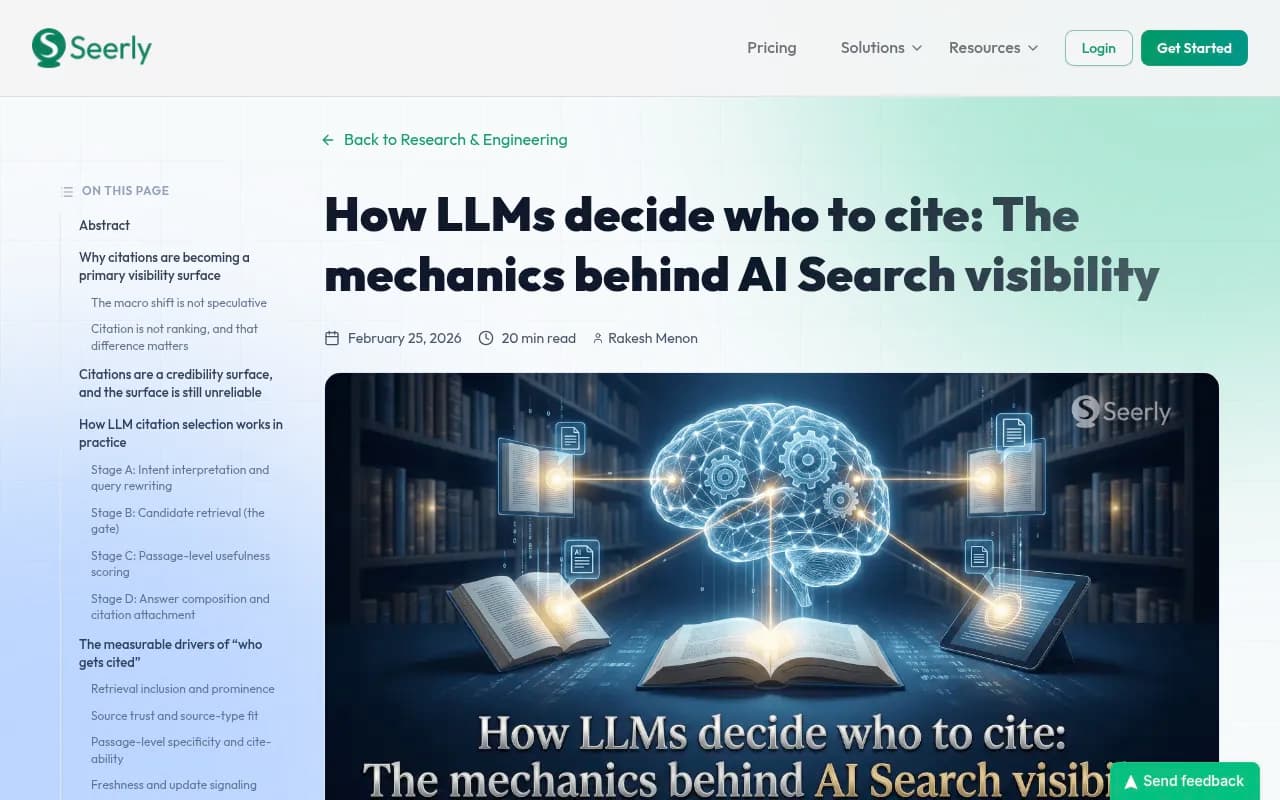
But citations remain unreliable. The same prompt can return different sources on consecutive runs. AI models sometimes cite pages that don't support the claim. They sometimes cite nothing at all. This gap between user expectations ("the AI cited it, so it must be true") and reality (citations are probabilistic, not deterministic) creates both opportunity and risk.
How LLMs decide which sources to cite
Citation selection in modern LLM systems happens in stages. Understanding the mechanics helps you influence outcomes.
Retrieval: getting into the candidate pool
Before an LLM can cite your content, it must retrieve it. Most commercial AI answer engines use retrieval-augmented generation (RAG): the system searches an index (often powered by traditional search engines or vector databases), pulls candidate documents, and feeds them to the LLM as context.
Retrieval depends on:
- Keyword and semantic matching: Does your content contain terms and concepts related to the query?
- Authority signals: Does the retrieval system trust your domain? Backlinks, domain age, and editorial quality still matter.
- Recency: Some systems favor recent content, especially for time-sensitive queries.
- Accessibility: Can the AI crawler read your page? JavaScript-heavy sites, paywalls, and robots.txt blocks reduce retrieval probability.
If your content doesn't make it into the retrieval set, the LLM never sees it. No retrieval means no citation.
Selection: which sources shape the answer
Once retrieved, the LLM decides which sources to use. This happens during response generation. The model reads the candidate documents, synthesizes an answer, and selects which sources to credit.
Selection factors include:
- Relevance to the specific claim: Does the source directly support the statement the model is making?
- Clarity and structure: Well-organized content with clear headings, bullet points, and concise answers gets cited more often than dense prose.
- Consensus across sources: If multiple retrieved documents say the same thing, the model is more likely to cite them.
- Token budget constraints: LLMs have limited context windows. If your content is verbose or buried in a long page, the model may not read far enough to find the relevant section.
Attribution: who gets credited
Even when your content shapes the answer, you may not get a visible citation. Some AI systems cite sparingly. Others cite generously but inconsistently.
Attribution behavior varies by platform:
- Perplexity: Cites inline with numbered references and shows source cards.
- ChatGPT (with search enabled): Cites sources in brackets and links to pages.
- Google AI Overviews: Shows source links below the generated text.
- Claude: Rarely cites external sources unless explicitly prompted.
The same content can be cited in Perplexity but ignored in ChatGPT. This platform-specific behavior makes multi-platform tracking essential.
Core metrics for tracking citation provenance
Traditional SEO metrics (rankings, impressions, clicks) don't translate to AI search. You need new KPIs that reflect how LLMs work.
Citation frequency
How often does an AI model cite your brand or domain when answering relevant queries?
Track this across:
- Platforms: ChatGPT, Perplexity, Gemini, Claude, Google AI Overviews, Copilot, etc.
- Query types: Branded queries ("What is [your product]?"), category queries ("Best project management tools"), and competitor comparisons ("[Competitor] vs [your brand]").
- Time: Weekly snapshots reveal trends. A single check tells you nothing about stability.
How to measure: Run the same set of prompts weekly on each platform. Log which sources the AI cites. Calculate citation frequency as (number of times cited / total prompts run) × 100.
Share of Intent (SoI)
Which brands dominate AI recommendations for buyer questions in your category?
Share of Intent measures competitive visibility. If 10 prompts return 50 total brand mentions and your brand appears 8 times, your SoI is 16%.
Why it matters: SoI reveals whether you're winning or losing in AI-mediated discovery. A competitor with 40% SoI is shaping buyer perceptions four times more than you.
How to measure: Define a prompt set that represents real buyer intent (e.g., "What's the best CRM for small businesses?", "Top email marketing platforms", "Salesforce alternatives"). Run each prompt, count brand mentions, calculate your share.
Citation drift and stability
How consistent are your citations over time?
Citation drift measures volatility. If you're cited in 80% of responses one week and 20% the next, your visibility is unstable. High drift means you can't rely on AI search as a predictable channel.
How to measure: Track citation frequency weekly. Calculate the standard deviation. Low standard deviation = stable visibility. High standard deviation = unpredictable presence.
Hallucination rate
How often do AI models make false or misleading claims about your brand?
Hallucinations are a brand risk. If ChatGPT says your product costs $99/month when it actually costs $49/month, prospects form incorrect expectations. If Perplexity claims you offer a feature you don't, you inherit support burden.
How to measure: Run branded prompts ("What is [your product]?", "[Your brand] pricing", "[Your brand] features"). Compare AI responses to ground truth (your actual product, pricing, features). Flag inaccuracies. Calculate hallucination rate as (inaccurate responses / total responses) × 100.
Sentiment in citations
When AI models cite you, what do they say?
Sentiment matters. Being cited in a list of "outdated tools" is worse than not being cited at all. Being cited as "the best option for enterprise teams" is valuable.
How to measure: Manually review AI responses that cite your brand. Classify sentiment as positive, neutral, or negative. Track sentiment distribution over time.
Consensus check
Do multiple AI models agree on facts about your brand?
Consensus reveals whether you've established a clear, consistent narrative. If ChatGPT says you're "best for small teams" but Perplexity says you're "designed for enterprise," your positioning is unclear.
How to measure: Run the same branded prompt across multiple platforms. Compare responses. Flag inconsistencies.
Tools for tracking citation provenance
Manual tracking works for small prompt sets but doesn't scale. Dedicated platforms automate citation monitoring across LLMs.
Multi-platform monitoring tools
These tools track your brand visibility across ChatGPT, Perplexity, Gemini, Claude, and other AI engines:
Promptwatch is the only platform that goes beyond monitoring to help you fix visibility gaps. It shows you which prompts competitors rank for but you don't (Answer Gap Analysis), then generates AI-optimized content grounded in 880M+ citations analyzed. You can track results with page-level citation tracking and tie visibility to actual traffic. Most competitors (Otterly.AI, Peec.ai, AthenaHQ) stop at monitoring.


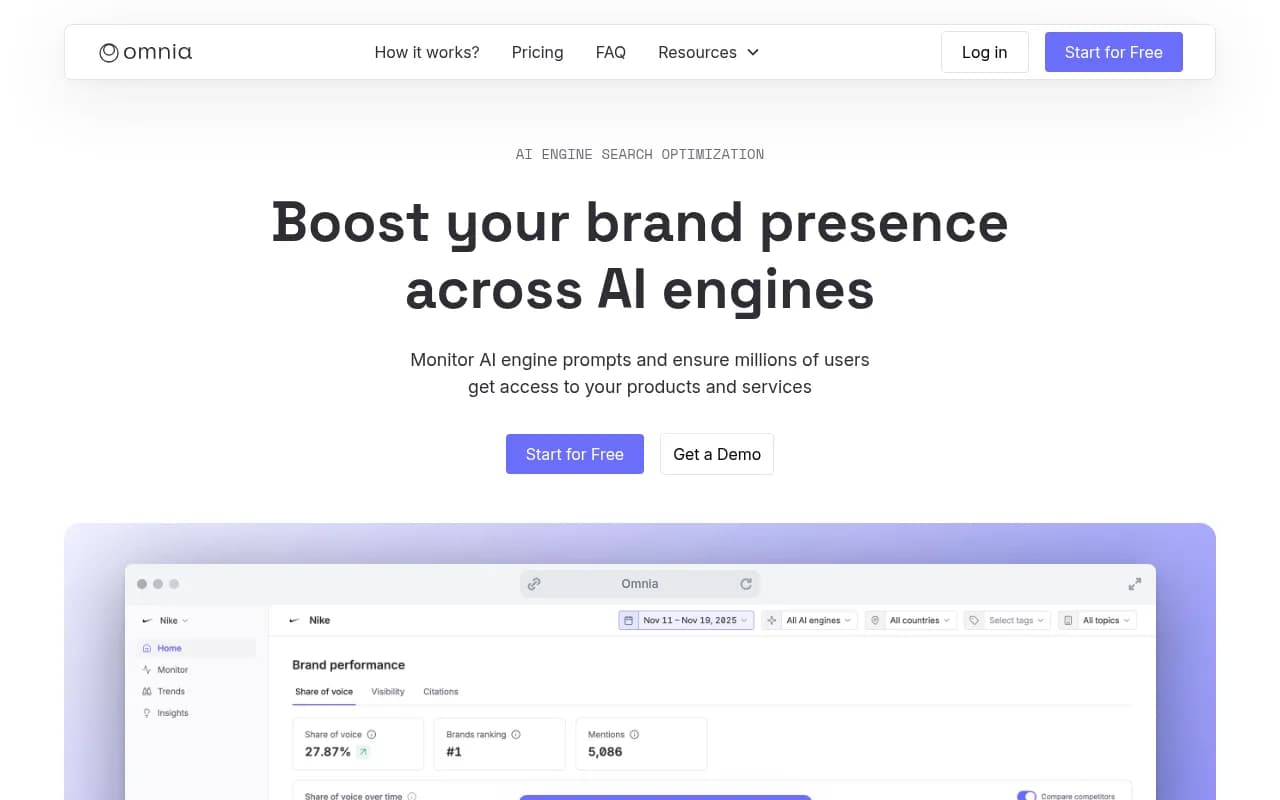
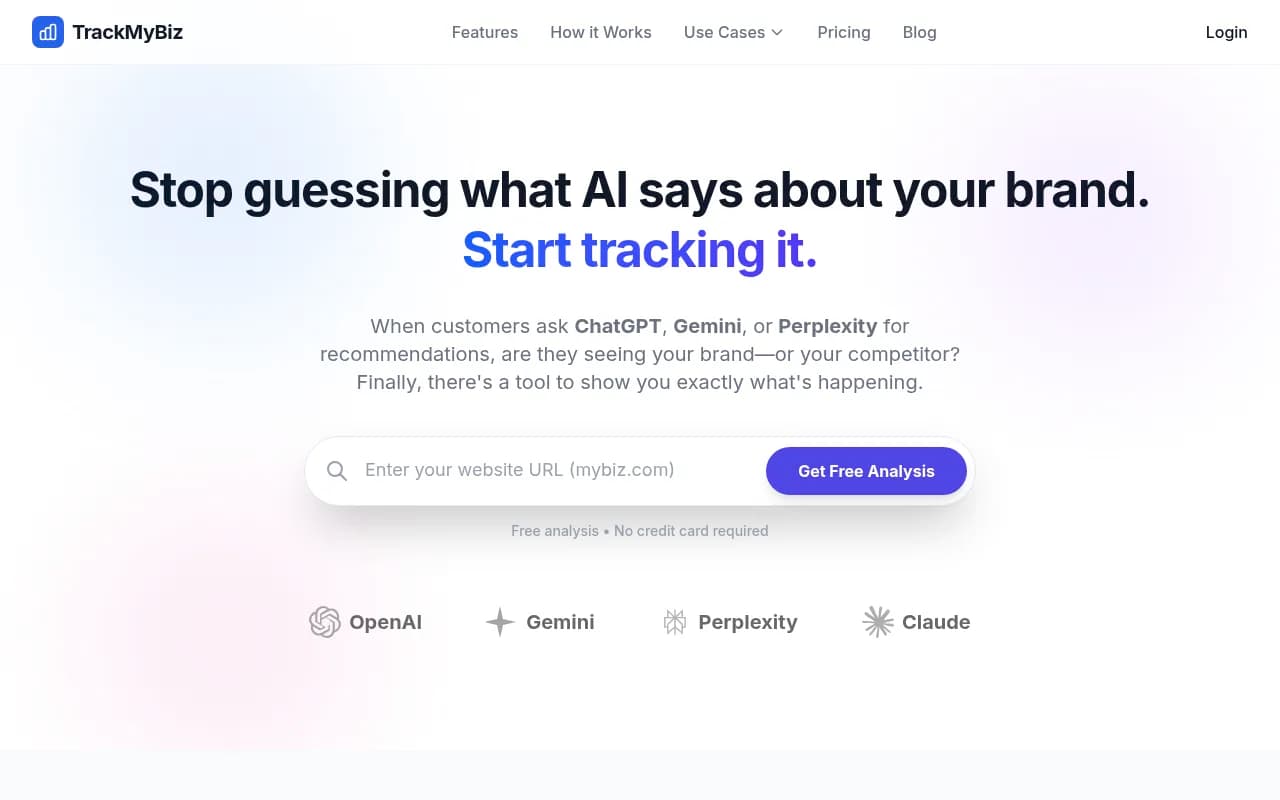
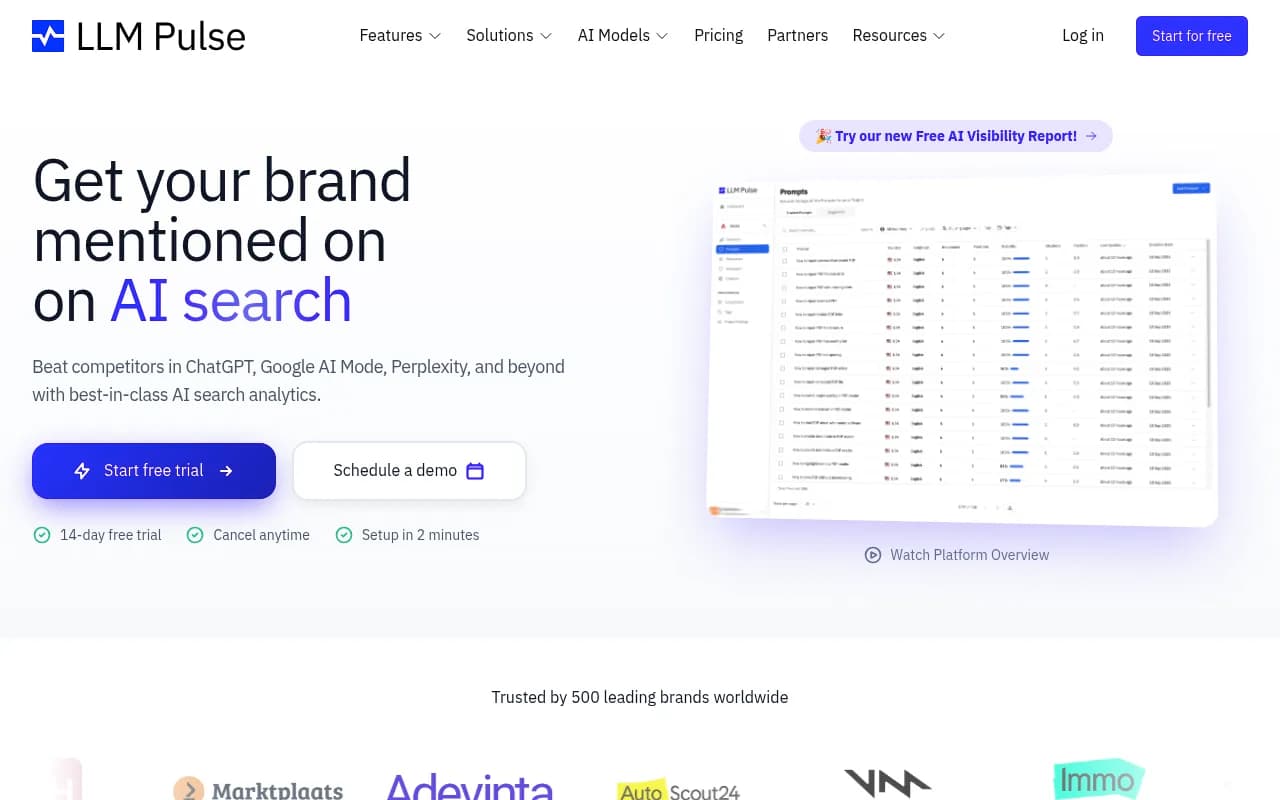
Comparison: monitoring vs optimization platforms
| Platform | Citation tracking | Crawler logs | Content gap analysis | AI content generation | Traffic attribution |
|---|---|---|---|---|---|
| Promptwatch | Yes (10 LLMs) | Yes | Yes | Yes | Yes |
| Rankshift | Yes (3 LLMs) | No | No | No | No |
| Omnia | Yes (basic) | No | No | No | No |
| TrackMyBusiness | Yes (3 LLMs) | No | No | No | No |
| LLM Pulse | Yes (5 LLMs) | No | No | No | No |
Manual tracking setup
If you're not ready for a paid tool, you can track citations manually:
- Define your prompt set: 10-20 queries that represent buyer intent in your category. Include branded queries, category queries, and competitor comparisons.
- Run prompts weekly: Use ChatGPT, Perplexity, Gemini, and Claude. Log responses in a spreadsheet.
- Extract citations: Note which sources each AI cites. Flag when your brand is mentioned.
- Calculate metrics: Citation frequency, Share of Intent, hallucination rate.
- Track trends: Compare week-over-week changes.
This approach is labor-intensive but gives you a baseline before investing in automation.
What drives citation probability
You can't control LLM citation behavior directly, but you can influence the inputs that shape it.
Content structure and clarity
AI models favor content that's easy to parse. Clear headings, bullet points, and concise answers increase citation probability.
Actionable changes:
- Use descriptive H2 and H3 headings that match query intent (e.g., "How to track LLM citations" instead of "Tracking methods").
- Answer questions directly in the first paragraph. Don't bury the answer.
- Use bullet points and numbered lists for multi-part answers.
- Keep paragraphs short (2-3 sentences).
Authority signals
LLMs inherit biases from their training data and retrieval systems. High-authority domains get retrieved and cited more often.
Actionable changes:
- Build backlinks from trusted sources in your industry.
- Publish on authoritative platforms (industry publications, research journals, major news sites).
- Earn mentions in Wikipedia, which many LLMs treat as a high-trust source.
Accessibility for AI crawlers
If AI crawlers can't read your content, you won't get cited.
Actionable changes:
- Check your robots.txt file. Make sure you're not blocking AI crawlers (GPTBot, ClaudeBot, PerplexityBot, etc.).
- Avoid heavy JavaScript rendering. Use server-side rendering or prerendering for critical content.
- Remove paywalls or login requirements for key pages you want cited.
- Monitor AI crawler logs to see which pages they're accessing. Promptwatch provides real-time AI crawler logs showing which pages ChatGPT, Claude, and Perplexity read, errors they encounter, and how often they return.
Recency and freshness
Some queries favor recent content. If you're in a fast-moving industry (e.g., AI tools, crypto, tech news), update your content regularly.
Actionable changes:
- Add publication dates and last-updated timestamps to articles.
- Refresh evergreen content quarterly with new data, examples, and insights.
- Publish timely content on emerging topics before competitors do.
Consensus and cross-referencing
LLMs are more likely to cite claims that multiple sources agree on. If your content aligns with the broader consensus, you're more likely to get cited.
Actionable changes:
- Research what other trusted sources say about your topic. Align your messaging with the consensus where appropriate.
- Cite authoritative sources in your content. This signals that you're part of the trusted information ecosystem.
- Avoid making unsupported claims. If you make a bold statement, back it up with data or expert quotes.
Risks and limitations of citation tracking
Citation tracking is valuable, but it has blind spots.
Citations are probabilistic, not deterministic
The same prompt can return different citations on consecutive runs. This is a feature of how LLMs work, not a bug. Models sample from a probability distribution. Even with identical inputs, outputs vary.
This means:
- A single check doesn't tell you much. You need repeated sampling to estimate citation probability.
- Perfect consistency is impossible. Even the best-optimized content won't get cited 100% of the time.
Platform-specific behavior
Each AI platform has its own retrieval system, citation policy, and model behavior. What works for Perplexity may not work for ChatGPT.
This means:
- You need to track multiple platforms separately.
- Optimization strategies may need to be platform-specific.
Personalization and context
Some AI platforms personalize responses based on user history, location, or preferences. This makes citation tracking harder.
This means:
- You may need to test from multiple accounts or locations to get a representative sample.
- Your citation rate may differ from what your customers actually see.
Hallucinations and inaccuracies
Even when you get cited, the AI may misrepresent your content. Tracking citations without checking accuracy gives you an incomplete picture.
This means:
- You need to manually review cited content for correctness.
- High citation frequency with high hallucination rate is a net negative.
Taking action: from tracking to optimization
Tracking citations is step one. The real value comes from using that data to improve visibility.
Close content gaps
If competitors get cited for queries you care about but you don't, you have a content gap.
How to fix it:
- Identify prompts where competitors appear but you don't.
- Analyze what content competitors have that you lack.
- Create content that directly answers those prompts.
- Structure it for AI readability (clear headings, concise answers, bullet points).
Promptwatch's Answer Gap Analysis automates this process. It shows you exactly which prompts competitors rank for but you don't, then generates AI-optimized content to fill those gaps.
Fix hallucinations
If AI models make false claims about your brand, you need to correct the record.
How to fix it:
- Publish clear, authoritative content that states the correct facts.
- Use structured data (schema.org markup) to make facts machine-readable.
- Reach out to high-authority sites that are being cited incorrectly and ask them to update.
- Monitor hallucination rate over time to see if corrections are working.
Improve citation stability
If your citations are volatile, you need to strengthen your authority signals and content quality.
How to fix it:
- Build more backlinks from trusted sources.
- Update content regularly to maintain freshness.
- Expand content depth—longer, more comprehensive articles get cited more consistently.
- Monitor AI crawler logs to ensure they're accessing your content regularly.
Tie visibility to revenue
Citation tracking is a vanity metric unless you connect it to business outcomes.
How to do it:
- Add tracking parameters to URLs cited by AI platforms (if possible).
- Monitor referral traffic from AI search engines in Google Analytics.
- Use Promptwatch's traffic attribution (code snippet, GSC integration, or server log analysis) to connect AI visibility to actual revenue.
- Compare conversion rates from AI referrals vs traditional search.
The future of citation attribution
Citation behavior in LLMs is evolving fast. What works in 2026 may not work in 2027.
Emerging trends:
- Agentic AI: AI agents that take actions (book meetings, make purchases) on behalf of users will rely even more heavily on citations to justify decisions.
- Multimodal citations: As LLMs incorporate images, videos, and audio, citation formats will expand beyond text links.
- Provenance verification: Platforms may add cryptographic signatures or blockchain-based provenance tracking to combat misinformation.
- Paid citation placements: Some platforms may introduce sponsored citations, blurring the line between organic and paid visibility.
The brands that win in AI search will be the ones that treat citation tracking as an ongoing discipline, not a one-time audit. Track weekly. Optimize continuously. Measure results. That's the loop.
Key takeaway: Citation attribution in AI outputs is the new SEO. Traditional rankings don't guarantee visibility in ChatGPT, Perplexity, or Gemini. Track citation frequency, Share of Intent, and hallucination rate across platforms. Use tools like Promptwatch to automate monitoring and close content gaps. Optimize for AI readability, authority signals, and crawler accessibility. Tie visibility to revenue. The brands that master citation provenance in 2026 will dominate AI-mediated discovery for years to come.