Omnia Review 2026
Practical tool for tracking how your brand appears across ChatGPT, Gemini, and other AI platforms with clear visibility metrics.
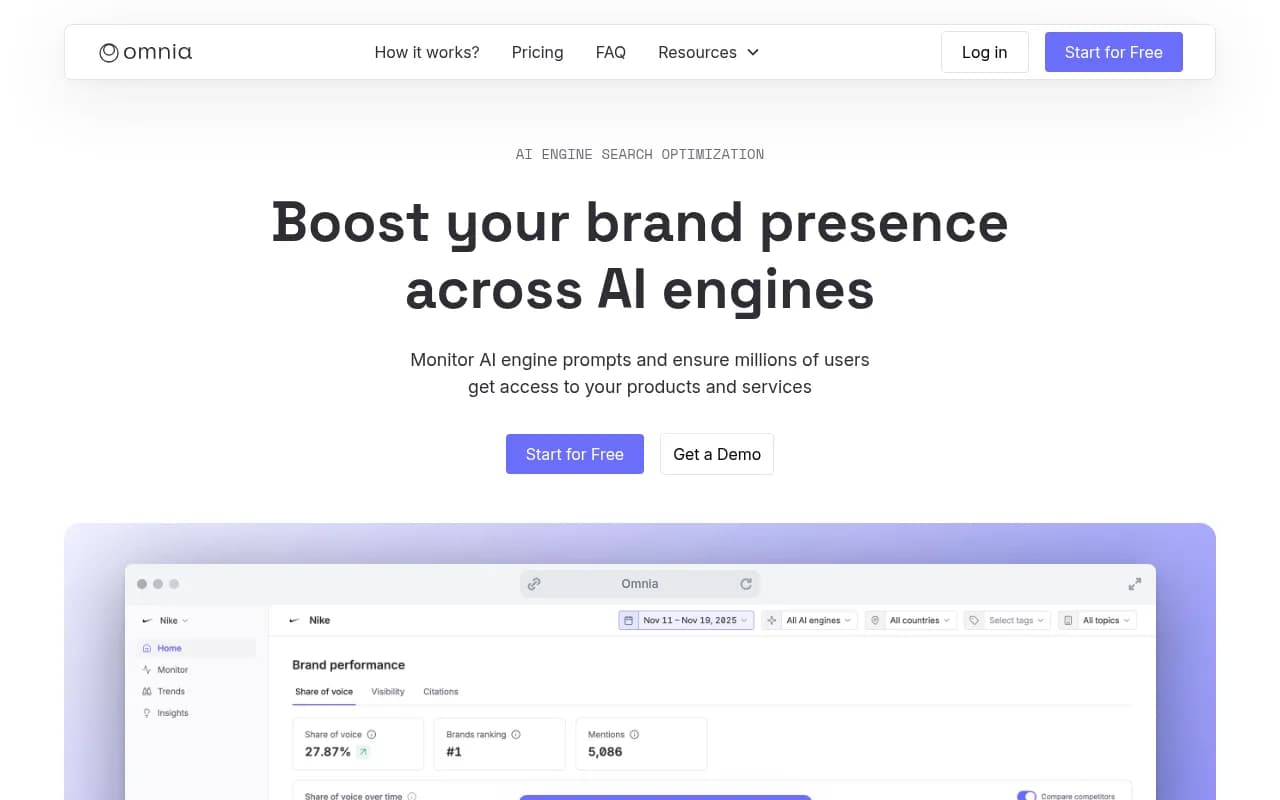
Omnia is an AI visibility monitoring platform built specifically for SEO specialists and marketing teams who need to understand how their brand appears in AI-generated search results. As AI engines like ChatGPT, Perplexity, and Google AI Overviews become primary research tools for consumers, brands need visibility into when and how these platforms mention them. Omnia addresses this by continuously monitoring AI responses across multiple engines and providing actionable insights on brand performance.
Key Takeaways:
• Monitors brand mentions across ChatGPT, Perplexity, Google AI Overviews, and Google AI Mode with daily or more frequent checks • Tracks up to 25-200+ prompts depending on plan tier, with unlimited country and language support • Shows exact sources and URLs that AI engines cite when mentioning your brand, helping you optimize content placement • Provides competitor comparison and share of voice metrics to benchmark your AI visibility • Pricing starts at €63/month (yearly) or €79/month (monthly) with a free trial available
How Omnia Works
Omnia connects directly to major AI engines and runs your monitored prompts through them just as a real user would. The platform starts by analyzing your website URL to understand your business, then suggests relevant topics and prompts that users commonly ask AI engines when searching for products or services like yours. Every few hours (or daily, depending on your settings), Omnia re-runs these prompts and parses the AI responses to track changes in brand mentions, citations, and positioning.
The platform operates through three core steps: you input your brand URL, select topics to monitor from Omnia's suggestions, and receive ongoing insights as the platform continuously queries AI engines and analyzes results.
Topic Discovery and Prompt Monitoring
Omnia's topic discovery feature identifies the most searched topics and prompts in AI engines related to your industry. For example, a luxury watch brand might see topics like "Best luxury watches," "Automatic watches," "Swiss watch brands," "Limited edition watches," and "Luxury watch investment." Each topic comes with search trend data showing volume and competition levels.
You can monitor 25 prompts on the Growth plan, 100 prompts on the Pro plan, or 200+ prompts on Enterprise. The platform supports unlimited countries and languages, making it suitable for global brands tracking AI visibility across different markets. This is particularly valuable for companies operating in multiple regions where AI responses may vary significantly based on local context.
Brand Performance Tracking
The platform provides share of voice metrics showing how your brand ranks against competitors across key topics over time. You can see percentage breakdowns of brand mentions in AI responses, with historical trend data. For instance, you might see that Rolex holds 48% share of voice for "luxury watches" while your brand holds 12%, with daily or weekly tracking showing whether your position is improving.
This competitive benchmarking helps you understand whether your content strategy is working and where you're losing ground to competitors. The visual dashboards show performance trends across multiple AI engines simultaneously, so you can see if you're gaining visibility in ChatGPT but losing it in Perplexity.
Citation and Source Analysis
One of Omnia's most practical features is showing exactly which sources AI engines pull information from when mentioning your brand. The platform displays a table of URLs, source types (owned, third-party, social media), and citation counts. For example, you might see that reddit.com is cited 15 times and a third-party review site is cited 17 times when AI engines discuss your product category.
This citation data is actionable: if AI engines are pulling information from Reddit threads or third-party review sites rather than your owned content, you know where to focus your content placement efforts. You can create optimized content for those high-citation sources or improve your presence on platforms that AI engines trust.
Multi-Engine Coverage
Omnia currently supports ChatGPT, Perplexity, Google AI Overviews, and Google AI Mode. This multi-engine approach is important because different AI platforms may surface different brands depending on their training data and retrieval methods. A brand might rank well in ChatGPT responses but poorly in Perplexity, indicating different content optimization needs for each platform.
The platform queries these engines as a real user would, not through APIs or simulations, ensuring you see actual user-facing results. This real-world testing approach provides more reliable data than synthetic benchmarks.
Who Is Omnia For
Omnia is designed for SEO specialists, content strategists, and marketing teams at companies where AI search visibility matters. This includes:
E-commerce brands and retailers tracking how AI engines recommend their products when users ask shopping-related questions. If consumers are asking ChatGPT "best running shoes for marathons" or Perplexity "most reliable laptop brands," these companies need to know if they're mentioned.
B2B SaaS companies monitoring whether AI engines surface their brand when users research software categories. For example, a project management tool needs to know if ChatGPT mentions them when users ask "best project management software for remote teams."
Service businesses and agencies in competitive categories like legal services, financial advisory, or healthcare, where AI-generated recommendations increasingly influence consumer decisions.
Enterprise brands with large content operations that need to justify content investments by showing AI visibility ROI. The Pro and Enterprise tiers with 100-200+ prompt monitoring are built for these larger organizations.
Omnia is less suitable for very small businesses or solopreneurs who don't have the resources to act on AI visibility insights, or for brands in highly regulated industries where AI mentions are less relevant to customer acquisition.
Integrations and Data Export
The Pro plan includes Slack customer support and data export capabilities, allowing teams to pull Omnia data into their existing analytics workflows. The Enterprise plan adds a dedicated account manager with 24-hour SLA.
The platform mentions upcoming sentiment analysis features, which will help brands understand not just whether they're mentioned, but whether those mentions are positive, negative, or neutral.
Pricing and Plans
Omnia offers three tiers:
Growth Plan: €79/month (or €63/month paid yearly, saving 20%). Includes monitoring up to 25 prompts, all four AI engines, unlimited countries and languages, competitor tracking, and citation monitoring. Daily monitoring frequency. Free trial available with no credit card required.
Pro Plan: €279/month (or €223/month yearly). Everything in Growth plus monitoring up to 100 prompts, Slack support, sentiment analysis (coming soon), and data export.
Enterprise Plan: Custom pricing. Everything in Pro plus 200+ prompt monitoring and a dedicated account manager with 24-hour SLA.
The yearly discount makes the Growth plan €756/year versus €948/year on monthly billing—a meaningful savings for teams committing long-term. The free trial lets you test the platform before committing.
Compared to tools like Promptwatch (which offers similar AI visibility tracking with broader LLM coverage and real prompt data from actual users), Omnia's pricing is competitive for teams focused specifically on the four supported AI engines. However, Omnia's engine coverage is narrower—it doesn't include Claude, Gemini, Grok, DeepSeek, or Copilot, which limits visibility into the full AI search landscape.
Strengths
Focused use case: Omnia does one thing well—tracking brand mentions in AI search results. The interface is built specifically for this workflow, not a general-purpose SEO tool trying to add AI features.
Citation source tracking: Showing exactly which URLs AI engines cite is highly actionable. This feature directly informs content strategy and placement decisions.
Multi-language and multi-country support: Unlimited language and country tracking on all plans is valuable for global brands, especially at this price point.
Competitive benchmarking: Share of voice metrics against competitors help teams understand their relative position, not just absolute performance.
Limitations
Limited AI engine coverage: Only four AI engines (ChatGPT, Perplexity, Google AI Overviews, Google AI Mode) means you're missing visibility data from Claude, Gemini, Grok, DeepSeek, and Microsoft Copilot. For comprehensive AI visibility, you'd need additional tools.
No real user prompt data: Omnia monitors prompts you define, but doesn't show what real users are actually asking AI engines. Tools like Promptwatch track real user prompts and volumes, giving you data-driven topic discovery rather than suggested topics.
Sentiment analysis not yet available: This feature is marked "coming soon" on the Pro plan, meaning current users can't yet analyze whether brand mentions are positive or negative.
Bottom Line
Omnia is a solid choice for SEO and marketing teams who need straightforward AI visibility monitoring across ChatGPT, Perplexity, and Google AI platforms. The citation source tracking is particularly valuable for content strategists trying to figure out where to place optimized content. Best use case: mid-sized e-commerce or B2B brands tracking 25-100 key prompts in their category who want clear, actionable data on where AI engines are finding information about their brand and competitors.
Similar and alternative tools to Omnia