Key Takeaways
- Pricing: Brantial starts at $59/mo (roughly €55) vs Omnia at €63/mo yearly (€79/mo monthly) -- nearly identical entry points, but Brantial's Growth plan ($149/mo for 5 users) scales better than Omnia's single-user base tier
- Actionability: Omnia provides a step-by-step AI visibility roadmap with content creation guidance, while Brantial focuses on schema markup and entity optimization for LLM citability
- Analytics depth: Omnia tracks citations and share of voice across AI engines; Brantial measures impressions, inclusion rate, referral clicks, and assisted conversions -- more granular conversion tracking
- Speed of iteration: Brantial explicitly markets rapid testing and updates across models without touching your core stack; Omnia's roadmap approach is more structured but potentially slower
- Team collaboration: Brantial's Growth and Pro plans include 5-10 users; Omnia's pricing structure doesn't clearly specify multi-user support at the base tier
- Best for: Pick Omnia if you want guided, step-by-step optimization with clear content gaps. Pick Brantial if you need fast iteration, conversion tracking, and technical LLM optimization.
Overview
Omnia: Practical AI visibility tracking for marketing teams
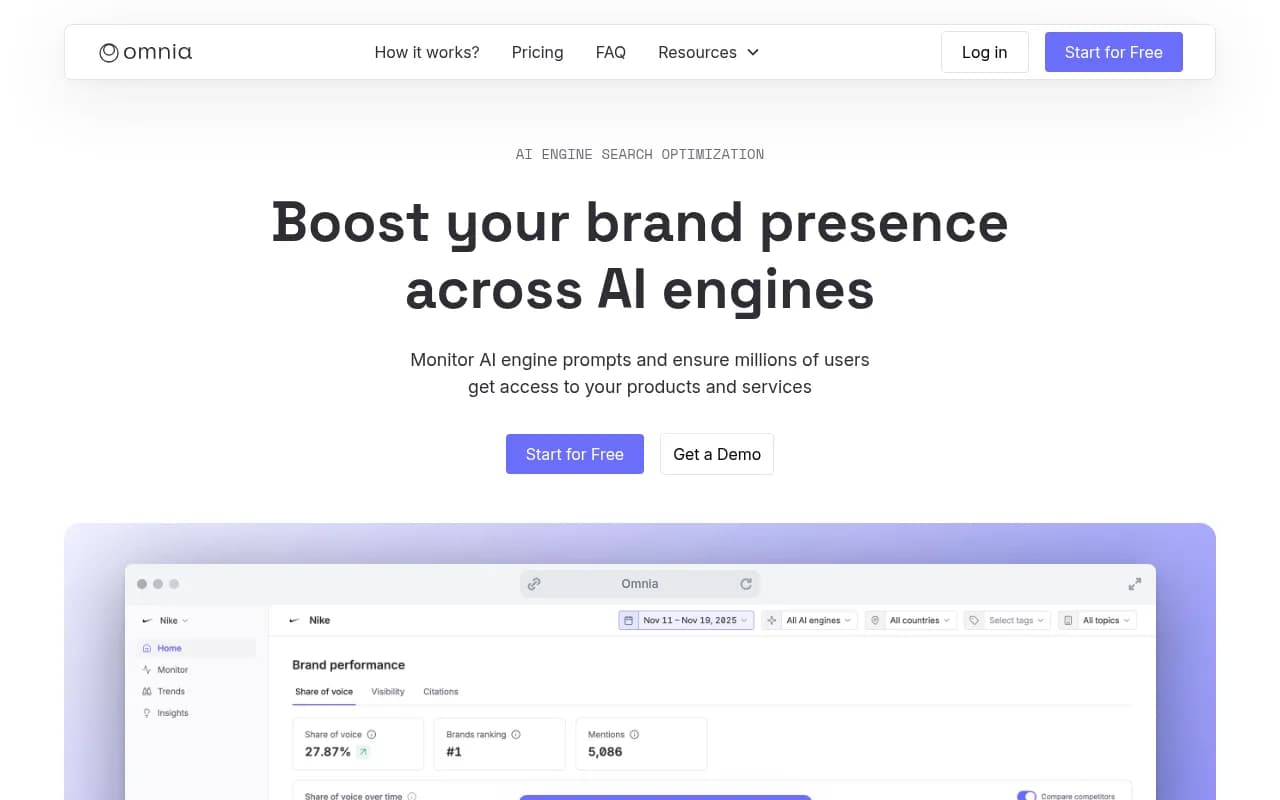
Omnia positions itself as a platform built for SEO and marketing experts who need to monitor how their brand shows up in ChatGPT, Perplexity, Google Gemini, and Microsoft Copilot. The core promise: see the real questions people ask AI, understand where your brand appears (or doesn't), and get a roadmap to fix the gaps. Clients include Exoticca, Ironhack, and Growth Hackers. Pricing starts at €63/mo on annual billing or €79/mo monthly, with a free trial available.
What stands out is Omnia's emphasis on translating tracking data into action. You're not just staring at dashboards -- the platform gives you a step-by-step visibility roadmap covering content creation, technical SEO, and content placement. It's designed for teams who want clear next steps, not just metrics.
Brantial: Fast-moving GEO with conversion tracking
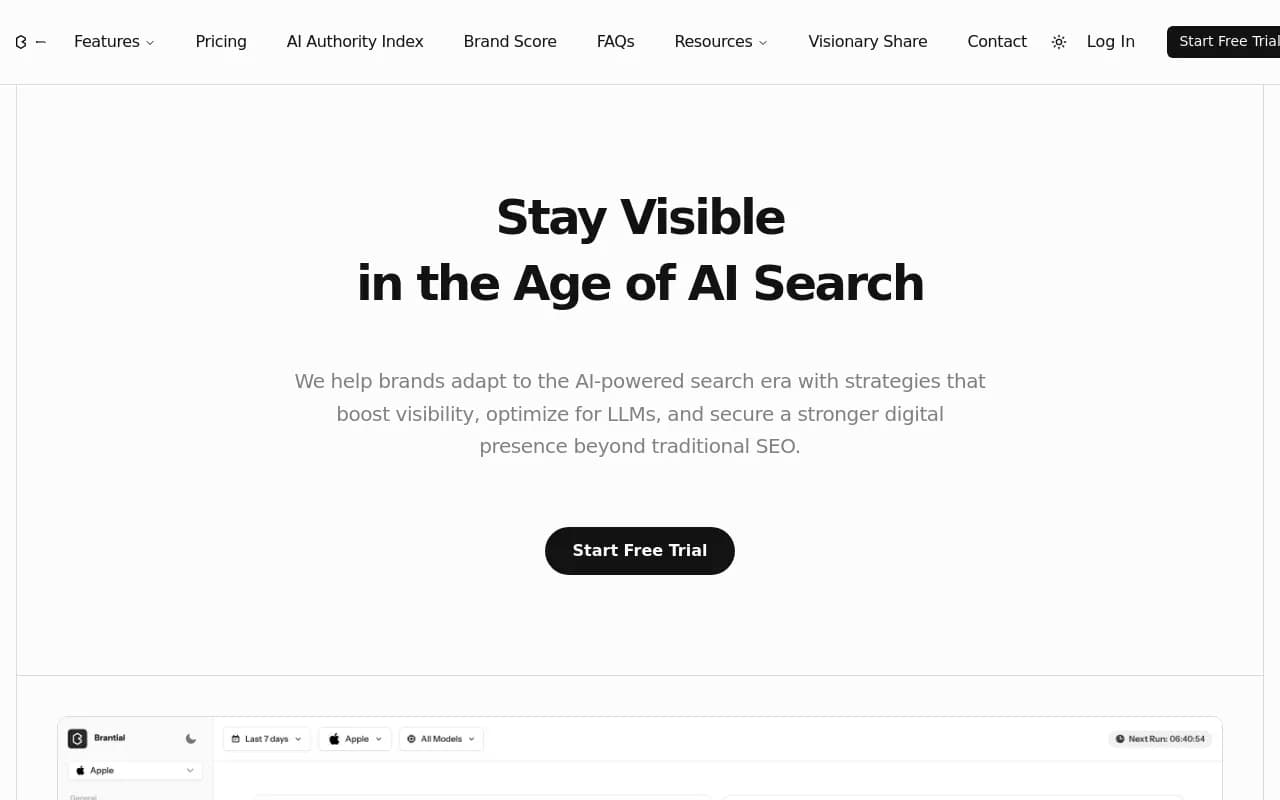
Brantial markets itself as a Generative Engine Optimization (GEO) platform for brands adapting to the AI search era. It tracks visibility across ChatGPT, Google SGE, and other LLMs, but the pitch is different: analyze millions of real conversations, optimize content so LLMs cite you, and measure impact with KPIs like impressions, inclusion rate, referral clicks, and assisted conversions. Pricing starts at $59/mo for the Starter plan (1 user), $149/mo for Growth (5 users), and $299/mo for Pro (10 users). Free trial available.
Brantial's angle is speed and adaptability. The AI search ecosystem shifts constantly, and Brantial claims to iterate content, schema, and entity signals rapidly, testing across models and rolling out updates without touching your core stack. If you need to move fast and prove ROI with conversion data, that's the hook.
Side-by-Side Comparison
| Feature | Omnia | Brantial |
|---|---|---|
| Starting price | €63/mo (yearly) / €79/mo (monthly) | $59/mo (Starter, 1 user) |
| Free trial | Yes | Yes |
| LLM coverage | ChatGPT, Perplexity, Gemini, Copilot | ChatGPT, Google SGE, other LLMs (not fully specified) |
| Prompt discovery | Real questions people ask AI | Analyze millions of real conversations |
| Citation tracking | Yes, with source analysis | Yes, with inclusion rate and referral clicks |
| Competitor benchmarking | Share of voice vs competitors | Not explicitly mentioned |
| Content optimization | Step-by-step roadmap (content creation, technical SEO, placement) | Schema markup, entity optimization, contextual structuring |
| Analytics | Citations, share of voice, visibility metrics | Impressions, inclusion rate, referral clicks, assisted conversions |
| Multi-user support | Not clearly specified at base tier | 5 users (Growth), 10 users (Pro) |
| Iteration speed | Roadmap-based (structured) | Rapid testing and updates across models |
| API/Integrations | Not mentioned | Not mentioned |
| Target audience | SEO and marketing teams | Fast-moving teams, brands adapting to AI search |
Pricing comparison
| Plan | Omnia | Brantial |
|---|---|---|
| Free tier | Free trial only | Free trial only |
| Starter/Base | €63/mo (yearly) or €79/mo (monthly) | $59/mo (1 user) |
| Growth/Mid-tier | Not specified | $149/mo (5 users) |
| Pro/High-tier | Not specified | $299/mo (10 users) |
| Enterprise | Not specified | Not specified |
Omnia's pricing is straightforward but doesn't show clear upgrade paths beyond the base tier. Brantial's tiered structure makes it easier to scale as your team grows -- $149/mo for 5 users is a better deal than paying 5x the single-user rate.
User interface and workflow
Omnia's interface centers on three tabs: "See the real questions people ask AI", "See your brand through AI's eyes", and "Act on your data". The workflow is linear -- discover prompts, monitor visibility, follow the roadmap. The screenshots show a clean dashboard with trend charts and share of voice metrics. It feels built for teams who want structure and clarity.
Brantial's site emphasizes speed and adaptability but doesn't show as much of the actual interface. The pitch is more about the underlying approach (schema markup, entity signals, rapid iteration) than the day-to-day UX. If you're the kind of team that wants to ship fast and test aggressively, that philosophy might resonate. If you want hand-holding, Omnia's roadmap approach is clearer.
Prompt discovery and monitoring
Both platforms help you figure out what prompts to track, but the framing is different.
Omnia shows you "real questions people ask AI" and helps you discover prompts you should monitor. The emphasis is on knowing what customers are asking about your industry or product. You're building a list of prompts that matter, then tracking how you show up for each one.
Brantial talks about analyzing "millions of real conversations" to uncover intent, trends, and opportunities. It's a bigger data story -- going beyond keywords to understand what people actually want. The implication is that Brantial's prompt intelligence is more comprehensive, but Omnia's approach is more focused and actionable for smaller teams.
Verdict
If you're a small team that needs a curated list of high-value prompts, Omnia's discovery flow is clearer. If you want to dig into massive datasets and find hidden patterns, Brantial's scale might be worth it.
Citation tracking and competitor analysis
Omnia explicitly tracks where you show up in AI search results, how you benchmark against competitors, and what citations AI engines pull information from. The share of voice metric is a direct competitor comparison -- you can see if you're winning or losing for specific prompts.
Brantial tracks impressions, inclusion rate (how often you appear), and referral clicks. The focus is more on your own performance and conversion impact than head-to-head competitor benchmarking. You can see if you're getting cited, but the competitor angle isn't as prominent.
Verdict
Omnia wins for competitive intelligence. If you need to know exactly how you stack up against rivals, that share of voice metric is gold. Brantial is better if you care more about conversion tracking than competitor rankings.
Content optimization and actionability
This is where the platforms diverge most.
Omnia translates tracking data into a step-by-step AI visibility roadmap. You get specific recommendations: create this content, fix this technical SEO issue, place content here. It's mapped to fill your brand's real gaps. The roadmap approach is prescriptive -- good for teams that want clear marching orders.
Brantial's optimization is more technical: schema markup, contextual optimization, entity signals. The pitch is "make your content AI-readable and citable" by structuring it correctly. You're not getting a roadmap as much as a set of technical levers to pull. The upside is speed -- Brantial claims to iterate and test rapidly without touching your core stack. The downside is you need to know what you're doing.
Verdict
Omnia is better for teams that want guided optimization. Brantial is better for technical teams that can move fast and want control over the optimization levers.
Analytics and conversion tracking
Omnia tracks citations, share of voice, and visibility metrics. You can see where you're showing up and how often. The analytics are solid for understanding brand presence.
Brantial goes deeper on conversion tracking: impressions, inclusion rate, referral clicks, and assisted conversions. You're not just measuring visibility -- you're measuring impact. The platform turns prompts and citations into clear KPIs so you can prove ROI and double down on what works.
Verdict
Brantial wins if you need to prove ROI and track conversions. Omnia is fine for visibility metrics but doesn't emphasize conversion tracking as much.
Speed and iteration
Brantial makes a big deal about speed: "The AI search ecosystem shifts weekly. We iterate content, schema, and entity signals rapidly, test across models, and roll out updates without touching your core stack." If you're in a fast-moving market and need to adapt constantly, that's the selling point.
Omnia's roadmap approach is more structured. You're following a plan, not iterating wildly. That's good for teams that want stability and clear priorities, but it might feel slow if you're trying to keep up with rapid AI model changes.
Verdict
Brantial is built for speed. Omnia is built for structure. Pick based on your team's pace.
Team collaboration and scaling
Brantial's pricing explicitly includes multi-user support: 5 users on Growth ($149/mo), 10 users on Pro ($299/mo). If you have a team, the math is straightforward.
Omnia's pricing doesn't clearly specify how many users you get at the base tier. For a platform "built for SEO and marketing teams", that's a notable omission. You might be paying per user, or the base plan might include a team -- it's not clear from the public pricing.
Verdict
Brantial's multi-user pricing is transparent and scales well. Omnia needs to clarify this.
Pros and cons
Omnia pros:
- Clear step-by-step roadmap for improving AI visibility
- Share of voice metrics for direct competitor comparison
- Clean interface with structured workflow
- Trusted by recognizable brands (Exoticca, Ironhack, Growth Hackers)
- Covers ChatGPT, Perplexity, Gemini, Copilot explicitly
Omnia cons:
- Pricing structure doesn't clearly show multi-user support or upgrade paths
- Roadmap approach might feel slow for fast-moving teams
- Less emphasis on conversion tracking and ROI metrics
- No mention of API or advanced integrations
Brantial pros:
- Conversion tracking with impressions, inclusion rate, referral clicks, assisted conversions
- Multi-user pricing is transparent and scales well (5-10 users)
- Emphasizes rapid iteration and testing across models
- Technical optimization levers (schema, entity signals) for teams that want control
- Lower starting price ($59/mo vs €63/mo)
Brantial cons:
- LLM coverage not as clearly specified ("ChatGPT, Google SGE, other LLMs")
- Less emphasis on competitor benchmarking
- Interface and workflow not as visible on the website
- Requires more technical know-how to use effectively
- Client logos look generic (Jitter, Vercel, Revolut -- unclear if real clients or placeholder branding)
Who should pick which tool
Pick Omnia if:
- You want a clear, step-by-step roadmap for improving AI visibility
- You need to benchmark against competitors with share of voice metrics
- You prefer structured workflows over rapid iteration
- Your team is SEO/marketing-focused and wants guided optimization
- You're tracking ChatGPT, Perplexity, Gemini, and Copilot specifically
Pick Brantial if:
- You need to prove ROI with conversion tracking (referral clicks, assisted conversions)
- You have a team of 5-10 people and want transparent multi-user pricing
- You want to move fast and iterate rapidly as AI models change
- You have technical chops and want control over schema markup and entity optimization
- You care more about conversion impact than competitor rankings
If you're also looking to track how your brand shows up in AI search results with deeper capabilities like AI crawler logs, Reddit/YouTube tracking, and content gap analysis, Promptwatch covers that angle with an end-to-end optimization platform.

Final verdict
Omnia and Brantial are solving the same problem -- AI visibility -- but with different philosophies. Omnia is the structured, roadmap-driven option for teams that want clear guidance and competitor benchmarking. Brantial is the fast-moving, conversion-focused option for teams that can iterate rapidly and want to prove ROI.
The pricing is nearly identical at the entry level, so the decision comes down to your team's working style. If you want hand-holding and a clear plan, go with Omnia. If you want speed, conversion tracking, and technical control, go with Brantial.
One-liner: Omnia gives you a roadmap; Brantial gives you speed and conversion data. Pick based on whether you value structure or agility more.