Brantial Review 2026
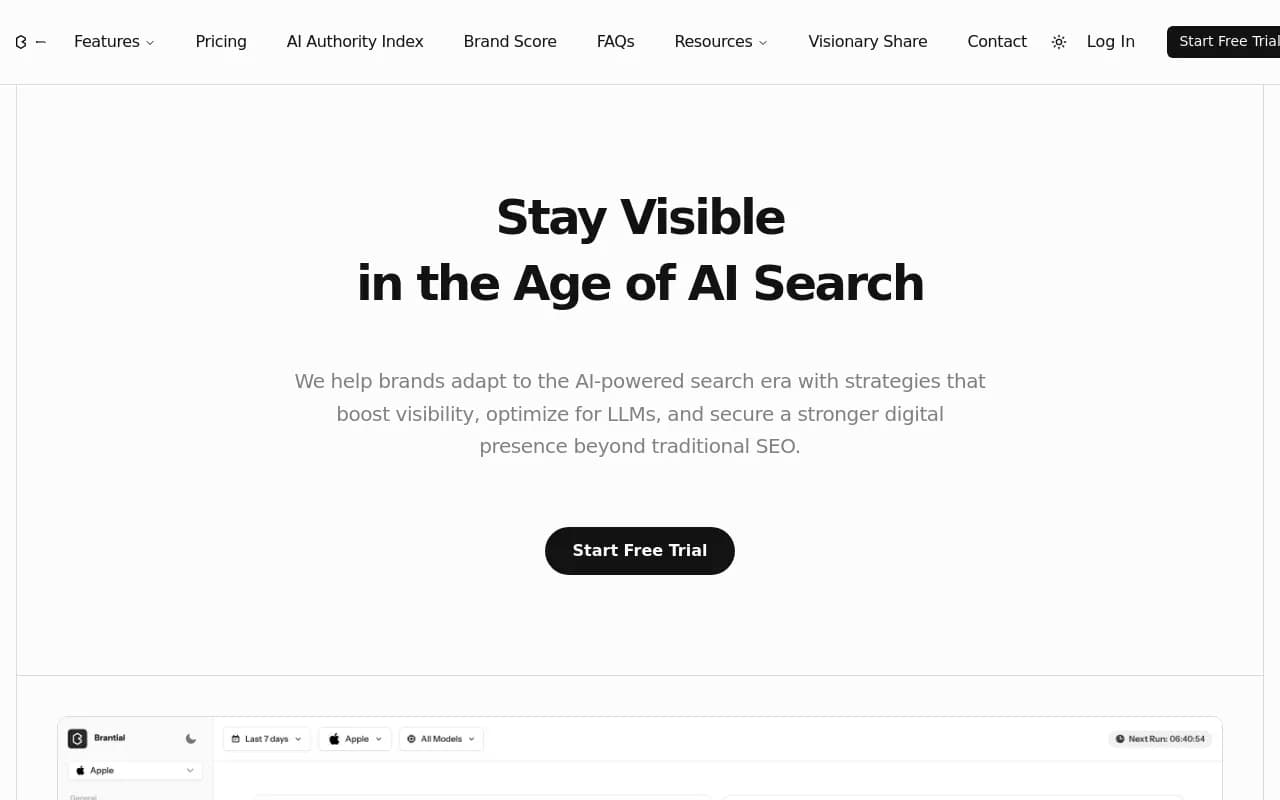
Brantial is a Generative Engine Optimization (GEO) platform that helps brands monitor and improve their visibility in AI-driven search results across ChatGPT, Google SGE, and other LLMs. Track brand mentions, analyze prompt volumes, optimize content for AI citations, and measure performance with integrated analytics and workflow automation.
Key Takeaways
- Missing critical capabilities vs Promptwatch: No AI crawler logs, no Reddit/YouTube tracking, no ChatGPT Shopping monitoring, no content generation engine, no query fan-outs, no multi-model comparison (only mentions ChatGPT/SGE), no visitor analytics or traffic attribution, no API access
- What it does well: Clean interface for tracking brand mentions in AI responses, Google Search Console integration, workflow automation for content audits, competitive benchmarking dashboard
- Best for: Mid-sized brands (50-500 employees) with existing content teams who need basic AI visibility monitoring and manual content optimization workflows
- Not ideal for: Agencies managing multiple clients, teams needing actionable content gap analysis, or brands wanting end-to-end GEO automation from discovery to content creation
- Pricing: Starter $59/mo (1 user), Growth $149/mo (5 users), Pro $299/mo (10 users) -- competitive entry point but limited feature depth at each tier
What Brantial Is and Who Built It
Brantial is a Generative Engine Optimization (GEO) platform launched in 2024 to help brands track and improve their visibility in AI-powered search results. As traditional organic search traffic declines -- with studies showing up to 50% potential loss by 2026 -- Brantial positions itself as a bridge between classic SEO and the emerging world of AI citations, where brands need to appear in ChatGPT responses, Google's AI Overviews, and other large language model outputs.
The platform targets marketing teams, SEO professionals, and digital agencies who recognize that being invisible in AI search means losing customers to competitors who do appear. Brantial's core promise is simple: measure where your brand shows up in AI responses, understand why competitors outrank you, and optimize content to earn more citations. The company claims partnerships with fast-moving teams at Jitter, Vercel, Revolut, Zoom, GitLab, and Airtable, though the depth of these relationships isn't publicly detailed.
Unlike monitoring-only dashboards that leave you stuck after showing the data, Brantial attempts to close the loop with workflow automation and content improvement tools. However, compared to action-oriented platforms like Promptwatch -- which combines monitoring with AI content generation, crawler log analysis, and traffic attribution -- Brantial's feature set stops short of true end-to-end optimization.
Core Features: What Brantial Actually Does
AI Visibility Analysis is the platform's foundation. You get daily tracking of how often your brand appears in AI-generated responses, with flexible date filters (7, 14, 30, 60, or 90 days) to spot trends. The dashboard shows visibility scores over time, competitive benchmarking against rivals, sentiment analysis of mentions, and a breakdown of which AI platforms contribute most to your visibility. Recent mentions surface the actual contexts where your brand appears, giving you qualitative insight into positioning. This is solid baseline monitoring, but it lacks the depth of platforms that track 10+ AI models simultaneously or provide page-level citation tracking.
AI Search Visibility & Prompt Volume Data helps you understand how users search within generative AI platforms. Brantial provides volume estimates for specific prompts, a proprietary Brand Potential Score (BPS) that highlights high-opportunity keywords, and metadata on competition levels, user intent, and country targeting. This is useful for prioritization, but the platform doesn't offer query fan-outs (how one prompt branches into sub-queries) or difficulty scoring based on actual citation data -- features that platforms like Promptwatch use to help teams pick winnable battles instead of guessing.
Workflow Agent for Automated Content Improvement is Brantial's attempt at closing the optimization loop. You submit a page URL, and the system fetches the content, detects language, analyzes structure and intent, reviews quality and AI-readiness, suggests improvements, and exports a compiled report. The workflow includes content retrieval, structural analysis, quality review, planned improvements, and a rewrite that preserves brand tone. This is a time-saver for auditing existing pages, but it's not a content creation engine -- you're optimizing what you already have, not generating new articles to fill content gaps. Competitors like Promptwatch go further by analyzing which prompts competitors rank for that you don't, then generating entirely new content grounded in citation data to capture those opportunities.
Google Search Console Integration connects traditional SEO metrics with AI visibility data. You can compare organic search performance against AEO (Answer Engine Optimization) and GEO insights, track how your brand ranks in classic blue-link results versus AI-driven responses, and identify gaps where AI mentions appear without corresponding search visibility. This integration is valuable for teams that want a unified view, though it doesn't extend to traffic attribution or visitor analytics -- you can't see which AI citations actually drove clicks or conversions back to your site.
Action Center: Prioritized Task Management organizes insights into a to-do list with progress tracking and a Quick Wins section that highlights high-impact, low-effort improvements. This is a smart UX decision that prevents analysis paralysis, but the tasks are still based on what Brantial's audits surface -- not on comprehensive content gap analysis that shows exactly which topics, angles, and questions your competitors are visible for but you're missing.
Competitive Benchmarking shows how your visibility stacks up against rivals, with sentiment and positioning metrics. You can see who's winning for specific prompts and track changes over time. However, the platform doesn't provide competitor heatmaps across multiple LLMs or detailed breakdowns of which pages, Reddit threads, or YouTube videos competitors are getting cited from -- context that's critical for understanding why they're outranking you.
What's Missing Compared to Full-Stack GEO Platforms
Brantial's feature gaps become clear when you compare it to platforms like Promptwatch that are built around the action loop (find gaps, create content, track results):
- No AI Crawler Logs: You can't see which AI crawlers (ChatGPT, Claude, Perplexity, etc.) are hitting your website, which pages they're reading, or errors they encounter. This is critical for diagnosing indexing issues and understanding how AI engines discover your content.
- No Content Generation Engine: Brantial audits and suggests improvements to existing pages, but it doesn't generate new articles, listicles, or comparisons to fill content gaps. You're left doing that work manually.
- No Reddit or YouTube Tracking: AI models heavily cite discussions from Reddit and YouTube videos. Brantial doesn't surface these sources, so you miss a major channel that influences AI recommendations.
- No ChatGPT Shopping Monitoring: If your brand sells products, you can't track when you appear in ChatGPT's shopping carousels or product recommendations.
- No Multi-Model Comparison: The platform mentions ChatGPT and Google SGE but doesn't provide detailed tracking across Claude, Gemini, Perplexity, Meta AI, DeepSeek, Grok, Mistral, or Copilot. You're flying blind on most of the AI search ecosystem.
- No Traffic Attribution: You can't connect AI visibility to actual revenue. There's no code snippet, server log analysis, or integration to show which AI citations drove clicks, conversions, or assisted revenue.
- No API Access: You can't export data for custom reporting or build on the platform for custom workflows. You're locked into Brantial's dashboard.
- No Query Fan-Outs: You don't see how one prompt branches into related sub-queries, which limits your ability to understand the full intent landscape around a topic.
Who Brantial Is Actually For
Brantial fits best for mid-sized B2B SaaS companies or e-commerce brands (50-500 employees) with established content teams who need basic AI visibility monitoring and are comfortable doing manual content optimization. If you're a marketing manager at a company like a project management tool, CRM platform, or DTC brand, and you want to start tracking whether your brand appears in ChatGPT responses without committing to a full GEO overhaul, Brantial's entry-level pricing ($59/mo) and clean interface make it accessible.
It's also reasonable for SEO consultants or small agencies (1-5 clients) who are adding AI visibility as a service line and need a simple dashboard to show clients where they stand. The competitive benchmarking and Google Search Console integration provide enough data to build basic reports.
Brantial is not ideal for:
- Agencies managing 10+ clients: The per-user pricing model and lack of white-label options or API access make it impractical at scale.
- Brands that need actionable content strategies: If you want to know exactly which prompts competitors rank for that you don't, and then generate content to capture those opportunities, Brantial's workflow agent won't get you there. You'll need a platform with content gap analysis and AI writing tools.
- Enterprise teams tracking ROI: Without traffic attribution or visitor analytics, you can't prove that AI visibility improvements drove revenue. CFOs and CMOs will ask for that data, and Brantial can't provide it.
- Teams optimizing for the full AI ecosystem: If you care about visibility in Claude, Perplexity, Gemini, Meta AI, or other models beyond ChatGPT and Google SGE, Brantial's coverage is too narrow.
Integrations and Ecosystem
Brantial's integration story is thin. The platform connects with Google Search Console to pull in organic search data, which is useful for comparing traditional SEO performance against AI visibility. However, there's no mention of integrations with Slack, Zapier, analytics platforms, CMS tools, or marketing automation systems. You can't push Brantial data into your existing workflows or dashboards.
There's no API access at any pricing tier, which limits customization and makes it impossible to build on the platform for enterprise use cases. You can export reports manually, but there's no programmatic way to pull data for custom analysis or integrate with BI tools like Looker Studio or Tableau.
The platform doesn't mention browser extensions, mobile apps, or developer tools, so you're working entirely within the web dashboard. For teams that want to check AI visibility on the go or integrate monitoring into their development workflow, this is a gap.
Pricing and Value Proposition
Brantial offers three tiers:
- Starter: $59/mo (1 user) -- Basic AI visibility tracking, competitive benchmarking, Google Search Console integration, and access to the workflow agent. Good for solo marketers or consultants testing the waters.
- Growth: $149/mo (5 users) -- Adds team collaboration features and presumably more prompt tracking capacity (exact limits aren't publicly detailed). Fits small in-house marketing teams.
- Pro: $299/mo (10 users) -- Designed for larger teams or small agencies, with expanded user seats and likely higher data limits.
Compared to competitors, Brantial's entry point is competitive. Promptwatch starts at $99/mo (Essential plan: 1 site, 50 prompts, 5 AI-generated articles, crawler logs, traffic attribution), which is $40 more but includes content generation and deeper tracking. Otterly.AI and Peec.ai are in a similar price range but also lack content creation tools. Profound and Scrunch are significantly more expensive ($500+/mo) but offer more comprehensive feature sets.
The value question comes down to what you need. If you only want monitoring and are willing to do content optimization manually, Brantial's pricing is fair. If you want a platform that helps you find gaps, generate content, and track results -- the full action loop -- you'll need to spend more on a tool like Promptwatch or Profound.
Brantial doesn't advertise a free trial prominently on the homepage, though there's a "Start Free Trial" CTA that suggests one exists. Exact trial terms (duration, feature access) aren't disclosed publicly. There's no freemium tier, so you'll need to commit to a paid plan to use the platform long-term.
Strengths: What Brantial Does Well
Clean, Intuitive Interface: The dashboard is visually polished and easy to navigate. Daily visibility trends, competitive benchmarks, and recent mentions are presented clearly without overwhelming users. For teams new to GEO, this lowers the learning curve.
Google Search Console Integration: Connecting traditional SEO data with AI visibility metrics in one place is genuinely useful. It helps teams see the full picture of how search behavior is shifting from blue links to AI answers.
Workflow Automation for Content Audits: The workflow agent saves time by automating the tedious parts of content analysis -- fetching pages, detecting language, identifying structural issues, and compiling improvement reports. For teams with large content libraries, this is a productivity win.
Competitive Benchmarking: Seeing how your visibility stacks up against rivals, with sentiment and positioning context, helps prioritize efforts. You can quickly identify where competitors are winning and focus optimization there.
Accessible Entry Pricing: At $59/mo, Brantial is one of the more affordable GEO platforms for solo marketers or small teams just starting to track AI visibility.
Limitations: Where Brantial Falls Short
Monitoring Without Action: Brantial shows you where you're invisible but doesn't help you fix it with content generation or gap analysis. You're left doing the hard work manually -- researching competitors, writing new articles, optimizing for citations -- without the tools to accelerate that process.
Narrow AI Model Coverage: The platform focuses on ChatGPT and Google SGE but doesn't provide detailed tracking for Claude, Perplexity, Gemini, Meta AI, DeepSeek, Grok, Mistral, or Copilot. In 2026, brands need visibility across the full AI ecosystem, not just two models.
No Traffic Attribution: You can't connect AI visibility to revenue. Without visitor analytics, code snippets, or server log analysis, you're guessing whether AI citations actually drive business outcomes. This makes it hard to justify GEO investments to leadership.
Missing Reddit and YouTube Insights: AI models cite Reddit discussions and YouTube videos heavily, but Brantial doesn't surface these sources. You miss a major channel that influences AI recommendations and can't optimize for it.
No AI Crawler Logs: You can't see which AI crawlers are hitting your website, which pages they're reading, or errors they encounter. This makes it impossible to diagnose indexing issues or understand how AI engines discover your content.
Limited Prompt Intelligence: Brantial provides volume estimates and a Brand Potential Score, but it doesn't offer difficulty scoring based on citation data, query fan-outs, or detailed intent analysis. You're prioritizing prompts with less context than platforms like Promptwatch provide.
No API or Advanced Integrations: You can't export data programmatically, build custom workflows, or integrate with BI tools. For agencies or enterprises, this is a dealbreaker.
Bottom Line: Who Should Use Brantial
Brantial is a solid entry-level GEO platform for mid-sized brands or small agencies that want to start tracking AI visibility without committing to a full-stack solution. If you're a marketing manager at a B2B SaaS company or e-commerce brand, and you need a clean dashboard to show leadership where you stand in ChatGPT and Google SGE, Brantial's $59-$299/mo pricing and intuitive interface make it accessible.
However, if you need more than monitoring -- if you want to find content gaps, generate AI-optimized articles, track crawler behavior, attribute traffic to AI citations, or monitor the full AI ecosystem (Claude, Perplexity, Gemini, etc.) -- Brantial's feature set will leave you stuck. Platforms like Promptwatch, Profound, or Scrunch offer the depth and automation required to actually improve AI visibility, not just measure it.
Best use case in one sentence: Brantial is for teams that want affordable, beginner-friendly AI visibility monitoring and are comfortable doing content optimization manually, but it's not built for agencies or brands that need end-to-end GEO automation from discovery to content creation to traffic attribution.
Tags:
Similar and alternative tools to Brantial