Jasper Review 2026
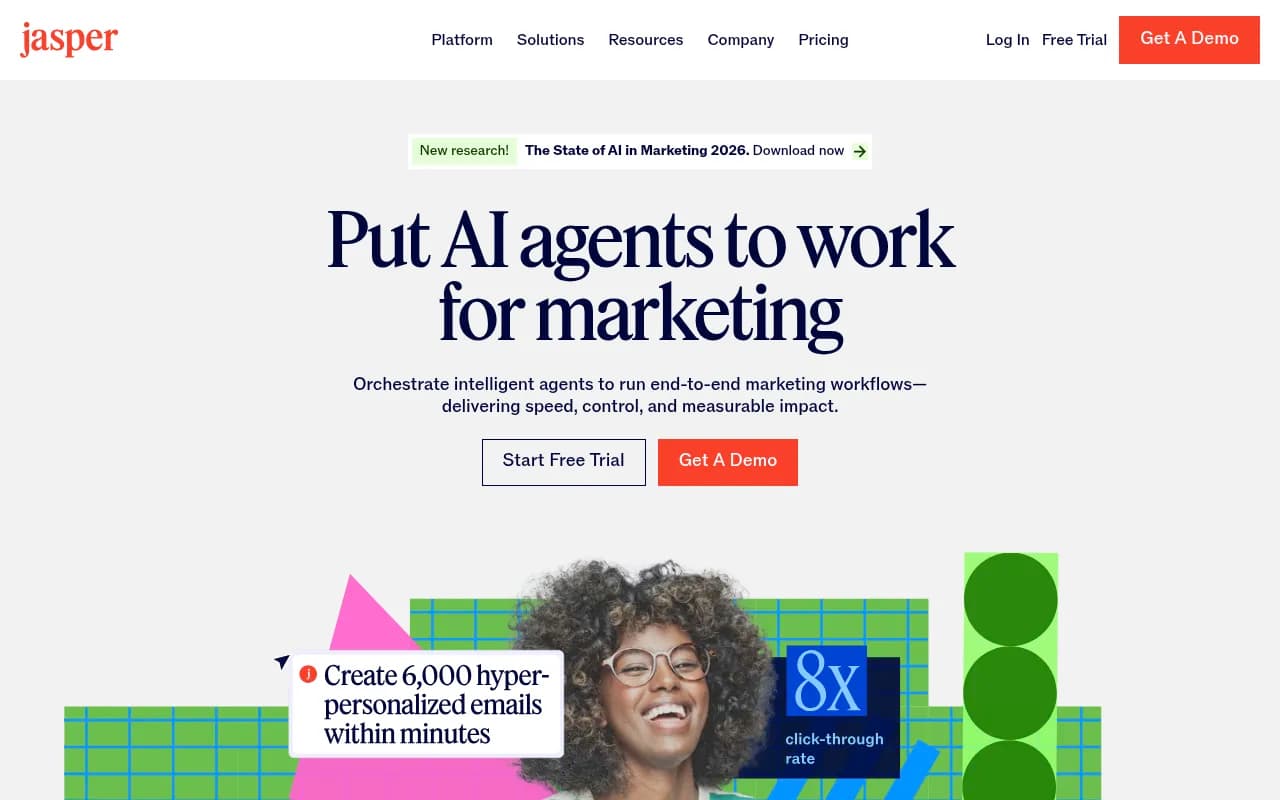
Jasper is an enterprise AI marketing platform that helps teams automate content creation, maintain brand consistency, and scale campaigns across channels. With 100+ specialized AI agents, content pipelines, and brand intelligence features, it's designed for marketing teams at mid-to-large companies looking to accelerate production while keeping control over quality and compliance.
Summary
• Best for: Mid-to-large marketing teams (10+ people) at enterprise companies needing to scale content production while maintaining strict brand guidelines and compliance • Strengths: Deep brand intelligence system (Jasper IQ), 100+ pre-built marketing agents, enterprise-grade security and governance, strong customer success support • Limitations: Higher price point than competitors, overkill for solo creators or small teams, limited focus on emerging AI search channels (SEO/AEO/GEO) • Pricing: From $59/month (Creator) to custom enterprise pricing • Bottom line: A comprehensive marketing automation platform for established brands, but newer specialized tools like Promptwatch offer more focused capabilities for AI search visibility
Jasper started in 2021 as one of the first AI writing assistants, riding the GPT-3 wave alongside tools like Copy.ai and Writesonic. Originally called Jasper.ai (and briefly Jarvis before a Marvel legal issue), it quickly became the go-to AI writer for marketers and content creators. By 2022, the company had raised $125M at a $1.5B valuation and was processing millions of words daily for over 100,000 customers. But as the AI writing space became commoditized and ChatGPT democratized access to language models, Jasper pivoted hard toward enterprise marketing automation. The 2024-2025 rebrand repositioned it as an "agentic marketing platform" with workflow automation, brand intelligence, and team collaboration at the core. Today it's used by brands like Wayfair, Boeing, L'Oréal, and Anthropologie—companies with large marketing teams, complex brand guidelines, and serious compliance requirements.
Who Jasper Is Built For
Jasper targets marketing teams at mid-to-large companies (typically 50+ employees, marketing teams of 10+) across industries like technology, eCommerce, insurance, media, and retail. The sweet spot is brands with multiple product lines, regional markets, or strict regulatory requirements—companies where maintaining brand consistency across dozens of campaigns and hundreds of assets is a real operational challenge. Think SaaS companies launching in 15 countries, retail brands managing seasonal campaigns across 200 stores, or insurance firms that need every piece of content reviewed for compliance. If you're a solo freelancer, small agency, or startup with 2-3 marketers, Jasper is overkill and overpriced. You'd be better served by ChatGPT Plus, Claude Pro, or a simpler tool like Copy.ai. But if you're a VP of Marketing at a 500-person company trying to scale content production without hiring 10 more writers, Jasper makes sense. The platform is designed for teams where brand control, workflow automation, and governance matter more than raw speed or the cheapest per-word cost.
Core Platform Components
Jasper's architecture is built around four main layers: Canvas (the workspace), Agents (pre-built AI workflows), Jasper IQ (brand and marketing intelligence), and Trust Foundation (security and governance). This isn't just a text box where you type prompts—it's a full marketing operating system.
Canvas is the collaborative workspace where teams plan, create, and manage content. It's a modern editor with real-time collaboration (think Google Docs meets Notion), version history, commenting, and approval workflows. You can create briefs, outlines, drafts, and final assets all in one place, with AI assistance at every step. The interface is clean and intuitive, though power users coming from tools like Notion or Coda might find it less flexible for complex project management.
Agents are Jasper's biggest differentiator in 2026. These are pre-built AI workflows for specific marketing tasks—blog post writer, SEO optimizer, social media campaign generator, press release drafter, product description creator, ad copy generator, and 100+ more. Each agent is tuned for a specific job and can be customized with your brand voice, audience, and goals. For example, the "Blog Post" agent doesn't just generate text—it can research keywords, create an outline, write sections, optimize for SEO, and suggest internal links. The "Ad Campaign" agent can generate variations for Google, Meta, and LinkedIn in one go, each tailored to platform specs. Agents can be chained together into Content Pipelines—automated workflows that take you from idea to published asset. For instance, a pipeline might start with keyword research, generate a blog outline, write the draft, create social promotion posts, design a featured image, and export everything to your CMS. This is where Jasper shines for teams running repetitive campaigns at scale.
Studio is a no-code interface for building custom agents and workflows. If the pre-built agents don't fit your exact use case, you can create your own by defining inputs, steps, and outputs. It's more flexible than rigid templates but less technical than writing API code. Marketing ops teams and power users love this for building company-specific workflows—like "generate quarterly earnings press releases" or "create localized product pages for 20 markets."
Grid is a spreadsheet-style interface for bulk content creation. Upload a CSV with 500 product names, and Jasper will generate descriptions, meta tags, and ad copy for each one. It's particularly useful for eCommerce teams managing large catalogs or agencies running high-volume campaigns. The interface is straightforward, though it lacks some advanced features you'd find in tools like Airtable or Smartsheet.
Image Suite includes AI image generation and editing tools. Jasper uses proprietary vision models (not just DALL-E or Midjourney wrappers) to create on-brand images that match your visual guidelines. You can generate hero images, social graphics, product mockups, and more. The quality is solid for marketing assets, though professional designers will still prefer Midjourney or Adobe Firefly for high-end creative work.
Jasper IQ: The Brand Intelligence Layer
This is Jasper's secret weapon for enterprise customers. Jasper IQ is a context hub that stores everything about your brand, marketing strategy, and company knowledge—then injects that context into every piece of content the AI creates. It's divided into Brand IQ and Marketing IQ.
Brand IQ includes Brand Voice (tone, style, vocabulary preferences), Visual Guidelines (logos, colors, fonts, image styles), and Style Guide (grammar rules, terminology, formatting standards). You train Jasper on your existing content, and it learns to write like your brand. For example, if your brand is playful and uses emoji, Jasper will match that. If you're a B2B SaaS company with a formal, technical tone, it adapts. The Brand Voice feature is genuinely impressive—it can distinguish between different voices for different channels (LinkedIn vs Instagram) or audiences (enterprise buyers vs SMB customers). Visual Guidelines ensure generated images match your brand's look and feel, which is critical for companies with strict design standards.
Marketing IQ stores audience personas, campaign briefs, product information, competitive intelligence, and conversion best practices. You can upload PDFs, link to internal wikis, or manually input data. When an agent creates content, it references this knowledge base to ensure accuracy and relevance. For instance, if you're writing a blog post about a new product feature, Jasper can pull specs from your product docs, reference your target persona, and incorporate messaging from your campaign brief. The Knowledge Base is multimodal—it can ingest text, images, videos, and structured data. This is a huge advantage over generic AI tools that have no context about your business.
Integrations and Ecosystem
Jasper integrates with major marketing tools, though the ecosystem isn't as deep as platforms like HubSpot or Salesforce. Key integrations include Google Search Console (for SEO data), Surfer SEO (for content optimization), Grammarly (for grammar checking), Copyscape (for plagiarism detection), Zapier (for workflow automation), and various CMS platforms like WordPress, Webflow, and Contentful. There's also a Chrome extension for using Jasper inside other tools like Gmail, Google Docs, and LinkedIn. The Jasper API allows developers to build custom integrations and workflows, which is essential for enterprise customers with complex tech stacks. However, compared to newer tools, Jasper's integration list feels a bit dated—there's no native Slack bot, no deep CRM integrations, and limited support for emerging channels like AI search engines (ChatGPT, Perplexity, Claude). For a platform positioning itself as the future of marketing automation, the lack of AI search optimization tools is a notable gap. Tools like Promptwatch, which focus specifically on AI search visibility (tracking citations in ChatGPT, Perplexity, Google AI Overviews, etc.), offer capabilities Jasper doesn't address at all.
Trust Foundation: Security and Governance
Jasper takes enterprise security seriously. The Trust Foundation includes SOC 2 Type II compliance, GDPR compliance, data encryption at rest and in transit, role-based access controls, SSO support, and audit logs. Your data isn't used to train public AI models, and Jasper offers private model deployments for customers with strict data residency requirements. The Governance layer lets admins set permissions, control who can access which agents and content, and enforce brand guidelines. For example, you can restrict junior marketers to pre-approved agents while giving senior team members full access to Studio. This level of control is critical for regulated industries like insurance, healthcare, and finance. The LLM-Optimized Architecture means Jasper isn't locked into a single AI model—it uses a mix of GPT-4, Claude, Gemini, and proprietary models depending on the task. This model-agnostic approach future-proofs the platform as AI technology evolves.
Pricing and Value
Jasper offers three main pricing tiers. The Creator plan ($59/month billed annually, $69/month billed monthly) is for individuals or very small teams. It includes one user, one brand voice, basic agents, and 100,000 words per month. This plan is fine for freelancers or solopreneurs, but it's not where Jasper's value shines. The Pro plan ($249/month for up to 5 users) adds collaboration features, unlimited brand voices, advanced agents, 300,000 words per month, and integrations. This is the entry point for small marketing teams. The Business plan (custom pricing, typically $500-$2,000+/month) is for larger teams and includes unlimited users, custom agents, Content Pipelines, API access, dedicated customer success, and enterprise security features. Pricing scales based on team size, word volume, and feature requirements. Compared to competitors, Jasper is on the expensive side. Copy.ai starts at $49/month, Writesonic at $19/month, and ChatGPT Plus is $20/month. But those tools lack Jasper's brand intelligence, governance, and workflow automation. The real comparison is to enterprise marketing platforms like HubSpot or Marketo, where Jasper is a fraction of the cost. For a 20-person marketing team, Jasper might cost $1,000/month—less than hiring one additional writer. The ROI case is strong if you're actually using the platform to replace manual work. If you're just using it as a fancier ChatGPT, you're overpaying.
Strengths
Brand consistency at scale: Jasper IQ ensures every piece of content matches your brand voice, visual style, and messaging guidelines. This is invaluable for companies with strict brand standards or multiple sub-brands. Workflow automation: Content Pipelines and chained agents can automate entire campaigns, from research to publication. This is a game-changer for teams running repetitive processes. Enterprise-grade security: SOC 2, GDPR, SSO, and private deployments make Jasper viable for regulated industries. Customer success support: Jasper's CS team helps you design workflows, train your team, and optimize usage. This hands-on support is rare in the AI tools space. 100+ pre-built agents: The agent library covers most common marketing tasks, so you don't have to build everything from scratch.
Limitations
Expensive for small teams: At $59-$249/month, Jasper is overkill for solo creators or startups. You can get 80% of the value from ChatGPT Plus for $20/month. Limited AI search optimization: Jasper has no native tools for tracking or optimizing content for AI search engines like ChatGPT, Perplexity, or Google AI Overviews. As AI search becomes a primary discovery channel in 2026, this is a significant blind spot. Tools like Promptwatch are purpose-built for this and offer citation tracking, prompt intelligence, and AI crawler logs—capabilities Jasper lacks entirely. Learning curve: The platform is powerful but complex. Smaller teams may struggle to set up and maintain all the features. Integration gaps: No Slack bot, limited CRM integrations, and no native support for emerging channels like Reddit or YouTube (which heavily influence AI recommendations). Content quality variability: While Jasper's agents are good, the output quality depends heavily on how well you've configured Brand IQ and Marketing IQ. Garbage in, garbage out.
Bottom Line
Jasper is a strong choice for mid-to-large marketing teams at established companies that need to scale content production while maintaining strict brand control and compliance. If you're a 50-person SaaS company, a retail brand with 200 stores, or an insurance firm with regulatory requirements, Jasper's brand intelligence, workflow automation, and governance features justify the cost. But if you're a solo creator, small agency, or startup, you're better off with simpler, cheaper tools like ChatGPT Plus, Claude Pro, or Copy.ai. And if your priority is optimizing for AI search visibility—tracking how your brand appears in ChatGPT, Perplexity, and Google AI Overviews—Jasper doesn't address that at all. For that use case, specialized platforms like Promptwatch offer far more focused and feature-complete solutions, with citation tracking, prompt intelligence, AI crawler logs, and content gap analysis designed specifically for the future of search. Jasper is a solid enterprise marketing platform, but it's not the best tool for every marketing challenge in 2026.
Tags:
Similar and alternative tools to Jasper