Key Takeaways
- Google rank ≠ AI citations: Your #1 Google ranking means nothing if AI models can't find structured, citable content on your pages
- AI search isn't killing SEO: It's exposing which content was always shallow — the winners are doing both traditional SEO and AI optimization
- Content volume doesn't work: Publishing 100 generic articles won't get you cited; one deeply researched piece with clear sources beats quantity every time
- You can't game AI models: Keyword stuffing and link schemes don't work — AI engines read for meaning, not patterns
- Action beats monitoring: Tracking where you're invisible is useless unless you fix the content gaps AI models are looking for
I've spent the last 18 months analyzing why some brands get cited by ChatGPT and Perplexity while others — often with better Google rankings — get ignored. The pattern is clear: most companies are optimizing for myths, not reality.
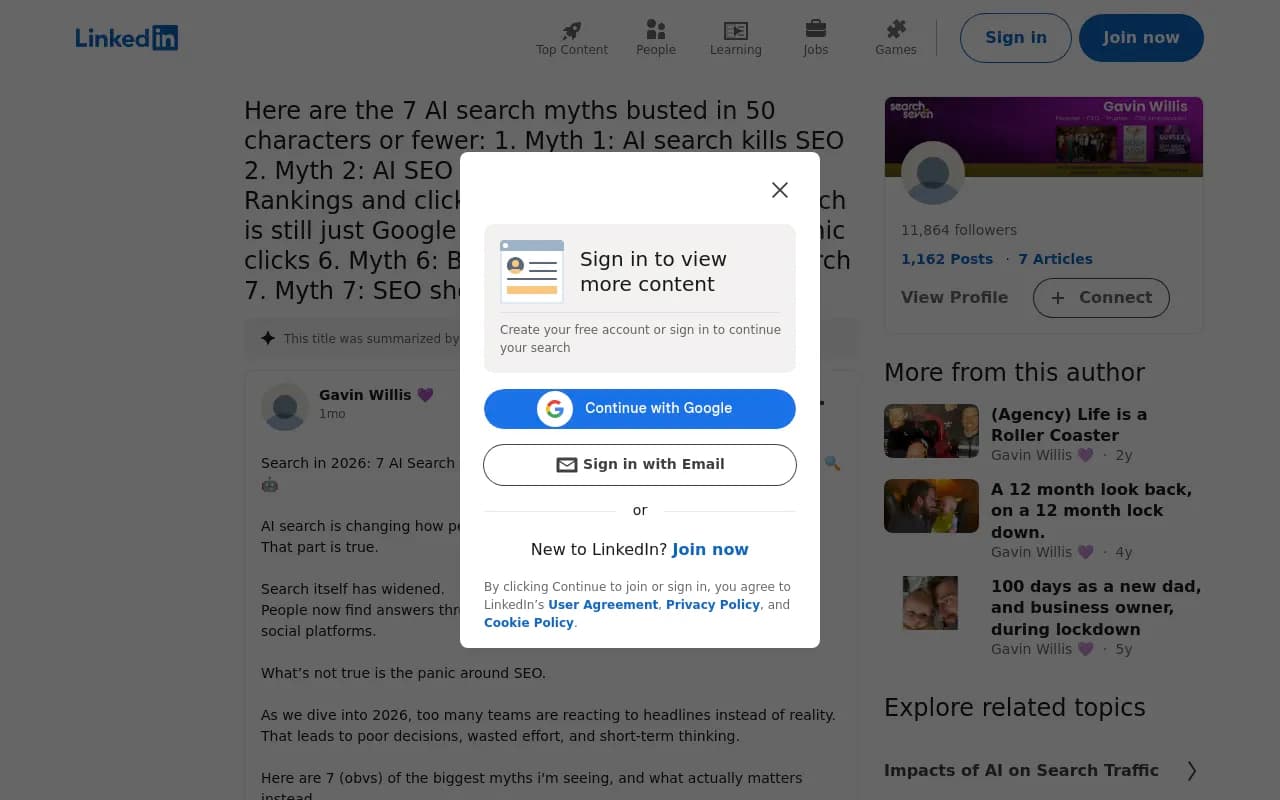
Here are the 10 myths I hear every week, why they're wrong, and what actually works.
Myth 1: "If I rank #1 on Google, AI will cite me"
Reality: Google rank and AI citations are weakly connected.
Why: AI answers are assembled from a mix of training data, retrieval indexes, and real-time web scraping. A page that ranks #1 for "best project management software" might have great backlinks and keyword density — but if the content is a listicle with no clear methodology, no pricing data, and no structured comparisons, AI models skip it.
ChatGPT doesn't care about your domain authority. It cares whether your page answers the question with citable facts.
What actually works: Structure your content for citability. Use tables, bullet points, and clear headings. Include specific data points ("Tool X costs $49/month for 10 users") instead of vague claims ("affordable pricing"). Add publication dates and author credentials. AI models cite pages that look like reference material, not marketing fluff.
Promptwatch analyzed 880M+ citations and found that pages with comparison tables get cited 3.2x more often than pages without them — even when the non-table pages rank higher on Google.

Myth 2: "AI search is a completely new discipline"
Reality: AI search optimization (GEO/AEO) is an extension of good content strategy, not a replacement.
Why: The fundamentals haven't changed — you still need to understand user intent, create comprehensive content, and make it technically accessible. What's different is the delivery mechanism. Instead of ranking in a list of blue links, you're being cited in a conversational answer.
The brands winning in AI search were already doing content marketing well. They're just adapting their distribution strategy.
What actually works: Start with your existing SEO content audit. Which pages get traffic but low engagement? Which topics do you cover superficially? AI models expose content gaps faster than Google ever did. Fix those gaps — add depth, data, and structure — and you'll improve in both channels.
Tools like Promptwatch show you exactly which prompts competitors are visible for but you're not. That's your content roadmap.
Myth 3: "Only rankings and clicks matter"
Reality: Visibility without conversion is vanity. AI search changes how users discover you, but the goal is still revenue.
Why: Getting cited by ChatGPT feels good. But if those citations don't drive traffic, or if the traffic doesn't convert, you've optimized for the wrong metric. Some brands obsess over citation counts while ignoring whether AI-referred visitors actually become customers.
What actually works: Track the full funnel. Use UTM parameters or server log analysis to see which AI engines send traffic. Connect that traffic to conversions. If Perplexity sends 500 visitors but zero signups, your content might be getting cited for informational queries but missing commercial intent.
Promptwatch's traffic attribution (via code snippet, GSC integration, or server logs) connects AI visibility to actual revenue. You see which prompts drive not just citations, but customers.
Myth 4: "I need to stuff my content with keywords for AI"
Reality: AI models read for meaning, not keyword density.
Why: Large language models understand context. They don't count how many times you said "best CRM software" — they evaluate whether your content comprehensively answers the question. Keyword stuffing makes your content worse for humans and invisible to AI.
ChatGPT and Claude are trained to detect thin content. If your article repeats the same phrases without adding new information, they'll cite a competitor instead.
What actually works: Write for humans. Answer the question completely. Use natural language and synonyms. If you're writing about CRM software, cover pricing, integrations, use cases, and customer reviews — not just the phrase "best CRM" 47 times.
AI models reward depth and specificity. One 3,000-word guide that covers every angle beats ten 500-word keyword-stuffed posts.
Myth 5: "Publishing more content = more AI citations"
Reality: Volume without quality gets you nowhere.
Why: AI models don't index your entire site and give you credit for having 10,000 blog posts. They evaluate each piece of content individually. Publishing 100 generic "What is X?" articles won't get you cited if each one is shallow.
I've seen brands with 50 deeply researched articles outperform competitors with 5,000 thin posts. Quality beats quantity in AI search more than it ever did in traditional SEO.
What actually works: Focus on content gaps. Use Answer Gap Analysis (available in Promptwatch) to see which prompts your competitors are visible for but you're not. Then create content that directly addresses those gaps — with more depth, better data, and clearer structure than what's already out there.
One article that becomes the definitive answer for a high-value prompt is worth more than 50 mediocre posts.
Myth 6: "AI models only cite big, authoritative sites"
Reality: AI models cite the best answer, regardless of domain size.
Why: ChatGPT doesn't have a built-in bias toward Fortune 500 companies. It evaluates content based on relevance, clarity, and factual accuracy. A well-structured blog post from a startup can outrank a vague corporate page from a household name.
This is actually an advantage for smaller brands — you can win on content quality without needing years of backlink building.
What actually works: Be specific and citable. If you're writing about "email marketing automation," include real examples, pricing comparisons, and step-by-step workflows. AI models cite pages that feel like they were written by someone who actually uses the tools, not by a content farm.
Add author bios, publication dates, and sources. These signals help AI models assess credibility.
Myth 7: "I can't control what AI says about my brand"
Reality: You have more control than you think.
Why: AI models pull from your website, third-party reviews, Reddit discussions, YouTube videos, and other public sources. If you're not actively managing those channels, you're letting others define your narrative. But if you publish authoritative content, engage in relevant communities, and optimize for citability, you can influence what AI models say.
What actually works: Own your narrative. Publish a comprehensive "About" page, product comparison guides, and use case studies. Monitor where AI models are citing competitors and create better content for those prompts. Track Reddit and YouTube discussions (Promptwatch surfaces these) and engage where relevant.
AI models cite the most comprehensive, recent, and authoritative source they can find. Make sure that's you.
Myth 8: "AI search optimization is just about metadata and schema"
Reality: Technical optimization matters, but content is still king.
Why: Yes, structured data helps. Yes, clean HTML and fast load times matter. But AI models don't cite your schema markup — they cite your actual content. I've seen perfectly optimized pages with thin content get ignored, while messy blogs with deep insights get cited constantly.
Technical SEO is table stakes. It won't save bad content.
What actually works: Start with content. Make sure you're answering the question completely, with clear structure and citable facts. Then layer on technical optimization — schema markup for products and reviews, clean heading hierarchy, fast page speed, and mobile responsiveness.
Use tools like Screaming Frog to audit technical issues, but don't let technical perfection distract you from content quality.
Myth 9: "Monitoring AI citations is enough"
Reality: Tracking where you're invisible is useless unless you fix it.
Why: Most AI visibility tools (Otterly.AI, Peec.ai, AthenaHQ) show you a dashboard of where you're getting cited and where you're not. That's step one. But then what? If you don't have a system for closing content gaps, you're just watching competitors win.
Monitoring-only platforms leave you stuck. You see the problem but have no path to solving it.
What actually works: Use a platform that closes the loop. Promptwatch's Answer Gap Analysis shows you exactly which prompts competitors are visible for but you're not — then its AI writing agent generates content grounded in real citation data to fill those gaps. You're not just tracking visibility; you're actively improving it.
The action loop: find gaps → create content → track results. Most tools stop at step one.
Myth 10: "AI search will replace Google"
Reality: AI search and traditional search are complementary, not competitive.
Why: Data from Silverback Strategies shows that nearly 100% of ChatGPT users still rely on Google for certain queries. AI search is better for exploratory questions and recommendations. Google is better for navigational queries and local results. Users switch between them based on intent.
Brands that ignore traditional SEO to focus only on AI search are making a mistake. The winners are optimizing for both.
What actually works: Build a unified content strategy. Create content that ranks on Google and gets cited by AI models. The fundamentals are the same — comprehensive, well-structured, citable content works everywhere. Use tools that track both channels (Promptwatch monitors AI citations and integrates with Google Search Console) so you're not optimizing in silos.
What Actually Works: The Action Loop
Here's the framework that consistently gets brands cited:
1. Find the gaps
Use Answer Gap Analysis to see which prompts competitors are visible for but you're not. Don't guess — use data. Promptwatch analyzes 880M+ citations to show you exactly where you're missing.
2. Create content that ranks in AI
Generate articles, listicles, and comparisons grounded in real citation data. Use AI writing tools (Promptwatch's built-in agent, or alternatives like Jasper or Frase) to draft content, then add human expertise and specific examples.
3. Track the results
Monitor your visibility scores as AI models start citing your new content. Use page-level tracking to see which pages are being cited, how often, and by which models. Connect visibility to traffic and revenue.
This cycle — find gaps, generate content, track results — is what separates optimization platforms from monitoring dashboards.
Tools That Actually Help
Here's a quick comparison of AI visibility platforms and what they're good for:
| Tool | Best for | Key limitation |
|---|---|---|
| Promptwatch | End-to-end optimization (gap analysis + content generation + tracking) | Premium pricing for full feature set |
| Otterly.AI | Basic monitoring across multiple LLMs | No content generation or gap analysis |
| Peec.ai | Simple citation tracking | Limited to monitoring only |
| AthenaHQ | Brand mention tracking | No optimization tools |
| Semrush | Traditional SEO + basic AI tracking | Fixed prompts, limited AI depth |
Otterly.AI



If you're serious about AI search visibility, you need a platform that does more than show you a dashboard. You need one that helps you fix the problem.
The Bottom Line
Most brands are invisible in AI search because they're optimizing for myths, not reality. They think Google rank matters. They think volume beats quality. They think monitoring is enough.
The brands winning in AI search are doing something different: they're finding content gaps, creating deeply researched content that AI models want to cite, and tracking the results to prove ROI.
Stop believing myths. Start optimizing for what actually works.
If you want to see where you're invisible and get a roadmap for fixing it, Promptwatch offers a free trial. No credit card required. See your gaps, generate content, and start getting cited.