Frase Review 2026
SEO content tool that combines research, outlining, writing, and optimization to help create content that ranks higher in search results.
Key Takeaways:
• Dual optimization approach: Only platform that optimizes for both traditional Google SEO and AI search engines (GEO) — ensuring your content ranks on Google AND gets cited by ChatGPT, Perplexity, Claude, and other AI platforms • All-in-one workflow: Replaces 5+ tools (SEMrush, Jasper, Surfer, etc.) with a single platform featuring 80+ AI tools and an AI Agent that automates research, writing, optimization, and publishing • AI visibility tracking: Monitor your brand's citations across 8 AI platforms (ChatGPT, Perplexity, Claude, Gemini, Grok, Copilot, DeepSeek, Google AI) with real-time alerts when you lose citations to competitors • Proven at scale: Trusted by 50,000+ content teams at Microsoft, Oracle, GitLab, Thomson Reuters, and Under Armour with a 4.8/5 G2 rating from 500+ reviews • Pricing starts at $39/month: 7-day free trial with no credit card required, making it accessible for solo creators while scaling to enterprise needs
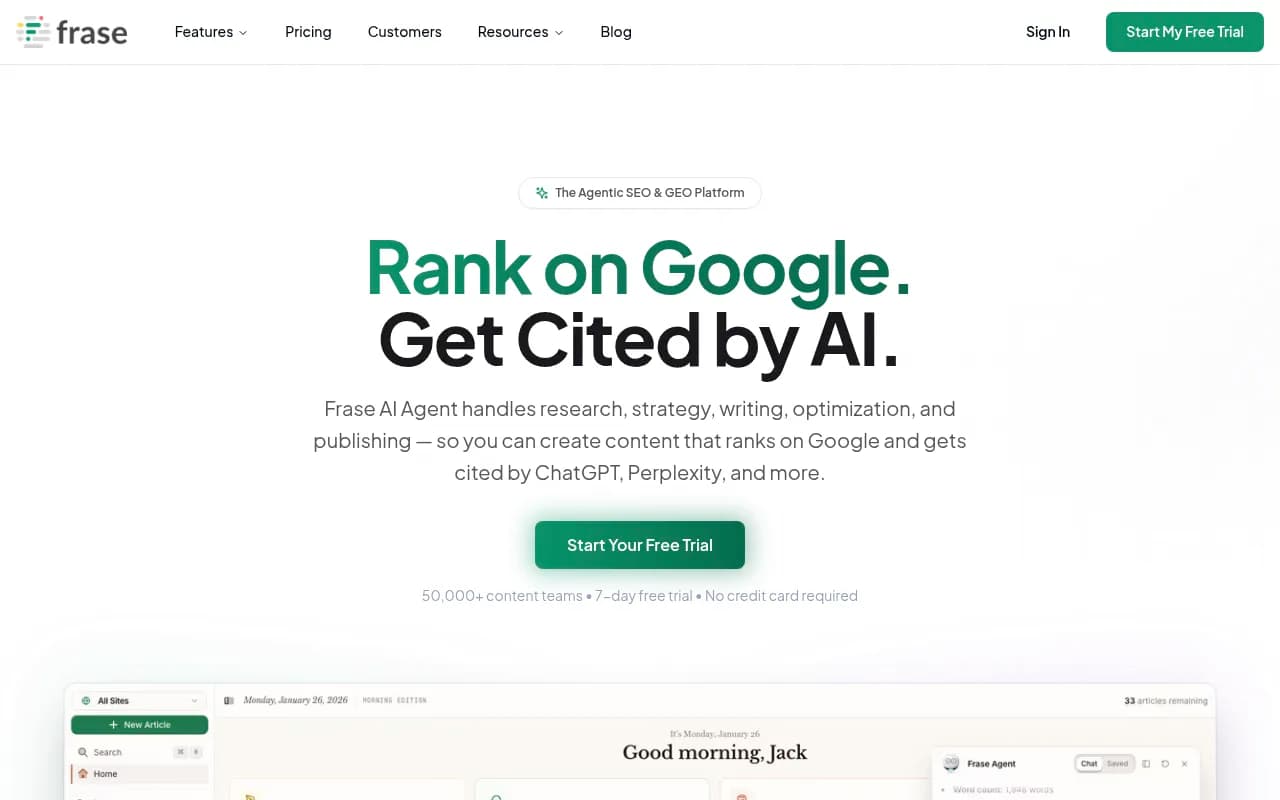
Frase has positioned itself as the bridge between traditional SEO and the emerging world of AI-powered search. Founded as an SEO content optimization tool, Frase has evolved into what they call an "Agentic SEO & GEO Platform" — a comprehensive solution for content teams navigating the shift from Google-first to AI-everywhere search behavior. With 50,000+ content teams using the platform and major enterprise clients like Microsoft, Oracle, and GitLab, Frase has become a serious player in the content optimization space.
The platform's core innovation is its dual focus: optimizing content to rank on traditional search engines while simultaneously ensuring it gets cited by AI search engines like ChatGPT, Perplexity, and Claude. This GEO (Generative Engine Optimization) capability sets Frase apart from competitors who are still focused exclusively on Google rankings. As more users turn to AI chatbots for information instead of search engines, Frase's approach addresses a real shift in how content gets discovered.
Frase Agent: The AI-Powered Content Workflow
The centerpiece of Frase's offering is Frase Agent, an AI assistant that handles the entire content creation workflow through natural language commands. Instead of clicking through multiple tools and interfaces, you simply tell Agent what you need: "Analyze my competitors for 'cloud storage comparison' and create an SEO brief." The Agent then pulls SERP data, analyzes the top 10 results, identifies content gaps, and generates a comprehensive brief — all in about 30 seconds.
Frase Agent includes 80+ specialized AI tools organized into functional teams:
• Research Agent: Performs SERP analysis, competitor content breakdown, question research, and search intent analysis. It scrapes the top-ranking pages for your target keyword, extracts topics and subtopics they cover, and identifies gaps your content could fill.
• Writing Agent: Generates SEO-optimized content with automatic brand voice enforcement. You can feed it your brand guidelines, terminology preferences, and reference documents, and it will apply these consistently across all AI-generated content.
• Audit Agent: Analyzes existing pages with E-E-A-T scoring (Experience, Expertise, Authoritativeness, Trustworthiness), identifies improvement opportunities, and suggests specific changes to boost rankings.
• Publishing Agent: Connects directly to WordPress, Webflow, and Sanity CMS, allowing you to publish optimized content without leaving the platform.
The Agent approach is genuinely useful for teams managing high content volumes. Instead of manually researching competitors in one tool, writing in another, and optimizing in a third, you get a conversational interface that orchestrates the entire workflow. For agencies managing 20+ client sites, this consolidation saves hours per article.
SERP Research and Competitor Analysis
Frase's research capabilities go deeper than basic keyword tools. When you enter a target keyword, Frase scrapes the top 20 Google results and performs detailed content analysis:
• Topic extraction: Identifies all topics and subtopics covered by ranking pages, showing you exactly what Google expects to see in comprehensive content on this keyword
• Question research: Pulls "People Also Ask" questions from Google plus questions from Reddit, Quora, and other forums where your audience discusses this topic
• Search intent analysis: Classifies whether the keyword is informational, commercial, transactional, or navigational, helping you match content format to user intent
• Content gap identification: Compares what competitors cover and highlights topics they're missing — opportunities for your content to provide more value
• Heading structure analysis: Shows the H2 and H3 structure of top-ranking articles, giving you a template for organizing your own content
The research output feeds directly into AI-generated outlines. Frase creates a structured brief with recommended headings, questions to answer, and topics to cover based on what's actually ranking. This is particularly valuable for junior writers or subject matter experts who understand the topic but lack SEO expertise — the brief gives them a proven structure to follow.
Compared to tools like Clearscope or Surfer SEO, Frase's research is more actionable. Instead of just showing you a list of keywords to include, it explains why those keywords matter and where they should appear in your content structure.
Real-Time Content Optimization
Frase's content editor provides live optimization scoring as you write. The interface shows two key metrics:
• SEO Score (0-100): Measures how well your content covers topics and keywords that appear in top-ranking pages. The score updates in real-time as you add content, with specific suggestions for improvement ("Add a section about X", "Include keyword Y in your introduction").
• GEO Score (0-100): Measures optimization for AI search engines. This score considers factors like content structure, citation-worthiness, factual density, and whether your content answers questions in a format AI models prefer to cite.
The editor highlights topics you haven't covered yet, suggests related keywords to include, and shows keyword density compared to competitors. A sidebar displays the topics and questions from your research, which you can click to insert AI-generated content addressing that specific point.
One standout feature is brand voice enforcement. You can upload brand guidelines, approved terminology, and reference documents. When the AI generates content, it automatically applies these rules — using your preferred terms, matching your tone, and avoiding phrases you've blacklisted. For enterprise teams with strict brand standards, this governance layer is essential.
The optimization guidance is more prescriptive than competitors. Where Surfer SEO might tell you to "use keyword X more," Frase suggests exactly where to add it and provides AI-generated sentences you can use or adapt. This hand-holding approach works well for teams scaling content production with less experienced writers.
AI Visibility Tracking (GEO Monitoring)
Frase's most distinctive feature is AI visibility tracking — monitoring whether AI search engines cite your brand when answering relevant questions. The platform tracks 8 AI platforms:
• ChatGPT (OpenAI) • Perplexity • Claude (Anthropic) • Gemini (Google) • Grok (X/Twitter) • Copilot (Microsoft) • DeepSeek • Google AI Overviews
For each platform, Frase shows:
• Citation count: How many times AI mentioned your brand in the last 30 days • AI visibility score: Your overall presence in AI-generated answers compared to competitors • Crawler activity: Which AI crawlers are visiting your site and how often • Citation alerts: Real-time notifications when you lose citations to competitors or gain new mentions • Competitor comparison: Side-by-side visibility scores showing whether competitors are dominating AI answers in your category
This GEO tracking addresses a real problem: as users shift from Google to ChatGPT for research, traditional SEO metrics (rankings, traffic) don't capture whether your brand is actually being recommended. A competitor could have lower Google rankings but dominate AI citations — and you'd never know without GEO monitoring.
For brands in competitive spaces (SaaS tools, professional services, e-commerce), tracking AI visibility is becoming as important as tracking Google rankings. Tools like Promptwatch offer more comprehensive AI visibility monitoring with real user prompt data, but Frase's integration of GEO tracking directly into the content optimization workflow is convenient for teams who want both capabilities in one platform.
Content Atomization and Repurposing
Frase includes content atomization tools that transform long-form content into multiple formats:
• LinkedIn carousels: Converts blog posts into multi-slide LinkedIn posts with key takeaways • Twitter threads: Breaks down articles into tweetable insights with proper threading • Email newsletters: Reformats content for email with compelling subject lines and preview text • Instagram posts: Creates visual-friendly versions of your content for social
This feature addresses a common pain point: you invest hours creating a comprehensive blog post, then spend more hours manually adapting it for social channels. Frase automates this repurposing, letting you multiply content ROI without multiplying effort.
The atomization quality is solid but not perfect. The AI-generated social posts usually need editing to match your brand voice and add personality. But they provide a strong starting point, cutting social content creation time by 60-70%.
Programmatic SEO for Scale
For teams creating hundreds or thousands of similar pages (location pages, product comparisons, directory listings), Frase offers programmatic SEO capabilities. You upload structured data (CSV or spreadsheet), define a template, and Frase generates unique, optimized pages at scale.
Use cases include:
• Location pages: Real estate sites creating pages for every neighborhood • Product comparisons: SaaS companies generating "X vs Y" pages for every competitor combination • Directory listings: Marketplaces creating optimized pages for every service provider or category
Each generated page includes unique content (not just template fill-ins), proper schema markup, and optimization for relevant keywords. This programmatic approach lets small teams compete with enterprises that have dedicated content operations.
Compared to dedicated programmatic SEO tools, Frase's capabilities are more basic. But for teams that occasionally need to generate 100-500 pages, it's sufficient without requiring a separate tool.
Content Clusters and Topical Authority
Frase helps you build topical authority through content cluster planning. The platform maps relationships between pillar content (comprehensive guides on broad topics) and cluster content (detailed articles on specific subtopics).
For example, if you're targeting "email marketing," Frase would suggest:
• Pillar page: "Complete Guide to Email Marketing" • Cluster content: "Email Subject Line Best Practices," "Email Segmentation Strategies," "Email Automation Workflows," etc.
The tool identifies internal linking opportunities, shows which cluster articles you're missing, and tracks how well your cluster is performing compared to competitors. This strategic layer helps you build comprehensive coverage of a topic rather than creating random articles.
For SEO teams focused on topical authority (a key ranking factor), this cluster planning is valuable. However, dedicated tools like MarketMuse offer more sophisticated topic modeling and gap analysis.
Content Opportunities and Performance Monitoring
Frase continuously monitors your published content and identifies opportunities:
• Quick wins: Pages ranking #11-20 that could reach page 1 with minor updates • Declining pages: Content losing rankings that needs refreshing • Keyword expansion: Related keywords you could target with existing content • Content gaps: Topics your competitors cover that you're missing
Each opportunity includes estimated monthly traffic potential and effort level (low, medium, high). This prioritization helps you focus on updates that will move the needle rather than randomly refreshing old content.
The opportunities dashboard is genuinely useful for teams managing 50+ articles. Instead of manually checking rankings and guessing what to update, Frase surfaces the highest-impact opportunities automatically.
Integrations and Publishing
Frase integrates directly with:
• WordPress: One-click publishing with automatic formatting, image optimization, and meta tag insertion • Webflow: Direct publishing to Webflow CMS collections • Sanity: Integration with Sanity headless CMS • Google Docs: Import/export for teams that draft in Docs • Google Search Console: Pull ranking and traffic data directly into Frase
The WordPress integration is particularly polished. You can publish directly from Frase's editor, and it handles formatting, adds proper heading tags, inserts optimized meta descriptions, and even suggests featured images. For teams publishing 10+ articles per week, this saves significant time.
Notably missing: integrations with HubSpot, Contentful, or other enterprise CMS platforms. For teams using these systems, you'll need to copy/paste content rather than publishing directly.
Who Should Use Frase
Frase is best suited for:
• Content agencies managing 10+ client sites: The ability to consolidate research, writing, and optimization into one platform with client-specific brand voice settings makes multi-client management much more efficient. Agencies report producing 3-4x more content per writer after adopting Frase.
• In-house content teams at SaaS companies: Teams publishing 20+ articles per month who need to maintain quality while scaling. The combination of SEO optimization and AI visibility tracking is particularly relevant for B2B SaaS brands competing for mindshare in AI-generated recommendations.
• SEO consultants and freelancers: Solo practitioners who need professional-grade research and optimization tools without enterprise pricing. The Starter plan at $39/month provides serious capabilities for individual consultants.
• E-commerce content teams: Brands creating product guides, comparison pages, and category content at scale. The programmatic SEO features and content atomization help maximize ROI from each piece of content.
Who Should Look Elsewhere
Frase may not be the best fit for:
• Enterprise teams needing advanced workflow management: Frase lacks sophisticated approval workflows, role-based permissions, and audit trails that enterprise content operations require. Tools like Contently or DivvyHQ are better for complex organizational workflows.
• Teams focused purely on technical SEO: Frase is a content optimization tool, not a technical SEO platform. It won't help with site speed, crawl optimization, or technical audits. You'll still need tools like Screaming Frog or Ahrefs for technical work.
• Brands requiring deep AI visibility analytics: While Frase tracks AI citations, it doesn't provide the depth of prompt-level data, citation source analysis, or competitive intelligence that dedicated GEO platforms like Promptwatch offer. If AI visibility is your primary concern, a specialized tool may be better.
• Teams creating primarily visual or video content: Frase is built for text-based content. If your content strategy centers on video, infographics, or interactive content, you'll need different tools.
Pricing and Value
Frase offers three paid tiers (annual pricing shown):
• Starter - $39/month: 1 user seat, 30 articles per month, full access to AI Agent, SERP research, content optimization, and AI visibility tracking. Good for freelancers or small teams just getting started.
• Professional - $103/month: 3 user seats, unlimited articles, priority support, custom brand voice profiles, and advanced analytics. Best for growing agencies or in-house teams publishing 50+ articles monthly.
• Scale - $239/month: Unlimited users, white-label options, API access, dedicated account manager, and custom integrations. Designed for agencies managing many clients or enterprises with large content operations.
All plans include the 7-day free trial with no credit card required, and you can cancel anytime.
Compared to competitors:
• vs. Surfer SEO ($89-$239/month): Frase is cheaper at the entry level and includes AI visibility tracking, which Surfer lacks. Surfer has slightly more advanced on-page optimization scoring.
• vs. Clearscope ($170-$1,200/month): Frase is significantly cheaper and includes writing assistance, while Clearscope is optimization-only. Clearscope's content grading is more sophisticated for enterprise needs.
• vs. MarketMuse ($149-$1,500/month): Frase is more affordable and easier to use. MarketMuse offers deeper topic modeling and content strategy planning for large sites.
For most content teams, Frase offers strong value. The combination of research, writing, optimization, and AI visibility tracking in one platform at $39-$239/month is competitive, especially considering you're replacing 3-5 separate tools.
Strengths
• Dual SEO/GEO optimization: Only platform optimizing for both Google and AI search engines, addressing the shift in how users find information • All-in-one workflow: Genuinely consolidates research, writing, optimization, and publishing in one platform, reducing tool sprawl • AI Agent interface: Natural language commands make complex workflows accessible to non-technical users • Brand voice enforcement: Enterprise-grade governance features at every price tier ensure consistent content quality at scale • Content atomization: Automated repurposing multiplies content ROI without additional effort • Strong integrations: WordPress, Webflow, and Google Search Console integrations are polished and save real time
Limitations
• AI visibility tracking is basic: Tracks citations but doesn't provide the prompt-level insights, citation source analysis, or competitive intelligence that dedicated GEO platforms offer • Limited technical SEO capabilities: Focuses on content optimization; won't help with site speed, crawl issues, or technical audits • Missing enterprise CMS integrations: No HubSpot, Contentful, or other enterprise CMS connections beyond WordPress/Webflow • Content quality varies: AI-generated content is a solid starting point but requires editing; not publish-ready for most brands • Learning curve for advanced features: While basic features are intuitive, mastering programmatic SEO and content clusters takes time
Bottom Line
Frase is the best all-in-one platform for content teams that want to optimize for both traditional search and AI search engines without juggling multiple tools. The combination of SERP research, AI-powered writing, real-time optimization, and AI visibility tracking in one platform at $39-$239/month offers strong value for agencies, in-house teams, and freelancers producing 20+ articles monthly.
The platform shines for teams scaling content production while maintaining quality — the AI Agent, brand voice enforcement, and optimization scoring let less experienced writers produce expert-level SEO content. The addition of GEO tracking positions Frase ahead of competitors still focused exclusively on Google rankings.
However, if you need deep AI visibility analytics, advanced technical SEO capabilities, or complex enterprise workflows, you'll likely need additional specialized tools. Frase is a content optimization platform, not a complete SEO suite.
Best use case in one sentence: Content agencies and in-house teams publishing 20-100 articles per month who want to consolidate their content stack while preparing for the shift from Google-first to AI-everywhere search behavior.
Tags:
Frequently asked questions
What is Frase and what does it do?
How much does Frase cost?
Is there a free trial for Frase?
What is GEO and does Frase support it?
Which AI search engines does Frase track for brand citations?
Who uses Frase?
What tools does Frase replace?
How does Frase compare to Surfer SEO?
How does Frase compare to Jasper AI?
What is Frase's G2 rating?
Does Frase have an AI writing assistant?
Is Frase good for enterprise content teams?
Similar and alternative tools to Frase