Orchly Review 2026
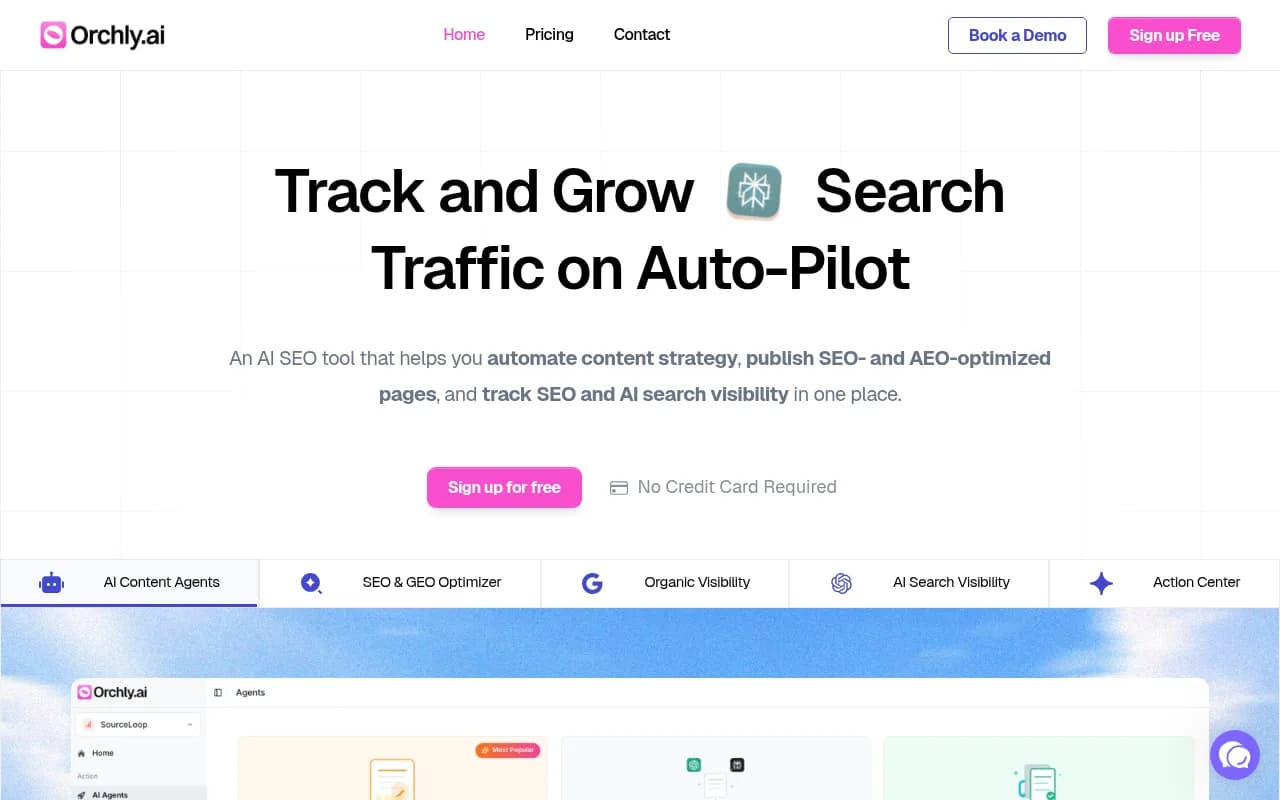
Track brand mentions across ChatGPT, Perplexity, Claude, and Google AI products with comprehensive visibility monitoring and analytics.
Key Takeaways:
- All-in-one platform combining AI search visibility tracking, automated content creation via AI agents, and SEO/AEO optimization in a single workflow
- Multi-platform monitoring tracks brand mentions across ChatGPT, Claude, Perplexity, Gemini, Grok, and Google Search with competitor benchmarking
- AI agent system automates research, writing, optimization, and publishing with human-in-the-loop review — not just another AI writer
- Best for marketing teams and agencies managing 10+ content pieces monthly who want to automate repetitive tasks while maintaining brand consistency
- Pricing starts at $49/month (Essential) with 1,500 task credits and 25 tracked prompts; free trial available with no credit card required
Orchly.ai positions itself as a comprehensive content operations platform that bridges the gap between traditional SEO and the emerging world of AI search optimization (AEO/GEO). Unlike tools that focus solely on visibility tracking or content generation, Orchly attempts to handle the entire content lifecycle — from identifying opportunities to publishing optimized articles — while monitoring how your brand appears in AI-powered search experiences.
The platform targets marketing teams at growing brands and agencies who are drowning in content production demands while trying to stay visible in both Google and AI search engines like ChatGPT and Perplexity. It's particularly aimed at teams producing 10-50+ pieces of content monthly who need to maintain quality and brand consistency without hiring an army of writers.
AI Search Visibility Tracking
Orchly monitors brand mentions across ChatGPT, Claude, Perplexity, Gemini, Grok, and traditional Google Search. You can track specific prompts (queries) to see when and how AI models mention your brand, compare your visibility against competitors, and identify which content sources are being cited by AI engines. The Essential plan includes 25 tracked prompts, while Pro bumps this to 100, and Enterprise offers 500+.
The visibility dashboard shows real-time data on where you rank for specific queries, sentiment analysis of how your brand is portrayed, and citation tracking to see which of your pages AI models are reading. This is particularly valuable for understanding the "dark funnel" of AI-assisted research that happens before prospects ever visit your website. Unlike tools that rely on API simulations, Orchly claims to track actual AI responses, though the methodology isn't fully detailed on their site.
For agencies managing multiple clients, the competitor benchmarking feature lets you see how client brands stack up against rivals in AI search results. You can export this data into white-label reports for client presentations.
AI Content Agents (Not Just AI Writing)
This is where Orchly differentiates itself from typical AI writing tools. Instead of a single text generator, Orchly offers specialized AI agents for different content tasks: SERP research agents, citation verification agents, internal linking agents, content refresh agents, and publishing agents. You can chain these together into automated workflows.
For example, a typical workflow might be: Research Agent analyzes top-ranking content and identifies content gaps → Brief Agent creates a detailed outline with target keywords and structure → Writing Agent drafts the article → Optimization Agent adds internal links, external citations, and structured data → Review step (human approval) → Publishing Agent pushes to your CMS.
The agents are trained on your brand guidelines, existing content, and website sitemap to maintain consistency. You can upload example documents, set tone preferences, and define vocabulary to avoid. This addresses the common complaint about AI-generated content sounding generic or off-brand. The system includes plagiarism scanning and accuracy scoring to catch hallucinations or duplicate content before publication.
Task credits are consumed by agent actions. The Essential plan includes 1,500 credits monthly (roughly 15-30 articles depending on complexity), Pro includes 5,000 credits, and Enterprise offers custom limits. Each agent task (research, writing, optimization) consumes a different number of credits.
SEO and AEO Optimization Engine
Orchly analyzes over 150 ranking factors to optimize content for both traditional search engines and LLMs. The optimization engine automatically adds internal and external links, inserts structured data markup, suggests NLP keywords, and formats content with images, tables, and rich media. It also identifies technical SEO issues like crawl errors, schema gaps, and indexing problems.
The AEO (Answer Engine Optimization) component specifically tunes content to be more "LLM-friendly" by adding factual citations, clear structure, and authoritative sources that AI models prefer to reference. This includes analyzing which external sources ChatGPT and Claude frequently cite and suggesting you link to similar authoritative domains.
For content refresh workflows, Orchly can scan your existing articles, identify outdated information or missing optimization opportunities, and automatically update them. This is particularly useful for maintaining large content libraries without manual audits.
Action Center and Insights
The Action Center aggregates recommendations across your content portfolio: which pages to create next based on keyword gaps, which existing articles to refresh, which backlinks are worth pursuing, and which Reddit discussions or forums are shaping AI search visibility in your niche. This helps prioritize work based on potential impact rather than guesswork.
The insights are data-driven, pulling from your Google Search Console data, AI visibility tracking, and competitor analysis. For example, if a competitor is consistently mentioned for a specific prompt where you're absent, Orchly will flag this as an opportunity and suggest content topics to close the gap.
CMS Integrations and Publishing
Orchly connects directly to WordPress, Webflow, Framer, and Ghost for one-click publishing. Once content is approved in the review step, you can push it live immediately or schedule publication. Content can also be exported in Markdown or HTML for other platforms.
The platform includes a "Brand Kit" feature (1 kit on Essential, 5 on Pro, unlimited on Enterprise) where you store brand guidelines, tone preferences, example content, and visual assets. This ensures all AI-generated content aligns with your brand identity across multiple projects or clients.
White-Label Reporting
For agencies, Orchly offers white-label reports that can be generated in one click. These include AI visibility metrics, SEO performance, content production summaries, and competitor benchmarks. Reports are client-ready and can be branded with your agency logo and colors. This is a significant time-saver compared to manually compiling data from multiple tools into PowerPoint decks.
Who Is Orchly For?
Orchly is best suited for in-house marketing teams at growing B2B SaaS companies or ecommerce brands producing 10-50+ content pieces monthly. If you're a 2-5 person marketing team drowning in content requests from sales, product, and leadership, Orchly's automation can help you scale output without sacrificing quality.
Marketing agencies managing 5-20 clients will find value in the white-label reporting, multi-brand kit support, and ability to track AI visibility across client portfolios. The Pro plan supports 5 users and 5 brand kits, making it practical for small to mid-size agencies. Larger agencies will need Enterprise.
SEO consultants and freelancers who produce content for clients can use the Essential plan ($49/month) to automate research and drafting, though the 25 tracked prompts may feel limiting if you're monitoring multiple client brands.
Who should NOT use Orchly: If you're a solo blogger or small business producing 1-5 articles per month, the pricing and complexity are overkill. Tools like Surfer SEO or Frase will be more cost-effective. If you need deep technical SEO auditing (site speed, Core Web Vitals, advanced schema), you'll still need dedicated tools like Screaming Frog or Ahrefs. Orchly's technical SEO features are more surface-level.
If you're in a highly regulated industry (legal, medical, financial) where AI-generated content requires extensive fact-checking and compliance review, the automation may not save as much time as promised. The human review step is essential, but you'll still need subject matter experts to verify every claim.
Integrations and Ecosystem
Orchly integrates with Google Search Console for organic search data, WordPress, Webflow, Framer, and Ghost for publishing. The platform doesn't currently list integrations with Zapier, Slack, or other workflow tools, which may limit automation for teams with complex tech stacks. There's no mention of an API for custom integrations, though Enterprise customers may have access.
The platform is web-based with no mobile app or browser extension mentioned. All work happens in the Orchly dashboard.
Pricing and Value
Orchly offers three tiers:
Essential: $49/month (or $37/month annually)
- 1,500 task credits (roughly 15-30 articles/month depending on complexity)
- 25 tracked prompts for AI visibility monitoring
- AI agents access (research, writing, optimization, publishing)
- SEO and AEO optimization
- 1 brand kit
- Auto CMS publishing
- 1 user
- Monitors ChatGPT, Google, Perplexity
This tier works for solo marketers or consultants managing a single brand with modest content needs. The 25 tracked prompts may feel limiting if you want comprehensive AI visibility monitoring.
Pro: $125/month (or $93/month annually)
- 5,000 task credits (roughly 50-100 articles/month)
- 100 tracked prompts
- All Essential features
- 5 brand kits
- 5 users
- Adds Gemini monitoring
This is the sweet spot for small marketing teams and agencies. The 5 brand kits and 5 users make it practical for agencies managing multiple clients. The jump from 25 to 100 tracked prompts is significant for comprehensive visibility monitoring.
Enterprise: Custom pricing
- Custom task credits
- 500+ tracked prompts
- Unlimited brand kits
- Unlimited users
- Customer success manager
- Adds Grok and Claude monitoring
Enterprise is for large brands or agencies with high-volume needs. The addition of a CSM and full LLM coverage (including Grok and Claude) makes this the only tier with truly comprehensive AI visibility tracking.
Free trial: 14 days, no credit card required. This is generous and lets you fully test the platform before committing.
Value assessment: Compared to buying separate tools for AI visibility tracking (like Promptwatch at ~$99+/month), content creation (Jasper at $49+/month), and SEO optimization (Surfer SEO at $89+/month), Orchly's all-in-one approach at $49-125/month is competitive. However, it may not be as deep or specialized as best-in-class tools in each category. You're trading some depth for convenience and integration.
The task credit system can be confusing. It's not clear exactly how many credits each agent action consumes, making it hard to predict monthly costs. Some users may hit credit limits faster than expected if they're running complex multi-agent workflows.
Strengths
Unified workflow: Having visibility tracking, content creation, optimization, and publishing in one platform eliminates tool-switching and data silos. You can see an AI visibility gap, create content to address it, optimize it, and publish it without leaving Orchly.
Agent-based automation: The specialized agent approach is more sophisticated than typical AI writers. Being able to chain agents into custom workflows (research → write → optimize → publish) with human review steps gives you control while automating repetitive tasks.
Brand consistency: The brand kit system and ability to train agents on your existing content helps maintain voice and style across AI-generated articles. This addresses a major pain point with AI writing tools.
White-label reporting: For agencies, the one-click client reports are a significant time-saver and professional touch.
Multi-platform AI monitoring: Tracking visibility across ChatGPT, Claude, Perplexity, Gemini, and Grok in one dashboard is valuable as AI search fragments across multiple platforms.
Limitations
Task credit opacity: The credit system lacks transparency. Without knowing exactly how many credits each action consumes, it's hard to budget or predict when you'll hit limits. This could lead to surprise overages or workflow interruptions.
Limited integrations: No Zapier, Slack, or API access (except possibly Enterprise) limits automation possibilities. Teams with complex tech stacks may find this frustrating.
Shallow technical SEO: While Orchly identifies technical issues, it doesn't offer the deep crawling and auditing capabilities of dedicated tools like Screaming Frog or Sitebulb. You'll still need those for comprehensive technical SEO work.
AI visibility methodology unclear: The site doesn't explain in detail how AI visibility tracking works — whether it's based on API calls, real user data, or simulations. Tools like Promptwatch are more transparent about tracking real user prompts vs. API simulations.
New player: Orchly appears to be a relatively new entrant (based on recent branding and website design). There are no public case studies, user reviews, or testimonials on the site, making it harder to assess real-world performance and reliability.
Bottom Line
Orchly.ai is best for marketing teams and agencies that want to consolidate their content operations stack and automate repetitive tasks while maintaining quality control. If you're currently juggling separate tools for AI visibility tracking, content creation, SEO optimization, and publishing, Orchly's unified workflow could save significant time and money. The agent-based approach is more sophisticated than typical AI writers, and the brand kit system helps maintain consistency at scale.
However, if you need best-in-class depth in any single category — deep technical SEO auditing, advanced AI visibility analytics with transparent methodology, or enterprise-grade content collaboration — you may find Orchly's features somewhat surface-level. It's a strong generalist platform but not a specialist in any one area.
Best use case in one sentence: Marketing teams at B2B SaaS companies or agencies managing 5-15 clients who need to produce 20-100 articles monthly while tracking brand visibility in both Google and AI search engines.
Tags:
Similar and alternative tools to Orchly