Key Takeaways
- Ceyo is a pure AI visibility tracker focused on monitoring brand mentions across ChatGPT, Gemini, Claude, and Perplexity -- no content creation or SEO features
- Orchly combines AI visibility tracking with SEO analytics, automated content generation, and optimization tools -- it's a full content operations platform, not just a tracker
- Pricing starts at $49/mo for both, but Ceyo's Core plan is monitoring-only while Orchly's Essential plan includes content agents and SEO tools
- Ceyo offers more granular prompt-level analytics with sentiment scoring and brand comparison tables; Orchly focuses on actionable insights and optimization recommendations
- Choose Ceyo if you only need AI search monitoring and competitor benchmarking; choose Orchly if you want to track visibility AND create content that improves it
- Both tools lack the depth of platforms like Promptwatch when it comes to citation analysis, crawler logs, and content gap identification -- worth considering if you need the full action loop
Overview
Ceyo: AI visibility monitoring specialist
Ceyo
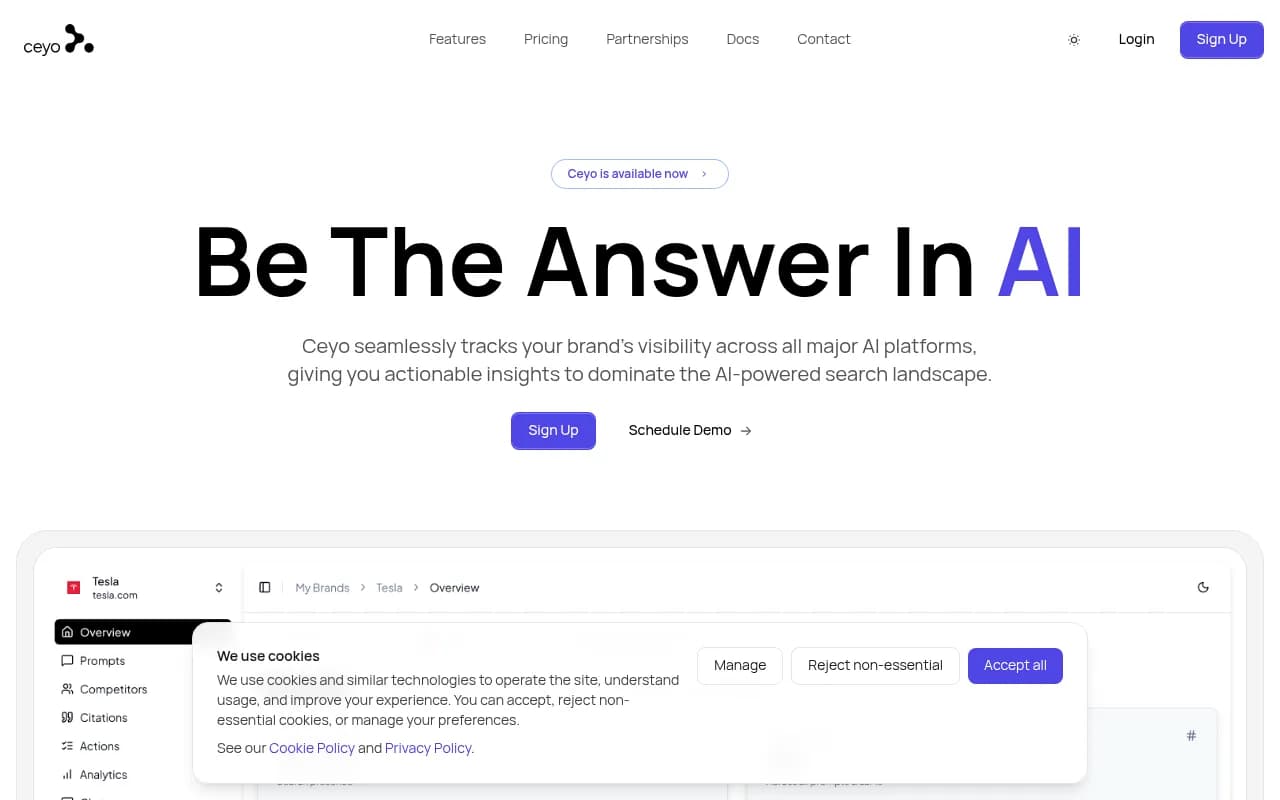
Ceyo positions itself as a GEO (Generative Engine Optimization) platform built specifically for tracking brand visibility across major AI search engines. It monitors ChatGPT, Gemini, Claude, and Perplexity, giving you prompt-level analytics on where your brand appears, how often, and with what sentiment. The platform is designed for marketers and agencies who want to understand their AI search footprint and compare it against competitors.
The core value is comprehensive monitoring -- thousands of prompts tracked, sentiment analysis on each mention, and detailed tables showing which brands appear for which queries. Ceyo doesn't try to be a content tool or SEO platform. It's a dashboard for AI visibility, period.
Orchly: AI visibility + content automation platform
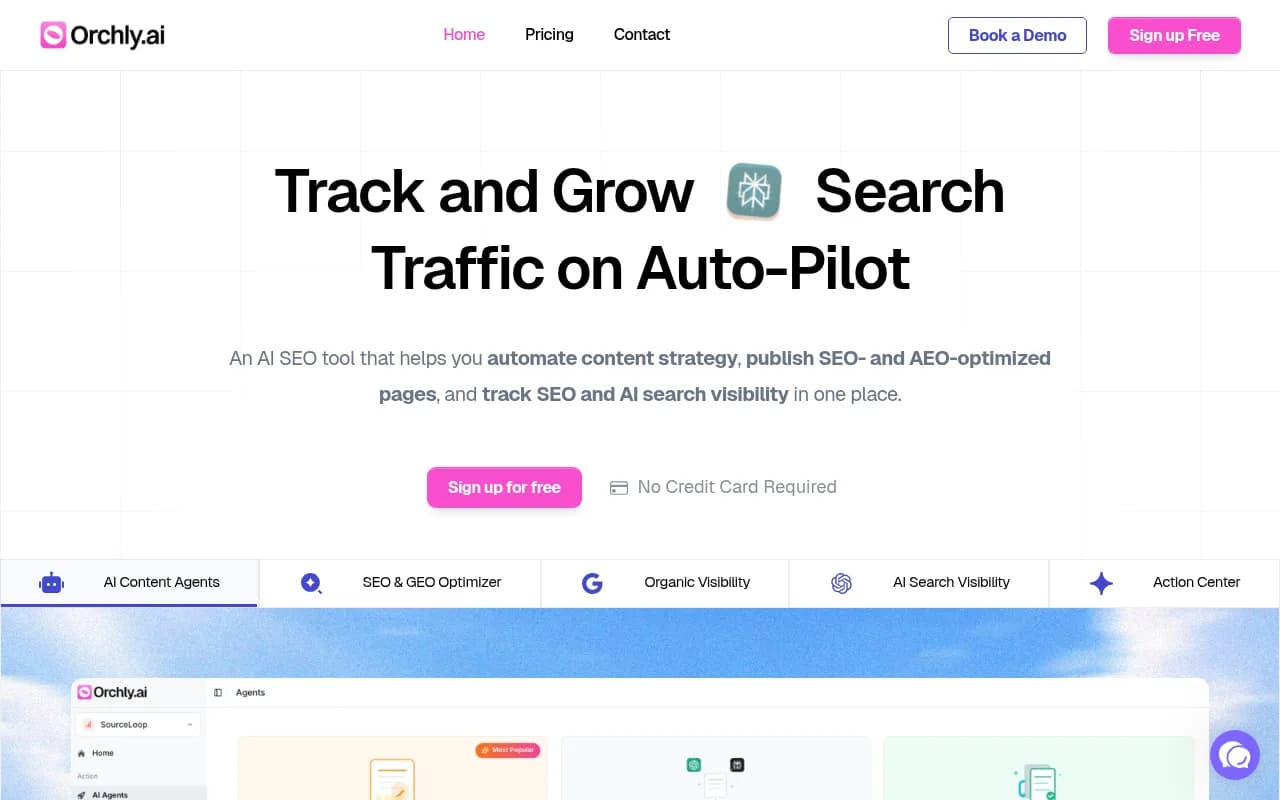
Orchly takes a different approach. It tracks AI visibility across ChatGPT, Claude, Perplexity, Gemini, and Google AI products, but that's just step one. The platform is built around a four-step workflow: track visibility, identify optimization opportunities, create content with AI agents, then optimize for both SEO and AEO (Answer Engine Optimization).
Orchly targets marketing teams who want to close the loop -- not just see where they're invisible, but actually fix it. The platform includes AI content agents that write and refresh articles, an SEO optimizer that analyzes 150+ ranking factors, and automated publishing workflows. It's less of a pure tracker and more of a content operations platform that happens to include AI visibility monitoring.
Side-by-Side Comparison
| Feature | Ceyo | Orchly |
|---|---|---|
| AI platforms tracked | ChatGPT, Gemini, Claude, Perplexity | ChatGPT, Claude, Perplexity, Gemini, Google AI products |
| Prompt analytics | ✓ Comprehensive with sentiment scoring | ✓ Basic visibility tracking |
| Competitor benchmarking | ✓ Side-by-side brand comparison tables | ✓ Real-time visibility comparison |
| Content creation | ✗ Not included | ✓ AI content agents with human-in-loop |
| SEO analytics | ✗ Not included | ✓ Organic visibility tracking + optimizer |
| Optimization recommendations | Limited to AI visibility insights | ✓ SEO + AEO action center with specific tasks |
| Automated publishing | ✗ | ✓ Auto-schedule and publish |
| White-label reports | Unknown | ✓ Shareable reports and audits |
| Free trial | Unknown | ✓ 14 days, no credit card |
| Starting price | $49/mo (Core) | $49/mo (Essential) |
| Annual discount | ✓ Available | ✓ 25% off |
| Enterprise pricing | ✓ Custom | ✓ Custom |
Monitoring capabilities
Ceyo's strength is depth of monitoring. The platform tracks thousands of prompts and presents detailed analytics tables showing visibility percentage, sentiment (positive/neutral/negative), average position, impact level, and which brands appear for each query. You can filter by category, geography, and relevance. The prompt table includes brand logos, making it easy to scan who's winning for specific queries.
This level of granularity is useful if you're trying to understand exactly which prompts drive your brand mentions and how you stack up against competitors. The sentiment analysis adds context -- a high visibility score with negative sentiment is a different problem than low visibility.
Orchly's monitoring is less granular. It tracks visibility across the same AI platforms but doesn't surface the same prompt-level detail. Instead, it focuses on actionable insights: which content you should create next, which pages to improve, which backlinks to build, which Reddit discussions are shaping AI search results. The monitoring feeds into an "Action Center" that prioritizes tasks.
The trade-off: Ceyo gives you more data to analyze yourself. Orchly gives you fewer metrics but tells you what to do about them.
Content and optimization features
Ceyo doesn't play in this space at all. It's a monitoring tool. If you want to improve your AI visibility based on what Ceyo shows you, you're on your own to create content, optimize pages, or build backlinks.
Orchly is built around taking action. The platform includes AI content agents that write articles, refresh existing content, and publish on a schedule. The agents are "trained on your data" (their claim) to avoid generic AI writing patterns. There's a human-in-the-loop workflow so you review before publishing.
The SEO/AEO optimizer analyzes 150+ factors and automatically adds internal links, external citations, structured data, rich formatting (images, tables, videos), and technical fixes. The idea is to create content that ranks in both Google and AI search engines.
This is a fundamental difference in philosophy. Ceyo assumes you have a content team or agency handling optimization. Orchly assumes you want the platform to do it for you.
Analytics and reporting depth
Ceyo's analytics are prompt-centric. You get tables of prompts with metrics for each one. The interface (based on the website screenshot) shows a clean table view with visibility %, sentiment, average position, impact level, and competing brands. You can see at a glance that "Best laptop for developers" has 85% visibility with positive sentiment and Apple/Lenovo/Dell mentioned, while "Top CRM for startups" has only 12% visibility with negative sentiment.
This format is great for agencies running reports for clients or brands doing competitive analysis. The data is specific enough to build a strategy around.
Orchly's analytics are split between AI visibility and SEO performance. The AI search analytics show where you rank across platforms, but the real value is in the SEO side -- organic visibility tracking, keyword rankings, technical issues, backlink analysis. The white-label reporting feature lets agencies create client-facing dashboards.
The difference: Ceyo is deeper on AI search analytics. Orchly is broader, covering both AI and traditional search.
Pricing comparison
| Plan | Ceyo | Orchly |
|---|---|---|
| Free trial | Unknown | 14 days, no credit card |
| Entry tier | Core: $49/mo | Essential: $49/mo |
| Mid tier | Standard: price unknown | Pro: $125/mo |
| Top tier | Enterprise: custom | Enterprise: custom |
| Annual discount | Available (amount unknown) | 25% off |
| What's included at entry level | AI visibility tracking across 4 platforms | AI + SEO tracking, content agents, optimizer |
Both platforms start at $49/mo, but you're getting very different things. Ceyo's Core plan is pure monitoring. Orchly's Essential plan includes monitoring plus content creation and optimization tools. If you only need tracking, Ceyo is the cleaner choice. If you want the full workflow, Orchly gives you more for the same starting price.
Orchly's 14-day free trial with no credit card required is a lower-friction way to test the platform. Ceyo's trial situation is unclear from their website.
Integration and workflow
Ceyo appears to be a standalone dashboard. You log in, review your AI visibility metrics, export reports, and use the insights to inform your content strategy elsewhere. The platform is designed for agencies and brands who already have content workflows in place.
Orchly is designed to be your content workflow. It integrates AI visibility tracking with content creation, SEO optimization, and publishing. The "Action Center" surfaces tasks based on what the platform detects (missing content, pages to refresh, technical issues). You can auto-schedule content to publish on your site.
This makes Orchly more opinionated about how you should work. Ceyo is tool-agnostic -- use whatever content stack you want, just come to Ceyo for the visibility data.
Competitor analysis features
Both platforms offer competitor benchmarking, but in different ways.
Ceyo shows you which brands appear for each prompt in a side-by-side table. You can see that for "Best laptop for developers," Apple, Lenovo, and Dell are mentioned. For "Top project management tools," it's Linear, Asana, and Monday. This lets you identify which competitors are winning specific queries and where you're absent.
Orchly's competitor comparison is real-time visibility benchmarking -- you can see how your AI search presence stacks up against competitors overall, but the granularity isn't as clear from their website. The focus seems to be more on identifying content gaps and opportunities than on detailed prompt-by-prompt competitor analysis.
If competitive intelligence is your main goal, Ceyo's prompt tables are more useful. If you want to know what to build to catch up, Orchly's action-oriented approach is better.
User interface and experience
Ceyo's interface (based on the website screenshot) is clean and table-driven. The prompt analytics table is the core UI element -- sortable columns, brand logos for visual scanning, color-coded sentiment. It's designed for people who are comfortable analyzing data and drawing their own conclusions.
Orchly's interface is more workflow-oriented. The website shows a multi-step process (track visibility → get insights → create content → optimize) with different screens for each stage. The Action Center appears to be a task list that tells you what to work on next. This is better for teams who want the platform to guide them, not just present data.
Neither platform has a public demo or interactive tour on their website, so it's hard to judge usability without signing up.
Who should pick Ceyo
- Agencies running AI visibility reports for clients: The prompt-level analytics and competitor tables are perfect for client presentations
- Brands with existing content teams: If you already have writers, SEO specialists, and a content workflow, you just need the visibility data to inform strategy
- Competitive intelligence focus: If your main question is "where do competitors appear that we don't?", Ceyo's granular prompt tracking answers that directly
- Pure monitoring needs: If you don't want a platform trying to automate your content creation, Ceyo stays in its lane
Who should pick Orchly
- Marketing teams without dedicated content resources: The AI content agents and automated publishing help small teams punch above their weight
- SEO + AI visibility in one place: If you're tracking both traditional search and AI search, Orchly covers both instead of needing separate tools
- Action-oriented workflows: If you want the platform to tell you what to do next (create this content, fix this page, build this link), Orchly's Action Center does that
- End-to-end content operations: If you want to track visibility, create content, optimize it, and publish it all in one platform, Orchly is built for that loop
Pros and cons
Ceyo pros:
- Deep prompt-level analytics with sentiment scoring
- Clean competitor comparison tables
- Focused on doing one thing well (monitoring)
- Trusted by agencies (BrandFirm, Zigt, Enreach listed as partners)
Ceyo cons:
- No content creation or optimization features
- Pricing details sparse (only Core plan price listed publicly)
- Free trial availability unclear
- Doesn't help you act on the insights -- just shows you the data
Orchly pros:
- Full content workflow from tracking to publishing
- Combines AI visibility with SEO analytics
- AI content agents to automate writing and refreshing
- 14-day free trial, no credit card required
- White-label reporting for agencies
- Clear annual discount (25% off)
Orchly cons:
- AI visibility tracking less granular than Ceyo's
- More complex platform means steeper learning curve
- "Trained on your data" AI writing claim is vague -- quality unclear without testing
- Tries to do many things, which can mean none are best-in-class
Final verdict
Pick Ceyo if you need a specialized AI visibility monitoring tool and already have a content team to act on the insights. The prompt-level analytics and competitor tables are more detailed than Orchly's, making it better for pure tracking and competitive analysis.
Pick Orchly if you want to close the loop from visibility tracking to content creation and optimization. The platform gives you less granular monitoring data but makes up for it by helping you actually improve your rankings with AI content agents and SEO tools.
The real question is whether you want a dashboard or a workflow platform. Ceyo is the former. Orchly is the latter.
One thing both tools lack: deep citation analysis and content gap identification. If you're serious about understanding why competitors rank and what specific content you're missing, Promptwatch offers a more comprehensive approach with 880M+ citations analyzed, Answer Gap Analysis that shows exactly which prompts competitors win but you don't, and AI content generation grounded in real citation data. Worth exploring if you need the full picture of what's working in AI search and how to replicate it.