GeoGen Review 2026
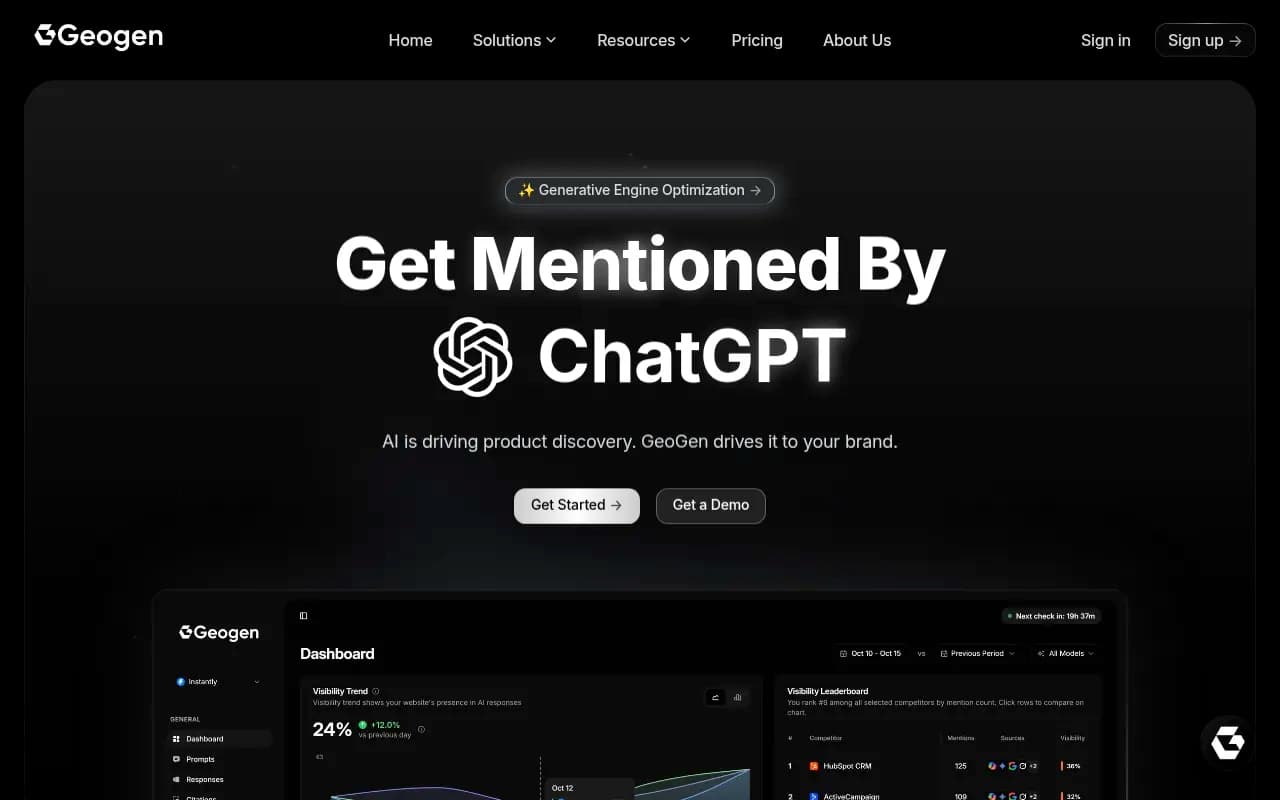
GeoGen is a Generative Engine Optimization (GEO) platform that helps brands monitor their visibility across ChatGPT, Perplexity, Gemini, and other AI search engines. Track brand mentions, analyze competitor rankings, and get recommendations to improve your AI search presence. Best for small to mid-sized brands focused on basic AI visibility tracking.
Key Takeaways:
- Monitoring-focused platform: GeoGen tracks brand mentions across 7+ AI models (ChatGPT, Perplexity, Gemini, Grok, Copilot, Google AIO, Google AI Mode) with daily checks and competitor comparisons
- Limited optimization capabilities: Unlike action-oriented platforms like Promptwatch, GeoGen lacks content gap analysis, AI content generation, Reddit/YouTube tracking, and crawler log analysis -- it shows you data but doesn't help you fix visibility issues
- Best for: Small brands and agencies (2-15 entities) needing basic AI visibility monitoring without advanced optimization workflows
- Pricing: Starts at €20/month (Micro plan) up to €399/month (Pro plan), with custom enterprise pricing available
- Main limitation: No actionable content creation tools or deep optimization features -- you'll need separate tools to act on the insights
GeoGen is a Generative Engine Optimization platform built to help brands understand how they're being mentioned in AI-powered search engines like ChatGPT, Perplexity, Google Gemini, and Microsoft Copilot. Founded by a European team (the platform uses Euro pricing and appears to be based in Europe based on client logos like HostingPerte and GdprWise), GeoGen positions itself as an "all-in-one" GEO solution. In practice, it's a solid monitoring dashboard that tracks brand visibility across major LLMs -- but it stops short of the optimization and content creation features that define true end-to-end platforms.
The core promise is straightforward: see where your brand is mentioned in AI-generated responses, compare your visibility against competitors, and get recommendations to improve your presence. For small brands just starting to think about AI search visibility, GeoGen offers an accessible entry point. For teams that need to actually optimize content and close visibility gaps, the platform's lack of action-oriented features becomes a significant limitation.
AI Visibility Tracking
GeoGen's primary feature is tracking how often your brand appears in responses from 7 AI models: ChatGPT, Perplexity, Google Gemini, Google AI Overviews, Google AI Mode, Grok, and Microsoft Copilot. You define a set of prompts (queries) relevant to your business -- for example, "best project management tools" or "top VPS hosting providers" -- and GeoGen runs these prompts daily across the selected models. The dashboard shows whether your brand was mentioned, at what rank, and how competitors performed on the same prompts.
The interface displays three key metrics: Reach (how often you're mentioned), Share-of-Voice (your visibility vs competitors), and Citation Rate (percentage of prompts where you appear). These are useful top-level indicators, but the platform doesn't provide the granular prompt intelligence you'd find in more advanced tools. There's no prompt volume data, no difficulty scoring, and no query fan-out analysis to show how one prompt branches into related sub-queries. You're essentially tracking a fixed list of prompts you manually define, without data-driven guidance on which prompts actually matter or are winnable.
Competitor Comparison
GeoGen lets you add competitor brands and compare visibility side-by-side. The dashboard shows live rankings for each prompt, highlighting where you rank vs competitors across different AI models. This is helpful for understanding your relative position in AI search results -- if Competitor A consistently ranks #1 on Perplexity while you're #3, you know there's a gap to close.
However, the platform doesn't tell you why competitors are winning or what content they have that you don't. There's no Answer Gap Analysis (a feature Promptwatch offers) that identifies the specific topics, angles, or content types competitors are being cited for. You can see the rankings, but you're left to manually investigate what's driving those rankings. For teams managing 5-10 competitors across dozens of prompts, this becomes a time-consuming manual research task.
Citation Insights
GeoGen provides a "Top Citations" view showing which domains AI models frequently cite when answering prompts in your category. The dashboard lists domains like reddit.com, forbes.com, or cybernews.com along with citation counts. This gives you a sense of which sources influence AI recommendations in your space.
What's missing: GeoGen doesn't track Reddit threads or YouTube videos specifically, and it doesn't surface the actual discussions or content that's being cited. Platforms like Promptwatch include dedicated Reddit and YouTube tracking modules that show you the specific threads, posts, and videos AI models reference -- allowing you to participate in those conversations or create similar content. GeoGen's citation data is high-level domain analysis, not actionable content intelligence.
Optimization Recommendations
The platform offers a task list of optimization suggestions: "Optimize meta descriptions," "Add structured data," "Improve content depth," "Build authoritative citations," and "Enhance brand mentions." These are generic SEO best practices presented as checkboxes. There's no specific guidance on which pages to optimize, what content is missing, or how to structure new content to get cited by AI models.
This is where GeoGen's monitoring-only approach becomes limiting. Compare this to platforms that offer content gap analysis (showing exactly which topics you need to cover) and AI content generation (creating articles grounded in citation data and prompt intelligence). GeoGen tells you to "improve content depth" but doesn't show you what depth looks like or help you create it. You're on your own to interpret the data and execute improvements.
Multi-Language and Multi-Region Support
GeoGen supports tracking prompts in 30+ languages and across different geographic regions. You can customize prompts per region to understand how AI visibility varies by market -- useful for global brands or agencies managing clients in multiple countries. The platform also includes sentiment analysis, showing whether AI mentions are positive, negative, or neutral.
These are solid features for international visibility tracking, though the lack of localized prompt intelligence (volume and difficulty data per region) limits their strategic value. You can track visibility in France, Germany, and Spain, but you won't know which prompts are high-volume or winnable in each market without external research.
Integrations and Crawler Tracking
GeoGen mentions integrations with edge platforms and CMSs to "track AI crawlers," but the website doesn't specify which integrations are available or how crawler tracking works. The pricing page lists "LLM Traffic" as an included feature, suggesting some level of traffic attribution, but there's no detail on implementation (code snippet, server log analysis, or GSC integration).
For comparison, Promptwatch offers real-time AI crawler logs showing exactly when ChatGPT, Claude, Perplexity, and other AI bots visit your site, which pages they read, and any errors they encounter. This level of crawler visibility is critical for debugging indexing issues and understanding how AI engines discover your content. GeoGen's crawler tracking appears less developed, though the lack of documentation makes it hard to assess.
Team Collaboration and Workspaces
GeoGen includes workspace functionality with granular permissions and team seats. The Micro plan includes 1 seat, Standard includes 2, Growth includes 10, and Pro includes 10. You can create separate workspaces for different clients or brands, each with its own upgrade path. This is useful for agencies managing multiple clients, though the seat limits on lower-tier plans are restrictive compared to competitors.
Who Is GeoGen For?
GeoGen is best suited for small brands and digital agencies (2-15 entities) that need basic AI visibility monitoring without the complexity or cost of enterprise platforms. If you're a SaaS startup, e-commerce brand, or B2B service provider just starting to track AI search presence, GeoGen offers an affordable entry point (€20-€199/month for most use cases). The interface is clean and the core tracking features work as advertised.
It's also a fit for agencies managing 5-10 clients that want a simple dashboard to show clients where they rank in AI search results. The workspace and team seat features support multi-client management, and the competitor comparison views make for good client reporting.
Who should NOT use GeoGen: SEO teams, content marketers, and growth teams that need to actually optimize and improve AI visibility. If your goal is to close content gaps, generate AI-optimized articles, or understand why competitors are winning, GeoGen's monitoring-only approach will leave you stuck. You'll see the data but have no tools to act on it. Teams managing 50+ prompts or tracking 10+ competitors will also find the platform's lack of prompt intelligence and automation limiting.
What's Missing (vs Full-Featured Platforms)
Compared to end-to-end GEO platforms like Promptwatch, GeoGen lacks several critical optimization features:
- No Content Gap Analysis: GeoGen doesn't show you which prompts competitors are visible for but you're not, or what content you're missing. You can see rankings, but not the gaps.
- No AI Content Generation: There's no built-in content creation tool to help you write articles, listicles, or comparisons optimized for AI citations. You'll need a separate tool or manual writing.
- No Reddit or YouTube Tracking: GeoGen doesn't surface the Reddit threads or YouTube videos that influence AI recommendations in your category -- a major blind spot since these sources heavily influence LLM responses.
- No Crawler Log Analysis: Limited or unclear crawler tracking means you can't debug indexing issues or understand how AI bots interact with your site.
- No Prompt Intelligence: No volume estimates, difficulty scores, or query fan-outs to help you prioritize which prompts to target.
- No Traffic Attribution: Unclear how LLM traffic tracking works or whether you can connect AI visibility to actual revenue.
These aren't minor features -- they're the difference between a monitoring dashboard and an optimization platform. GeoGen shows you where you stand, but it doesn't help you improve.
Pricing and Value
GeoGen uses Euro pricing with four main tiers:
- Micro: €20/month (€16/month annual) -- 1 entity, 7,440 credits/year, 2 AI models, 10 prompts, 1 seat
- Standard: €60/month (€48/month annual) -- 2 entities, 74,400 credits/year, 4 AI models, 50 prompts, 2 seats
- Growth: €199/month (€159/month annual) -- 5 entities, 334,800 credits/year, 6 AI models, 150 prompts, 10 seats
- Pro: €399/month (€319/month annual) -- 15 entities, 892,800 credits/year, 7 AI models, 300 prompts, 10 seats
- Custom: Enterprise pricing -- unlimited entities, credits, models, prompts, and seats
All plans include daily checks, competitor overview, website citations, LLM traffic, unlimited countries/languages/tags, and email support. The credit system isn't clearly explained on the website -- it's unclear what actions consume credits or how they translate to actual prompt checks.
For basic monitoring, the pricing is competitive. €60/month for 2 brands and 50 prompts across 4 AI models is reasonable for small teams. However, when you compare feature sets to platforms like Promptwatch (which includes content gap analysis, AI content generation, crawler logs, Reddit/YouTube tracking, and prompt intelligence starting at $99/month), GeoGen's value proposition weakens. You're paying for a dashboard that shows you data, not a platform that helps you act on it.
Strengths
- Clean, accessible interface: Easy to set up and understand, even for teams new to GEO
- Multi-language and multi-region support: Track visibility across 30+ languages and different geographic markets
- Competitor comparison: Side-by-side rankings make it easy to see where you stand vs competitors
- Affordable entry point: €20/month Micro plan is accessible for small brands testing AI visibility tracking
- Workspace and team features: Supports multi-client agency workflows with granular permissions
Limitations
- Monitoring-only approach: No content gap analysis, no AI content generation, no tools to actually improve visibility
- Missing social and video tracking: No Reddit or YouTube insights, which are critical sources for AI citations
- Limited prompt intelligence: No volume data, difficulty scores, or query fan-outs to guide strategy
- Unclear crawler tracking: LLM traffic feature is mentioned but not documented -- unclear how it works or what data it provides
- Generic optimization suggestions: Task list offers SEO best practices, not specific, actionable guidance based on your data
Bottom Line
GeoGen is a straightforward AI visibility monitoring tool for small brands and agencies that want to track how they're mentioned in ChatGPT, Perplexity, and other AI search engines. The interface is clean, the competitor comparison features are useful, and the pricing is accessible for teams managing 1-5 brands. If you're just starting to think about AI search visibility and want a simple dashboard to track your presence, GeoGen delivers on that promise.
However, if your goal is to actually improve AI visibility -- to close content gaps, generate optimized content, and understand why competitors are winning -- GeoGen's monitoring-only approach will leave you stuck. The platform shows you the data but provides no tools to act on it. For teams serious about GEO, platforms like Promptwatch offer the content gap analysis, AI content generation, crawler logs, Reddit/YouTube tracking, and prompt intelligence needed to actually move the needle. GeoGen is a starting point, not a complete solution.
Tags:
Similar and alternative tools to GeoGen