Anyword Review 2026
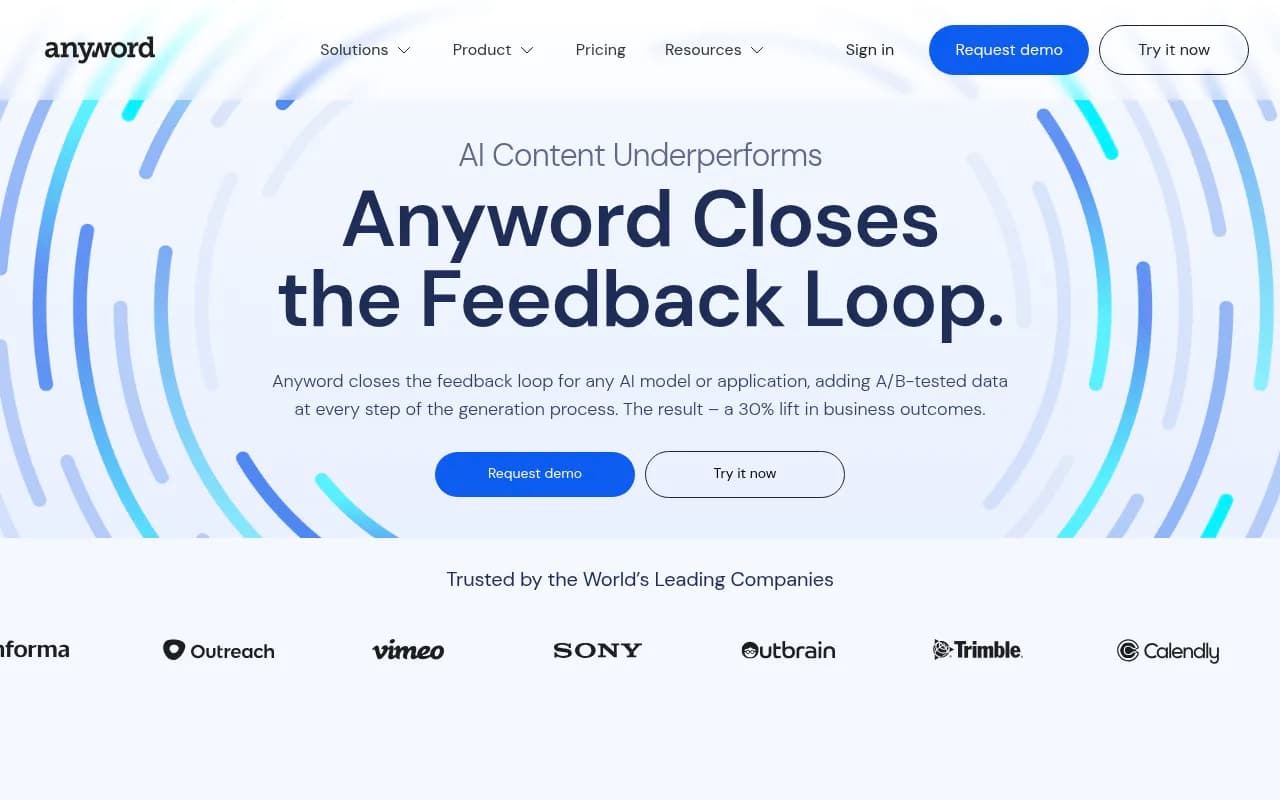
Anyword is an enterprise AI content platform that uses A/B-tested data to generate and optimize marketing copy across channels. Unlike generic AI models, it predicts which content variations will perform best with 82% accuracy, helping marketing teams boost conversions by 30% while maintaining brand
Key Takeaways:
- Anyword delivers 82% accuracy in predicting which content will perform best (vs 52% for GPT-4o alone), backed by 880M+ A/B-tested data points
- Closes the feedback loop for AI content: find gaps in existing content, generate optimized variations, track performance across channels
- Built for enterprise with SOC 2, ISO 27001, GDPR, and HIPAA compliance, SSO, role-based access, and 99.9% uptime
- Works as both a standalone platform and an API that integrates with ChatGPT, Notion, Gemini, and other AI tools
- Pricing starts at $39/mo (Starter), $79/mo (Data-Driven), with custom enterprise plans available
Anyword is an AI content generation and optimization platform built specifically for enterprise marketing teams who need their AI-generated copy to actually perform -- not just sound good. Founded as a data-driven copywriting tool, Anyword has evolved into what the company calls a "Gen-AI Content Performance Platform" that addresses the core problem with most AI writing tools: they generate content that reads well but doesn't convert.
The platform is used by major brands including Amazon, IBM, Deloitte, and Ted Baker, and has processed over 1.1 billion data points from real marketing campaigns. Unlike generic AI models that rely on public training data, Anyword's proprietary engine is trained on actual A/B test results from thousands of marketing campaigns across industries. This gives it an 82% accuracy rate in predicting which of two content variations will perform better -- compared to just 52% for GPT-4o without Anyword's data layer.
Anyword targets mid-market to enterprise B2B and B2C marketing teams, particularly those running multi-channel campaigns where consistency and performance matter more than raw content volume. It's especially popular with demand gen teams, product marketers, social media managers, and marketing ops professionals who need to scale content production without sacrificing quality or brand alignment.
The Core Problem Anyword Solves
Most AI writing tools can generate hundreds of variations of ad copy, email subject lines, or social posts in seconds. But they can't tell you which one will actually drive clicks, conversions, or revenue. Marketing teams end up either guessing (and wasting budget on underperforming content) or running expensive A/B tests to find winners. Anyword flips this model by predicting performance before you publish, using real marketing data instead of generic language patterns.
The platform also addresses the brand consistency problem that comes with AI content at scale. When multiple team members use ChatGPT or other generic tools, output quality and tone vary wildly. Anyword centralizes brand voice, messaging guidelines, and audience personas so every piece of generated content stays on-brand -- whether it's written by the CMO or a junior copywriter.
Content Intelligence: Finding What's Missing
Anyword's Content Intelligence feature analyzes your existing published content (landing pages, blog posts, ads, emails) and compares it against the platform's database of high-performing content in your industry. It surfaces specific opportunities to improve performance -- missing CTAs, weak value propositions, suboptimal headline structures, tone mismatches for your target audience.
This isn't generic SEO advice like "add more keywords." Content Intelligence shows you exactly which messaging angles, emotional triggers, and structural elements are proven to drive results in your vertical. For example, if you're a SaaS company, it might flag that your landing page lacks social proof in the hero section (a pattern that lifts conversions by 18% in B2B software based on Anyword's data). Or it might show that your email subject lines are too long compared to top performers in your industry.
The real value here is that Content Intelligence feeds directly into content generation. When you create new assets, Anyword uses these insights to guide the AI toward proven patterns instead of generic output. This creates a feedback loop: analyze what works, generate more of it, measure results, refine.
Data-Driven Editor: Performance Prediction Before Publishing
The Data-Driven Editor is where Anyword's predictive capabilities shine. When you generate copy variations (or write your own), each option gets a Performance Score from 0-100 based on how similar content has performed in real campaigns. The score is broken down by channel (Facebook ads, Google ads, email, landing pages, etc.) and by target audience persona.
For example, if you're writing Facebook ad copy for a fitness app targeting busy professionals, Anyword might score one variation at 78 (strong) and another at 52 (weak). The platform explains why: the higher-scoring version uses urgency language ("Start today"), includes a clear benefit ("10-minute workouts"), and matches the tone that resonates with that persona. The lower-scoring version is too generic and lacks a strong CTA.
You can generate dozens of variations and instantly see which ones are predicted to perform best. This eliminates the guesswork and drastically reduces the need for A/B testing. Multiple customers report going from testing every piece of copy to just using Anyword's top-scoring variations -- because the predictions are accurate enough to trust.
The editor also includes real-time suggestions as you write. If you're drafting an email subject line and it's too long, Anyword flags it and suggests a shorter version. If your landing page headline lacks emotional appeal, it recommends adding power words that have driven higher engagement in similar campaigns.
Brand Voice: Centralized Messaging Control
Anyword's Brand Voice feature lets you define and enforce your brand's tone, messaging pillars, key value propositions, and audience personas in one place. You can upload existing brand guidelines, sample content, and competitor positioning, and Anyword will extract the core elements and apply them to all generated content.
This is critical for enterprises where multiple teams and agencies are creating content. Without a centralized system, you end up with inconsistent messaging -- sales uses different value props than marketing, the social team has a different tone than the email team, and nobody's sure which positioning actually resonates with customers.
Brand Voice includes audience persona management with detailed profiles: demographics, pain points, goals, preferred channels, language preferences. When you generate content, you select which persona you're targeting, and Anyword tailors the output to match their needs and communication style. For example, content for C-level executives will be more formal and ROI-focused, while content for individual contributors will be more tactical and feature-focused.
You can also set up approval workflows and content guidelines that flag or block content that doesn't meet brand standards. This is especially important for regulated industries (healthcare, finance) where compliance matters.
Works With Any AI Model or Application
One of Anyword's most strategic features is its ability to integrate with other AI tools and platforms. The company offers a Chrome extension that adds Anyword's performance prediction and brand voice capabilities to ChatGPT, Notion AI, Google Gemini, and other writing tools. This means you can use your preferred AI interface while still getting Anyword's data-driven insights and brand consistency.
For example, if you're drafting a blog post in Notion AI, the Anyword extension can analyze each paragraph and suggest improvements based on performance data. Or if you're using ChatGPT to brainstorm ad copy, Anyword can score each variation and highlight the top performers.
This "bring your own AI" approach is smart positioning. Instead of forcing users to abandon their existing workflows, Anyword layers on top of them. It also future-proofs the platform -- as new AI models emerge, Anyword can integrate with them without rebuilding its core technology.
API: Performance Predictions for Custom Applications
For enterprises building their own AI-powered marketing tools or workflows, Anyword offers a comprehensive API that exposes its performance prediction engine, brand voice management, and content generation capabilities. This is aimed at companies that want to embed Anyword's intelligence into their own applications, marketing automation platforms, or content management systems.
The API includes endpoints for generating content, scoring existing content, retrieving brand voice guidelines, and accessing performance data. It's LLM-agnostic, meaning you can use it with any underlying AI model (OpenAI, Anthropic, Google, etc.) while adding Anyword's performance layer on top.
Use cases include: auto-generating and scoring email subject lines in a marketing automation platform, optimizing product descriptions at scale for e-commerce sites, personalizing ad copy based on audience segments, and building custom content workflows that enforce brand guidelines.
The API is available on Business and Enterprise plans, with rate limits and pricing based on usage volume. Documentation is comprehensive, and Anyword provides dedicated support for API customers.
Multi-Channel Content Generation
Anyword supports content creation across virtually every marketing channel: Facebook ads, Google ads, LinkedIn ads, Instagram posts, Twitter/X posts, email subject lines and body copy, landing pages, blog posts, product descriptions, SMS messages, and more. Each channel has optimized templates and performance benchmarks specific to that format.
For example, when generating Facebook ad copy, Anyword knows that shorter headlines (5-7 words) and benefit-focused body copy perform best. When generating email subject lines, it knows that personalization and urgency drive higher open rates. When generating landing page headlines, it knows that clarity beats cleverness.
The platform also supports long-form content generation for blog posts and articles, with built-in SEO optimization (keyword suggestions, meta descriptions, header structure). However, Anyword is not primarily a long-form SEO tool -- its strength is short-form, high-conversion marketing copy. For 3,000-word blog posts, you'll get decent output, but tools like Jasper or Copy.ai might be better suited for pure content volume.
Integrations and Ecosystem
Anyword integrates with major marketing platforms including HubSpot, Salesforce Marketing Cloud, Google Ads, Facebook Ads Manager, Mailchimp, and Constant Contact. These integrations allow you to generate and publish content directly from Anyword, or pull performance data back into the platform for analysis.
The platform also offers a Looker Studio (formerly Google Data Studio) integration for custom reporting and dashboards. You can export Anyword's performance data and combine it with other marketing metrics to build comprehensive campaign reports.
For team collaboration, Anyword includes workspace management, user roles and permissions, content approval workflows, and activity logs. Multiple team members can work on campaigns simultaneously, with version control and commenting features.
There's also a Chrome extension (mentioned earlier) that brings Anyword's capabilities into other tools, and a Zapier integration for connecting to thousands of other apps.
Who Should Use Anyword
Anyword is best suited for:
- Mid-market to enterprise B2B companies running multi-channel demand gen campaigns (paid ads, email, social) where performance and brand consistency matter. Think SaaS companies with 50-500 employees, agencies managing 10+ clients, or marketing teams at established brands.
- Performance marketers and demand gen teams who are tired of guessing which ad copy will work and want data-driven predictions before spending budget. If you're running $50K+/month in ad spend, Anyword's performance lift can pay for itself many times over.
- Product marketing teams launching new products or features who need to test messaging quickly and ensure it resonates with target personas. Anyword's persona-based scoring helps you tailor messaging to different audience segments without running expensive focus groups.
- Social media managers at brands or agencies who need to produce high volumes of engaging posts while maintaining brand voice. Anyword's social templates and performance scoring help you identify winning content patterns.
- Marketing ops and email teams who want to optimize subject lines, preview text, and body copy for higher open and click-through rates. Anyword's email-specific predictions are particularly strong.
Anyword is not ideal for:
- Solo freelancers or very small businesses with limited budgets. At $39/mo minimum (and $79/mo for the features most teams actually need), it's priced for teams, not individuals. If you're a one-person content shop, Jasper or Copy.ai might be more cost-effective.
- Pure SEO content farms focused on churning out high volumes of blog posts. Anyword can generate long-form content, but its strength is conversion-focused marketing copy, not SEO filler.
- Companies that don't run paid campaigns or have limited marketing data. Anyword's performance predictions are most valuable when you're actively testing and optimizing campaigns. If you're just starting out with marketing, you might not have enough data to fully leverage the platform.
Pricing and Value
Anyword offers three main pricing tiers:
- Starter ($39/mo): 100 performance predictions, 50 performance data rows, 1 seat, unlimited copy generation, 1 brand voice. Good for solo marketers or small teams testing the platform, but limited for serious use.
- Data-Driven ($79/mo): 150 performance predictions, 100 performance data rows, 3 seats, unlimited copy generation, 3 brand voices, performance analytics. This is the sweet spot for most small to mid-sized teams.
- Business ($579/mo): 350 performance predictions, 500 performance data rows, 5 seats, unlimited copy generation, 5 brand voices, API access, dedicated support. For larger teams or agencies managing multiple clients.
Enterprise plans with custom pricing are available for companies needing more seats, higher usage limits, advanced security features (SSO, SAML), and dedicated account management.
There's a free trial available (no credit card required), which is a low-risk way to test the platform's performance predictions against your own content.
How Pricing Compares: Anyword is more expensive than basic AI writing tools like Jasper ($39-$125/mo) or Copy.ai ($36-$186/mo), but those tools don't offer performance prediction or data-driven optimization. It's cheaper than enterprise marketing platforms like Persado (custom pricing, typically $50K+/year) that offer similar predictive capabilities but require long contracts and heavy implementation.
For teams spending significant budget on paid ads or email campaigns, Anyword's performance lift (customers report 20-30% improvements in CTR and conversions) can easily justify the cost. If a 20% lift in ad performance saves you $5K/month in wasted spend, the $79/mo plan pays for itself 60x over.
Strengths
- Industry-leading performance prediction accuracy (82%) backed by real A/B test data from thousands of campaigns. This is Anyword's core differentiator and it actually works.
- Comprehensive brand voice management that ensures consistency across teams, channels, and AI tools. Critical for enterprises where multiple people are creating content.
- Works with any AI model via Chrome extension and API, so you're not locked into Anyword's interface. Use ChatGPT, Claude, Gemini, or whatever model you prefer, and still get Anyword's performance layer.
- Enterprise-grade security and compliance (SOC 2, ISO 27001, GDPR, HIPAA) with SSO, role-based access, and data isolation. Your content and data never train third-party models.
- Multi-channel support with optimized templates and benchmarks for every major marketing channel. Generate and optimize ads, emails, social posts, landing pages, and more in one platform.
Limitations
- Pricing can add up quickly for larger teams or high-volume users. The performance prediction limits on lower tiers (100-150 predictions/mo) can be restrictive if you're generating a lot of content.
- Long-form content generation is decent but not exceptional. Anyword shines at short-form, conversion-focused copy. For 2,000+ word blog posts, you might prefer tools like Jasper, Writesonic, or even ChatGPT with custom prompts.
- Performance predictions are most accurate for paid ads and emails, less so for organic social or blog content where engagement patterns are harder to predict. The platform is optimized for direct-response marketing, not brand awareness or thought leadership.
- Learning curve for advanced features. Brand voice setup, persona management, and API integration require some upfront investment. Smaller teams might find it overwhelming compared to simpler tools.
Bottom Line
Anyword is the best choice for marketing teams that need AI-generated content to actually perform, not just exist. If you're running paid campaigns, sending email blasts, or managing social media for a brand that cares about ROI, Anyword's performance predictions and brand consistency features are worth the investment. The platform's ability to integrate with other AI tools (via extension and API) also makes it a smart long-term bet as the AI landscape evolves.
Best use case in one sentence: Mid-market to enterprise demand gen and product marketing teams running multi-channel campaigns who need to scale content production while maintaining brand consistency and maximizing conversion rates.
Tags:
Similar and alternative tools to Anyword