Promptmonitor Review 2026
Promptmonitor is a simplified AI visibility tracking tool that monitors brand mentions across ChatGPT, Claude, Gemini, and other LLMs. While it offers basic monitoring dashboards and source tracking, it lacks critical optimization features like AI crawler logs, content gap analysis, prompt intelligence, and content generation capabilities found in more comprehensive platforms like Promptwatch.
Summary: A Basic Monitoring Tool Missing Critical Optimization Features
• Promptmonitor provides basic AI visibility tracking across 8 LLMs but stops at showing you data -- no tools to actually fix visibility gaps • Missing essential features: no AI crawler logs, no content gap analysis, no prompt volume data, no content generation, no Reddit/YouTube tracking • Best for: Small businesses wanting simple brand mention monitoring on a tight budget ($29-129/mo) • Not suitable for: Teams serious about improving AI visibility, agencies managing multiple clients, or anyone needing actionable optimization insights • Better alternatives exist (like Promptwatch) that combine monitoring with actual optimization tools
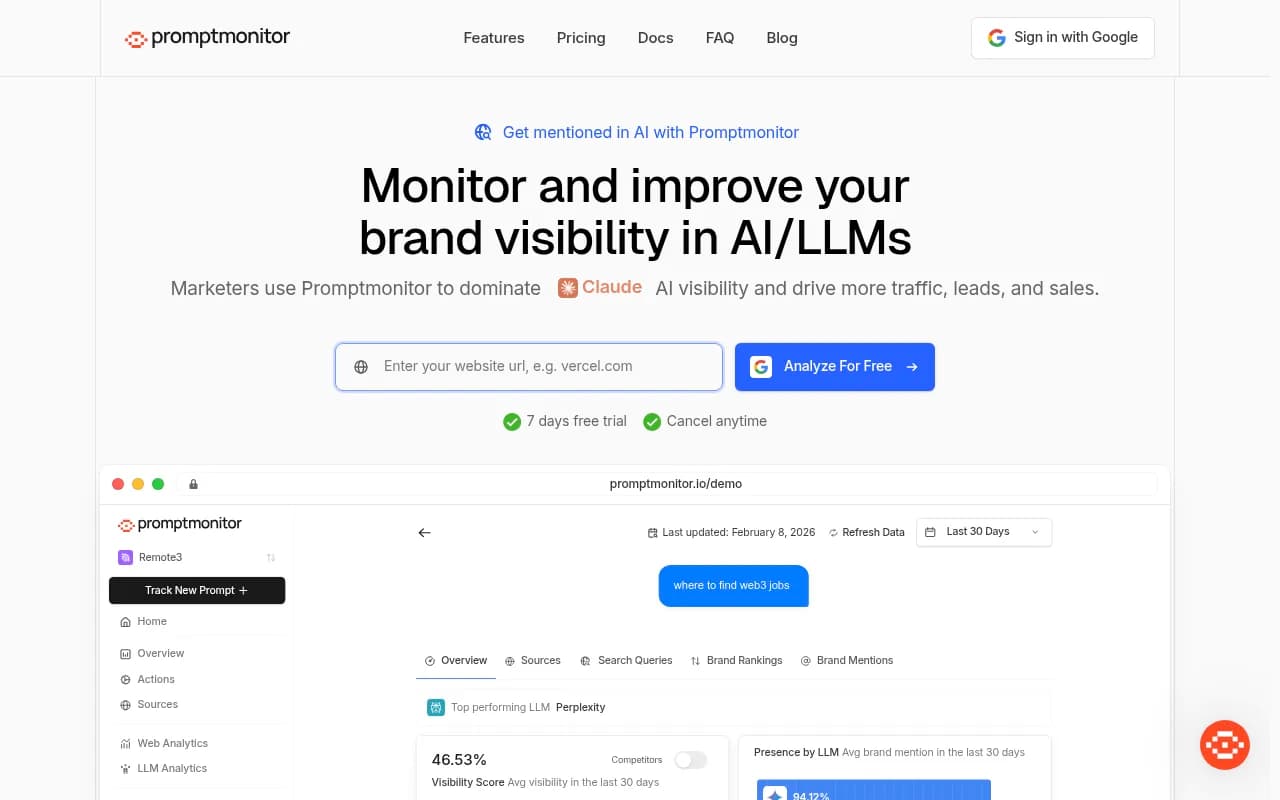
Promptmonitor launched as a budget-friendly AI visibility tracker targeting small businesses and startups who want to know if ChatGPT, Claude, Gemini, and other AI models mention their brand. The pitch is simple: enter your website, track specific prompts (questions people ask AI), and see a daily-updated dashboard showing whether you get mentioned and which sources AI cites. It monitors 8 AI models -- ChatGPT, Claude, Gemini, DeepSeek, Grok, Perplexity, Google AI Overview, and Google AI Mode -- and provides basic analytics like visibility scores, competitor comparisons, and source lists.
The problem: Promptmonitor is a monitoring-only tool that shows you the problem but gives you almost nothing to solve it. It's missing the features that actually help you improve AI visibility -- no crawler logs to see if AI bots are even reading your site, no content gap analysis to identify what's missing from your pages, no prompt volume or difficulty data to prioritize efforts, and no content generation to help you create citation-worthy material. You're left staring at a dashboard that says "you're not visible" with no clear path forward. For teams serious about AI search optimization (GEO/AEO), this is a non-starter.
What Promptmonitor Actually Does
Promptmonitor's core workflow is straightforward: you define prompts (e.g. "best project management tools for agencies"), and the platform queries AI models daily to see if your brand appears in responses. The main dashboard shows a Visibility Score (0-100%) calculated from presence rate (80% weight) and cross-model consistency (20% weight). If ChatGPT mentions you 50% of the time and Claude mentions you 30% of the time, your score reflects that average weighted by how many models cite you.
Source Tracking: For each prompt, Promptmonitor lists the URLs AI models cited when generating responses. You see the domain, how many times it was used, which AI models referenced it, and whether it mentions your brand. The platform extracts author contact info (emails, social profiles) so you can pitch publishers for backlinks or mentions. It also pulls basic SEO metrics -- domain rating, backlink count -- to help you decide whether to outreach or create competing content.
Competitor Analysis: Enter competitor domains and Promptmonitor tracks their visibility scores alongside yours. You see which brands AI mentions most often for your target prompts and can compare performance across models. This is useful for benchmarking but doesn't tell you why competitors rank or what content gaps you need to fill.
Search Query Tracking: When AI models search the web to answer prompts, Promptmonitor captures the exact queries they use (e.g. "web3 job boards", "blockchain developer jobs"). You see a list of queries, usage counts, and which models ran them. The idea is to reverse-engineer what AI is looking for so you can create content targeting those keywords. However, there's no volume data (how often users actually ask these prompts), no difficulty scoring, and no fan-out analysis showing how prompts branch into sub-queries -- all features you'd find in more advanced platforms.
Geographic Targeting: You can set prompts to run from specific countries, states, or cities (200+ regions supported). This matters because AI gives different answers in different locations -- a "best pizza in NYC" prompt will cite different sources than "best pizza in London." Useful for local businesses or brands with regional strategies.
Web Analytics & AI Bot Tracking: Promptmonitor includes GDPR-compliant, cookie-free web analytics (page views, visitors, traffic sources) and logs of AI bots crawling your site. You see which pages ChatGPT, Claude, Perplexity, and other crawlers visit, how often, and any errors they encounter. This is one of the platform's stronger features -- most competitors (Otterly.AI, Peec.ai, AthenaHQ) don't offer crawler logs at all. However, Promptmonitor's implementation is basic compared to platforms like Promptwatch, which provide deeper indexing diagnostics and actionable recommendations.
What's Missing (And Why It Matters)
Here's where Promptmonitor falls apart for serious AI visibility work:
No Content Gap Analysis: The platform doesn't tell you what content you're missing. You see that competitors rank for certain prompts, but you don't get a breakdown of topics, angles, or questions your site fails to address. Promptwatch, by contrast, runs Answer Gap Analysis that shows exactly which prompts competitors are visible for but you're not, then highlights the specific content elements (FAQs, comparisons, use cases) your pages lack. Without this, you're guessing at what to create.
No Prompt Intelligence: Promptmonitor shows you search queries AI models use, but it doesn't estimate volume (how many people ask each prompt) or difficulty (how hard it is to rank). You have no way to prioritize high-value, winnable prompts vs. low-traffic or ultra-competitive ones. Platforms like Promptwatch provide volume estimates, difficulty scores, and query fan-outs (how one prompt branches into sub-queries) so you can focus efforts strategically.
No Content Generation: Once you identify gaps, you're on your own to create content. Promptmonitor doesn't include an AI writing agent or content optimizer. Promptwatch, by comparison, has a built-in AI writer that generates articles, listicles, and comparisons grounded in real citation data (880M+ citations analyzed), persona targeting, and competitor analysis. This is the difference between a monitoring tool and an optimization platform.
No Reddit or YouTube Tracking: AI models increasingly cite Reddit threads and YouTube videos when answering prompts, especially for product recommendations and how-to queries. Promptmonitor doesn't surface these discussions or help you identify which Reddit posts or YouTube channels influence AI responses. Promptwatch tracks both and shows you exactly which threads/videos AI cites, so you can participate in discussions or create competing video content.
No ChatGPT Shopping Tracking: ChatGPT now includes product recommendations and shopping carousels in some responses. Promptmonitor doesn't monitor these, so you miss a critical e-commerce visibility channel. Promptwatch tracks ChatGPT Shopping explicitly.
Limited Crawler Diagnostics: While Promptmonitor logs AI bot visits, it doesn't provide deep indexing diagnostics or recommendations. You see that Perplexity visited your site, but you don't get actionable insights like "your robots.txt is blocking Claude" or "ChatGPT is hitting 404 errors on these pages." Promptwatch's crawler logs include error analysis and optimization suggestions.
No Traffic Attribution: Promptmonitor's web analytics show overall traffic but don't connect AI visibility to actual revenue. You can't see which AI-cited pages drove conversions or how much traffic came from AI referrals. Promptwatch offers traffic attribution via code snippet, Google Search Console integration, or server log analysis, closing the loop between visibility and business outcomes.
Who Is Promptmonitor For?
Promptmonitor works for a narrow audience: small businesses or solopreneurs on a tight budget who want basic brand mention monitoring and nothing more. If you're a local service business (plumber, lawyer, consultant) and you just want to know if ChatGPT mentions you when people ask for recommendations in your city, Promptmonitor's $29/mo Starter plan is cheap and gets the job done. You track 25 prompts, see daily updates, and get a simple visibility score. That's it.
It's also viable for early-stage startups doing initial AI visibility research -- you want to see if you're on AI's radar at all before investing in a full GEO strategy. The 7-day free trial lets you test a handful of prompts and see where you stand.
Who should NOT use Promptmonitor:
- Marketing teams or SEO professionals who need to actually improve AI visibility, not just track it. You'll hit the feature ceiling immediately and waste time on a tool that can't help you optimize.
- Agencies managing multiple clients. Promptmonitor's "Agency Plan" is vague ("contact us for pricing") and the platform lacks white-label reporting, client dashboards, or bulk management features. Competitors like Promptwatch offer structured agency plans with per-client tracking, custom reporting, and revenue sharing.
- E-commerce brands or SaaS companies where AI visibility directly impacts revenue. You need traffic attribution, ChatGPT Shopping tracking, and content optimization tools -- none of which Promptmonitor provides.
- Content teams or publishers who want to create AI-optimized content. Without content gap analysis, prompt intelligence, or a writing agent, you're flying blind.
Integrations & Ecosystem
Promptmonitor is a standalone tool with minimal integrations. You can export data to CSV and that's about it. No API, no Zapier, no Google Search Console sync, no Looker Studio connector. If you want to build custom workflows or pull data into other tools, you're out of luck. Promptwatch, by contrast, offers a full API and Looker Studio integration for custom reporting.
The platform includes a basic web analytics script you can add to your site (GDPR-compliant, no cookies), but it's not a replacement for Google Analytics or Plausible -- just a lightweight visitor counter.
Pricing & Value
Promptmonitor offers three paid tiers:
- Starter ($29/mo, discounted from $49): 1 project, 25 prompts, 2,250 responses/month, daily refresh, 8 AI models, web analytics, AI bot tracking, 1 team seat, CSV export.
- Growth ($39/mo, discounted from $66): 2 projects, 50 prompts, 4,500 responses/month, unlimited team seats. Everything else same as Starter.
- Pro ($129/mo, discounted from $219): 5 projects, 150 prompts, 14,000 responses/month, unlimited seats. Adds Google AI Mode and AI Overview tracking.
- Agency Plan: "Contact us" pricing. Unlimited projects and seats, priority support, revenue sharing (details unclear).
All plans include a 7-day free trial. Annual billing discounts are available but not specified.
Value assessment: Promptmonitor is cheap, but you get what you pay for. At $29/mo, Starter is affordable for basic monitoring, but you'll outgrow it fast if you're serious about AI visibility. Growth at $39/mo is the most popular tier ("79% pick this") but still lacks the features that matter. Pro at $129/mo is expensive for what you get -- Promptwatch's Professional plan ($249/mo) costs more but includes crawler logs, content gap analysis, prompt intelligence, and 15 AI-generated articles/month. You're paying double for 10x the functionality.
For agencies, the vague "contact us" pricing and lack of structured plans is a red flag. Competitors like Promptwatch offer transparent agency pricing with per-client tracking and white-label reporting.
Strengths
- Affordable entry point: $29/mo Starter plan is one of the cheapest AI visibility trackers available. Good for testing the waters.
- AI bot tracking included: Crawler logs are a nice-to-have feature that many competitors skip entirely. Promptmonitor logs bot visits and shows which pages AI models read.
- Geographic targeting: 200+ countries/regions supported, useful for local businesses or multi-market brands.
- Simple interface: The dashboard is clean and easy to navigate. No learning curve.
- Contact extraction: Automatically pulls author emails and social profiles from cited sources, saving manual research time.
Limitations (Be Honest)
- Monitoring-only tool: Shows you the problem but gives you nothing to solve it. No content gap analysis, no prompt intelligence, no content generation.
- No prompt volume or difficulty data: You can't prioritize which prompts to target or estimate traffic potential. You're working blind.
- Missing Reddit and YouTube tracking: AI increasingly cites these platforms, but Promptmonitor ignores them entirely.
- No ChatGPT Shopping tracking: E-commerce brands miss a critical visibility channel.
- Weak crawler diagnostics: Logs bot visits but doesn't provide actionable indexing recommendations or error analysis.
- No traffic attribution: Can't connect AI visibility to actual revenue or conversions.
- Limited integrations: No API, no Zapier, no GSC sync, no Looker Studio. CSV export only.
- Vague agency offering: "Contact us" pricing with no clear feature set or client management tools.
- No content optimization tools: You're on your own to create AI-friendly content.
Bottom Line
Promptmonitor is a budget-friendly AI visibility tracker that does one thing adequately: it shows you if ChatGPT, Claude, Gemini, and other LLMs mention your brand. If you're a small business owner who just wants basic brand monitoring and you're not ready to invest in serious AI search optimization, the $29/mo Starter plan is a low-risk way to get started. You'll see your visibility score, track a handful of prompts, and get a sense of where you stand.
But if you're a marketing team, agency, or any business serious about improving AI visibility, Promptmonitor is a dead end. It's a monitoring-only tool that leaves you stuck after showing you the data. You don't get content gap analysis to identify what's missing, prompt intelligence to prioritize efforts, or content generation to actually create citation-worthy material. You're paying for a dashboard that says "you're not visible" with no path forward. Competitors like Promptwatch offer the full optimization loop -- find gaps, generate content, track results -- for a higher price but exponentially more value. Promptmonitor is fine for dipping your toes in AI visibility tracking, but you'll outgrow it fast if you're serious about ranking in AI search.
Similar and alternative tools to Promptmonitor