Rankability Review 2026
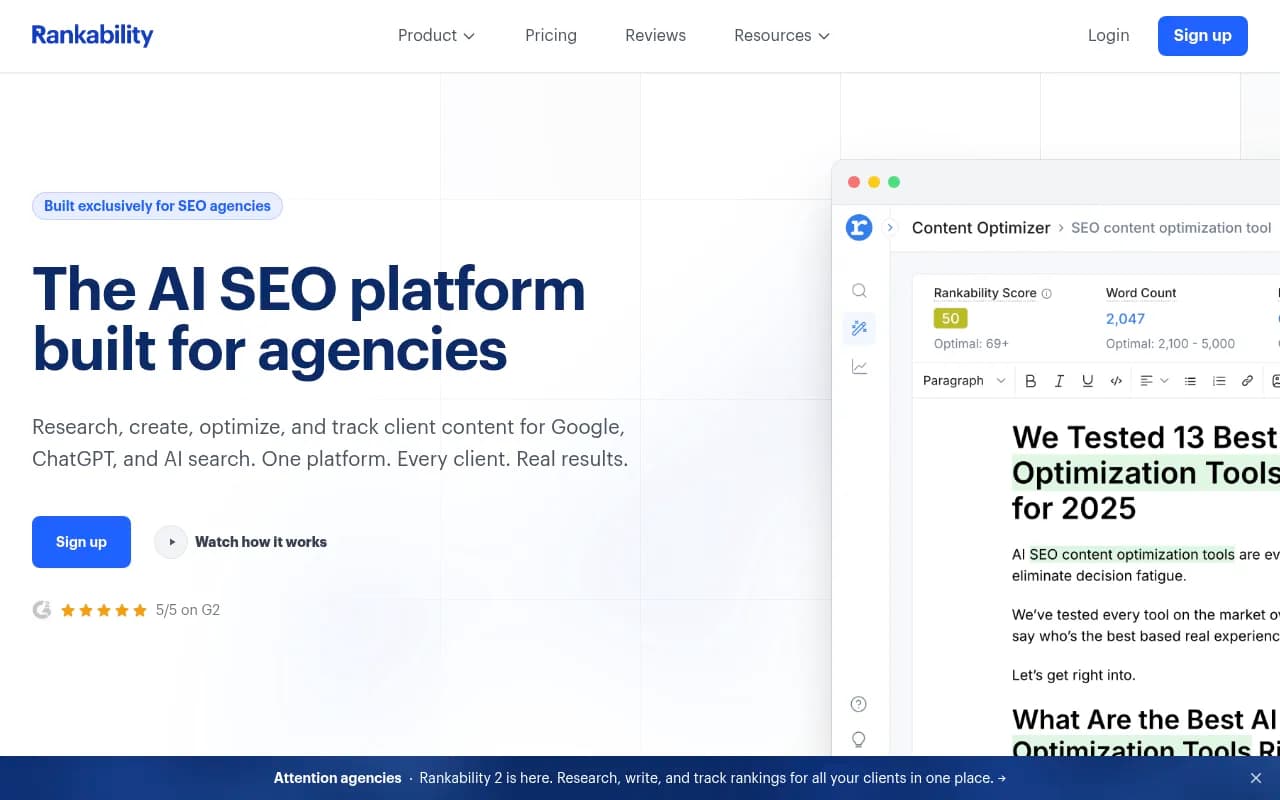
Rankability is an AI-powered SEO platform designed for agencies to research, create, optimize, and track client content across Google and AI search engines like ChatGPT. It combines keyword research, NLP optimization, content briefs, and AI answer tracking in one dashboard. Used by 500+ agencies, it offers multi-client management with team collaboration features. Pricing starts at $149/month.
Key Takeaways:
• Limited AI search capabilities: Rankability positions itself as an AI search platform but lacks critical features like AI crawler logs, content gap analysis, prompt volume data, and citation tracking that competitors like Promptwatch offer • Agency workflow focus: Strong multi-client dashboard and team collaboration features make it suitable for agencies managing multiple clients, but individual consultants may find better value elsewhere • Basic optimization toolkit: Provides NLP scoring, entity analysis, and content briefs, but the optimization engine is less sophisticated than specialized platforms • Pricing concerns: At $149-$449/month, it's expensive for what you get compared to platforms with deeper AI search intelligence and actionable insights • Best for: Small-to-mid-sized SEO agencies that need basic AI answer tracking alongside traditional Google optimization, not agencies serious about dominating AI search
Rankability is an SEO platform built specifically for agencies that want to manage client content optimization and track visibility across Google and AI search engines. Launched as "Rankability 2" in its current form, it's used by over 500 agencies worldwide and positions itself as an all-in-one solution for research, content creation, optimization, and tracking. The platform is developed by a team focused on agency workflows, with clients including recognizable brands like Johnson & Johnson and Honeywell.
The core promise is simple: manage every client from a single dashboard, optimize content for both traditional search and AI answers, and track results across multiple search environments. However, Rankability falls short of being a true AI search optimization platform -- it's more accurately described as a traditional SEO tool with basic AI answer monitoring bolted on. If you're serious about AI search visibility, you'll quickly hit its limitations.
Research & Keyword Intelligence
Rankability's research module helps you discover what customers are searching for in Google and "AI chat platforms" (their term for ChatGPT, Claude, Perplexity, etc.). You can identify content opportunities and see search intent patterns. The interface shows keyword volumes, difficulty scores, and related queries.
What's missing: Real prompt intelligence. Unlike platforms like Promptwatch that analyze actual prompt volumes, difficulty scoring for AI-specific queries, and query fan-outs (how one prompt branches into sub-queries), Rankability appears to rely on traditional keyword data. There's no indication they're tracking how people actually prompt AI models versus how they Google. This is a critical gap -- AI search behavior is fundamentally different from traditional search, and optimizing for one doesn't automatically win you the other.
The research tool is adequate for basic keyword planning but won't tell you which prompts are high-value targets in ChatGPT or Claude, which queries have low competition in AI search, or how to prioritize your content roadmap for AI visibility.
Content Creation & Briefs
The content creation module generates outlines and briefs based on competitor analysis and keyword research. You get suggested headings, questions to answer, and keyword targets. The system analyzes top-ranking pages and extracts common themes, which it packages into a content brief your writers can follow.
This is standard SEO content planning -- nothing groundbreaking. The briefs are Google-focused, meaning they're optimized for what ranks in traditional search results. There's no evidence that Rankability analyzes what AI models actually cite or what content structure gets you into ChatGPT responses versus just Google page one.
Compare this to platforms with AI-native content generation (like Promptwatch's AI writing agent, which creates content grounded in 880M+ citation data and engineered specifically to get cited by AI models), and you see the difference. Rankability gives you a traditional SEO brief. It doesn't tell you what's missing from your site that AI models want to cite, or how to structure content so Claude or Perplexity will reference it.
Optimization & NLP Scoring
This is where Rankability has its strongest feature set. The optimization module uses NLP (Natural Language Processing) and entity analysis to score your content and suggest improvements. You paste in existing content or draft new content in their editor, and it grades you on a scale (testimonials mention scores like "9" improving to "30" after optimization).
The system identifies: • NLP keywords: Terms and phrases that top-ranking pages use frequently • Entity coverage: Whether you're mentioning relevant people, places, brands, and concepts • Content depth: How thoroughly you cover the topic compared to competitors • Readability and structure: Heading hierarchy, paragraph length, etc.
You get real-time suggestions as you write, with specific keywords and entities to add. Several users report ranking improvements within days of optimizing content using these suggestions, which suggests the NLP analysis is reasonably effective for Google.
Limitations: The optimization is still Google-centric. There's no indication Rankability understands what makes content cite-worthy for AI models specifically. AI engines don't just look at keyword density and entity coverage -- they evaluate content freshness, source authority, structural clarity, and how well you answer specific questions. Rankability's optimization engine doesn't appear to account for these AI-specific ranking factors.
Also missing: AI crawler log analysis. Platforms like Promptwatch show you real-time logs of AI crawlers (ChatGPT, Claude, Perplexity bots) hitting your website -- which pages they read, errors they encounter, crawl frequency. This is critical for understanding whether AI models can even discover your content. Rankability has no equivalent feature, meaning you're optimizing blind without knowing if AI engines are actually indexing your pages.
Tracking & Visibility Monitoring
Rankability's tracking module (marked as "New" on their site) monitors rankings and "AI answer presence" across clients. You can see where client pages rank in Google and whether they appear in AI-generated answers.
This is the platform's weakest area. The tracking appears to be basic presence/absence monitoring -- you can see if a client shows up in an AI answer, but you don't get: • Citation-level detail: Which specific sentences or facts the AI model pulled from your page • Competitor citation analysis: Who else is being cited and why • Prompt-level tracking: How visibility changes across different prompt variations • Multi-model comparison: Detailed breakdowns of how you perform in ChatGPT vs Claude vs Perplexity vs Gemini • Page-level attribution: Which specific pages are driving AI visibility and traffic
Platforms like Promptwatch track all of this, plus they integrate with Google Search Console and offer traffic attribution (via code snippet or server logs) so you can connect AI visibility to actual revenue. Rankability's tracking is more like a basic dashboard that says "yes, you appeared" or "no, you didn't" -- not actionable intelligence you can use to improve.
The Content Gap Problem
Here's the biggest missing piece: Rankability has no Answer Gap Analysis or content gap identification for AI search. This is the core of modern AI search optimization.
Answer Gap Analysis shows you exactly which prompts your competitors are visible for but you're not. It identifies the specific content your website is missing -- the topics, angles, and questions AI models want answers to but can't find on your site. This is how you go from monitoring ("we're not showing up") to action ("here's what we need to create").
Without this, Rankability leaves you stuck. You can see you're not visible in AI search, but you don't know why or what to do about it. You're forced to guess at content strategy instead of following data-driven insights.
Competitors like Promptwatch have built their entire platform around this action loop: find the gaps, generate content to fill them, track the results. Rankability stops at step one.
Integrations & Ecosystem
Rankability doesn't publicize extensive integrations. There's no mention of API access, Google Search Console integration, or connections to popular marketing tools. The platform appears to be a standalone system.
You can export content and briefs, but there's no indication of Looker Studio connectors, Zapier integration, or webhook support for custom workflows. For agencies with existing tech stacks, this means Rankability is an island -- you'll be manually moving data in and out.
Who Is Rankability For?
Rankability is built for SEO agencies managing 5-20 clients who want a single dashboard for content optimization and basic AI answer tracking. It's particularly suited to:
• Small-to-mid-sized agencies (3-10 person teams) that need multi-client management and team collaboration • Agencies focused primarily on Google SEO that want to add basic AI search monitoring without changing their entire workflow • Content teams that need NLP-guided optimization and don't have deep technical SEO expertise • Agencies with traditional clients (local businesses, small ecommerce, professional services) where AI search visibility is a nice-to-have, not a primary KPI
Rankability is NOT ideal for:
• Agencies serious about AI search dominance: If AI visibility is a core service offering, you need a platform with crawler logs, citation analysis, prompt intelligence, and content gap identification • Solo consultants or freelancers: At $149/month minimum, you're paying for agency-scale features you may not need • Enterprise brands: Large companies with complex SEO needs will find Rankability's feature set too basic • Data-driven agencies: If you need API access, custom reporting, or deep integrations, look elsewhere
Pricing & Value
Rankability offers three tiers:
• SEO Specialist: $149/month
• SEO Expert: $249/month
• SEO Master: $449/month
Specific feature breakdowns for each tier aren't publicly detailed on the pricing page, which is a red flag. You have to sign up to see what you get at each level.
A free trial is available, and you keep your projects if you convert to paid. No annual discount is mentioned.
Value assessment: At $149-$449/month, Rankability is expensive for what it delivers. You're paying agency-tier pricing for a tool that's really a traditional SEO platform with basic AI monitoring. Compare this to:
• Promptwatch: $99-$579/month with far deeper AI search intelligence, crawler logs, citation tracking, content gap analysis, and AI content generation • Surfer SEO: $89-$219/month for similar NLP optimization without the AI search positioning • Clearscope: $189-$399/month for content optimization with better integrations
Rankability sits in an awkward middle ground -- too expensive to justify as a pure SEO tool, not capable enough to justify as an AI search platform.
Strengths
• Agency-friendly dashboard: Multi-client management and team collaboration are well-executed. You can manage dozens of clients from one interface. • NLP optimization works: Users report real ranking improvements after applying Rankability's keyword and entity suggestions. The optimization engine is solid for Google. • Intuitive interface: Multiple testimonials praise the ease of use. Writers and non-technical team members can jump in without extensive training. • Content brief generation: Saves time on research and outlining, especially for agencies producing high volumes of content.
Limitations
• Shallow AI search capabilities: Despite positioning itself as an AI search platform, Rankability lacks the core features needed for serious AI optimization -- no crawler logs, no citation analysis, no prompt intelligence, no content gap identification. • No actionable AI insights: You can see if you're visible in AI answers, but you don't get the data needed to improve. It's monitoring without optimization. • Limited integrations: No API, no GSC integration, no Looker Studio connector. You're stuck in their ecosystem. • Pricing opacity: Feature breakdowns by tier aren't public, making it hard to evaluate value before signing up. • Google-first optimization: The entire platform is built around traditional SEO best practices. AI search is an afterthought, not a core competency.
Bottom Line
Rankability is a competent traditional SEO platform with basic AI answer monitoring. If you're an agency that primarily focuses on Google rankings and wants to add a simple "we track AI too" checkbox for clients, it's serviceable. The NLP optimization works, the interface is clean, and the multi-client dashboard is well-designed.
But if AI search visibility is a real priority -- if you're trying to get clients cited in ChatGPT, Claude, and Perplexity as a core service offering -- Rankability is not the right tool. It's missing the foundational features needed for AI search optimization: crawler logs to see if AI models can even find your content, citation analysis to understand what's working, prompt intelligence to prioritize high-value queries, and content gap analysis to identify what you need to create.
Rankability is a traditional SEO tool wearing an "AI search" label. For agencies serious about AI visibility, platforms like Promptwatch offer the depth of intelligence and actionable insights Rankability lacks. Best use case: Small agencies managing traditional SEO clients who want basic AI answer tracking without investing in a true AI search optimization platform.
Tags:
Similar and alternative tools to Rankability