Bluefish AI Review 2026
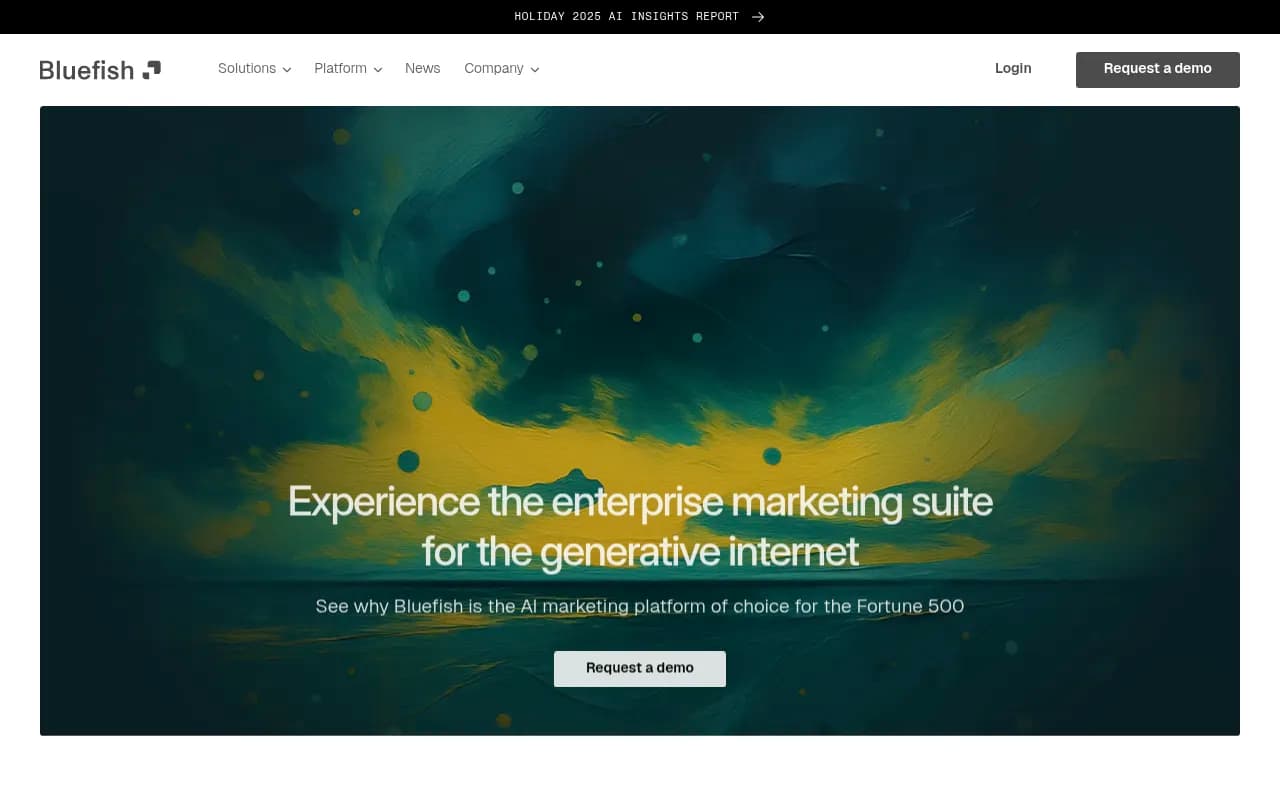
Bluefish AI is an enterprise-focused AI marketing platform that helps Fortune 500 brands monitor and optimize their presence across AI search engines and agentic commerce channels. Built for large marketing teams, it offers custom audiences, tailored prompts, and deep performance analytics -- though it lacks content generation, crawler logs, and several optimization features found in more comprehensive GEO platforms.
Key Takeaways:
• Enterprise positioning with limited optimization depth: Bluefish markets itself as the "AI marketing platform of choice for the Fortune 500" with strong enterprise features like custom audiences and infosec compliance, but lacks critical optimization capabilities that competitors like Promptwatch offer -- no AI content generation, no crawler log analysis, no Answer Gap Analysis, no Reddit/YouTube tracking, and no ChatGPT Shopping monitoring
• Monitoring-first approach: The platform excels at tracking brand mentions and measuring "authority and influence" across AI channels, but stops short of helping you actually fix visibility gaps or create content that ranks in AI search results
• Custom pricing only: No transparent pricing tiers or self-service options -- all plans are quote-based and require sales conversations, making it inaccessible for smaller teams or those wanting to test before committing
• Best for: Large enterprise marketing teams (Fortune 500 scale) with dedicated budgets who need custom reporting frameworks and can handle optimization work in-house. Not suitable for agencies, SMBs, or teams that need actionable content recommendations.
• Missing the action loop: Unlike platforms built around find-gaps-create-content-track-results workflows, Bluefish focuses on measurement and reporting without providing tools to actually improve your AI visibility through content optimization
Bluefish AI positions itself as the enterprise-grade solution for AI marketing, targeting Fortune 500 brands that need visibility and control over how their brand appears in AI-generated responses. Founded as a monitoring and measurement platform, Bluefish emphasizes depth of analytics and custom reporting frameworks over the optimization and content creation tools that define more comprehensive GEO platforms. The company has gained traction with large enterprise clients and was named a GEO Market Leader by CB Insights in October 2025.
The platform's core value proposition centers on three pillars: understanding how AI "thinks" about your brand, automating measurement workflows, and providing enterprise-scale customization. Bluefish explicitly positions against what it calls "superficial metrics" and "generic datasets," arguing that category leaders need deeper control through custom audiences and tailored prompts. This enterprise-first positioning comes with trade-offs -- the platform lacks self-service options, transparent pricing, and several optimization features that smaller competitors have built into their core workflows.
What Bluefish Actually Does
Bluefish operates as a monitoring and measurement platform across four main areas: AI Monitoring, AI Optimization (GEO), GEO Measurement, and AI Commerce. The platform tracks how brands appear in AI search results and agentic commerce experiences, providing analytics on brand mentions, sentiment, and what Bluefish calls "authority and influence" -- proprietary metrics designed to go beyond simple share-of-voice calculations.
AI Monitoring provides real-time visibility into brand reputation across AI-native experiences. You can track when and how your brand is mentioned in responses from major AI models, monitor competitor mentions, and analyze sentiment trends over time. The platform supports custom audience segmentation, allowing enterprise teams to track different personas or use cases separately -- a feature particularly valuable for brands with diverse product lines or regional variations.
AI Optimization (GEO) is where Bluefish's limitations become apparent. While the platform provides visibility into performance gaps, it doesn't offer the content creation or gap analysis tools that define true optimization platforms. You can see where you're underperforming, but Bluefish won't tell you which specific content pieces you're missing or generate articles to fill those gaps. This is a fundamental difference from platforms like Promptwatch, which combine monitoring with Answer Gap Analysis and AI content generation to actually help you improve visibility.
GEO Measurement focuses on tracking the ROI of digital marketing campaigns in AI channels. Bluefish recently introduced "Collections" (February 2026) -- a feature that lets marketing teams group related content and measure its collective impact on AI visibility. This is useful for understanding whether a content campaign or product launch is moving the needle in AI search results, though it still requires manual analysis to determine what to do next.
AI Commerce tracks brand presence in agentic commerce experiences -- AI-powered shopping assistants and product recommendation engines. This is an emerging area where Bluefish has invested early, though specific capabilities and coverage aren't detailed in their public materials.
What's Missing Compared to Comprehensive GEO Platforms
Bluefish's monitoring-first approach leaves significant gaps in the optimization workflow:
• No AI Content Generation: Bluefish won't create articles, listicles, or comparison pages optimized for AI citation. Platforms like Promptwatch include built-in AI writing agents that generate content grounded in citation data and prompt analysis. With Bluefish, you identify gaps but must create content manually.
• No Answer Gap Analysis: You can't see which specific prompts competitors rank for that you don't, or what content angles are missing from your site. This is a core feature in Promptwatch and other optimization-focused platforms -- it shows exactly what to write about.
• No Crawler Log Analysis: Bluefish doesn't provide visibility into which AI crawlers (ChatGPT, Claude, Perplexity bots) are actually visiting your website, which pages they're reading, or errors they encounter. This makes it impossible to diagnose indexing issues or understand how AI models discover your content.
• No Reddit or YouTube Tracking: The platform doesn't surface Reddit discussions or YouTube videos that influence AI recommendations -- channels that increasingly drive AI model responses, especially for product recommendations and reviews.
• No ChatGPT Shopping Monitoring: While Bluefish mentions "AI Commerce," it doesn't specifically track ChatGPT's shopping carousels and product recommendations -- a feature Promptwatch added in 2025 as ChatGPT became a shopping destination.
• No Prompt Intelligence: Bluefish doesn't provide volume estimates, difficulty scores, or query fan-outs for individual prompts. You can't prioritize which prompts to target based on search volume or competitive difficulty.
• No Page-Level Citation Tracking: You can't drill down to see exactly which pages on your site are being cited by AI models, making it difficult to understand what content is actually working.
These gaps mean Bluefish functions as a reporting dashboard rather than an optimization platform. You get visibility into performance but limited guidance on how to improve it.
Enterprise Features and Customization
Where Bluefish does excel is enterprise-grade features and customization. The platform is built to pass infosec reviews, supports complex organizational structures, and offers deep customization of measurement frameworks. Marketing teams can define custom audiences that match their specific buyer personas, create tailored prompt sets that reflect how their customers actually search, and build reporting dashboards that align with internal KPIs.
This level of customization is valuable for Fortune 500 brands with dedicated data teams and complex reporting requirements. If your organization needs to segment AI visibility by product line, region, and customer segment -- then roll those metrics into executive dashboards -- Bluefish's architecture supports that. Smaller platforms often struggle with this level of organizational complexity.
The platform also emphasizes "understanding how AI thinks" -- providing insights into why AI models recommend certain brands over others, which sources they cite, and how sentiment varies across different AI channels. This is more sophisticated than simple mention counting, though it's unclear how actionable these insights are without the optimization tools to act on them.
Integrations and Data Access
Bluefish provides API access for enterprise clients, allowing data teams to pull AI visibility metrics into existing business intelligence systems. The platform integrates with standard marketing tech stacks, though specific integration partners aren't publicly listed. For enterprise buyers, the focus is on custom data pipelines rather than pre-built connectors to tools like Slack or Zapier.
The platform doesn't offer browser extensions or mobile apps -- it's a web-based dashboard designed for marketing teams working at desks, not field teams or individual contributors checking metrics on the go.
Who Bluefish Is Actually For
Bluefish is explicitly built for Fortune 500 marketing teams with six-figure budgets and dedicated resources for AI channel optimization. The ideal customer is a VP of Marketing or Director of Digital Marketing at a large enterprise brand who needs to report AI visibility metrics to the C-suite and has separate teams handling content creation and SEO execution.
Specific personas who fit Bluefish's model:
• Enterprise brand marketers at companies like consumer goods manufacturers, financial services firms, or healthcare brands who need to monitor brand reputation across AI channels and report metrics to executives
• Large marketing teams (10+ people) with dedicated analysts who can interpret Bluefish's data and translate it into content briefs for separate content teams
• Companies with complex organizational structures that need to segment AI visibility by product line, region, or business unit
• Brands in highly competitive categories where generic prompt sets and standard audiences aren't sufficient -- you need custom tracking that matches your specific market position
Who Should NOT Use Bluefish:
• Agencies managing multiple clients: The enterprise pricing model and lack of multi-tenant features make Bluefish impractical for agencies. Platforms like Promptwatch offer agency plans with client management features.
• SMBs and startups: If you don't have a six-figure marketing budget and dedicated data analysts, Bluefish's custom pricing and complexity will be overkill. You need a platform with transparent pricing and built-in optimization tools.
• Teams that need to create content: If you're a lean marketing team that needs to both identify gaps and create content to fill them, Bluefish only solves half the problem. You'll need separate tools for content creation and optimization.
• Companies wanting to test before committing: The quote-based pricing model and sales-driven process mean you can't try Bluefish without significant time investment in demos and negotiations.
Pricing and Value
Bluefish operates on a fully custom, quote-based pricing model. There are no published pricing tiers, no self-service signup, and no free trials. All prospects must go through a sales process to get pricing, which is tailored based on company size, number of brands tracked, prompt volume, and customization requirements.
Third-party sources suggest Bluefish pricing starts around $4,000/month for enterprise plans, though this is unverified and likely varies significantly based on scope. For context, comprehensive GEO platforms like Promptwatch offer transparent pricing starting at $99/month for small businesses, scaling to $579/month for teams tracking multiple sites with full optimization features.
The value equation for Bluefish depends entirely on your organization's scale and needs. If you're a Fortune 500 brand with a $500K+ annual marketing budget and you need custom reporting frameworks that integrate with existing BI systems, Bluefish's enterprise features may justify the premium. If you're a smaller company or agency that needs transparent pricing and built-in optimization tools, you'll get better value from platforms designed for your segment.
Competitive Positioning
Bluefish competes in the GEO/AI visibility space but occupies a distinct niche focused on enterprise measurement rather than optimization. In CB Insights' October 2025 GEO market analysis, Bluefish was named a market leader alongside platforms like Promptwatch, though the criteria for "leadership" vary significantly.
Compared to Promptwatch (the only platform rated as a "Leader" across all categories in a 2026 comparison of 12 GEO platforms), Bluefish lacks the action-oriented workflow that defines comprehensive optimization platforms. Promptwatch combines monitoring with Answer Gap Analysis, AI content generation, crawler log analysis, and page-level tracking -- creating a complete loop from identifying gaps to creating content to measuring results. Bluefish stops at measurement.
Compared to other monitoring-focused platforms like Otterly.AI or Peec.ai, Bluefish offers more enterprise features and customization but at a significantly higher price point. These smaller platforms also lack optimization tools but provide transparent pricing and faster implementation.
Compared to traditional SEO platforms like Semrush or Ahrefs (which have added basic AI monitoring features), Bluefish offers deeper AI-specific analytics but lacks the comprehensive SEO toolsets that make those platforms valuable for organic search optimization.
Recent Developments and Market Validation
Bluefish has been active in establishing thought leadership in the AI marketing space. In February 2026, the company published research proving that Super Bowl ads influence AI recommendations -- demonstrating that traditional advertising impacts AI model responses. This type of market research helps position Bluefish as an authority in the space, even if the platform itself doesn't provide tools to optimize for those insights.
The CB Insights recognition in October 2025 provides third-party validation of Bluefish's market position, though it's worth noting that "market leader" designations often reflect company size and enterprise traction rather than feature completeness or customer value.
Bluefish's introduction of Collections in February 2026 shows the platform is evolving toward more actionable measurement, allowing teams to group related content and track collective impact. This is a step toward closing the gap between monitoring and optimization, though it still requires manual interpretation and action.
Strengths
• Enterprise-grade infrastructure: Built to pass infosec reviews, support complex organizational structures, and integrate with existing BI systems
• Custom audience and prompt frameworks: Deep customization that allows Fortune 500 brands to track AI visibility in ways that match their specific market position and customer segments
• Authority and influence metrics: Goes beyond simple mention counting to measure how AI models actually think about and recommend brands
• Early mover in AI commerce: Tracking brand presence in agentic commerce experiences positions Bluefish for an emerging channel
• Thought leadership and research: Active in publishing market insights that help enterprise buyers understand the AI marketing landscape
Limitations
• No content creation or optimization tools: You can see where you're underperforming but Bluefish won't help you create content to fix it -- a fundamental gap compared to platforms built around optimization workflows
• Opaque pricing and sales-driven process: No transparent pricing, no self-service options, no way to test the platform without significant time investment in sales conversations
• Missing critical optimization features: No crawler logs, no Answer Gap Analysis, no Reddit/YouTube tracking, no ChatGPT Shopping monitoring, no prompt intelligence, no page-level citation tracking
• Not suitable for agencies or SMBs: The enterprise pricing model and feature set make Bluefish impractical for smaller teams or agencies managing multiple clients
• Monitoring-first philosophy: The platform is built around measurement and reporting rather than taking action -- you need separate tools and teams to actually improve your AI visibility
Bottom Line
Bluefish AI is a specialized enterprise measurement platform for Fortune 500 marketing teams that need custom reporting frameworks and deep analytics on AI channel performance. If you're a large brand with a six-figure budget, dedicated data analysts, and separate content teams -- and you primarily need to report AI visibility metrics to executives -- Bluefish's enterprise features and customization may justify the premium pricing.
For everyone else -- agencies, SMBs, lean marketing teams, or anyone who needs to both identify gaps and create content to fix them -- platforms like Promptwatch offer better value with transparent pricing, built-in optimization tools, and complete workflows from gap analysis to content generation to results tracking. Bluefish's monitoring-first approach leaves you stuck at the "what's wrong" stage without providing tools to actually improve your AI visibility.
Best use case in one sentence: Fortune 500 brand marketing teams that need enterprise-grade AI visibility reporting and have separate resources for content creation and optimization.
Tags:
Similar and alternative tools to Bluefish AI