Content at Scale Review 2026
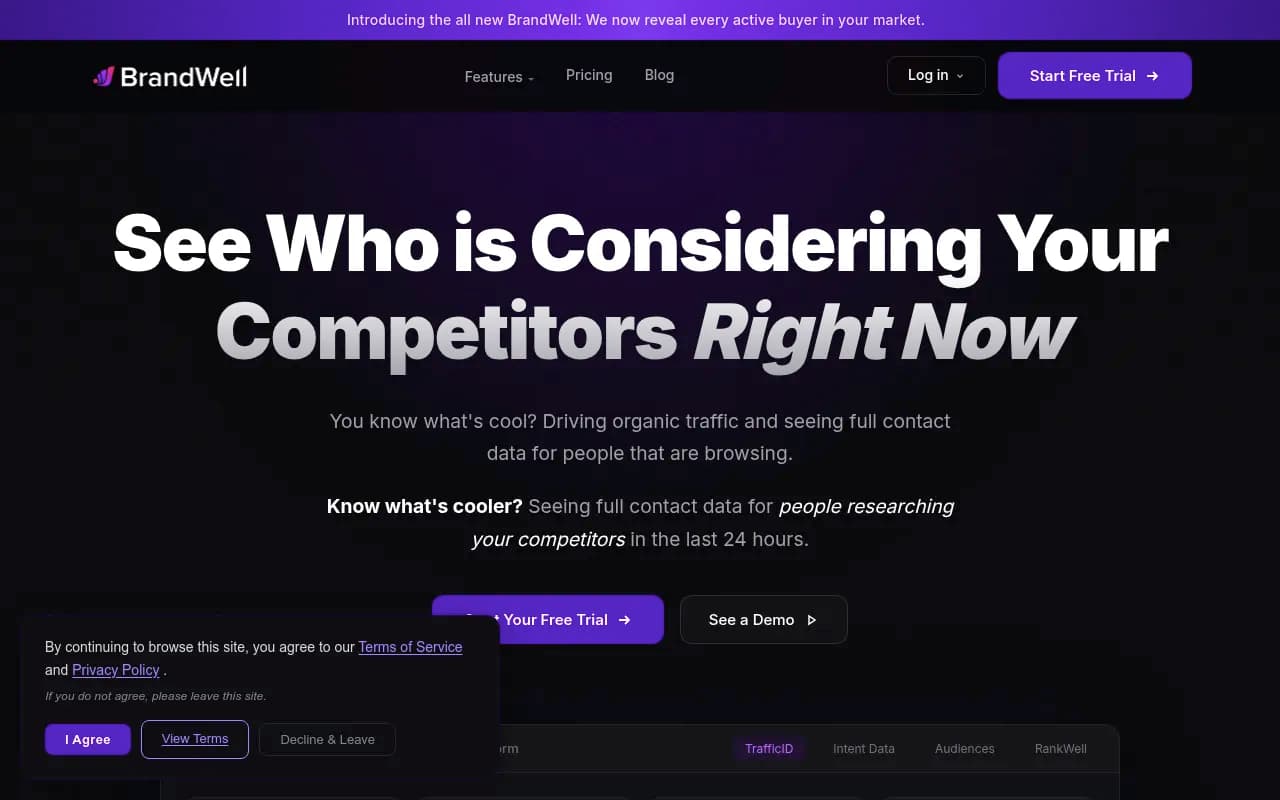
BrandWell (formerly Content at Scale) is an intent-led go-to-market platform that identifies anonymous website visitors, tracks competitor site traffic, and maps buying committees with full contact data. Combines visitor identification, intent data from 5B+ daily visits, AI content creation (RankWel
Key Takeaways:
• BrandWell reveals anonymous visitors on your site AND your competitors' sites with full contact data (name, email, title, company) — no form fills required • Intent data from 5B+ daily visits across 35,000+ topics identifies professionals actively researching solutions in your space, updated daily with fresh profiles • Stakeholder mapping connects visitor signals to full buying committees (VP, CFO, CMO) and syncs audiences directly to Meta, Google, and LinkedIn Ads for targeted campaigns • RankWell AI content engine writes SEO-optimized articles calibrated to your brand voice with 12-factor scoring, programmatic SEO for thousands of pages, and Weekly 5 ranking opportunities • AIMEE AI agent with 20+ skills manages content creation, competitive analysis, ad creative generation, and research — not just a chatbot but a full marketing execution engine • Pricing starts at $250/month with a 7-day free trial; higher tiers for volume content production and enterprise ABM features
BrandWell (formerly known as Content at Scale) has evolved from an AI content creation tool into a full intent-led ABM platform that solves one of B2B marketing's biggest problems: knowing who's in-market before they raise their hand. The platform now combines three core capabilities — visitor identification (TrafficID), intent data aggregation, and AI content creation (RankWell) — into a unified go-to-market engine used by over 10,000 brands and content publishers.
The company's pivot reflects a fundamental shift in B2B buying behavior: 95% of your market is not ready to buy right now, and when they are ready, they've already done most of their research anonymously. BrandWell's answer is to identify those anonymous researchers early — whether they're on your site, your competitors' sites, or reading industry reviews — then surround the decision-makers with targeted content and ads before they ever fill out a form.
TrafficID — Visitor Identification Across Your Site and Competitors' Sites
TrafficID is BrandWell's visitor identification engine. Unlike basic IP lookup tools that only show company names, TrafficID delivers full contact data for individual visitors: names, email addresses, job titles, company info, LinkedIn profiles. This works for people who click your ads, land on your organic search results, come from social media, or browse your site directly — no form fill required.
What sets BrandWell apart from competitors like Clearbit Reveal, 6sense, or Demandbase is the competitor tracking layer. Through data partnerships tracking over 5 billion visits per day, BrandWell identifies people actively browsing your competitors' websites and delivers their full profiles. You see who visited which competitor, which pages they viewed, how many times they returned, and their full contact details. This is not aggregated company-level data — it's individual visitor tracking with personal identifiers.
The platform also tracks industry researchers: professionals evaluating solutions in your space by reading review sites, comparing tools, researching vendors, or consuming educational content across 35,000+ intent topics. These topics span categories like CRM, cybersecurity, marketing automation, sales enablement, HR tech, fintech, and more. Each topic shows average daily profile counts so you can gauge market size before committing budget.
TrafficID updates daily with fresh profiles, meaning you're not working off stale data from weeks or months ago. The system captures real-time signals: someone visited your pricing page three times yesterday, someone else read your competitor's case studies this morning, another person downloaded a comparison guide two hours ago. This recency is critical for sales teams working hot leads.
Stakeholder Audiences — ABM That Maps Buying Committees
BrandWell's ABM engine takes visitor signals and intent data, then maps them to the full buying committee at each target account. If a content manager at Acme Corp visits your blog, BrandWell identifies the VP of Marketing, CFO, CTO, Head of RevOps, and other decision-makers at that company — even if they haven't visited your site yet. The platform pulls org chart data to enrich accounts with stakeholders who hold budget authority.
Each stakeholder gets a full profile: name, title, email, LinkedIn, company size, industry, location. BrandWell scores accounts by intent level (high, medium, low) based on visit frequency, page depth, competitor research activity, and buying stage signals. You see which accounts are in awareness, research, decision, or negotiation stages.
The real power comes from audience syncing. BrandWell pushes these stakeholder audiences directly to Meta Ads, Google Ads, and LinkedIn Ads as custom audiences. You're not manually exporting CSVs or building lookalikes — the platform automatically syncs decision-makers so your ads follow them across the web. If the CFO at a high-intent account hasn't visited your site yet, they'll start seeing your ads on Facebook, Instagram, YouTube, and LinkedIn. This "surround sound" approach ensures you're top of mind when the buying committee convenes.
BrandWell also tracks which stakeholders are synced, which ads they've seen, and which have converted. You close the loop from anonymous visitor to identified stakeholder to ad impression to pipeline.
RankWell — AI Content Engine with 12-Factor SEO Scoring
RankWell is BrandWell's AI content creation engine, originally the core product when the company was called Content at Scale. It writes long-form articles (2,000-5,000+ words) optimized for SEO and calibrated to your brand voice. The system uses a proprietary 12-factor scoring algorithm that grades every article before publish: word count, media usage, keyword in title, keyword in headers, meta description, internal/external links, first paragraph optimization, URL slug, title length, primary keyword usage, secondary keyword coverage, and brand voice consistency.
Each article gets a score out of 100. Anything above 90 is "publish ready." Below that, RankWell highlights exactly what's missing: add two more images, strengthen the first paragraph, include three internal links, adjust keyword density. This scoring system replaces the manual SEO checklist most content teams use.
Brand voice calibration is where RankWell differentiates from generic AI writing tools like Jasper, Copy.ai, or ChatGPT. The platform analyzes your published content (blog posts, landing pages, case studies) and builds an 11-factor voice model: sentence structure, vocabulary match, tone consistency, formality level, readability, jargon usage, storytelling style, CTA patterns, formatting preferences, example usage, and humor/personality. Every new article is graded against this model to ensure it sounds like your brand, not a robot.
RankWell also handles programmatic SEO at scale. Feed it a CSV, API, or product feed (e.g. 10,000 city + service combinations for a local business, or 5,000 product SKUs for an e-commerce site), and it generates thousands of unique, optimized pages. Each page is drip-published over time to avoid Google sandbox effects. This is how publishers like Hawaii-Guide.com (15M+ annual visitors) scale content production without hiring armies of writers.
The Weekly 5 feature is a standout for SEO teams. Every week, RankWell surfaces your five highest-impact ranking opportunities — the pages closest to page one that need the least work to jump rankings. For each opportunity, it shows current position, target position, search volume, keyword difficulty, and the exact edits needed (e.g. "add two expert quotes + update statistics section, estimated +5 positions"). This turns SEO optimization from a guessing game into a prioritized task list.
AIMEE — AI Marketing Agent with 20+ Skills
AIMEE is BrandWell's AI agent, positioned as a "supertrained marketing team" rather than a chatbot. She has over 20 specialized skills and 70+ internal tools, meaning she can execute tasks end-to-end, not just answer questions. AIMEE writes full-length articles calibrated to your brand voice, builds stakeholder audiences from TrafficID and intent signals, generates ad creative for Meta and Google campaigns, runs competitive analysis and content gap strategies, and executes your Weekly 5 with deep research and exact edits.
The difference between AIMEE and tools like ChatGPT, Claude, or Jasper Chat is execution depth. Ask AIMEE to "analyze my top 5 competitors' content gaps," and she'll crawl their sites, identify 23 high-intent keywords you're missing, draft a content plan targeting those gaps, create 23 articles across 4 content clusters, schedule them 3x/week, and estimate the organic visibility impact (+340% within 90 days). Then she'll build Meta ad creatives targeting the CMOs at your top 50 intent accounts — all in one conversation.
AIMEE integrates with the rest of BrandWell's platform, so she has access to your visitor data, intent signals, content library, ad accounts, and SEO metrics. She's not operating in a vacuum — she's pulling real data to inform recommendations and executing directly in your connected tools.
Intent Data Coverage and Accuracy
BrandWell's intent data comes from partnerships tracking 5 billion+ visits per day across the web. The platform monitors 35,000+ intent topics, updated daily with fresh profiles. This is broader coverage than most competitors: 6sense focuses on account-level intent, Bombora tracks content consumption on B2B sites, ZoomInfo Intent monitors job change and hiring signals, and Clearbit Reveal only identifies your own site visitors. BrandWell combines all these signals — your site, competitors' sites, industry research, review sites, comparison pages — into one feed.
Accuracy is harder to verify independently, but the platform shows profile counts per topic (e.g. "CRM" averages 12,400 daily profiles, "cybersecurity" averages 8,900). You can search the database before committing to see if your market is covered. The system also scores intent by recency and engagement depth, so you're not chasing cold leads from three months ago.
Who Is BrandWell For?
BrandWell is built for B2B marketing teams, demand gen managers, ABM strategists, and content marketers at companies with long sales cycles and complex buying committees. The ideal customer is a SaaS company, B2B service provider, or agency selling to mid-market or enterprise accounts where multiple stakeholders influence the purchase decision.
Specific personas:
• Demand gen managers at B2B SaaS companies (50-500 employees) who need to identify in-market accounts early and build targeted ad campaigns around buying committees. If you're running ABM plays but struggling to get full contact data for decision-makers, BrandWell solves that.
• Content marketing teams producing 20-100+ articles per month who need to scale production without sacrificing quality or brand voice. RankWell replaces freelance writers and agencies while maintaining SEO standards.
• SEO teams managing 500-10,000+ pages who need programmatic content generation and a prioritized optimization roadmap. The Weekly 5 feature is built for this persona.
• Agencies managing multiple clients who need white-label content production, visitor identification, and intent data reporting. BrandWell offers agency pricing and multi-client dashboards.
• Content publishers (blogs, niche sites, affiliate sites) driving 100K-10M+ monthly visitors who want to monetize traffic with better ad targeting and content optimization. Hawaii-Guide.com is a case study here.
BrandWell is NOT ideal for:
• B2C companies or e-commerce brands selling to individual consumers. The platform is built for B2B buying committees, not consumer behavior.
• Early-stage startups with no existing content library or traffic. You need some baseline traffic and content for the platform to analyze and optimize. If you're pre-product-market fit, start with simpler tools.
• Companies with very short sales cycles (transactional, self-serve, low-ticket). If your customers buy in one session without research, the intent data and ABM features are overkill.
Integrations and Ecosystem
BrandWell integrates with major ad platforms (Meta Ads, Google Ads, LinkedIn Ads) for audience syncing, CMS platforms (WordPress, Shopify, Webflow, HubSpot, Squarespace, GoHighLevel) for content publishing, and CRM/marketing automation tools for lead enrichment. The platform also connects to Google Search Console for SEO data and supports API access for custom workflows.
There's no mention of Zapier, Slack, or Salesforce integrations in the available materials, which may be a gap for teams relying on those tools. The focus is clearly on ad platforms and CMS publishing rather than sales/CRM workflows.
BrandWell offers a Chrome extension for on-the-go visitor identification and a mobile app for monitoring intent signals and content performance. The platform also provides Looker Studio templates for custom reporting.
Pricing and Value
BrandWell pricing starts at $250/month based on third-party reviews (SourceForge lists "Starting Price: $250/month"). Historical pricing from when the company was Content at Scale showed plans starting at $39/month for basic content creation, scaling to $500-$1,199+/month for high-volume production. The current pricing structure likely tiers by number of visitors identified, intent profiles accessed, content articles generated, and ad accounts synced.
A 7-day free trial is available, and the company previously offered annual billing discounts and bonus credits for affiliates (20% more post credits). There's no freemium tier — this is a paid platform from day one.
Compared to competitors:
• 6sense (ABM platform): Starts at $3,000+/month for enterprise contracts, no self-serve pricing. BrandWell is significantly cheaper for mid-market teams.
• Demandbase (ABM platform): Enterprise pricing, typically $30K-$100K+ annually. BrandWell is a fraction of the cost.
• Clearbit Reveal (visitor identification): $999/month for 10K visitors identified. BrandWell includes competitor tracking and intent data at a lower price point.
• Jasper (AI content creation): $49-$125/month for content generation only, no SEO scoring or programmatic features. RankWell is more comprehensive.
• Surfer SEO (content optimization): $89-$219/month for SEO scoring and optimization, but no AI writing or programmatic generation. RankWell combines both.
For a mid-market B2B company spending $5K-$10K/month on content production (freelancers, agencies) and another $3K-$5K/month on ABM tools (6sense, Demandbase, Clearbit), BrandWell consolidates both into one platform at $250-$1,000/month depending on volume. The ROI case is strong if you're already paying for multiple tools.
Strengths
• Competitor visitor tracking is a unique capability. Most visitor identification tools (Clearbit, Leadfeeder, Albacross) only show who's on YOUR site. BrandWell shows who's on your competitors' sites with full contact data.
• Stakeholder mapping that connects visitor signals to full buying committees (VP, CFO, CMO) and syncs them to ad platforms is a major workflow accelerator. You're not manually building audiences in Meta Ads Manager.
• RankWell's brand voice calibration is more sophisticated than generic AI writing tools. The 11-factor voice model trained on your published content ensures articles sound like your brand.
• Programmatic SEO for thousands of pages is a standout feature for publishers and local businesses. Most AI writing tools (Jasper, Copy.ai) don't handle bulk generation at this scale.
• Weekly 5 ranking opportunities turn SEO optimization from a guessing game into a prioritized task list. You know exactly which pages to update and what edits to make.
• AIMEE's execution depth goes beyond chatbot Q&A. She can analyze competitors, draft content plans, create articles, build audiences, and generate ad creative in one workflow.
Limitations
• No CRM integrations mentioned (Salesforce, HubSpot CRM, Pipedrive). If you want to push identified visitors and intent signals into your CRM for sales follow-up, you may need to export CSVs or use the API. This is a gap compared to 6sense and Demandbase, which integrate deeply with CRMs.
• Intent data accuracy is hard to verify independently. The platform shows profile counts per topic, but there's no third-party audit or comparison to Bombora, ZoomInfo Intent, or other intent data providers. You're trusting BrandWell's data partnerships.
• Pricing transparency is low. The website doesn't list specific plan tiers or feature breakdowns. You need to book a demo or start a trial to see full pricing, which is frustrating for buyers who want to self-serve.
• No mention of GDPR/CCPA compliance or data privacy safeguards in the available materials. If you're targeting EU or California audiences, you'll need to verify how BrandWell handles personal data collection and consent.
• Learning curve for AIMEE. While the AI agent is powerful, it's not clear how much prompt engineering or training is required to get useful outputs. If AIMEE needs extensive setup or fine-tuning, that's a barrier for small teams.
Bottom Line
BrandWell is best for B2B marketing teams at mid-market companies (50-500 employees) who need to identify in-market accounts early, build targeted ABM campaigns around buying committees, and scale content production without hiring agencies. If you're spending $5K-$10K/month on content and another $3K-$5K/month on ABM tools, BrandWell consolidates both into one platform at a fraction of the cost.
The competitor visitor tracking and stakeholder mapping features are genuinely differentiated — most ABM platforms only show who's on YOUR site, not your competitors'. If you're in a competitive market where buyers are actively comparing solutions, knowing who's researching your competitors (and targeting them with ads before they decide) is a massive advantage.
For content teams, RankWell's brand voice calibration and programmatic SEO capabilities are more sophisticated than generic AI writing tools like Jasper or Copy.ai. The Weekly 5 ranking opportunities also provide a clear optimization roadmap that most SEO tools lack.
The main limitations are CRM integration gaps, pricing transparency, and unverified intent data accuracy. If you need deep Salesforce integration or want to compare intent data quality across providers, BrandWell may not be the best fit. But for demand gen managers and content marketers who want an all-in-one platform for visitor identification, intent data, ABM, and content creation, BrandWell delivers strong value at a competitive price point.
Best use case in one sentence: B2B SaaS companies (50-500 employees) running ABM campaigns who need to identify competitors' site visitors, map buying committees, and scale SEO content production in one platform.
Tags:
Similar and alternative tools to Content at Scale