Digital First AI Review 2026
All-in-one platform for AI-powered content marketing including writing, video creation, and SEO optimization. Tested tools for comprehensive marketing needs.
Key Takeaways:
- Unified AI marketing workspace that integrates 50+ AI tools (Claude, GPT-4, Gemini, Flux, Stable Diffusion, Kling AI, SEMrush, etc.) into one drag-and-drop canvas for campaign creation
- AI agent workflows handle research, copywriting, visual creation, and competitive intelligence -- not just generation but analysis and strategy
- Best for marketing teams and agencies managing multiple campaigns who need to produce dozens of variations quickly and cut production time by 60-80%
- Freemium plan available with 80 daily tokens; paid plans start at $39/month (Starter) with Pro at $199/month for advanced features
- Limitations: Learning curve for the canvas interface, token-based pricing can add up for heavy users, and some AI integrations may lag behind standalone tools in specialized tasks
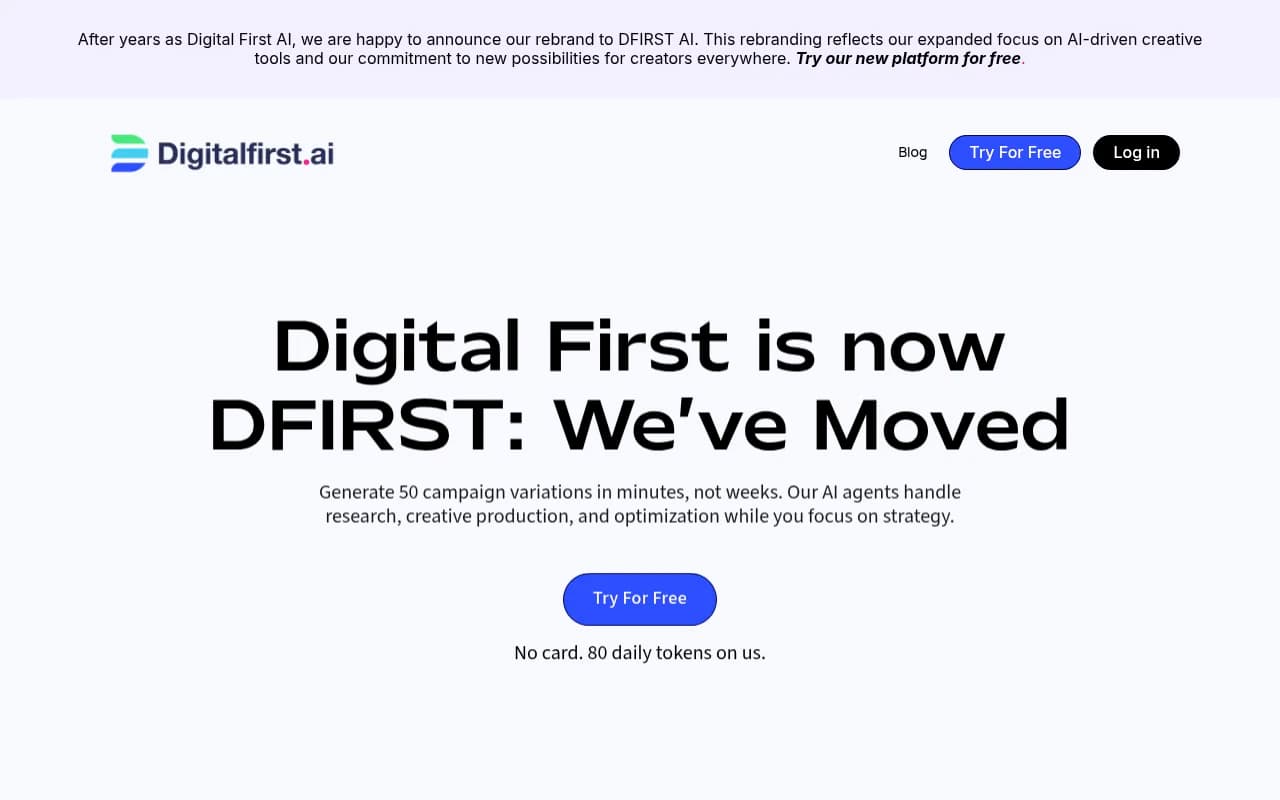
DFIRST AI (recently rebranded from Digital First AI) is a comprehensive AI marketing platform designed to collapse the traditional multi-tool marketing workflow into a single visual workspace. Rather than juggling separate subscriptions for copywriting, image generation, video creation, and research, DFIRST consolidates 50+ AI tools and services into one drag-and-drop canvas where marketers can build, test, and deploy entire campaigns. The platform is built around the concept of AI agents -- specialized workflows that don't just generate content but analyze data, conduct research, and execute multi-step marketing tasks. It's used by marketing teams at companies like ORT Family, Euvic Media, and Entic Media, with users reporting 60-80% reductions in campaign production time.
The platform targets marketing teams, agencies, and in-house marketers who are drowning in tool sprawl and need a centralized system for campaign creation. DFIRST is particularly well-suited for teams managing multiple clients or product lines who need to generate dozens of campaign variations quickly -- social posts, ad copy, landing page content, visuals, and video -- without context-switching between tools. The rebrand to DFIRST reflects the company's shift toward agentic AI workflows and creative production at scale.
AI Agent Workflows DFIRST's core differentiator is its AI agent system. These aren't simple prompt templates -- they're multi-step workflows that combine research, analysis, and content generation. For example, the competitive intelligence agent can scrape competitor websites, analyze their messaging and positioning, identify content gaps, and then generate strategic recommendations or draft content to fill those gaps. The social intelligence agent monitors social platforms for trending topics, sentiment analysis, and audience insights, then feeds that data into content generation workflows. Agents can be chained together: research feeds into strategy, strategy informs copywriting, copywriting triggers visual generation. This orchestration is what allows teams to produce campaign variations at scale -- one user reported generating 50 variations in the time it previously took to create 5.
50+ Integrated AI Tools The platform integrates major AI models and marketing tools into a single interface. For text generation, you get access to Claude (Anthropic), GPT-4 (OpenAI), Gemini (Google), and Grok (xAI). For image generation: Flux AI, Stable Diffusion, DALL-E, Ideogram, and Recraft. For video: Kling AI. For research and SEO: SEMrush integration and Google Search data. Each tool is accessible via the drag-and-drop canvas -- you can route outputs from one tool into another, compare results side-by-side, or run A/B tests across models. This is particularly useful for teams that want to test which AI model produces the best results for specific content types (e.g., Claude for long-form blog posts, GPT-4 for ad copy, Flux for product images). The downside: you're limited to DFIRST's integrations and can't easily plug in custom models or niche tools.
Drag-and-Drop Campaign Canvas The visual workspace is DFIRST's interface for building marketing campaigns. Instead of linear workflows or rigid templates, you get a freeform canvas where you can drop AI agents, connect them with logic flows, add input fields for brand guidelines or product data, and route outputs to different formats (social posts, blog articles, ad creatives, etc.). For example, a typical workflow might start with a market research agent analyzing competitor content, feed that into a positioning agent that drafts messaging angles, then branch into separate paths for social media copy, email sequences, and landing page content -- all generated in parallel. The canvas supports conditional logic, so you can set rules like "if sentiment is positive, generate testimonial-style content; if negative, generate educational content." This flexibility is powerful but comes with a learning curve -- new users report spending a few hours getting comfortable with the interface.
Content Generation at Scale DFIRST excels at producing high-volume content variations. Marketing teams use it to generate dozens of social media posts, ad headlines, email subject lines, and visual assets from a single campaign brief. The platform supports multi-format output: you can generate a blog post, extract key quotes for social media, create accompanying images, and produce a video script -- all from one workflow. The content quality is generally strong for marketing copy (ad headlines, social posts, email sequences) but can be generic for long-form content like blog articles or whitepapers unless you provide detailed brand guidelines and examples. Users recommend feeding the platform with brand voice documents, competitor examples, and specific audience personas to get the best results.
Research & Competitive Intelligence The research agents are where DFIRST moves beyond simple content generation. The web scraping agent can extract data from competitor websites, landing pages, and product pages, then analyze messaging, pricing, and positioning. The social intelligence agent monitors platforms like Twitter, LinkedIn, and Reddit for brand mentions, trending topics, and audience sentiment. The SEMrush integration provides keyword research, backlink analysis, and traffic estimates. All of this data can be fed directly into content generation workflows -- for example, you can scrape a competitor's top-performing blog posts, analyze their structure and keywords, then generate your own optimized version. This is particularly valuable for agencies managing multiple clients who need to conduct competitive research at scale.
Visual & Video Creation DFIRST integrates multiple image and video generation models. For static visuals, you can generate product images, social media graphics, ad creatives, and illustrations using Flux AI, Stable Diffusion, DALL-E, Ideogram, or Recraft. The platform supports style consistency -- you can define brand colors, fonts, and visual styles, then apply them across all generated assets. For video, the Kling AI integration allows you to generate short-form video content, animations, and motion graphics. The video capabilities are more limited than dedicated tools like Runway or Pika, but they're sufficient for social media clips, explainer videos, and ad creatives. Users report that image quality is generally strong, but video generation can be hit-or-miss and often requires multiple iterations to get usable results.
Team Collaboration & Workflow Management DFIRST includes collaboration features for marketing teams. Multiple users can work on the same canvas simultaneously, leave comments on specific nodes, and track version history. The platform supports role-based permissions (admin, editor, viewer) and project organization. Teams can create template workflows for recurring campaign types (product launches, seasonal promotions, content series) and share them across the organization. The workflow management is solid but not as robust as dedicated project management tools -- there's no built-in approval workflows, task assignments, or deadline tracking. Most teams use DFIRST for content production and rely on external tools like Asana or Monday.com for project management.
Integrations & Export Options Beyond the 50+ AI tools, DFIRST integrates with SEMrush for SEO data and Google for search insights. Content can be exported in multiple formats: plain text, Markdown, HTML, PDF, or directly to social media platforms (though direct publishing is limited compared to tools like Buffer or Hootsuite). The platform has an API for custom integrations, but documentation is sparse and most users rely on the built-in integrations. There's no native CMS integration (WordPress, Webflow, etc.), so you'll need to copy-paste or use Zapier for content publishing. Browser extensions and mobile apps are not available -- DFIRST is web-only.
Who Is DFIRST AI For? DFIRST is best suited for marketing teams and agencies managing multiple campaigns or clients who need to produce high volumes of content variations quickly. Specific personas include: (1) Marketing agencies with 5-20 clients who need to generate campaign assets at scale without hiring additional writers or designers. (2) In-house marketing teams at mid-sized companies (50-500 employees) who are managing product launches, seasonal campaigns, and ongoing content production across multiple channels. (3) Growth marketers and performance marketers who run A/B tests and need to generate dozens of ad variations, landing page copy, and email sequences for testing. (4) Solo marketers or small teams (1-3 people) who are wearing multiple hats and need to compress production timelines.
DFIRST is less ideal for: (1) Enterprise marketing teams with complex approval workflows, compliance requirements, or need for deep customization -- the platform lacks enterprise-grade governance features. (2) Content-focused teams producing long-form editorial content (magazines, publications, thought leadership) -- the AI-generated content is better for marketing copy than editorial depth. (3) Highly specialized industries (legal, medical, finance) where content accuracy and compliance are critical -- AI-generated content requires significant human review. (4) Teams already invested in best-in-class tools for each function (Jasper for copy, Midjourney for images, Descript for video) -- DFIRST's integrations are convenient but not always as powerful as standalone tools.
Pricing & Value DFIRST offers four pricing tiers. The Freemium plan is free and includes 80 daily tokens, access to basic AI agents, and limited integrations -- sufficient for exploring the platform or small-scale personal projects. The Starter plan is $39/month and includes increased token limits, access to all AI models, and basic collaboration features -- suitable for solo marketers or small teams. The Pro plan is $199/month and adds advanced agents, priority processing, higher token limits, and team collaboration features -- designed for agencies or in-house teams managing multiple campaigns. Enterprise pricing is custom and includes dedicated support, custom integrations, and white-label options.
The token-based pricing model means costs can scale quickly for heavy users. Tokens are consumed based on the AI models you use and the complexity of workflows -- generating a simple social post might cost 5-10 tokens, while a complex multi-step campaign with research, copywriting, and visual generation could consume 100+ tokens. Users on the Starter plan report hitting token limits within 1-2 weeks of active use, requiring upgrades to Pro. Compared to competitors like Jasper ($49/month for similar features) or Copy.ai ($36/month), DFIRST is competitively priced for the breadth of tools included, but the token system makes it harder to predict monthly costs.
Strengths
- All-in-one consolidation: Replaces 5-10 separate tools (copywriting, image generation, video, research) with one platform, reducing tool sprawl and subscription costs.
- AI agent workflows: Multi-step automation that goes beyond simple generation to include research, analysis, and strategic recommendations.
- Campaign variation at scale: Ability to generate dozens of content variations (copy, visuals, video) from a single brief, dramatically reducing production time.
- Visual canvas interface: Flexible drag-and-drop workspace allows for complex, non-linear workflows that match how marketing teams actually work.
- Broad AI model access: Integration with 50+ AI tools means you can test and compare results across models without managing multiple subscriptions.
Limitations
- Learning curve: The canvas interface and agent system require time to master -- new users report 2-4 hours of onboarding before feeling productive.
- Token-based pricing unpredictability: Costs can escalate quickly for heavy users, and it's hard to estimate monthly spend without tracking token consumption closely.
- Content quality variability: AI-generated content is strong for marketing copy but can be generic for long-form or editorial content without extensive prompting and brand guidelines.
- Limited video capabilities: Video generation via Kling AI is less powerful than dedicated tools like Runway or Pika, often requiring multiple iterations.
- Weak CMS integrations: No native WordPress, Webflow, or other CMS integrations -- content publishing requires manual copy-paste or Zapier workarounds.
Bottom Line DFIRST AI is the right choice for marketing teams and agencies who are managing multiple campaigns, need to produce high volumes of content variations quickly, and want to consolidate their AI tool stack into one platform. It's particularly valuable for performance marketers running A/B tests, agencies juggling multiple clients, and in-house teams with limited resources. The AI agent workflows and visual canvas provide flexibility that rigid template-based tools lack. However, teams focused on editorial content quality, those with complex compliance requirements, or users already invested in best-in-class standalone tools may find DFIRST's breadth comes at the cost of depth. Best use case in one sentence: marketing teams producing 50+ campaign assets per month who need to cut production time by 60% without hiring additional staff.
Tags:
Similar and alternative tools to Digital First AI