Outrank Review 2026
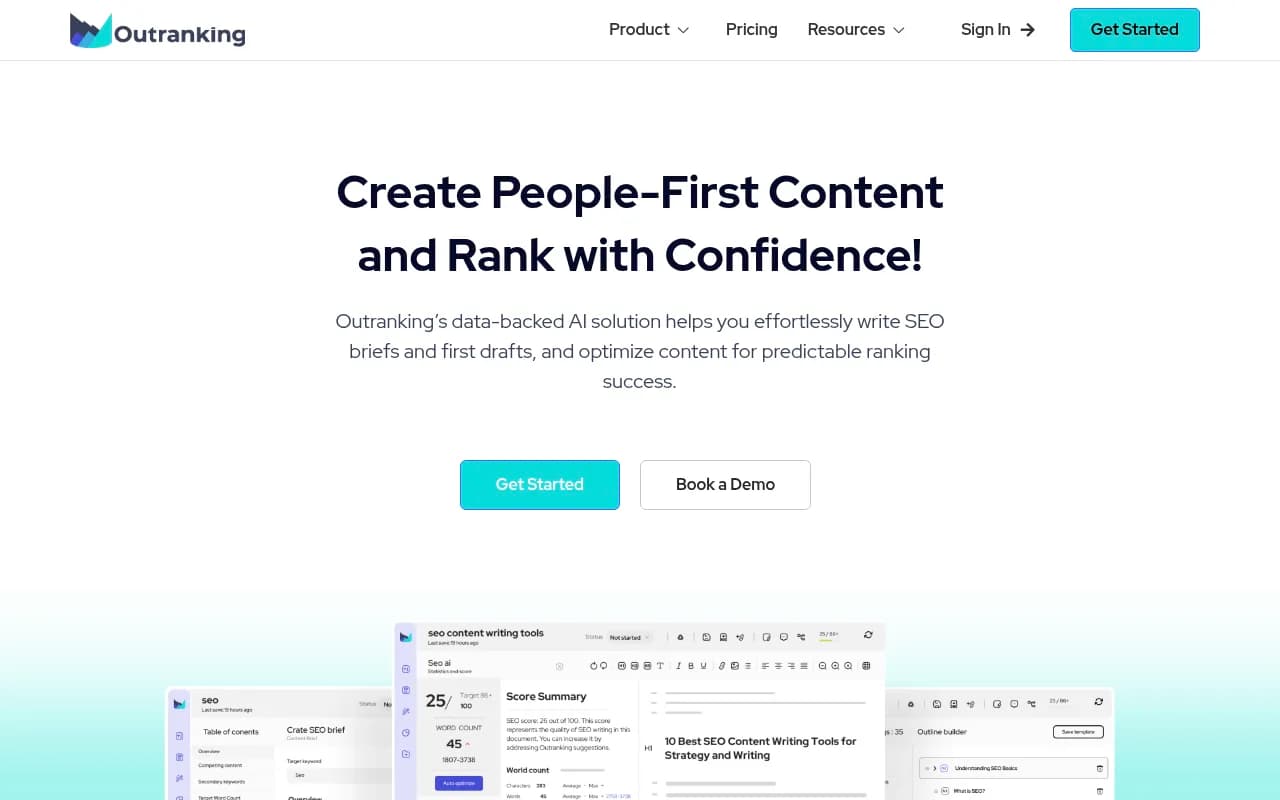
AI-powered SEO content platform that helps create optimized articles based on competitive analysis and search intent to improve rankings.
Key Takeaways:
- Strong SERP analysis and content briefs -- Outranking crawls top 20 ranking pages to generate SEO outlines, keyword suggestions, and competitive insights, making it easy to understand what Google wants before you write
- AI writing with brand personalization -- GPT-4-powered first drafts that adapt to your brand voice through custom style guides, reducing editing time and maintaining consistency across content teams
- Real-time optimization scoring -- Live content grading across 10+ on-page SEO factors (NLP terms, readability, internal links, originality) with automatic fixes for common issues like keyword stuffing and duplicate content
- Lacks AI search visibility tracking -- Unlike Promptwatch, Outranking doesn't monitor how your content performs in AI engines like ChatGPT, Perplexity, or Claude -- it's purely focused on traditional Google search optimization
- Best for SEO agencies and content teams managing 20+ articles per month who need a structured workflow from keyword research through publication, not solo bloggers or small sites
Outranking positions itself as an end-to-end SEO content platform that bridges the gap between keyword research tools (Semrush, Ahrefs) and generic AI writers (Jasper, Copy.ai). The pitch: instead of bouncing between five tools to research competitors, build outlines, write drafts, and optimize on-page SEO, Outranking consolidates everything into one workflow. It's built for content teams at agencies, SaaS companies, and ecommerce brands who publish at scale and need predictable ranking results.
The company has been around since early 2021 and serves 12,000+ users including recognizable brands like IKEA, Zoho, Rewardful, and Clickworker. One customer (Clickworker's SEO manager) reported a 1000% increase in blog clicks after implementing Outranking -- a claim that sounds wild but is backed by specific before/after data they shared publicly. The tool has evolved significantly since launch, adding features like plagiarism checking, automatic interlinking, and keyword clustering that weren't there in the early days.
SERP-Driven Content Briefs and Outlines
Outranking's core strength is its ability to reverse-engineer what's already ranking. You enter a target keyword, and it crawls the top 20 Google results to extract:
- Common headings and structure -- What H2s and H3s appear across multiple top-ranking articles, suggesting topics Google expects to see covered
- NLP terms and semantic keywords -- Entities and phrases that Google's natural language processing associates with your topic, pulled from actual ranking content
- Word count benchmarks -- Average and median word counts of top results, so you know if you need 800 words or 3000
- Competitor metrics -- Domain authority, page authority, backlink counts, and originality scores for each ranking page
- Questions to answer -- People Also Ask boxes and related queries that signal user intent
The outline builder uses this data to generate a suggested structure for your article. It's not just pulling headings from one competitor -- it's synthesizing patterns across all top results to identify what's essential vs optional. You can accept suggestions wholesale or customize them before moving to the writing phase. This is where Outranking separates itself from tools like Surfer SEO (which focuses more on keyword density) or Clearscope (which is more expensive and less hands-on with AI writing).
The "Concepts" feature is particularly clever. Instead of asking GPT-4 to make up information about a topic (which leads to hallucinations and generic fluff), Concepts lets you select specific sections from top-ranking pages and have the AI rewrite them in your brand voice. You're essentially using real SERP data as source material, which produces more factual and relevant output than pure generative AI.
AI Writing with Brand Style Guides
Outranking's AI writing assistant is powered by GPT-4, but the differentiator is the style guide system. You can define:
- Tone and voice -- Formal, conversational, technical, friendly, etc.
- Word choice preferences -- Terms to use or avoid (e.g. "customers" vs "clients", "software" vs "tool")
- Product information -- Key features, pricing, differentiators that should be mentioned when relevant
- Sentence structure -- Preferred length, active vs passive voice, use of contractions
Once configured, the AI generates first drafts that sound like your brand wrote them, not a generic content mill. This is huge for agencies managing multiple clients or in-house teams trying to maintain consistency across writers. The alternative -- using ChatGPT directly or tools like Jasper -- requires manually prompting for brand voice every single time, which is tedious and inconsistent.
The AI can generate full articles from scratch or assist with specific sections (intros, conclusions, featured snippet answers). There's also a prompt-based writing mode where you can give custom instructions like "Explain this concept for a non-technical audience" or "Add a case study example here." The output quality is solid -- better than early GPT-3 tools, though still requiring human editing for accuracy and originality.
One limitation: the AI sometimes produces generic transitions or filler sentences that feel obviously AI-generated ("In today's digital landscape...", "It's important to note that..."). You'll want to edit these out. The plagiarism checker helps catch duplicate content, and there's an originality scorer that flags sections lacking unique insights -- both useful for avoiding Google's "unhelpful content" penalties.
Real-Time SEO Optimization and Scoring
As you write (or after importing existing content), Outranking grades your article in real time across 10+ factors:
- NLP term coverage -- Are you using the semantic keywords Google expects? The tool highlights missing terms and suggests where to add them naturally.
- Keyword usage -- Target keyword in title, H1, first 100 words, meta description, URL. Warns against over-optimization.
- Readability -- Flesch reading ease score, sentence length, paragraph length. Flags dense sections.
- Internal links -- Suggests relevant pages to link to based on semantic relationships and PageRank.
- External links -- Checks if you're citing authoritative sources (important for E-E-A-T).
- Media elements -- Prompts to add images, videos, tables, lists for better engagement.
- Originality -- Compares your content to top-ranking pages to identify sections that are too similar.
- Meta tags -- Title tag length, meta description length, keyword placement.
The scoring is more nuanced than older tools like Yoast (which just checks keyword density). Outranking uses Google's NLP API to understand semantic relationships, so it won't penalize you for using synonyms or related terms instead of exact-match keywords. The automatic optimizer can insert missing NLP terms, fix heading hierarchy, and add internal links with one click -- though you'll want to review suggestions before applying them blindly.
The plagiarism checker scans your content against the web and flags duplicate passages. If it finds matches, you can use the built-in GPT-4 rewriter to automatically rephrase them. This is handy for avoiding penalties, though the rewrites sometimes need manual cleanup.
Keyword Clustering and Content Strategy
Outranking's Strategist module is designed for planning content at scale. You can upload a list of up to 100,000 keywords, and it will:
- Group keywords into clusters based on SERP overlap -- keywords that share 3+ common ranking pages are grouped together, indicating they can be targeted with one article instead of separate pieces
- Calculate ranking difficulty using metrics like "allintitle" operator results, average domain authority of top 10, and search volume
- Identify quick wins -- keywords where your domain already ranks on page 2-3 and could jump to page 1 with optimized content
- Map to Search Console data -- If you connect GSC, it shows which keywords you're already getting impressions for but not clicks, highlighting optimization opportunities
This is similar to what tools like Keyword Insights or Topic Ranker do, but integrated into the same platform where you'll write the content. The clustering algorithm is solid -- it uses live SERP data rather than static keyword databases, so groupings reflect current Google behavior. One user mentioned the hub-and-spoke model (pillar pages + supporting articles) that used to take 6 weeks to plan now takes minutes with Strategist.
The content inventory dashboard shows all your documents, their optimization scores, and workflow status (brief, draft, optimized, published). You can assign tasks to team members, set deadlines, and track progress -- basic project management features that keep larger teams organized.
Automatic Interlinking
The interlinking module crawls your website to find opportunities to connect related pages. It:
- Identifies semantic relationships between pages based on content analysis
- Suggests anchor text that targets relevant keywords
- Prioritizes high-authority pages -- links from pages with strong PageRank to underperforming pages that need a boost
- Integrates with WordPress -- you can push internal link updates directly to your site with one click
This is a time-saver for large sites with hundreds of articles. Manually finding link opportunities is tedious, and most teams just don't do it consistently. Outranking automates the discovery and makes implementation easy. The WordPress plugin is a nice touch -- competitors like Surfer SEO require manual copy-paste.
One caveat: the interlinking suggestions are based on keyword matching and semantic similarity, not user intent or conversion goals. You'll want to review recommendations to make sure they make sense from a user experience perspective, not just an SEO one.
Integrations and Workflow
Outranking integrates with:
- Google Docs -- One-click export of briefs and drafts for collaboration with writers who prefer Docs
- WordPress -- Publish directly from Outranking or update existing posts with optimized content and internal links
- Google Search Console -- Import keyword data, impressions, and click-through rates to inform content strategy
- Grammarly -- Browser extension works inside Outranking's editor for grammar and tone checking
No Zapier integration, no API (as far as I can tell from their site), and no native connections to tools like Ahrefs, Semrush, or Slack. For agencies managing multiple clients, you'll need to manually export/import data if you want to combine Outranking insights with other platforms.
The workflow system is basic but functional. You can create stages like "Brief", "First Draft", "Editing", "Optimized", "Published" and assign team members to each. There's no built-in commenting or version control -- for that, you'd export to Google Docs. It's enough for small teams but might feel limiting for larger agencies used to tools like Asana or Monday.com.
Who Is Outranking For?
Outranking is built for content teams that publish at scale -- think 20+ articles per month. The ideal user is:
- SEO agencies managing 5-15 clients who need a repeatable process for content briefs, writing, and optimization. The workflow features and brand style guides make it easy to keep clients organized and maintain voice consistency.
- In-house content teams at SaaS companies or ecommerce brands publishing blog content, landing pages, and product descriptions. The keyword clustering and interlinking features are particularly valuable for sites with 100+ pages.
- Freelance SEO writers who want to deliver optimized content to clients without bouncing between Surfer, Clearscope, Grammarly, and ChatGPT. Outranking consolidates the stack.
It's less suited for:
- Solo bloggers or small sites publishing 1-5 articles per month. The pricing (starting at $19/mo for 4 documents) is reasonable, but you won't use most of the features. A simpler tool like Frase or even just ChatGPT + Yoast might be enough.
- Enterprise teams needing advanced collaboration, custom reporting, or API access. Outranking's workflow features are basic, and there's no mention of SSO, user permissions, or white-label options.
- Teams focused on AI search visibility -- Outranking optimizes for traditional Google search, not AI engines like ChatGPT, Perplexity, or Claude. If you want to track and optimize for how AI models cite your content, you'd need a tool like Promptwatch instead.
Pricing and Value
Outranking offers four pricing tiers:
- Starter: $19/mo -- 4 SEO documents, AI-assisted optimization, content briefs, first drafts, integrations. Good for testing the platform or very light usage.
- SEO Writer: $69/mo (listed as $9 starting in some places, likely a typo or old pricing) -- More documents, full feature access.
- SEO Wizard: $99/mo -- Higher document limits, priority support.
- SEO Ace: Custom pricing -- For agencies and enterprises needing unlimited documents and custom features.
The exact document limits for each tier aren't clearly listed on the site, which is frustrating. Based on user reviews, the mid-tier plans seem to allow 20-50 documents per month. There's a free trial available (no credit card required), which is the best way to test if the platform fits your workflow.
Compared to competitors:
- Surfer SEO is $89/mo for 30 articles -- similar price, but Surfer focuses more on on-page optimization and less on AI writing and workflow.
- Clearscope starts at $170/mo -- more expensive, better for enterprise teams, but no AI writing assistant.
- Frase is $45/mo for 30 documents -- cheaper, but less sophisticated SERP analysis and no keyword clustering.
- Jasper (AI writing) is $49/mo but doesn't include SEO optimization or content briefs -- you'd need to pair it with another tool.
Outranking sits in the middle of the pack on price but offers more features in one platform than most competitors. The value proposition is strongest for teams that would otherwise pay for 3-4 separate tools (keyword research, AI writing, SEO optimization, workflow management).
Strengths
- SERP-driven content briefs -- The outline builder and Concepts feature produce briefs grounded in real ranking data, not generic templates. This is the platform's biggest differentiator.
- Brand style guides -- AI writing that adapts to your voice is rare and valuable for maintaining consistency across teams.
- Keyword clustering at scale -- Analyzing 100K keywords and grouping them by SERP overlap is powerful for content planning. Most competitors cap at 10K keywords or charge extra.
- All-in-one workflow -- From keyword research to publication, you can stay in one tool instead of juggling Ahrefs, ChatGPT, Surfer, and Google Docs.
- Automatic interlinking with WordPress integration -- Saves hours of manual work for large sites.
Limitations
- No AI search visibility tracking -- Outranking optimizes for Google's traditional search algorithm, not AI engines like ChatGPT, Perplexity, or Claude. If you want to monitor and improve how AI models cite your content, you'd need a separate platform like Promptwatch, which offers citation tracking, AI crawler logs, and content gap analysis specifically for AI search.
- Basic workflow features -- No commenting, version control, or advanced permissions. Agencies used to tools like Asana or ClickUp might find it limiting.
- Unclear pricing tiers -- The website doesn't clearly list document limits for each plan, making it hard to estimate costs before signing up.
- AI writing still needs editing -- The first drafts are better than generic AI tools, but you'll still spend time removing filler sentences and adding original insights. This is true of all AI writers, but worth noting.
- No API or Zapier integration -- Limits automation and integration with other tools in your stack.
Bottom Line
Outranking is a strong choice for SEO agencies and in-house content teams publishing 20+ articles per month who want a structured, data-driven workflow from keyword research through optimization. The SERP analysis and brand-personalized AI writing are standout features that justify the price if you're currently paying for multiple tools. Solo bloggers and small sites might find it overkill, and enterprise teams will likely outgrow the basic workflow features. If you're focused on traditional Google search, Outranking delivers. If you need to track and optimize for AI search engines like ChatGPT or Perplexity, Promptwatch is the better fit -- it's the only platform that combines AI visibility monitoring with content gap analysis and optimization tools specifically for AI search.
Tags:
Frequently asked questions
What is Outrank and what does it do?
How much does Outrank cost?
Who is Outrank best suited for?
What are the key features of Outrank?
Does Outrank track AI search engine visibility?
How does Outrank compare to other SEO and AI writing tools?
Similar and alternative tools to Outrank