Key Takeaways
- 47% of marketers encounter AI errors multiple times per week, with over 70% spending 1-5 hours weekly just fact-checking AI output—offsetting the promised efficiency gains
- 36.5% of marketers have published hallucinated or incorrect AI content publicly, leading to false facts, broken citations, and brand-unsafe language reaching customers
- 70-95% of enterprise AI deployments fail to reach production, costing American companies $644 billion in 2025 alone—a wave of economic vandalism that continues into 2026
- AI-generated content carries hidden compliance costs: regulatory violations, data privacy breaches, and legal exposure that traditional content workflows never faced
- Recovery requires a complete shift: from monitoring-only dashboards to action-oriented platforms that identify gaps, generate optimized content, and track real results
The promise of AI content generation was seductive: produce more content faster, scale your marketing effortlessly, and free up your team to focus on strategy. In 2026, the reality is starkly different. Behind the efficiency narrative lies a growing crisis of brand damage, search penalties, compliance failures, and a hidden "tax" of fact-checking that's offsetting every productivity gain.
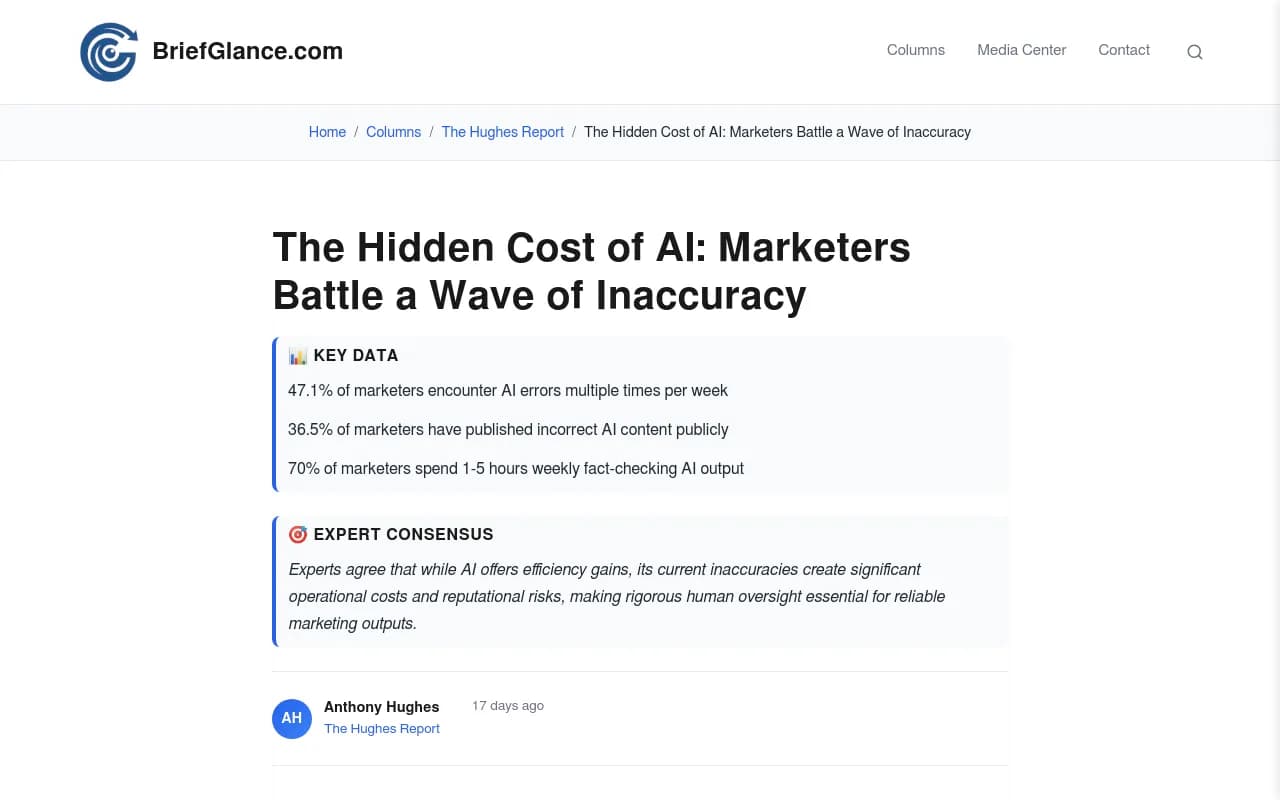
This isn't theoretical. According to NP Digital's 2026 AI Hallucinations and Accuracy Report, 47.1% of marketing professionals encounter AI errors multiple times per week. More alarming: 36.5% have published hallucinated or incorrect AI content publicly. The most common mistakes? False facts, broken citations, and brand-unsafe language—all delivered with the same confident tone as accurate information.
The cost isn't just embarrassment. It's lost trust, damaged reputation, search penalties, and compliance violations that can take months or years to recover from. Let's break down the hidden costs and what recovery actually looks like in 2026.
The Efficiency Myth: AI's Hidden Tax
AI content tools are marketed as time-savers, but the data tells a different story. Over 70% of marketers now spend between 1-5 hours every week just fact-checking and correcting AI-generated output. For a mid-sized marketing team, that's hundreds of lost productivity hours each month—a significant operational cost that challenges the technology's ROI.
The problem isn't just volume—it's the nature of AI hallucinations. Unlike human errors (which tend to be obvious), AI-generated mistakes are delivered with the same authoritative tone as factual content. They look believable at first glance. This makes them dangerously easy to miss without rigorous human review.
A November 2025 McKinsey report found that 51% of organizations using AI have faced negative consequences, with nearly a third of those issues stemming directly from AI inaccuracy. The hidden tax isn't just time—it's the cognitive load of constant vigilance, the stress of wondering what you missed, and the reputational damage when errors slip through.
Brand Damage: When AI Errors Go Public
The consequences of AI errors aren't just internal. For 36.5% of marketers, hallucinated or incorrect AI content has been published publicly. The fallout is severe:
- Eroded consumer trust: Customers who encounter false information or broken links lose confidence in your brand's credibility
- Damaged reputation: Public errors spread quickly—especially when they're egregious or embarrassing
- Stakeholder scrutiny: 57.7% of marketers report that clients or internal stakeholders have questioned the quality of AI-assisted work
- Lost revenue: Trust is hard to rebuild, and customers who leave rarely come back
The most common mistakes making it to press:
- False facts and fabricated statistics: AI models confidently cite data that doesn't exist or misrepresent real research
- Broken citations and dead links: AI generates references to sources that don't exist or URLs that lead nowhere
- Brand-unsafe language: Tone, phrasing, or messaging that violates brand guidelines or crosses ethical lines
- Outdated information: AI training data has cutoff dates, leading to content that references obsolete products, policies, or market conditions
- Competitor mentions: AI sometimes weaves in competitor brands or products inappropriately
Recovery from public AI errors isn't quick. It requires:
- Issuing corrections and apologies
- Auditing all published AI content for similar errors
- Rebuilding trust through transparent communication
- Implementing stricter review processes (which negates the efficiency gains)
Search Penalties: The SEO Consequences of Bulk AI Content
Google's stance on AI content has evolved, but the core principle remains: content must be helpful, accurate, and created for users—not search engines. Bulk AI content that fails this test faces real penalties:
Traditional Search Penalties
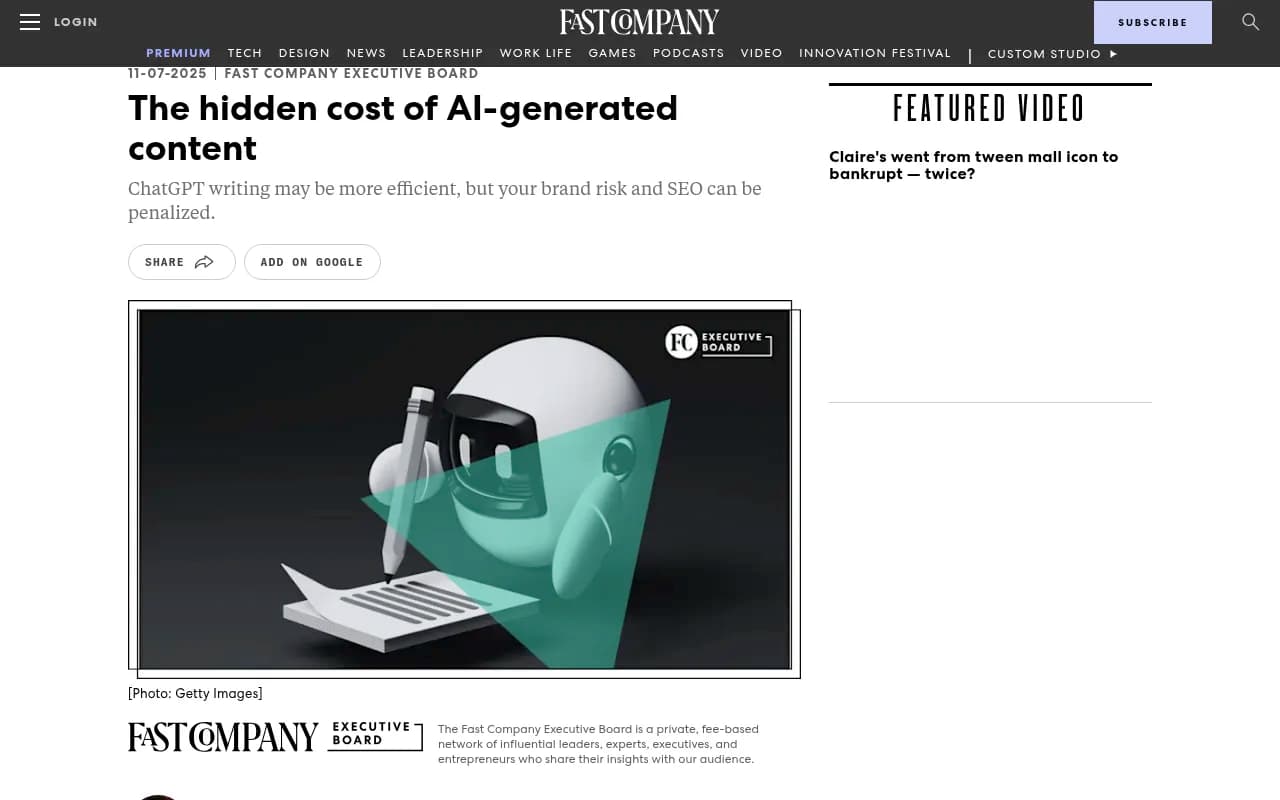
- Algorithmic devaluation: Google's Helpful Content system (updated continuously through 2026) demotes sites with large volumes of low-quality AI content
- Manual actions: Sites caught publishing AI spam at scale receive manual penalties that can take months to recover from
- Loss of E-E-A-T signals: AI content often lacks the Experience, Expertise, Authoritativeness, and Trust signals Google values
- Thin content classification: Bulk AI articles that rehash the same information without adding value get filtered out
AI Search Penalties: The New Frontier
In 2026, the bigger risk is invisibility in AI search. ChatGPT, Perplexity, Claude, Gemini, and Google AI Overviews are where your customers are discovering brands and making decisions. These AI models don't just penalize low-quality content—they ignore it entirely.
AI search engines prioritize:
- Authoritative sources: Content from recognized experts, institutions, and brands with strong citation histories
- Unique insights: Original research, data, case studies, and perspectives that add value
- Structured information: Well-organized content that AI models can parse and cite accurately
- Freshness: Up-to-date information that reflects current market conditions
Bulk AI content—generic, repetitive, and lacking original insights—simply doesn't get cited. Your brand becomes invisible in the channels where buying decisions are increasingly made.
Promptwatch helps brands understand and fix this invisibility. Unlike monitoring-only tools, it shows you exactly which prompts competitors are visible for but you're not, then helps you create content that actually gets cited by AI models.

Compliance Costs: The Hidden Legal Exposure
Beyond brand damage and search penalties, bulk AI content creates compliance risks that traditional content workflows never faced:
Regulatory Violations
- Data privacy breaches: AI models trained on scraped data may inadvertently include personal information in generated content
- Copyright infringement: AI-generated content can reproduce copyrighted material without attribution
- Industry-specific regulations: Financial services, healthcare, and legal sectors face strict content accuracy requirements that AI often violates
- Accessibility compliance: AI-generated content frequently fails WCAG standards for alt text, heading structure, and readability
Financial Consequences
According to Compliance Week, 70-95% of enterprise AI pilots fail to reach production, with compliance issues being a leading cause. The hidden costs include:
- Legal fees for defending against copyright claims
- Regulatory fines for data privacy violations
- Remediation costs to fix non-compliant content at scale
- Lost business from clients who discover compliance failures
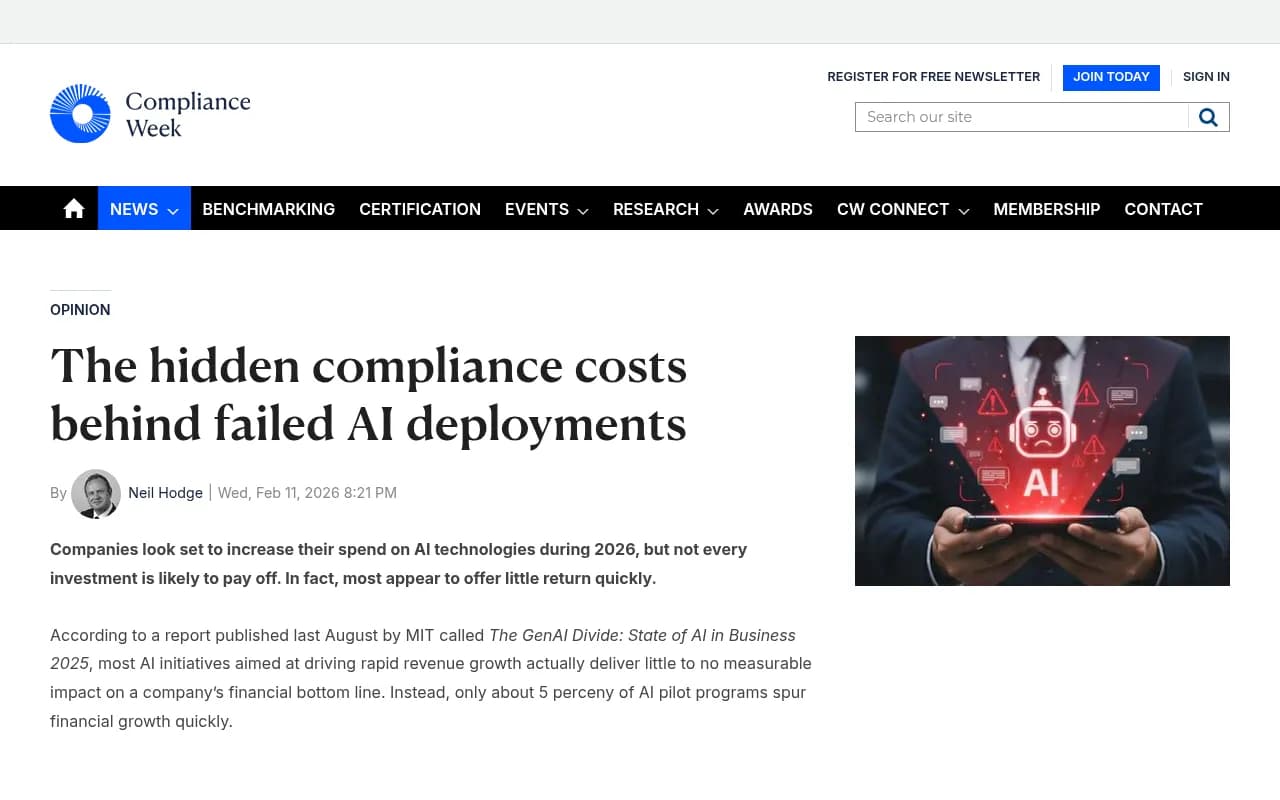
A 2025 report found that American companies spent $644 billion on enterprise AI deployments, with the vast majority delivering little to no measurable impact. This "economic vandalism" continues into 2026 as companies chase AI efficiency without accounting for the hidden costs.
The AI Washing Problem: Trust Erosion at Scale
Beyond individual content failures, there's a broader crisis: AI washing—making exaggerated or false claims about AI capabilities. This erodes public trust not just in your brand, but in AI-assisted content generally.
The risks of AI washing:
- Loss of public trust: Customers who feel misled by AI claims become skeptical of all your content
- Regulatory scrutiny: The FTC and EU regulators are cracking down on misleading AI claims
- Competitive disadvantage: Brands that are transparent about AI use build stronger relationships
- Internal credibility loss: Stakeholders lose confidence in your marketing team's judgment
Recovery from AI washing requires:
- Transparent disclosure: Clearly label AI-assisted content and explain your quality controls
- Human oversight: Demonstrate that real experts review and validate AI output
- Quality standards: Publish your content guidelines and show how you enforce them
- Accountability: Take responsibility for errors and explain how you're preventing them
Recovery: From Monitoring to Action
Most companies approach AI content recovery the wrong way: they add more monitoring dashboards and hope to catch errors before they go live. This doesn't work. You can't fact-check your way out of a systemic problem.
Real recovery requires a fundamental shift from monitoring-only to action-oriented workflows:
Step 1: Find the Gaps
You can't fix what you can't see. Start by understanding:
- Which prompts are your competitors visible for but you're not? This reveals content gaps that AI models want answers to but can't find on your site.
- What topics, angles, and questions are AI models looking for? This shows you what to create, not just what to monitor.
- Where are you being cited vs. ignored? Page-level tracking reveals which content works and which doesn't.
Tools like Promptwatch excel here because they don't just show you data—they show you actionable gaps. The Answer Gap Analysis feature reveals exactly which prompts competitors rank for but you don't, along with the specific content angles AI models are seeking.
Step 2: Create Content That Ranks in AI
Once you know the gaps, you need to fill them—but not with more bulk AI content. You need content engineered to get cited by AI models:
- Grounded in real citation data: Analyze 880M+ citations to understand what AI models actually cite
- Optimized for prompt volumes: Prioritize high-value, winnable prompts instead of guessing
- Targeted to personas: Match how your actual customers prompt AI engines
- Structured for AI parsing: Use formats, headings, and data that AI models can extract and cite
Promptwatch's built-in AI writing agent generates articles, listicles, and comparisons specifically designed for AI search visibility—not generic SEO filler. This is content that actually gets cited by ChatGPT, Claude, Perplexity, and other AI models.
Step 3: Track the Results
Recovery isn't complete until you can prove it's working:
- Visibility scores: Track how your AI search presence improves as you publish optimized content
- Page-level citations: See exactly which pages are being cited, how often, and by which models
- Traffic attribution: Connect visibility to actual revenue with code snippets, GSC integration, or server log analysis
- Competitor benchmarking: Compare your AI visibility vs. competitors to measure progress
This action loop—find gaps, generate content, track results—is what separates optimization platforms from monitoring-only dashboards. Most competitors (Otterly.AI, Peec.ai, AthenaHQ, Search Party) stop at step one. They show you the problem but leave you stuck.
Additional Capabilities That Support Recovery
AI Crawler Logs
Understand how AI engines discover your content:
- Real-time logs: See which pages ChatGPT, Claude, Perplexity, and other AI crawlers are reading
- Error detection: Identify crawling issues, blocked pages, and indexing problems
- Return frequency: Track how often AI models revisit your content
This visibility helps you fix technical issues that prevent AI models from citing your content—something most competitors lack entirely.
Prompt Intelligence
- Volume estimates: Prioritize prompts with high search volume
- Difficulty scores: Focus on winnable prompts instead of impossible battles
- Query fan-outs: See how one prompt branches into sub-queries for comprehensive coverage
Citation & Source Analysis
- Competitive intelligence: See exactly which pages, Reddit threads, YouTube videos, and domains AI models cite
- Channel insights: Understand where to publish (Reddit, YouTube, your blog) for maximum visibility
- Content formats: Identify which formats (listicles, comparisons, guides) get cited most
Multi-Language & Multi-Region Tracking
Monitor AI responses in any language, from any country, with customizable personas that match how your actual customers prompt.
Best Practices for Avoiding Future Damage
Once you've recovered, prevent future AI content disasters:
1. Implement Strict Review Processes
- Human-in-the-loop: Every AI-generated piece must be reviewed by a subject matter expert
- Fact-checking protocols: Verify all statistics, citations, and claims before publishing
- Brand safety checks: Ensure tone, language, and messaging align with guidelines
- Compliance reviews: Legal and regulatory teams must sign off on sensitive content
2. Use AI as a Co-Pilot, Not a Replacement
- Research assistant: Let AI gather information and suggest angles
- First draft generator: Use AI to create outlines and rough drafts
- Optimization tool: Leverage AI to improve structure, readability, and SEO
- Human expertise: Always add original insights, examples, and perspectives
3. Monitor AI Search Visibility Continuously
- Daily tracking: Monitor how AI models cite (or ignore) your content
- Competitor benchmarking: Track visibility vs. competitors across prompts
- Alert systems: Get notified when visibility drops or competitors gain ground
- Attribution tracking: Connect AI visibility to actual traffic and revenue
4. Invest in Quality Over Quantity
The bulk AI content era is over. In 2026, quality beats quantity in both traditional and AI search:
- Fewer, better articles: One authoritative guide beats ten thin AI posts
- Original research: Invest in data, case studies, and unique insights
- Expert voices: Feature real people with real expertise
- Long-form depth: Comprehensive content gets cited; surface-level content gets ignored
5. Build for AI Search from Day One
Don't treat AI search as an afterthought:
- Structured content: Use clear headings, lists, and data formats AI models can parse
- Entity optimization: Help AI models understand who you are, what you do, and why you're authoritative
- Citation-worthy content: Create content that AI models want to cite—data, examples, step-by-step guides
- Technical optimization: Ensure AI crawlers can access and index your content
The Path Forward: Action Over Monitoring
The hidden costs of bulk AI content—brand damage, search penalties, compliance failures, and the efficiency tax—are real and growing. But recovery is possible if you shift from monitoring to action.
The brands that will win in 2026 and beyond are those that:
- Understand the gaps: Know exactly where they're invisible in AI search and why
- Create strategically: Generate content engineered for AI citations, not bulk output
- Track results: Connect AI visibility to real business outcomes
- Iterate continuously: Treat AI search optimization as an ongoing process, not a one-time fix
This requires tools that go beyond monitoring. Platforms like Promptwatch that close the loop—find gaps, generate optimized content, track results—are essential for brands serious about recovering from AI content damage and building sustainable visibility in AI search.
The efficiency promise of AI content generation wasn't entirely false—it was just incomplete. The real efficiency comes not from generating more content faster, but from generating the right content strategically, with human expertise and AI assistance working together. That's the path to recovery, and the foundation for long-term success in the AI search era.