Content Harmony Review 2026
Content Harmony is a content intelligence platform designed for SEO teams, content marketers, and agencies who need to produce high-quality content briefs at scale. It analyzes search intent, competitor content, and keyword data to generate comprehensive briefs that help writers create content optim
Key Takeaways:
• Best for: SEO agencies, in-house content teams, and freelance content strategists who produce multiple content briefs per month and need to standardize their research process • Standout strength: Transforms a 60-90 minute manual research process into a 10-15 minute workflow by consolidating keyword analysis, competitor research, and search intent classification into one platform • Pricing sweet spot: $99/month for 12 content workflows makes it cost-effective for teams producing 10-15 pieces of content monthly • Honest limitation: Not a writing tool -- it's purely for research and briefing, so you'll still need writers or AI writing tools to produce the actual content • Bottom line: If you're spending hours manually researching topics in Ahrefs, Semrush, and Google Docs before handing off to writers, Content Harmony will pay for itself in time savings within the first month
Content Harmony is a content intelligence and briefing platform built by Kane Jamison, who ran a content marketing agency for nearly a decade before productizing the internal research workflow his team used for client projects. The tool launched in 2020 and has since been adopted by agencies like Directive, KlientBoost, and Mole Street, as well as in-house teams at companies ranging from SaaS startups to enterprise organizations. The core problem it solves: the tedious, repetitive research process that content strategists go through before a single word gets written -- analyzing search intent, reviewing competitor content structure, identifying related keywords, surfacing questions readers are asking, and compiling authoritative sources.
The Research-to-Brief Workflow
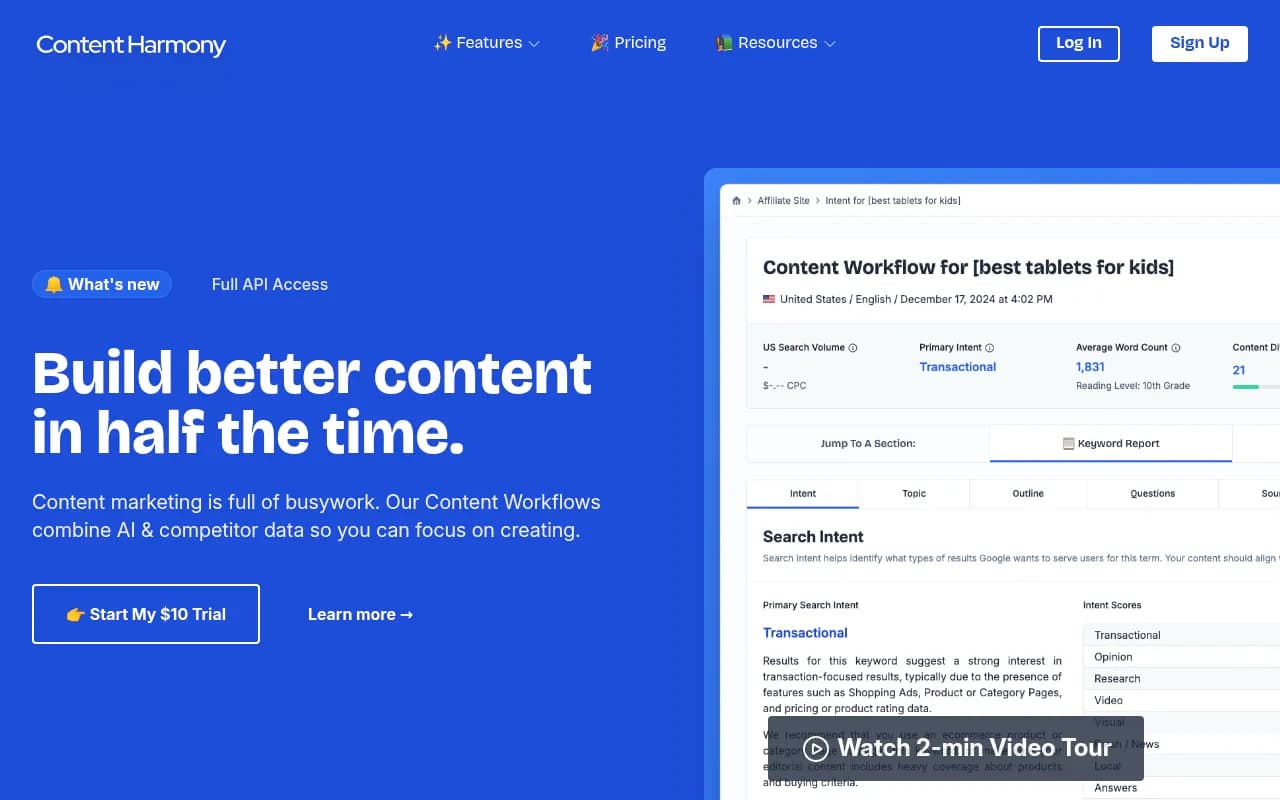
Content Harmony's workflow mirrors how experienced SEO content strategists actually work, but automates the data gathering. You start by entering a target keyword. The platform then generates a detailed keyword report that includes search volume, keyword difficulty, related terms, and -- critically -- a search intent classification that goes beyond the standard "informational/transactional/navigational" framework. Content Harmony uses a more nuanced intent model (Investigate, Compare, Purchase, Learn, etc.) based on SERP feature analysis, which helps strategists understand not just what people are searching for, but what they're trying to accomplish.
From the keyword report, you move into the brief builder. This is where Content Harmony really shines. The platform automatically pulls in competitor analysis by scraping the top 20 ranking pages for your target keyword, then extracts their document structure (headings, subheadings, content length, images used). You can see at a glance which topics competitors are covering, how they're organizing information, and where there might be content gaps you can exploit. The tool also surfaces "People Also Ask" questions from Google, related searches, and -- uniquely -- relevant Reddit threads and Quora discussions where real people are asking questions about your topic. This Reddit/Quora integration is particularly valuable for understanding the actual language and pain points your audience uses, not just what SEO tools think is important.
Brief Templates & Standardization
One of Content Harmony's biggest selling points for agencies and larger teams is brief standardization. The platform includes customizable brief templates that ensure every strategist on your team produces consistent, comprehensive briefs. A typical Content Harmony brief includes: target keyword and search intent classification, recommended word count based on competitor analysis, suggested outline with H2/H3 structure, related keywords to include naturally, questions to answer, authoritative sources to cite, visual content requirements (charts, screenshots, infographics), and internal linking opportunities. You can customize these templates to match your agency's specific workflow or client requirements.
Briefs are shareable via unique URLs, so you can send them to freelance writers, clients for approval, or internal team members without requiring them to have a Content Harmony account. The sharing permissions are flexible -- you can make briefs view-only or allow collaborators to comment and suggest edits. For agencies working with multiple clients, this means you can give clients visibility into your research process without exposing your entire account or other client data.
Content Grading & Optimization
After a writer produces a draft, Content Harmony includes a content grader that scores the piece against the original brief and the AI-driven topic model. The grader checks whether the draft covers the recommended topics, includes target keywords naturally, answers key questions, and matches the recommended structure. It's not a simple keyword density checker -- it uses natural language processing to evaluate topical coverage and comprehensiveness. This is particularly useful for editors who need to quickly assess whether a draft is ready to publish or needs another revision round. The grader also works on existing published content, so you can audit your current content library and identify pieces that need updating or expansion.
Who Should Use Content Harmony
Content Harmony is purpose-built for three primary user groups:
SEO agencies managing 5-50+ client content programs: If you're producing 50-200 content briefs per month across multiple clients, Content Harmony's standardized workflow and shareable briefs will dramatically reduce the time your strategists spend on research. Agencies report cutting brief creation time from 60-90 minutes down to 10-15 minutes per brief. The platform's project organization features let you keep client work separate, and the rollover credit system means you're not penalized for uneven monthly workloads.
In-house content teams at SaaS companies, eCommerce brands, or B2B companies: Teams producing 10-30 pieces of content per month will find Content Harmony helps maintain quality and consistency as you scale. The tool is especially valuable when you're working with a mix of in-house writers and freelancers, since the standardized briefs ensure everyone has the same level of detail and direction. Companies like K Health and iTacit have used Content Harmony to scale their content output while maintaining editorial standards.
Freelance content strategists and SEO consultants: If you're billing clients for content strategy and brief creation, Content Harmony lets you deliver more value in less time. The professional-looking briefs and detailed research reports make it easy to justify your rates and demonstrate the depth of work you're doing. The pay-as-you-go credit system (you can buy credits in batches that last 90 days) works well for freelancers with variable monthly workloads.
Who Should NOT Use Content Harmony: If you're a solo blogger or small business owner writing your own content without a formal brief process, Content Harmony is probably overkill. The tool assumes you have a research-to-brief-to-writing workflow with multiple people involved. If you're looking for an AI writing tool that generates finished articles, Content Harmony isn't that -- it's purely for research and briefing. You'll still need writers (human or AI) to produce the actual content. Also, if you're only producing 1-2 pieces of content per month, the subscription cost may not justify the time savings.
Integrations & Technical Details
Content Harmony is a standalone web application with no native integrations with other marketing tools. Briefs are accessed via web URLs, so you can link to them from project management tools like Asana, Trello, or Monday.com. The platform doesn't have an API, so if you need to programmatically generate briefs or pull data into other systems, you're out of luck. There's no browser extension or mobile app -- it's desktop web only. For most users, this isn't a dealbreaker since brief creation is typically a desktop task anyway, but it's worth noting if you're looking for a tool that plugs into a larger martech stack.
The platform does integrate with Google Search Console for keyword data, and it pulls SERP data from its own crawling infrastructure. Content Harmony doesn't rely on third-party SEO tools like Ahrefs or Semrush for keyword metrics, which means you're not paying for duplicate data if you already have those subscriptions.
Pricing & Value
Content Harmony uses a credit-based pricing model. Each "content workflow" (one keyword report + one brief) costs one credit. Pricing tiers:
Standard - 5 plan: $50/month ($42/month annually) for 5 content workflows per month. Good for small teams or freelancers with light content calendars.
Standard - 12 plan: $99/month ($89/month annually) for 12 content workflows per month. The sweet spot for most in-house teams producing 10-15 pieces of content monthly.
Custom/Agency plans: Available for teams needing more than 12 workflows per month. Pricing is custom quoted based on volume.
All plans include unlimited users, unlimited projects, and rollover credits (unused credits carry over month-to-month, though there's a 90-day expiration on rolled-over credits). There's also a pay-as-you-go option where you can buy credit packs without a subscription -- useful for freelancers or agencies with variable workloads.
Content Harmony offers a $10 trial for your first 10 workflows, or you can schedule a demo and get 10 free credits. There's no traditional free tier.
Value assessment: At $99/month for 12 briefs, you're paying about $8 per brief. If a content strategist's time is worth $75-150/hour, and Content Harmony saves 45-60 minutes per brief, the ROI is immediate. Compared to competitors like MarketMuse (starts at $149/month for 10 queries) or Clearscope ($170/month for 20 credits), Content Harmony is competitively priced, especially considering it includes both keyword research and brief creation in one workflow.
Strengths
Speed without sacrificing depth: The 10-15 minute brief creation time is genuinely achievable because the platform pre-populates all the research data you'd normally gather manually. You're not skipping steps -- you're just not spending 20 minutes in Ahrefs, 15 minutes analyzing competitor content, and 10 minutes pulling Reddit threads.
Search intent classification that's actually useful: Moving beyond the basic informational/transactional/navigational framework to more nuanced intent categories helps strategists make better content decisions. The intent scoring (how strongly a keyword matches each intent type) is particularly valuable for mixed-intent keywords.
Reddit and Quora integration: Most content brief tools ignore community discussions entirely. Content Harmony surfaces relevant threads automatically, which gives you access to real user language, pain points, and questions that don't show up in traditional keyword research.
Shareable briefs with no login required: The ability to send a brief URL to a freelance writer or client without requiring them to create an account removes friction from the workflow. The briefs are well-formatted and professional-looking, which matters when you're sending them to clients.
Built by people who actually do this work: Kane Jamison and the Content Harmony team ran a content agency for years before building the tool, and it shows. The workflow feels natural because it's based on how real strategists work, not how engineers think strategists should work.
Limitations
No content writing functionality: If you're looking for an all-in-one tool that researches, briefs, AND writes content, Content Harmony only handles the first two. You'll still need writers or AI writing tools like Jasper, Copy.ai, or ChatGPT to produce the actual articles. Some competitors like Frase and MarketMuse include AI writing features.
Limited integrations: The lack of API access and native integrations with project management tools, CMS platforms, or other SEO tools means Content Harmony lives in its own silo. You can't automatically push briefs to WordPress, sync with Asana tasks, or pull data into custom dashboards.
Keyword data limitations for low-volume terms: Content Harmony's keyword research is solid for mainstream topics with decent search volume, but for very niche or long-tail keywords with minimal search volume, the data can be sparse. If you're working in highly specialized B2B niches, you may still need to supplement with Ahrefs or Semrush for keyword discovery.
Bottom Line
Content Harmony is the best choice for SEO agencies, in-house content teams, and freelance strategists who produce multiple content briefs per month and want to standardize their research process without sacrificing quality. The tool's strength is speed -- it condenses 60-90 minutes of manual research into a 10-15 minute workflow by automating data gathering while still giving strategists full control over the final brief. The search intent classification, Reddit/Quora integration, and shareable brief format are standout features that competitors either lack or handle less elegantly. At $99/month for 12 briefs, it's priced competitively and will pay for itself quickly if you're currently spending hours on manual research. The main limitation is that it's purely a research and briefing tool -- you'll still need writers or AI writing tools to produce the actual content. If you're looking for an all-in-one platform that also generates finished articles, consider Frase or MarketMuse instead. But if you want the best tool specifically for creating comprehensive, research-backed content briefs at scale, Content Harmony is the clear winner in 2026.
Tags:
Similar and alternative tools to Content Harmony