ContentKing Review 2026
Cloud-based platform that continuously monitors websites for technical SEO issues, content changes, and provides instant alerts when problems occur.
Key Takeaways:
• Real-time monitoring advantage: Unlike traditional SEO tools that crawl weekly or monthly, Conductor Monitoring checks your site 24/7 and alerts you within minutes of issues appearing -- critical for enterprise sites where a broken canonical tag can cost thousands in lost traffic • Built for enterprise scale: Intelligent prioritization automatically surfaces high-impact issues on sites with millions of pages, while custom segmentation lets you monitor specific page types, brands, or regions independently • Compliance and change tracking: Beyond technical SEO, it tracks custom page elements (pricing, legal disclaimers, brand standards) and maintains a complete changelog of every website modification -- essential for regulated industries and large teams • Premium pricing reflects enterprise focus: Starting at $139/month for basic monitoring, scaling to $1,279/month for enterprise features. Not ideal for small sites or solo practitioners, but the ROI is clear for organizations where downtime costs real money • Acquired by Conductor: Originally ContentKing, now part of Conductor's broader SEO platform. Integration with Conductor's keyword research and content tools provides end-to-end visibility from monitoring to optimization
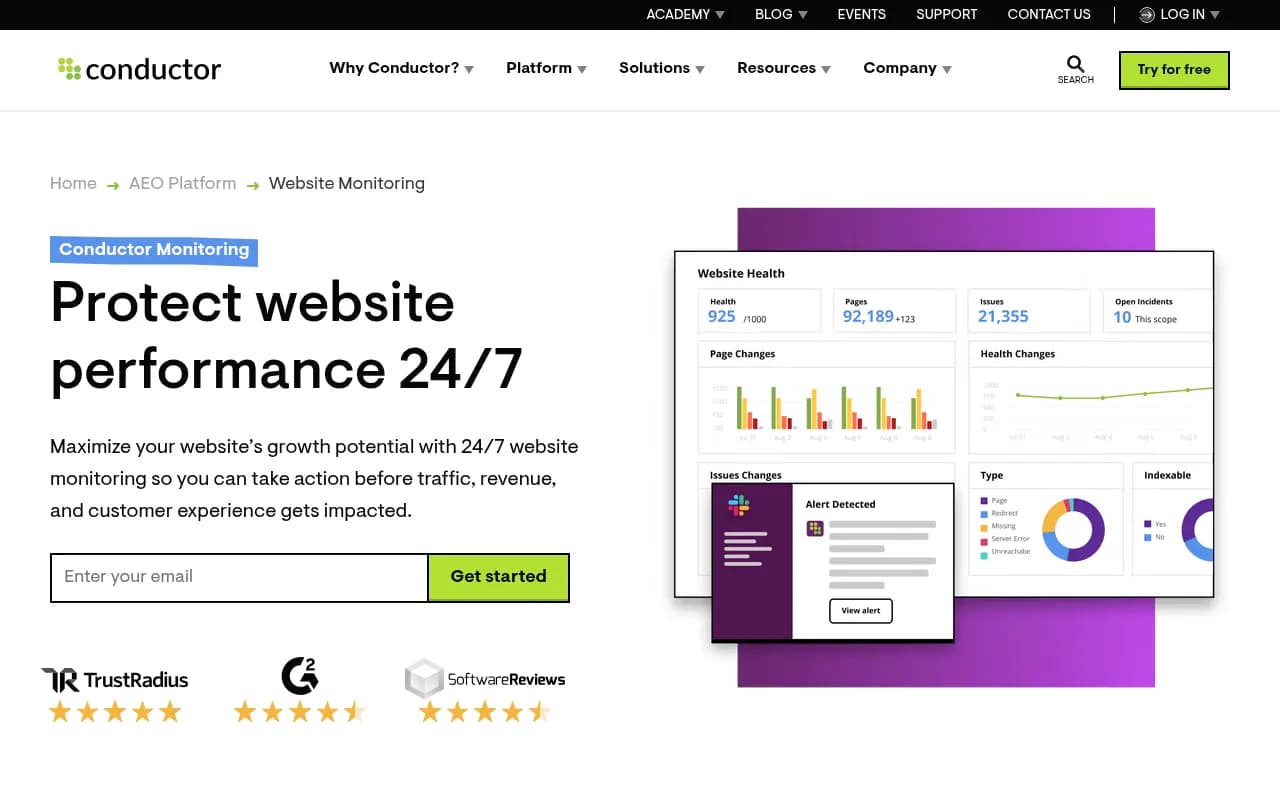
Conductor Website Monitoring (the platform formerly known as ContentKing before its acquisition by Conductor in 2021) is an always-on technical SEO monitoring system designed for organizations where website issues translate directly into revenue loss. While most SEO tools crawl your site periodically -- weekly, daily, or at best hourly -- Conductor Monitoring operates continuously, checking pages in real-time and alerting teams within minutes when problems surface. This matters most for enterprise sites, e-commerce platforms, and publishers where a misconfigured robots.txt or broken structured data can cost tens of thousands in organic traffic before anyone notices.
The platform was built by Bartosz Góralewicz and Vincent van Scherpenseel in 2015 specifically to solve the lag problem in traditional SEO auditing. They recognized that scheduled crawls miss the critical window between when an issue is deployed and when it starts hurting rankings. Conductor acquired ContentKing in 2021 to add real-time monitoring capabilities to its enterprise SEO platform, and the product now operates as "Conductor Website Monitoring" while retaining its core real-time architecture. It's used by brands like Krinal Mehta's team (who reported avoiding $1M+ in traffic loss) and technical SEO teams at major e-commerce and financial services companies.
24/7 Real-Time Monitoring: The core differentiator is continuous monitoring rather than periodic crawling. Conductor Monitoring maintains a persistent connection to your website, checking pages constantly and detecting changes within minutes of deployment. When a developer accidentally adds a noindex tag to a category page or a CMS update breaks your hreflang implementation, you get an alert immediately -- not three days later when your next Screaming Frog crawl runs. The system monitors technical SEO fundamentals (canonicals, redirects, status codes, robots directives, structured data, page speed metrics, mobile usability) plus content changes (title tags, meta descriptions, headings, body content). For enterprise sites with frequent deployments, this real-time layer acts as insurance against the inevitable mistakes that slip through QA.
Intelligent Prioritization by Business Impact: On a site with 500,000 pages, a traditional audit might flag 50,000 issues -- an overwhelming and useless list. Conductor Monitoring automatically prioritizes issues based on business impact, surfacing problems on high-traffic pages or revenue-generating sections first. You can define custom page segments (product pages, blog posts, regional sites, brand microsites) and set different monitoring rules and alert thresholds for each. The platform learns which pages matter most by integrating with Google Analytics and Google Search Console, so it knows that a broken canonical on your top landing page is more urgent than the same issue on an archived blog post from 2018. This intelligent filtering is what makes the tool usable at enterprise scale -- you're not drowning in alerts, you're seeing the 10 issues that actually threaten your traffic.
Custom Element Monitoring for Compliance: Beyond standard technical SEO checks, Conductor Monitoring can track any HTML element or text string on your pages. This is critical for compliance, brand standards, and content governance. Examples: ensuring legal disclaimers appear on all financial product pages, verifying that promotional banners display correctly during a campaign, confirming that pricing information matches approved rates, checking that required accessibility attributes are present. You define the element (CSS selector, XPath, or text pattern), set the pages it should appear on, and get alerted if it goes missing or changes unexpectedly. For regulated industries (finance, healthcare, legal) or brands with strict content standards, this feature alone justifies the platform cost. It's essentially a 24/7 QA team checking that your site stays compliant.
Real-Time Alerting with Customizable Rules: Alerts fire immediately when issues are detected, delivered via email, Slack, or webhook integrations. You control alert sensitivity by setting thresholds (e.g., only alert if more than 50 pages are affected, or if the issue impacts pages with >1,000 monthly visits). Alert rules can be scoped to specific page segments, so your product team only sees alerts about product pages, while your content team monitors blog issues. The changelog view shows exactly what changed, when, and on which pages -- critical for diagnosing root causes. If 500 product pages suddenly lost their structured data, you can see it happened at 2:47 PM and correlate it with a deployment or CMS update. This audit trail is invaluable for large teams where multiple people have site access and changes happen constantly.
Change Tracking and Full Audit Trail: Every modification to your website -- content updates, technical changes, new pages, deleted pages -- is logged with timestamps and before/after comparisons. This creates a complete history of your site's evolution, which is essential for troubleshooting ("What changed right before our traffic dropped?"), compliance audits ("Prove that disclaimer was present on these dates"), and team coordination ("Who removed the canonical tags from these pages?"). The changelog is searchable and filterable, so you can quickly find all changes to a specific page type or element. For enterprise organizations with complex approval workflows and multiple stakeholders, this transparency prevents finger-pointing and speeds up issue resolution.
AI Crawler Monitoring: Conductor Monitoring now tracks AI crawler activity (ChatGPT, Claude, Perplexity, Google AI crawlers) hitting your site, showing which pages AI models are accessing, how often, and whether they're encountering errors. This is increasingly important as AI search engines become traffic sources -- if ChatGPT can't crawl your product pages because of robots.txt blocks or rate limiting, you're invisible in AI-generated recommendations. The platform alerts you to AI crawler errors and helps ensure your content is accessible to these new discovery engines. This feature puts Conductor ahead of traditional SEO tools that only monitor Google's crawlers.
Integration Ecosystem: Conductor Monitoring integrates with Google Analytics and Google Search Console to pull traffic and performance data for impact prioritization. It connects to Slack for real-time alerts, and offers webhook integrations for custom workflows (e.g., automatically creating Jira tickets for detected issues). As part of the broader Conductor platform, it shares data with Conductor's keyword research, content optimization, and rank tracking tools -- so you can see how technical issues correlate with ranking changes and traffic drops. API access is available for enterprise customers who want to build custom dashboards or integrate monitoring data into their own systems.
Enterprise Reporting and Stakeholder Communication: Automated reports can be scheduled and customized for different audiences -- executives get high-level summaries of site health and traffic impact, while technical teams receive detailed issue breakdowns. Reports include trend data showing how site health improves over time as issues are resolved, which is useful for demonstrating SEO team value to leadership. The platform's white-label reporting options make it suitable for agencies managing client sites, though the pricing structure is more enterprise-focused than agency-friendly.
Who This Platform Is Built For:
Conductor Monitoring is designed for enterprise SEO teams, large e-commerce operations, publishers with thousands of pages, and agencies managing high-value client sites. Specific personas: SEO managers at companies with 10,000+ pages where technical issues can cost significant revenue (e-commerce, travel, finance, SaaS), technical SEO specialists who need to monitor complex implementations (international sites with hreflang, JavaScript-heavy sites, headless CMS setups), compliance officers in regulated industries who must ensure legal and brand standards are maintained across all pages, and digital agencies managing enterprise clients where real-time monitoring is a competitive differentiator.
Team size: typically 5+ person marketing or SEO teams, or agencies with dedicated technical SEO resources. Company stage: established businesses with significant organic traffic (100K+ monthly visits) where downtime or technical issues have measurable financial impact. Industries where it particularly shines: e-commerce (monitoring product page templates, pricing accuracy, structured data), financial services (compliance tracking, legal disclaimer monitoring), travel and hospitality (seasonal content updates, promotional campaigns), publishing and media (high-volume content operations, ad implementation monitoring).
Who should NOT use this tool: small businesses with under 1,000 pages (the pricing doesn't make sense and manual audits are sufficient), solo practitioners or freelancers (the cost is prohibitive unless you're managing multiple high-value clients), startups in early stages (focus on content and links first, worry about real-time monitoring later), anyone looking for keyword research or content optimization (Conductor Monitoring is purely technical/monitoring -- you need the full Conductor platform or separate tools for content strategy).
Pricing and Value:
Conductor Monitoring uses tiered subscription pricing based on site size and feature access. Basic plan: $139/month -- covers smaller sites (exact page limits not publicly disclosed but typically 10,000-50,000 pages), includes core monitoring, alerting, and change tracking with unlimited users. Standard plan: $319/month -- adds everything in Basic plus expanded page limits and more advanced segmentation options. Pro plan: $449/month -- includes everything in Standard with higher page limits and priority support. Enterprise plan: $1,279/month -- everything in Pro plus custom page limits (millions of pages), dedicated account management, API access, white-label reporting, and SLA guarantees. All plans include unlimited users, which is valuable for large teams.
Free trial available (typically 14 days). No freemium tier -- this is a paid-only platform. Annual billing discounts are offered but not publicly disclosed (contact sales). Custom pricing available for very large sites or agency partnerships.
How this compares to competitors: Screaming Frog (£149/year or $259/year for unlimited crawls) is far cheaper but requires manual crawls and lacks real-time monitoring. Sitebulb (£35/month or $43/month) is similarly manual. OnCrawl (starting around €79/month or $85/month) offers scheduled crawls but not true real-time monitoring. Botify (enterprise pricing, typically $500-2000+/month) is the closest competitor with real-time capabilities but focuses more on log file analysis and is priced even higher. Lumar (formerly DeepCrawl, enterprise pricing) offers scheduled crawls and some monitoring but isn't as real-time focused.
Value assessment: For the target audience (enterprise sites where technical issues cost real money), Conductor Monitoring delivers clear ROI. The testimonial from Krinal Mehta's team claiming $1M+ in avoided traffic loss is credible -- a single incident where a noindex tag hits your top 100 landing pages for even 24 hours can cost that much in lost revenue for a large e-commerce site. The pricing is high for small sites but reasonable for enterprises. The main value isn't just catching issues (which cheaper tools can do on a schedule) but catching them immediately and prioritizing them intelligently so large teams can act fast.
Strengths:
• True real-time monitoring: The only platform in its price range that continuously monitors rather than crawling on a schedule. This speed advantage is critical for enterprise sites with frequent deployments. • Intelligent prioritization at scale: Automatically surfaces high-impact issues first, making the tool usable on sites with millions of pages and thousands of potential issues. • Custom element tracking: The ability to monitor any HTML element or text string for compliance and brand standards goes beyond what traditional SEO tools offer. • Complete audit trail: Full changelog of every site modification with timestamps and before/after comparisons is invaluable for troubleshooting and compliance. • AI crawler monitoring: Ahead of competitors in tracking how AI search engines interact with your site, increasingly important as ChatGPT and Perplexity become traffic sources.
Limitations:
• Premium pricing excludes smaller sites: At $139/month minimum, this is out of reach for small businesses, solo practitioners, and startups. The ROI only makes sense for sites where technical issues have significant financial impact. • Monitoring-only focus: Conductor Monitoring doesn't help with keyword research, content strategy, link building, or rank tracking unless you buy the full Conductor platform. It's purely technical monitoring and alerting. • Learning curve for advanced features: Setting up custom segments, alert rules, and element monitoring requires technical SEO knowledge. Not as plug-and-play as simpler audit tools. • Limited agency-friendly features: While white-label reporting exists in enterprise plans, the pricing structure and feature set are more enterprise-focused than agency-optimized. Agencies managing many small client sites will find the per-site cost prohibitive.
Bottom Line:
Conductor Website Monitoring is the right choice for enterprise SEO teams, large e-commerce operations, and agencies managing high-value clients where real-time issue detection prevents significant revenue loss. If your site has 10,000+ pages, frequent deployments, and organic traffic that drives meaningful revenue, the platform pays for itself by catching critical issues before they impact rankings. The intelligent prioritization and custom element monitoring make it usable at scale, while the complete audit trail and AI crawler tracking provide capabilities that traditional SEO tools lack. However, smaller sites, solo practitioners, and teams focused primarily on content strategy rather than technical monitoring should look at more affordable alternatives like Screaming Frog or Sitebulb. Best use case in one sentence: Enterprise technical SEO teams managing large, complex sites where a single technical mistake can cost tens of thousands in lost organic traffic.
Tags:
Similar and alternative tools to ContentKing