Clay Review 2026
Combines data enrichment, prospecting, and workflow automation to help GTM teams build targeted lead lists and automate outbound sales processes.
Key Takeaways:
• Best for: Sales teams, RevOps, and marketers at B2B companies (especially SaaS) who need comprehensive data enrichment and automated prospecting workflows • Standout strength: Access to 150+ data providers in one platform with waterfall enrichment, eliminating the need for multiple point solutions • AI capabilities: Claygent AI agents can research prospects, navigate gated forms, and find unique data points that traditional enrichment tools miss • Pricing: Starts at $134/month (annual) or $149/month (monthly) for Starter plan; credit-based system for data usage • Notable limitation: Steeper learning curve than simpler enrichment tools, though extensive community support helps
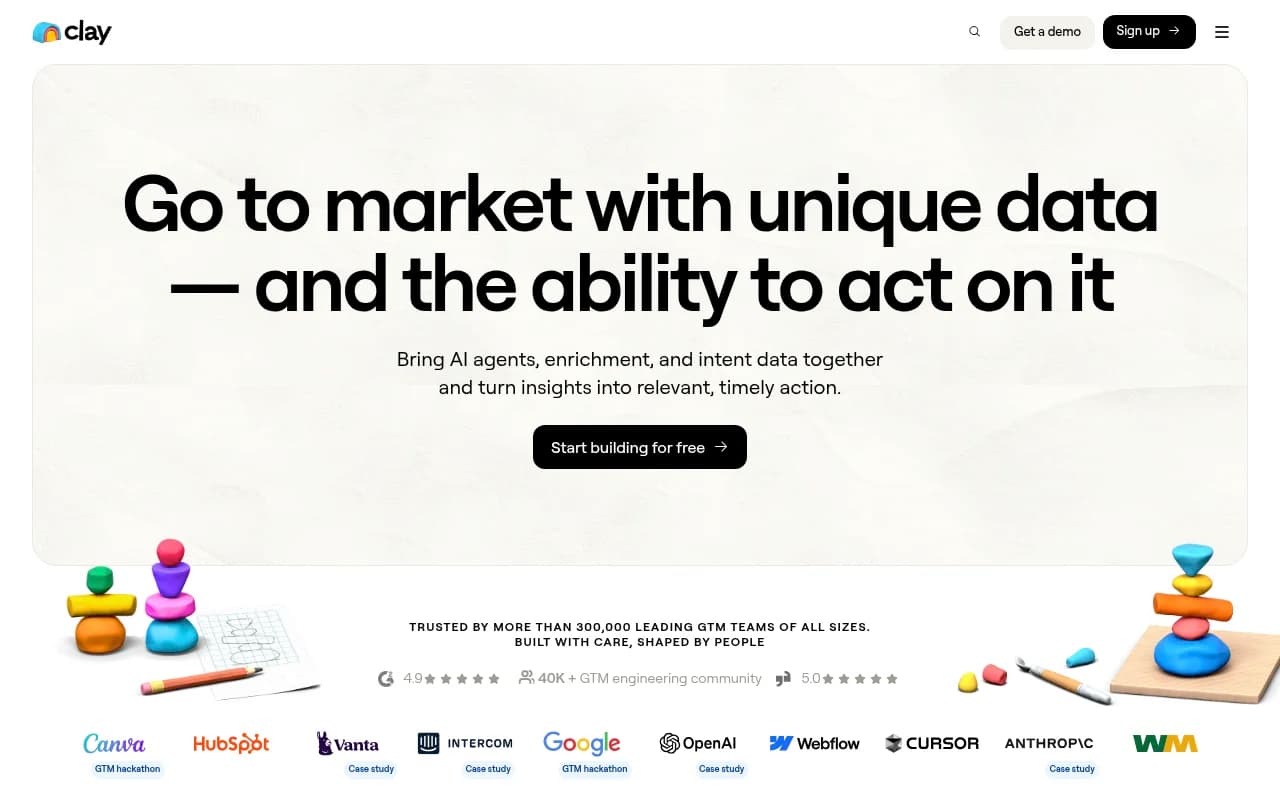
Clay has emerged as one of the most comprehensive data enrichment and GTM automation platforms in the B2B sales tech stack. Founded to solve the fragmentation problem in sales data tools, Clay consolidates access to over 150 premium data providers, AI-powered research agents, and workflow automation into a single interface. The platform is used by more than 300,000 GTM professionals at companies ranging from early-stage startups to enterprises like OpenAI, Anthropic, Google, Notion, and Rippling.
What sets Clay apart is its approach to data enrichment: instead of relying on a single database, it lets you query multiple providers in sequence (waterfall enrichment) to maximize coverage. If one provider doesn't have a phone number or email, Clay automatically tries the next one. This approach has helped customers like Anthropic triple their data enrichment rates from the low 40% range to over 80%.
The platform combines three core capabilities: data enrichment from premium providers, AI-powered research through Claygent agents, and workflow automation that connects to your entire GTM stack. It's designed for teams who want to move beyond basic list building and create sophisticated, multi-step prospecting workflows that would traditionally require engineering resources.
Data Enrichment: 150+ Providers in One Platform
Clay's primary value proposition is consolidating access to the entire data enrichment ecosystem. Instead of managing separate subscriptions to ZoomInfo, Apollo, Clearbit, Hunter, and dozens of other providers, you access them all through Clay's unified interface.
Waterfall Enrichment: This is Clay's killer feature. You set up a sequence of data providers to query in order. If Provider A doesn't have an email address, Clay automatically tries Provider B, then C, and so on. This dramatically increases data coverage compared to using a single provider. Customers report enrichment rates jumping from 40-50% with single providers to 80-90% with Clay's waterfall approach.
150+ Data Sources: Clay integrates with virtually every major B2B data provider including Apollo, ZoomInfo, Clearbit, Hunter, RocketReach, Lusha, Kaspr, Cognism, LeadIQ, and many more. You can also connect your own API keys for providers you already subscribe to, or use Clay's built-in credits to access providers you don't have direct relationships with.
Company & Contact Data: Enrich records with firmographics (company size, industry, revenue, funding, tech stack), contact information (emails, phone numbers, social profiles), job changes, hiring signals, and more. Clay pulls from multiple sources to give you the most complete picture possible.
Intent Signals: Monitor buying signals like job changes, company funding rounds, website visits, social media mentions, and technology adoption. Clay can trigger workflows automatically when these signals fire, enabling timely outreach.
Custom Data Sources: Beyond standard providers, Clay offers web scraping capabilities, Google search integration, and the ability to connect any API. This means you can pull data from industry-specific databases, public records, or proprietary sources that competitors can't access.
AI-Powered Research with Claygent
Claygent is Clay's AI research agent that goes beyond traditional data enrichment. While standard enrichment tools query databases, Claygent can actually browse the web, navigate forms, and synthesize information like a human researcher would.
Web Research at Scale: Claygent can visit company websites, read blog posts, analyze LinkedIn profiles, and extract specific information you're looking for. For example, you can ask it to determine if a company uses a specific technology, identify their main competitors, or find the name of their head of sales.
Gated Content Navigation: Unlike traditional scrapers, Claygent can navigate forms and gated content to access information that would normally require manual research. This is particularly useful for finding contact information on company websites or accessing industry directories.
Custom AI Agents: You can build and version multiple Claygent agents for different research tasks, then reuse them across workflows. This ensures consistency when scaling research across thousands of prospects.
MCP Server Integration: Clay recently added support for Model Context Protocol (MCP) servers, allowing Claygent to connect to tools like Salesforce, Gong, Google Docs, and other business systems. This means your AI agents can enrich data with context from your own CRM, call recordings, or internal documents.
Sculptor AI Assistant: Clay's newest AI feature is Sculptor, a conversational interface for building workflows. You can describe what you want to accomplish in plain English, and Sculptor will generate the table structure, enrichment steps, and logic needed. It's like having a Clay expert helping you build.
Workflow Automation & Orchestration
Clay isn't just about getting data—it's about putting that data into action through automated workflows.
Visual Workflow Builder: Clay uses a spreadsheet-like interface where each column represents a step in your workflow. You can chain together data enrichment, AI research, conditional logic, formatting, and integrations without writing code. It's more flexible than no-code tools like Zapier but more accessible than writing Python scripts.
Conditional Logic: Run different enrichment steps based on any criteria. For example, use different phone number providers for US vs. international contacts, or only enrich contacts at companies with 50+ employees. Clay's conditional logic lets you build sophisticated decision trees without engineering.
AI Formatting: Use AI to clean and format data automatically. Concatenate fields, remove emojis and special characters, ensure consistent formatting, or transform data into specific formats (like converting company names to email domains).
CRM Sync & Destinations: Push enriched data to Salesforce, HubSpot, Pipedrive, or any other CRM on a recurring basis. Clay can also send data to email sequencers (Outreach, Salesloft, Instantly), ad platforms (LinkedIn, Google), data warehouses (Snowflake, BigQuery), or any tool with an API via HTTP requests.
Native Email Sequencer: Clay includes a built-in email sequencer so you can launch outbound campaigns directly from enriched lists without needing a separate tool. It supports multi-step sequences, A/B testing, and personalization using any data in your Clay table.
Scheduled Runs: Set workflows to run automatically on a schedule (daily, weekly, etc.) to continuously monitor for new leads, update CRM records, or trigger outreach when intent signals fire.
Who Is Clay For?
Clay is built for B2B GTM teams who need comprehensive data enrichment and want to automate complex prospecting workflows. It's particularly strong for:
Sales Development Teams (5-50 SDRs): Teams running high-volume outbound campaigns who need maximum data coverage and want to automate list building, enrichment, and sequencing. Clay eliminates the manual research that typically consumes 50%+ of SDR time.
Revenue Operations: RevOps teams responsible for CRM data quality, lead routing, account scoring, and GTM infrastructure. Clay can automatically enrich inbound leads, maintain CRM data hygiene, and build dynamic audience segments based on intent signals.
Growth Marketers: Marketers running account-based marketing campaigns, building targeted ad audiences, or personalizing website experiences. Clay's ability to combine firmographic data, intent signals, and AI research enables highly targeted campaigns.
Agencies: Marketing and sales agencies managing prospecting for multiple clients. Clay's template system and ability to clone workflows makes it easy to replicate successful campaigns across clients.
Enterprise Sales Teams: Large sales organizations at companies like OpenAI, Anthropic, Google, and Rippling use Clay to automate territory planning, account research, and personalized outreach at scale.
Clay is less suitable for very small teams (1-2 people) who just need basic email finding and would be better served by simpler tools like Hunter or Apollo. It's also not ideal for teams that need a fully managed service—Clay requires someone to build and maintain workflows, though the learning curve has improved significantly with Sculptor AI and extensive documentation.
Integrations & Ecosystem
Clay's integration ecosystem is one of its strongest assets. The platform connects to virtually every tool in the modern GTM stack:
CRMs: Salesforce, HubSpot, Pipedrive, Close, Copper, and others. Two-way sync keeps data flowing between Clay and your CRM.
Email & Sequencing: Outreach, Salesloft, Apollo, Instantly, Lemlist, Smartlead, and more. Plus Clay's native sequencer.
Data Providers: 150+ including Apollo, ZoomInfo, Clearbit, Hunter, RocketReach, Lusha, Kaspr, Cognism, LeadIQ, Seamless.ai, ContactOut, and many more.
Intent Data: Bombora, 6sense, Clearbit Reveal, Koala, and custom website visitor tracking.
Ad Platforms: LinkedIn Ads, Google Ads, Facebook Ads for building custom audiences.
Productivity Tools: Slack (for alerts), Google Sheets, Airtable, Notion.
Developer Tools: HTTP API for custom integrations, webhooks, and MCP server support for connecting to any business system.
Community: Clay has a 40,000+ member Slack community that's incredibly active. It's one of the best resources for learning the platform, getting workflow ideas, and troubleshooting issues.
Pricing & Value
Clay uses a credit-based pricing model where you pay for the platform subscription plus credits for data usage.
Free Plan: Available with limited credits to test the platform. Good for learning and small experiments.
Starter Plan: $134/month (annual) or $149/month (monthly). Includes more credits and access to core features. Suitable for small teams or individuals running modest outbound volumes.
Explorer Plan: Mid-tier plan with higher credit limits and additional features. Pricing available on request.
Pro Plan: For teams running high-volume campaigns. Includes priority support and higher rate limits.
Enterprise Plan: Custom pricing for large organizations. Includes dedicated support, SSO, advanced security features, and volume discounts on credits.
Credit System: Clay uses credits for data enrichment operations. Different providers cost different amounts of credits. For example, finding an email might cost 1-3 credits, while a comprehensive company enrichment might cost 10-20 credits. You can purchase additional credit packs as needed.
The value proposition is compelling for teams currently paying for multiple data tools. Instead of separate subscriptions to ZoomInfo ($15k+/year), Clearbit ($10k+/year), and other providers, you get access to all of them through Clay's unified platform. Customers report significant cost savings by consolidating their data stack.
That said, Clay can get expensive at high volumes. Teams running large campaigns (100k+ enrichments/month) should carefully model credit usage. The platform is most cost-effective when you're replacing multiple existing tools.
Strengths
Unmatched Data Coverage: The waterfall enrichment approach and access to 150+ providers means you'll find data that single-provider tools miss. Customers consistently report 2-3x improvement in enrichment rates.
Flexibility: Clay's workflow builder can handle virtually any GTM use case from simple list building to complex multi-step campaigns with conditional logic, AI research, and cross-platform orchestration.
AI Innovation: Claygent and Sculptor represent genuinely useful applications of AI for GTM work, not just buzzword features. The ability to do custom research at scale is a game-changer.
Active Community: The 40k+ member Slack community is incredibly valuable. You can find templates, get help, and learn from other users' workflows.
Continuous Improvement: Clay ships new features and integrations constantly. The product evolves faster than most competitors.
Limitations
Learning Curve: Clay is more complex than simple enrichment tools. While Sculptor AI helps, there's still a learning curve to build sophisticated workflows. Plan on spending time in the documentation and community.
Credit Management: The credit system requires monitoring and budgeting. It's easy to burn through credits quickly if you're not careful about which providers you're using and how you structure waterfall logic.
Not a Full CRM: Clay is designed to enrich data and trigger actions, not replace your CRM. You'll still need Salesforce, HubSpot, or similar for deal management and sales workflows.
Bottom Line
Clay has established itself as the go-to platform for B2B teams who are serious about data-driven GTM. If you're currently juggling multiple data providers, spending hours on manual research, or struggling with low enrichment rates, Clay is worth evaluating. The combination of 150+ data sources, AI research capabilities, and flexible workflow automation is unmatched in the market.
Best use case in one sentence: B2B sales and marketing teams at SaaS companies who need maximum data coverage and want to automate complex prospecting workflows without engineering resources.
The platform is particularly compelling for teams that have outgrown simple tools like Apollo or Hunter but don't want the complexity and cost of enterprise solutions like ZoomInfo. With strong adoption at leading tech companies and an active community, Clay has become essential infrastructure for modern GTM teams.
Tags:
Similar and alternative tools to Clay