Metadata.io Review 2026
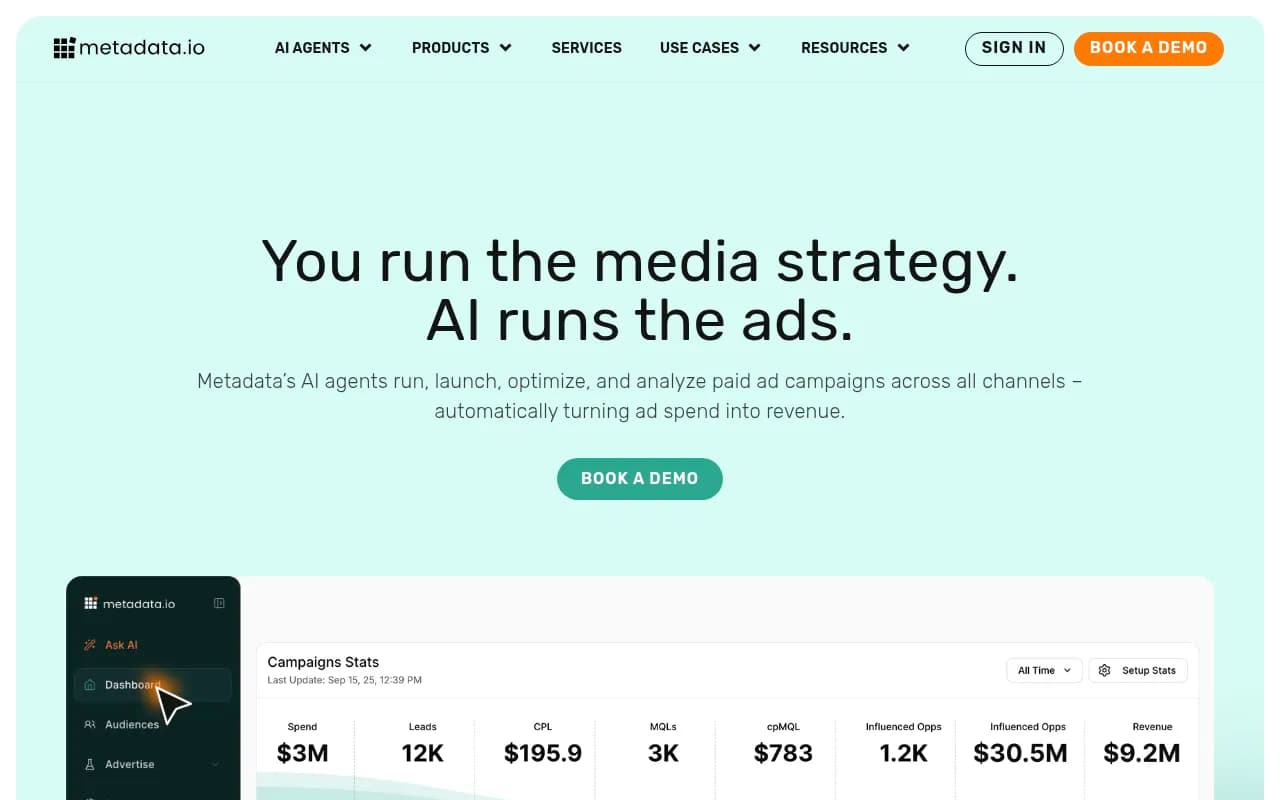
Metadata.io is an AI-driven B2B marketing automation platform that runs, optimizes, and analyzes paid ad campaigns across LinkedIn, Google, Meta, Reddit, and more. Built for demand gen teams and performance marketers, it automates targeting, bidding, creative testing, and budget allocation while con
Key Takeaways
- Metadata.io automates the entire paid campaign workflow with AI agents that handle targeting, bidding, creative testing, and budget optimization across LinkedIn, Meta, Google, and Reddit—freeing up hours of manual work each week
- Unlike monitoring-only platforms, Metadata connects directly to Salesforce and HubSpot to optimize campaigns toward pipeline and revenue, not just vanity metrics like CPL or CPC
- MetaMatch audience engine uses 1.5 billion matched emails and 10+ data partners to build ultra-targeted B2B audiences with higher match rates than native platforms
- Pricing starts at $20,000/year for the Spotlight plan, positioning it as an enterprise solution for mid-market and large B2B companies running serious paid media budgets
- Best for B2B demand gen teams, performance marketers, and agencies managing multi-channel campaigns who want to scale results without scaling headcount
Metadata.io is a B2B marketing automation platform that uses AI agents to run paid advertising campaigns across multiple channels. Founded to solve the problem of manual campaign management and disconnected performance data, it's used by companies like Zoom, Docebo, Eightfold, and Automation Anywhere to automate everything from audience building to bid optimization to revenue attribution. The platform sits at the center of your paid media stack, connecting ad platforms (LinkedIn, Meta, Google, Reddit) with your CRM and marketing automation platform to optimize campaigns based on what actually drives pipeline and closed-won deals.
The target audience is B2B demand generation teams, performance marketers, and paid media managers at mid-market to enterprise companies—typically those spending $10K+ per month on paid ads and looking to improve efficiency without hiring more headcount. It's particularly strong for companies running account-based marketing (ABM) campaigns or those who need to prove ROI to the C-suite with revenue attribution, not just lead volume.
AI Agents That Actually Do the Work
Metadata's core differentiator is its collection of AI agents that automate specific parts of the campaign workflow. These aren't chatbots or copilots—they're autonomous systems that execute tasks 24/7 without human intervention.
Bid Agent monitors LinkedIn campaign performance in real time and automatically adjusts bids to hit your target cost-per-lead or cost-per-opportunity. Instead of manually tweaking bids every few hours (or letting LinkedIn's algorithm optimize for the wrong goal), Bid Agent uses historical performance data and real-time signals to find the optimal bid for each campaign. Customers report 35% lower CPM compared to industry averages and significant reductions in cost-per-MQL.
Targeting Agent builds and refines audiences across all channels using Metadata's proprietary MetaMatch engine (more on that below). It automatically tests different audience segments, identifies which ones drive the best results, and reallocates budget accordingly. You can layer in firmographic filters (company size, industry, revenue), technographic data (what tools they use), and intent signals from partners like 6sense, G2, Bombora, and Qualified.
Analyst Agent translates raw ad data into actionable insights. Instead of exporting CSVs and building pivot tables, Analyst Agent surfaces what's working and what's not—across campaign names, budget groups, channels, offers, and audiences. It highlights underperforming segments, recommends budget shifts, and flags opportunities to scale winning campaigns. The goal is to give you the insights you'd get from a full-time analyst without the headcount.
Campaign Execution Agent handles the grunt work of launching campaigns: uploading creatives, setting up tracking parameters, configuring audience targeting, and syncing everything across platforms. Metadata's Campaign Upload feature lets you bulk-create campaigns from a spreadsheet, which is a huge time-saver if you're running dozens of experiments or managing multiple clients.
The platform also runs multivariate testing (MVT) at scale, testing every combination of creative, audience, offer, and channel to find what drives results. Most marketers run A/B tests one variable at a time; Metadata tests everything simultaneously and uses statistical models to isolate what's actually moving the needle.
MetaMatch: The Audience Engine That Makes B2B Targeting Work
MetaMatch is Metadata's patented B2B audience matching technology, and it's one of the biggest reasons customers see better performance than running campaigns natively. The problem it solves: platforms like Facebook and Instagram are built for B2C, not B2B. You can't target by job title or company size the way you can on LinkedIn. MetaMatch bridges that gap by matching personal email addresses to business identities across 1.5 billion records, then uploading those matched audiences to Meta, Google, and other platforms.
Here's how it works in practice. You upload a list of target accounts from Salesforce or a CSV. MetaMatch enriches that list with additional contact data, matches personal emails to business profiles, and creates a custom audience on Meta or Google with a much higher match rate than you'd get uploading the list directly. You can also build audiences from scratch using firmographic filters (company size, industry, revenue), technographic data (what software they use), and intent signals (who's researching your category on G2 or visiting your website).
MetaMatch integrates with 10+ data providers including ZoomInfo, Clearbit, 6sense, Bombora, and G2 Buyer Intent. This means you can target companies showing active buying signals—like researching competitors or reading comparison pages—and reach them on channels where they're already spending time, not just LinkedIn.
The result: higher match rates, better lead quality, and more efficient spend. Customers report 2-3x higher match rates on Meta compared to uploading lists natively, which translates to lower CPMs and more impressions delivered to the right people.
Revenue Optimization: Campaigns That Optimize to Closed-Won Deals
Most ad platforms optimize to clicks, impressions, or conversions. Metadata optimizes to revenue. It connects directly to your CRM (Salesforce, HubSpot) and marketing automation platform (Marketo, Pardot, HubSpot Marketing Hub) to track every lead from first impression to closed-won deal. Then it uses that revenue data to automatically shift budget toward campaigns, audiences, and creatives that drive pipeline—not just form fills.
Here's what that looks like in practice. Let's say you're running five LinkedIn campaigns targeting different personas. Campaign A generates 50 leads at $100 CPL. Campaign B generates 30 leads at $150 CPL. Most marketers would double down on Campaign A because it has the lower cost-per-lead. But if you connect Metadata to Salesforce, you might discover that Campaign B's leads convert to opportunities at 3x the rate and close at 2x the average deal size. Metadata's revenue optimization engine sees that and automatically reallocates budget from Campaign A to Campaign B—even though Campaign B has a higher CPL.
This is the core insight that separates Metadata from native platforms and most marketing automation tools: optimizing to leads is optimizing to the wrong goal. What matters is pipeline and revenue. Metadata is built around that principle from the ground up.
You can set custom KPIs based on what matters to your business: cost-per-opportunity, cost-per-SQL, pipeline influenced, or even cost-per-closed-won deal. Metadata's AI continuously adjusts bids, budgets, and audience targeting to hit those goals. It's not just reporting on revenue—it's actively optimizing toward it.
Integrations and Ecosystem
Metadata integrates with the tools B2B marketers already use. On the CRM side: Salesforce and HubSpot. For marketing automation: Marketo, Pardot, and HubSpot Marketing Hub. Ad platforms: LinkedIn, Meta (Facebook and Instagram), Google (Search and Display), Reddit, with Bing in development. Intent data providers: 6sense, G2, Bombora, Qualified, and others.
The platform also offers a REST API for custom integrations and data exports. You can pull campaign performance data into your own dashboards or push audience lists from internal systems into Metadata for targeting. There's also a Looker Studio connector if you want to build custom reports.
Metadata handles tracking and attribution through direct integrations with your CRM and MAP. You don't need to set up UTM parameters manually or rely on last-touch attribution—Metadata tracks the full customer journey from first ad impression to closed deal and attributes revenue accordingly. It also offers a JavaScript snippet for tracking website visitors and syncing that data back to your CRM.
Who Is It For
Metadata is built for B2B companies with serious paid media budgets—typically $10K+ per month—who want to scale results without scaling headcount. The ideal customer is a demand gen team at a mid-market or enterprise SaaS company, a performance marketing team at a high-growth B2B startup, or an agency managing paid campaigns for multiple clients.
Specific personas who get the most value:
- Demand gen managers at companies with 100-1000 employees who are tired of manually optimizing bids and building audiences in five different platforms
- Performance marketers who need to prove ROI to the CFO and want revenue attribution, not just lead volume
- Paid media managers running multi-channel campaigns (LinkedIn + Meta + Google) who spend 10+ hours per week on manual optimization
- ABM teams targeting specific accounts and need hyper-targeted audience building with intent data layered in
- Agencies managing paid campaigns for multiple B2B clients who want to deliver better results without hiring more media buyers
Company stage: Metadata works best for Series B+ startups, mid-market companies, and enterprises. Early-stage startups with limited budgets (under $5K/month) will find the pricing prohibitive. Companies spending $50K+ per month on paid ads see the most dramatic ROI because the time savings and performance improvements compound at scale.
Industries where it shines: SaaS, enterprise software, HR tech, martech, fintech, and any B2B company with a complex sales cycle and high customer lifetime value. If you're selling a $50K+ ACV product with a 3-6 month sales cycle, Metadata's revenue optimization makes a huge difference.
Who should NOT use Metadata: B2C companies, local businesses, early-stage startups with tiny budgets, or anyone who doesn't have a CRM and marketing automation platform already set up. Metadata's value comes from connecting ad performance to revenue data—if you don't have that infrastructure, you're paying for features you can't use.
Pricing and Value
Metadata.io pricing starts at $20,000 per year for the Spotlight plan, which is designed for growing B2B companies. There are higher-tier plans for larger enterprises with more complex needs, but specific pricing isn't publicly listed—you need to book a demo to get a custom quote based on ad spend, number of channels, and feature requirements.
The $20K/year entry point positions Metadata as an enterprise solution, not a self-serve tool. For context, that's roughly $1,667 per month, which is comparable to hiring a junior media buyer for 10-15 hours per week—except Metadata works 24/7 and optimizes faster than any human could.
There's no free trial listed on the website, but the company offers demos where they'll walk through the platform and show how it would work with your specific use case. Most customers see improved performance within days of launching their first campaigns, according to case studies on the site.
How does pricing compare to competitors? Metadata is in the same ballpark as platforms like 6sense, Demandbase, and RollWorks—all of which start around $20K-$30K per year for mid-market plans. The difference is that Metadata focuses specifically on paid campaign automation, while those platforms offer broader ABM suites (website personalization, intent data, account scoring). If you only need paid media automation and don't want to pay for features you won't use, Metadata is a better fit.
Is it good value? If you're spending $10K+ per month on paid ads, the ROI case is strong. Customers report 24% reductions in cost-per-lead, 86% reductions in cost-per-MQL, and 177% increases in influenced revenue. Even a 10% improvement in campaign efficiency would pay for the platform several times over at that spend level. The bigger value is the time savings—most customers report getting back 10-20 hours per week that they were spending on manual bid adjustments, audience uploads, and performance reporting.
Strengths and Limitations
What Metadata does exceptionally well:
- True automation, not just dashboards. Most marketing platforms show you data and leave you to act on it. Metadata's AI agents actually execute the optimizations—adjusting bids, reallocating budgets, and refining audiences without human intervention.
- Revenue optimization, not just lead optimization. By connecting directly to your CRM, Metadata optimizes campaigns based on what drives pipeline and closed deals, not just form fills. This is a fundamental shift in how B2B paid media works.
- MetaMatch audience engine. The ability to target B2B audiences on Meta and Google with the same precision you'd get on LinkedIn is a game-changer for companies that want to diversify beyond LinkedIn's high CPMs.
- Multivariate testing at scale. Most marketers run one A/B test at a time. Metadata tests every combination of creative, audience, offer, and channel simultaneously, then uses statistical models to find what works.
- Time savings. Customers consistently report getting back 10-20 hours per week that they were spending on manual campaign management. For a demand gen team of 2-3 people, that's like adding a full-time headcount without the salary.
Honest limitations:
- High price point. At $20K/year minimum, Metadata is out of reach for early-stage startups and small businesses. You need to be spending at least $10K/month on paid ads to justify the cost.
- Requires existing infrastructure. Metadata's value comes from connecting ad performance to CRM data. If you don't have Salesforce or HubSpot set up with clean lead tracking and revenue attribution, you won't get the full benefit.
- Limited channel support. Metadata currently supports LinkedIn, Meta, Google, and Reddit. If you're running paid campaigns on TikTok, Quora, or niche B2B platforms, you'll need to manage those separately. Bing is in development but not live yet.
- Learning curve. While the platform automates a lot, there's still a learning curve to set up campaigns correctly, configure revenue tracking, and interpret the AI's recommendations. Most customers work with Metadata's customer success team during onboarding to get everything dialed in.
Bottom Line
Metadata.io is the best option for B2B demand gen teams and performance marketers who are tired of manually optimizing paid campaigns and want to prove ROI with revenue attribution, not just lead volume. If you're spending $10K+ per month on LinkedIn, Meta, and Google ads, the time savings and performance improvements will pay for the platform several times over. The AI agents handle the grunt work—bid adjustments, audience refinement, budget allocation—so you can focus on strategy and creative.
Best use case in one sentence: Mid-market to enterprise B2B companies running multi-channel paid campaigns who want to scale results without scaling headcount and need to optimize toward pipeline and revenue, not just cost-per-lead.
Tags:
Frequently asked questions
What is Metadata.io and what does it do?
How much does Metadata.io cost?
Who is Metadata.io best for?
What ad platforms does Metadata.io integrate with?
How does Metadata.io differ from other marketing automation platforms?
Does Metadata.io offer a free plan?
What tasks does Metadata.io automate?
Can Metadata.io help with revenue attribution?
Similar and alternative tools to Metadata.io