ZoomInfo Review 2026
Offers comprehensive company and contact-level data with intent signals to help sales teams identify and engage high-value prospects.
Key Takeaways:
- Comprehensive B2B data platform with 250M+ verified contacts and company profiles, plus AI-powered intent signals and buying committee mapping
- All-in-one GTM execution system that unifies prospecting, engagement automation, data enrichment, and pipeline intelligence in one platform
- Best for mid-market to enterprise sales teams (10+ reps) who need scale, accuracy, and deep account intelligence - not ideal for solopreneurs or early-stage startups on tight budgets
- Premium pricing with seat-based model starting around $15K-$20K+ annually for small teams - significant investment but ROI-positive for teams closing $50K+ deals
- Proven results: customers report 40-54% increases in engagement, 43% more qualified pipeline, and 50% faster prospecting
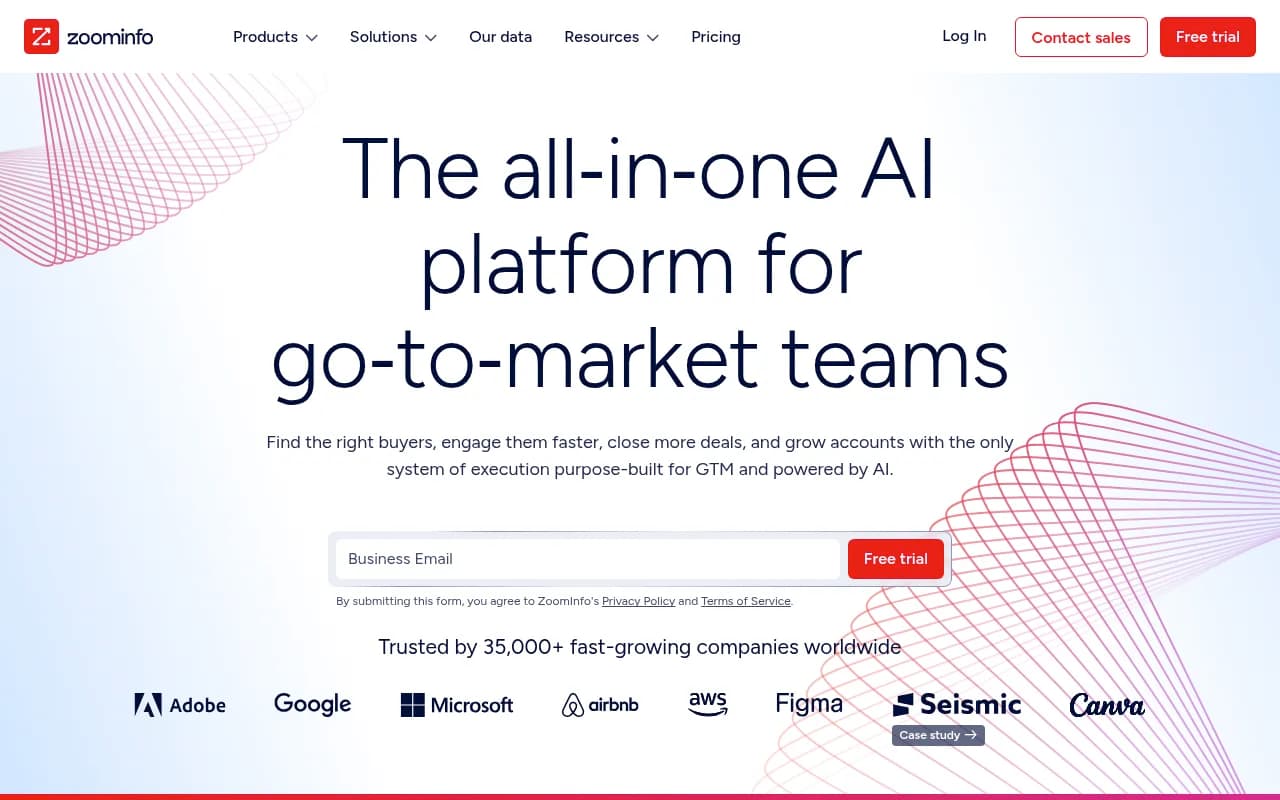
ZoomInfo has become the dominant player in B2B sales intelligence, and for good reason. This isn't just a contact database - it's a full go-to-market execution platform that combines the world's most comprehensive business data with AI-powered workflows that help revenue teams find, engage, and close their ideal customers. With 35,000+ companies using the platform (including Adobe, Microsoft, AWS, and Databricks), ZoomInfo has evolved from a simple lead generation tool into an essential system of record for modern GTM teams.
The platform was founded in 2000 and went public in 2020 (NASDAQ: ZI). Over the past few years, ZoomInfo has aggressively expanded beyond contact data into intent signals, conversation intelligence (via Chorus acquisition), sales engagement automation, and most recently, generative AI with ZoomInfo Copilot. The company now processes over 1 billion data points daily and maintains profiles on 250+ million professionals and 100+ million companies globally.
ZoomInfo targets mid-market to enterprise B2B companies with dedicated sales and marketing teams. If you're a SaaS company with 10+ sales reps, an agency managing multiple clients, or an enterprise sales org selling complex solutions with 6-12 month cycles, this platform is built for you. Solo founders, early-stage startups with <5 employees, or companies selling low-ticket B2C products will find the pricing prohibitive and the feature set overkill.
The B2B Data Foundation: More Than Just Contact Info
At its core, ZoomInfo maintains the largest proprietary database of business contacts and company intelligence in the market. But calling it a "contact database" undersells what you actually get. The platform tracks:
Contact-level data including direct dial phone numbers, verified email addresses (with deliverability scoring), mobile numbers, job titles, reporting structure, tenure, education, social profiles, and professional background. Unlike scraped LinkedIn data that goes stale in weeks, ZoomInfo uses a combination of machine learning, public records, contributory network data (from users who opt-in to share their contact data), and a team of researchers to verify and update records continuously. The company claims 95%+ accuracy on contact data, and in practice, bounce rates are significantly lower than tools like Apollo or Lusha.
Company intelligence goes far beyond basic firmographics. You get employee count, revenue estimates, growth trends, funding history, tech stack (technographics tracking 20,000+ technologies), office locations, subsidiary relationships, parent company structures, industry classifications, and even hiring velocity signals. For example, if a company just raised a Series B and is hiring 15 sales reps, ZoomInfo surfaces that as a buying signal - they're likely investing in growth tools.
Organizational charts and buying committees are where ZoomInfo really shines. The platform maps out reporting structures so you can see who reports to whom, identify decision-makers, and build multi-threaded relationships. When selling enterprise deals, knowing that the VP of Sales reports to the CRO who reports to the CEO (and having contact info for all three) is game-changing. You can also see "recommended contacts" based on similar deals - if companies like yours typically involve IT, Finance, and Operations in the buying process, ZoomInfo will surface those personas automatically.
Intent Signals and Buying Intelligence
ZoomInfo's intent data is sourced from multiple streams: website visitor tracking (via ZoomInfo's pixel), content consumption signals across a network of 10,000+ B2B sites, job posting analysis, technographic changes (e.g. a company just adopted Salesforce, signaling they might need sales tools), funding announcements, executive moves, and keyword-based intent (tracking when companies research specific topics related to your solution).
The platform scores accounts based on intent strength and recency. You can set up alerts to notify reps when a target account shows high intent, visits your pricing page, or experiences a trigger event like a new CMO hire. This is particularly powerful for account-based marketing (ABM) - instead of cold outreach, you're reaching out when prospects are actively researching solutions.
One standout feature: Scoops, which are AI-generated news alerts about your target accounts. These include funding rounds, executive changes, office expansions, product launches, partnerships, and other events that create buying opportunities. Reps can use Scoops as conversation starters ("Congrats on the Series B - are you scaling your sales team?") rather than generic cold emails.
ZoomInfo Copilot: AI-Powered GTM Execution
Launched in 2024, ZoomInfo Copilot is the company's generative AI layer that sits on top of the data platform. It's not a chatbot - it's an AI agent that automates research, prioritization, and outreach tasks that normally take hours.
Copilot can generate account summaries ("Here's everything you need to know about Acme Corp before your call"), draft personalized emails based on intent signals and account context, suggest next-best actions ("This account just hired a new VP of Sales - reach out with this message"), build target account lists based on natural language queries ("Show me Series B SaaS companies in fintech with 50-200 employees using Salesforce"), and even create multi-step sequences with personalized messaging for each contact.
The AI is trained on ZoomInfo's proprietary data, so it has context that generic LLMs like ChatGPT don't. For example, it knows which companies are growing fast, which are contracting, which technologies they use, and which executives just changed roles. This makes the AI's recommendations far more actionable than generic "personalization" tools.
Early adopters report significant time savings. Seismic (a sales enablement platform) saw a 54% increase in customer engagement and saved reps 11.5 hours per week using Copilot. Spekit (a sales training tool) found that opportunities at higher-scoring accounts (identified by Copilot) were 43% more likely to convert and moved 58% faster through qualification.
Sales Engagement and Automation
ZoomInfo isn't just about data - it's also a sales engagement platform. The Engage module lets you build multi-channel sequences (email, phone, LinkedIn, direct mail) with automated follow-ups, A/B testing, and performance analytics. You can dial directly from the platform using built-in power dialer functionality, leave pre-recorded voicemails, and log all activity back to your CRM automatically.
The platform integrates with Outreach, Salesloft, and other dedicated sales engagement tools, but having it natively built-in means one less tool to manage. You can also use ZoomInfo Chat to engage website visitors in real-time, identify anonymous visitors by company, and route high-value accounts to the right reps instantly.
FormComplete is another clever feature: it auto-fills web forms with ZoomInfo data, so prospects don't have to manually enter their info. This reduces form abandonment and increases conversion rates on gated content.
Data Enrichment and CRM Hygiene
One of ZoomInfo's most valuable (and underrated) use cases is keeping your CRM clean. The platform integrates with Salesforce, HubSpot, Microsoft Dynamics, and other CRMs to automatically enrich records with missing data, update outdated info, and flag invalid contacts.
You can set up workflows to enrich new leads as they enter your system, append missing phone numbers or job titles, and even de-duplicate records. This is critical for RevOps teams trying to maintain data quality at scale. Dirty data kills sales productivity - reps waste hours researching contacts, calling wrong numbers, or emailing bounced addresses. ZoomInfo solves this by keeping your CRM perpetually up-to-date.
The platform also offers lead-to-account matching and routing automation. When a new lead comes in (from a webinar, content download, or demo request), ZoomInfo matches it to the correct account, checks if it's already assigned to a rep, and routes it based on territory rules. This eliminates the chaos of manual lead assignment and ensures no opportunities fall through the cracks.
Integrations and Ecosystem
ZoomInfo integrates with virtually every major sales and marketing tool: Salesforce, HubSpot, Marketo, Pardot, Outreach, Salesloft, Gong, Chorus, Slack, Microsoft Teams, LinkedIn Sales Navigator, Zapier, and dozens more. The integrations are deep - not just basic data syncing, but bi-directional workflows, trigger-based automation, and embedded UI components.
For example, the Salesforce integration lets you access ZoomInfo data directly inside Salesforce records, enrich contacts with one click, and push intent signals into custom fields for scoring. The Outreach integration lets you build sequences in Outreach using ZoomInfo contacts, and automatically sync engagement data back to ZoomInfo for reporting.
ZoomInfo also has a robust API for custom integrations and data exports. Developers can pull contact data, company profiles, intent signals, and technographic info programmatically. The API is well-documented and supports bulk operations, making it suitable for data science teams building custom models or enrichment pipelines.
There's also a Chrome extension that surfaces ZoomInfo data on LinkedIn, company websites, and other pages. You can prospect directly from LinkedIn, export contacts to lists, and add people to sequences without leaving your browser.
Who Should Use ZoomInfo
ZoomInfo is best suited for:
Mid-market and enterprise B2B sales teams (10+ reps) selling solutions with average contract values of $10K+. If you're closing $50K-$500K deals with 3-12 month sales cycles, the ROI is clear. The platform helps you identify decision-makers, track buying signals, and personalize outreach at scale.
Account-based marketing (ABM) teams running targeted campaigns to specific accounts. ZoomInfo's intent data, account scoring, and buying committee mapping are essential for ABM. You can build highly targeted lists, track engagement across multiple stakeholders, and measure account-level pipeline contribution.
RevOps and sales operations teams responsible for CRM hygiene, lead routing, and territory management. ZoomInfo automates the tedious data work that ops teams spend 50%+ of their time on. You can set up enrichment workflows, routing rules, and data quality checks that run automatically.
Recruiting and talent acquisition teams sourcing candidates. ZoomInfo's contact data isn't just for sales - recruiters use it to find and reach passive candidates, especially for hard-to-fill technical or executive roles.
Who should NOT use ZoomInfo:
Early-stage startups with <5 employees or founders doing their own prospecting. The pricing is prohibitive, and you don't need this level of sophistication when you're doing 10-20 outreach emails per day. Tools like Apollo, Hunter, or even LinkedIn Sales Navigator are more cost-effective at this stage.
B2C companies or businesses selling to consumers. ZoomInfo is built for B2B. If you're selling to individuals (not companies), the data won't be relevant.
Companies with very small TAMs (e.g. selling to 50 specific enterprise accounts). If your entire addressable market fits in a spreadsheet, you don't need a massive database. You're better off doing manual research and building deep relationships.
Teams selling low-ticket products (<$5K ACV). The cost per seat won't justify the ROI if you're closing $500-$2K deals. You need volume and velocity to make ZoomInfo pay for itself.
Pricing and Plans
ZoomInfo does not publish pricing publicly, which is frustrating but standard for enterprise sales intelligence tools. Pricing is seat-based and varies based on the number of users, features, and data credits (contact exports).
Based on user reports and third-party sources, here's what you can expect:
Professional Plan: Starts around $15,000-$20,000 per year for 3-5 seats. Includes core contact and company data, basic intent signals, CRM integrations, and limited exports (typically 2,000-5,000 contacts per year per seat).
Advanced Plan: $25,000-$40,000+ per year for 5-10 seats. Adds advanced intent data, conversation intelligence (Chorus), sales engagement (Engage), and higher export limits (10,000+ contacts per seat).
Elite Plan: $50,000-$100,000+ per year for larger teams (10+ seats). Includes everything plus API access, custom integrations, dedicated support, and unlimited exports.
Add-ons like ZoomInfo Copilot, FormComplete, Chat, and premium intent data cost extra. Enterprise contracts with 50+ seats can run $200K-$500K+ annually.
There is no free tier, but ZoomInfo offers a limited free trial (typically 7-14 days with restricted exports) and free access to basic company profiles via their public directories (zoominfo.com/companies-search and zoominfo.com/people-search).
Compared to competitors: ZoomInfo is more expensive than Apollo ($49-$149/user/month), Lusha ($39-$79/user/month), or Cognism ($500-$1,000/user/year), but it offers significantly more data depth, accuracy, and features. It's comparable in price to 6sense and Demandbase (both $30K-$100K+ annually), but those are more focused on intent and ABM, while ZoomInfo is a broader GTM platform.
Strengths
Data accuracy and coverage: ZoomInfo has the most comprehensive and accurate B2B database on the market. Direct dial phone numbers, verified emails, and org charts are consistently better than competitors.
Intent signals and buying intelligence: The combination of website visitor tracking, content consumption signals, technographic changes, and Scoops gives you a 360-degree view of account activity. You know when to reach out, not just who to reach out to.
All-in-one platform: Unlike point solutions, ZoomInfo combines data, intent, engagement, enrichment, and AI in one system. This reduces tool sprawl and makes it easier to execute GTM strategies without jumping between 5 different platforms.
Deep integrations: The Salesforce, HubSpot, and Outreach integrations are best-in-class. Data syncs bi-directionally, workflows are automated, and the UI is embedded where your team already works.
AI-powered automation with Copilot: ZoomInfo Copilot is genuinely useful (not just AI hype). It saves reps hours per week on research, list building, and email drafting, and the recommendations are contextually relevant because they're based on proprietary data.
Limitations
Expensive: ZoomInfo is a significant investment, especially for smaller teams. If you're a 10-person startup, $20K-$30K per year is a big chunk of your budget. The ROI is there for teams closing large deals, but it's hard to justify for early-stage companies.
Learning curve: The platform is powerful but complex. It takes time to learn all the features, set up workflows, and train your team. Expect a 2-4 week ramp period before reps are fully productive.
Export limits can be restrictive: Even on higher-tier plans, you're limited in how many contacts you can export per year. If you're running high-volume outbound campaigns (10,000+ emails per month), you might hit your limits quickly and need to upgrade or purchase additional credits.
International data is weaker: ZoomInfo's coverage is strongest in North America (US and Canada). European, APAC, and LATAM data is improving but not as comprehensive. If you're selling primarily outside the US, consider Cognism (stronger in Europe) or LeadIQ (better APAC coverage).
GDPR and privacy concerns: ZoomInfo has faced criticism and lawsuits over data privacy practices, particularly in Europe. The company is GDPR and CCPA compliant and offers opt-out mechanisms, but some prospects may be uncomfortable with how their data is collected and used. This can create friction in sales conversations, especially with privacy-conscious buyers.
Bottom Line
ZoomInfo is the gold standard for B2B sales intelligence and GTM execution. If you're a mid-market or enterprise sales team selling complex solutions with 6-12 month cycles, this platform will pay for itself many times over. The combination of accurate contact data, intent signals, AI-powered automation, and deep CRM integrations makes it an essential tool for modern revenue teams.
Best use case in one sentence: Mid-market to enterprise B2B sales teams (10+ reps) selling $50K+ deals who need accurate contact data, buying intent signals, and AI-powered workflows to identify, engage, and close high-value accounts faster.
If you're an early-stage startup, solo founder, or selling low-ticket products, the pricing won't justify the ROI - start with Apollo, Hunter, or LinkedIn Sales Navigator and graduate to ZoomInfo once you have a dedicated sales team and proven GTM motion. But if you're at the stage where data accuracy, pipeline velocity, and sales productivity directly impact revenue, ZoomInfo is worth every dollar.
Tags:
Similar and alternative tools to ZoomInfo