Relixir Review 2026
Enterprise-grade platform for generative engine optimization with comprehensive coverage and actionable insights for AI search visibility.
Key Takeaways:
• Unique positioning: Relixir is the only platform that combines AI visibility tracking with autonomous content refresh agents that actually update your CMS at scale -- most competitors just monitor, Relixir acts • Proven results: Users report moving from #5 to #1 in ChatGPT rankings in under 90 days, 600% average AI traffic increases, and 38% MoM lead growth from AI search • Best for: B2B SaaS companies, enterprise brands, and marketing teams managing 100+ content pages who need to stay fresh in AI search without manual rewrites • Limitations: Pricing not publicly listed (enterprise-focused), newer platform (Y Combinator backed but still building out features), overkill for small blogs or companies not competing in AI search • Bottom line: If AI search is a meaningful inbound channel for your business and you have a large content library going stale, Relixir solves the refresh problem no other tool addresses
Relixir is a Y Combinator-backed content refresh platform built specifically for the era of AI search. It's designed to solve a problem most brands are just starting to realize they have: LLMs like ChatGPT, Perplexity, and Claude heavily favor fresh, recently-updated content when deciding what to cite. According to Relixir's data, content updated within the last 30 days gets cited 6x more than baseline, while content that hasn't been touched in 12+ months gets cited 60% less. The math is brutal -- if you're not continuously refreshing your content library, your AI search visibility decays month over month, and competitors with fresher pages leapfrog you in AI rankings.
The platform is used by over 200 B2B companies including FaceApp, Hostie, DocuBridge, and Reframe. It's positioned as an end-to-end GEO (Generative Engine Optimization) platform, but what makes it different from pure monitoring tools is the autonomous refresh layer. Relixir doesn't just tell you your content is stale -- it deploys AI agents directly into your CMS to update, rewrite, and republish content at scale based on signals it detects (keyword position changes, competitor updates, social mentions, etc.). Think of it as "Cursor for your CMS" -- you can edit thousands of blog posts through chat prompts, and the agents handle the execution.
Core Features Breakdown
AI Visibility Monitoring Across LLMs: Relixir tracks when and where AI engines mention your brand across ChatGPT, Perplexity, Claude, Google AI Overviews, DeepSeek, and more. You get position tracking (e.g. #1.2 in ChatGPT, #2.8 in Perplexity), citation counts (direct answers vs. source mentions), sentiment analysis (positive/neutral/negative), and competitor benchmarking. The dashboard shows visibility trends by provider, folder-level tracking (so you can see which product categories are winning), and AI-driven traffic attribution. Unlike basic prompt trackers, Relixir monitors real user queries and shows you exactly how AI engines rank and describe your brand in context.
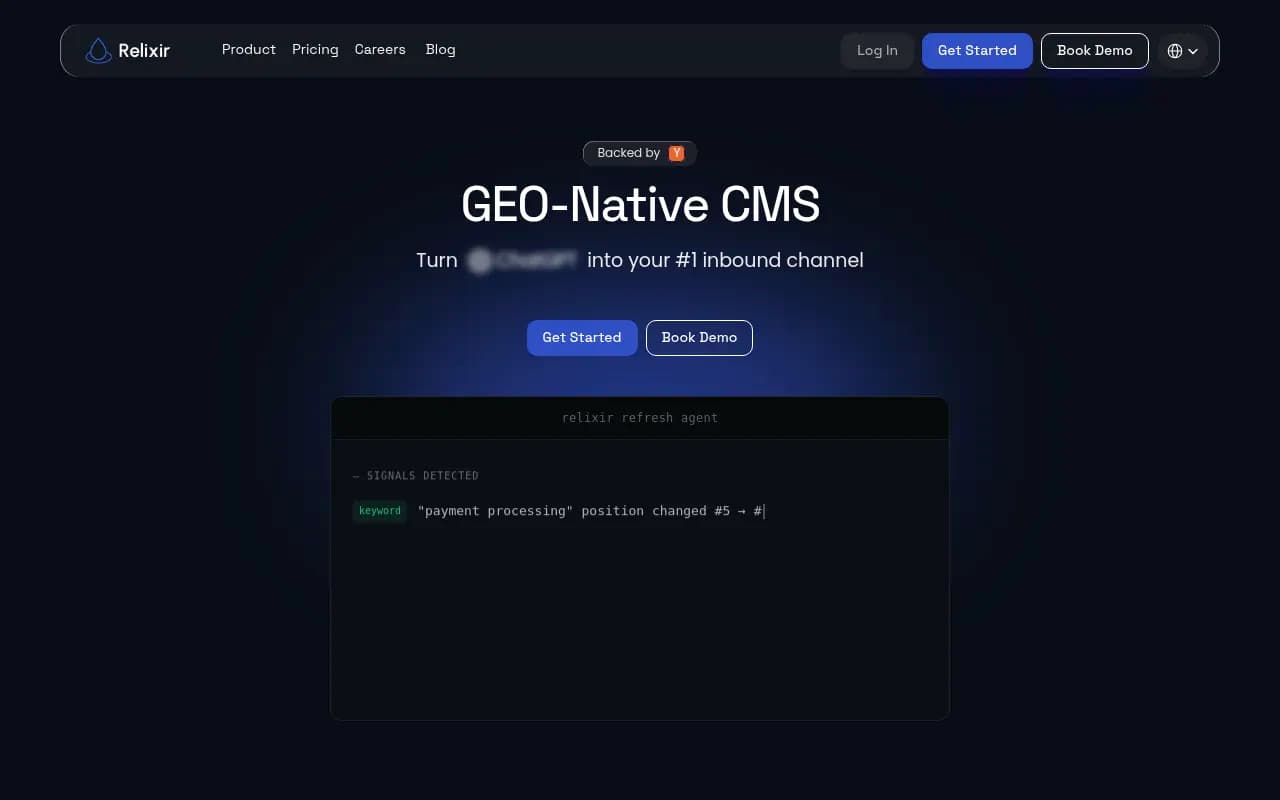
Keyword Signal Agents: The platform continuously monitors keyword positions across AI and traditional search. When it detects a ranking change (e.g. "payment processing" moved from #5 to #1), it flags the page for potential refresh or optimization. You can track position trends over time, see which keywords are driving AI citations, and benchmark performance against competitors. This is similar to what tools like Promptwatch offer, but Relixir ties it directly into the content refresh workflow.
Autonomous Content Refresh Agents: This is Relixir's standout feature. You configure agent guidelines (brand voice, fact-checking sources, update frequency, etc.), and the agents scan your content library for staleness signals -- outdated stats, competitor updates, new social discussions, keyword position drops, etc. When a page needs refreshing, the agent rewrites sections, updates data points, adds new examples, and syncs the changes back to your CMS (Webflow, WordPress, Contentful, Ghost, or hosted). The goal is to keep your entire content library under 30 days old without manual intervention. Relixir claims this solves the "manual refresh can't keep up" problem -- if you have 200+ pages needing updates but your team can only handle 15/month, it takes 13+ months to refresh everything, by which point the first pages are stale again.
Cursor-Style CMS Editing: You can edit your entire CMS through chat. Push changes across thousands of blog posts with a single prompt (e.g. "update all pricing pages to reflect the new $500/month tier"). The platform supports 57+ languages, so you can manage multilingual content libraries from one interface. This is essentially an AI agent layer on top of your existing CMS -- no migration required.
GEO Blog Generation: Relixir helps you identify high-intent topics that AI engines are likely to cite, then generates full blog posts optimized for AI search. The content is grounded in real prompt data and competitor analysis, so it's built to rank in ChatGPT responses, not just fill a blog. You can publish directly to your CMS from the platform. This is similar to content generation features in tools like Promptwatch, but Relixir's focus is specifically on GEO (not traditional SEO).
Employee-Led Publishing: The platform allows individual team members to spin up their own employee-led blogs (think thought leadership or personal expertise content). This maximizes your brand's surface area in AI search by creating more fresh, authoritative content that LLMs can cite. Each employee can manage their own publishing workflow while staying within brand guidelines.
Social Research Agents: Relixir scans Reddit, Twitter, and other social platforms for brand mentions and discussions that influence AI recommendations. When it detects relevant conversations (e.g. "best payment processor for SaaS" on Reddit), it can flag them for your team to engage with or incorporate into content updates. This is a channel most GEO tools ignore entirely.
CMS Integrations: One-click integrations with Webflow, WordPress, Contentful, and Ghost. You can also use Relixir as a headless CMS layer on top of your existing setup, or host your content directly in the platform. No code required to get started.
Visitor ID & Traffic Attribution: Track AI-driven traffic to your site and attribute it back to specific AI engines (ChatGPT, Claude, Perplexity, etc.). This closes the loop from visibility to actual business impact -- you can see which AI citations are driving booked demos and pipeline.
Who Is Relixir For?
Relixir is built for B2B SaaS companies and enterprise brands with large content libraries (100+ pages) who are competing in AI search and need to stay fresh without burning out their content team. The ideal customer is a marketing team at a Series A-C startup or mid-market company that:
- Has a substantial blog or knowledge base (200-1000+ articles)
- Competes in crowded categories where AI search is becoming a meaningful inbound channel (fintech, HR tech, dev tools, martech, etc.)
- Lacks the bandwidth to manually refresh content at the pace required to stay visible in LLMs
- Already tracks AI visibility and sees competitors outranking them due to fresher content
Specific personas: Head of Content at a 50-200 person SaaS company managing a team of 2-5 writers who can't keep up with refresh demands. VP of Marketing at an enterprise brand with 500+ product pages that need continuous updates to reflect new features, pricing, and integrations. SEO/GEO Manager at a B2B company tracking AI search rankings and realizing their content is decaying month over month.
Relixir is also a fit for agencies managing content for multiple clients who need to deliver AI search results at scale without hiring more writers.
Who should NOT use Relixir: Small businesses or solo creators with <50 pages of content (manual refresh is still feasible at that scale). Companies in industries where AI search isn't a meaningful channel yet (highly regulated verticals, local services, etc.). Brands that don't compete on thought leadership or educational content (pure e-commerce, for example). If you're just starting to build a content library, you don't need autonomous refresh yet -- focus on creation first.
Integrations & Ecosystem
Relixir integrates directly with Webflow, WordPress, Contentful, and Ghost via one-click connectors. It can also work as a headless layer on top of custom CMSs or proprietary content systems. The platform supports 57+ languages for multilingual content management.
On the data side, Relixir monitors ChatGPT, Perplexity, Claude, Google AI Overviews, DeepSeek, Gemini, and other LLMs. It pulls social signals from Reddit and Twitter to inform content updates. For traffic attribution, it integrates with Google Search Console and can track visitors via code snippet or server log analysis.
There's no mention of API access for developers, but the platform is designed to be headless-friendly, so you can likely build custom workflows on top of it. The "Cursor-style" chat interface suggests a developer-friendly approach to CMS editing.
Pricing & Value
Relixir's pricing is not fully public. The website mentions "Pay as you go" and "Flexible Pricing from Self-Serve to Enterprise," with a note that detailed pricing is "Coming soon." Based on third-party sources, the Starter plan is $500/month for growing teams. There are likely higher tiers for larger content libraries and enterprise features (managed services, dedicated support, custom integrations).
Relixir also offers managed services where their team runs your entire GEO/SEO engine end-to-end -- from strategy to execution. This is positioned as a white-glove option for brands that want results without building internal GEO expertise.
Compared to pure monitoring tools (which range from $75-$300/month), Relixir is more expensive, but it's solving a different problem. You're paying for the autonomous refresh layer, not just dashboards. The ROI case is straightforward: if AI search is driving meaningful pipeline (as case studies suggest), and manual refresh would require hiring 1-2 additional content writers ($100k+ annually), then $500-$1000/month for automation is a bargain.
There's no mention of a free trial, but the site encourages booking a demo with the CEO, which suggests a sales-assisted onboarding process (typical for enterprise tools).
Strengths
Autonomous refresh at scale: No other GEO platform deploys agents directly into your CMS to update content. This is Relixir's killer feature -- it doesn't just tell you what's stale, it fixes it.
Proven results: Case studies show real impact -- Hostie went from near-zero AI mentions to 1500+ citations in under a month. DocuBridge hit #1 ChatGPT ranking in 90 days. Reframe saw 38% MoM lead growth from AI search. These aren't vanity metrics -- they're tied to pipeline and demos.
Multi-LLM coverage: Tracks ChatGPT, Perplexity, Claude, Google AI Overviews, DeepSeek, and more. Most competitors focus on one or two engines.
CMS-agnostic: Works with Webflow, WordPress, Contentful, Ghost, or as a headless layer. You don't have to migrate your content.
Social signal integration: Monitoring Reddit and Twitter for brand discussions that influence AI recommendations is a smart, underutilized channel.
Limitations
Pricing opacity: The lack of transparent pricing is frustrating for buyers who want to self-evaluate. The $500/month starting point (from third-party sources) is steep for smaller teams.
Newer platform: Y Combinator backing is a positive signal, but Relixir is still building out features (the pricing page literally says "Coming soon"). Some capabilities may be in beta or roadmap-only.
Enterprise focus: The positioning and pricing suggest this is built for mid-market and enterprise, not startups or solo creators. If you have <100 pages of content, you're probably not the target customer.
No API mentioned: For developer-heavy teams that want to build custom workflows, the lack of API documentation is a gap (though it may exist and just isn't marketed).
Bottom Line
Relixir is the first platform to solve the AI search refresh problem at scale. If you're a B2B brand with a large content library competing in AI search, and you're seeing competitors outrank you because their content is fresher, Relixir is the most direct solution available in 2026. The autonomous agents, CMS integrations, and proven case studies make it a strong choice for teams that need results without hiring more writers. It's overkill for small blogs or companies not yet competing in AI search, but for the right customer -- mid-market SaaS, enterprise brands, agencies -- it's a category-defining tool.
Best use case in one sentence: B2B SaaS marketing teams managing 200+ content pages who need to stay fresh in ChatGPT, Perplexity, and Claude without manual rewrites.
Tags:
Similar and alternative tools to Relixir