Bear AI Review 2026
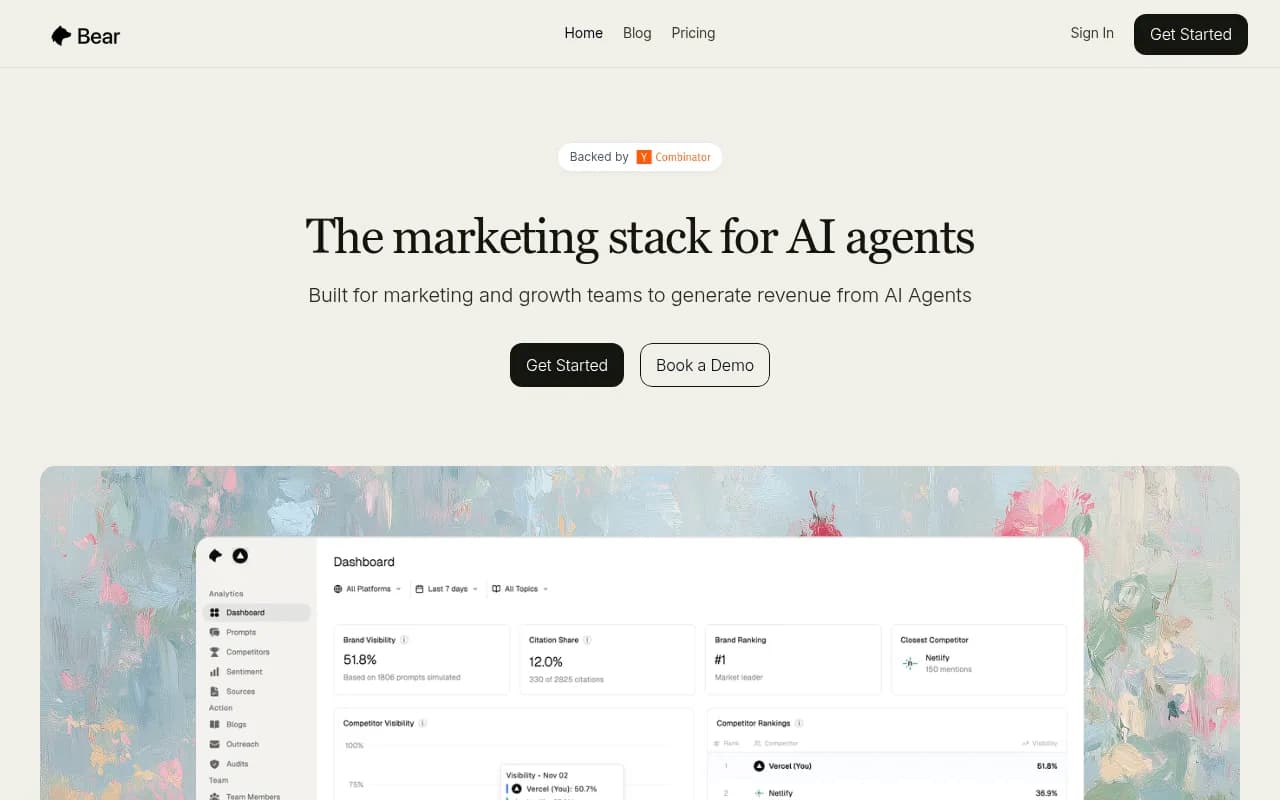
Bear AI is a marketing platform designed to help businesses generate revenue from AI agents like ChatGPT, Claude, and Google AI Overviews. It tracks how AI models discover and recommend your brand, identifies high-intent visitors from AI sources, and provides tools to convert that traffic into leads. Built for marketing and growth teams looking to capitalize on the emerging AI search channel.
Key Takeaways:
• Bear AI focuses on AI agent traffic conversion and lead generation, but lacks the comprehensive optimization capabilities that platforms like Promptwatch offer -- no Answer Gap Analysis to identify missing content, no AI content generation grounded in citation data, no crawler log monitoring, and no Reddit/YouTube citation tracking • Strong lead identification feature that captures visitors coming from ChatGPT and other AI sources, turning anonymous AI traffic into actionable sales opportunities • Limited AI model coverage (GPT-4o, Google AI Mode on Basic plan; GPT-5, Claude, Gemini, Perplexity on Enterprise) compared to competitors that monitor 10+ models including DeepSeek, Grok, and Mistral • Pricing starts at $199/month for basic tracking (75 prompts, 2 blogs/month) with custom Enterprise pricing for full features -- higher entry point than monitoring-focused alternatives • Best for B2B SaaS companies and service businesses with high-value customers where lead identification justifies the cost, less suitable for content publishers or agencies managing multiple clients
Bear AI positions itself as "the marketing stack for AI agents" -- a platform built specifically for marketing and growth teams trying to generate revenue from the emerging channel of AI-powered search. Unlike monitoring-only dashboards that show you where you appear in ChatGPT or Perplexity responses, Bear AI focuses on the conversion side: identifying who's visiting from AI sources and turning those visits into pipeline.
The platform launched in 2025 and has quickly gained traction with B2B companies looking to capitalize on AI search traffic. Their customer base includes brands like Blee (a case study on their site shows how they generated pipeline from AI search), and they're backed by investors betting on the AI search opportunity. The core thesis: as more users turn to ChatGPT, Claude, and Perplexity for recommendations instead of Google, businesses need tools to track, optimize, and monetize that traffic.
Bear AI targets marketing teams at B2B SaaS companies, agencies, and service businesses where customer lifetime value justifies investing in lead identification and conversion optimization. If you're selling a $10,000/year software product or $50,000 consulting engagements, knowing which visitors came from a ChatGPT recommendation and what they were asking about is extremely valuable intelligence.
AI Traffic Analytics & Visibility Tracking
Bear AI monitors how AI agents discover and recommend your brand across major language models. On the Basic plan ($199/month), you get tracking for GPT-4o and Google AI Mode. Enterprise customers get access to GPT-5, Claude, Gemini, and Perplexity. This is narrower coverage than platforms like Promptwatch (which monitors 10 models including DeepSeek, Grok, Mistral, and Meta AI) or Profound (which covers 12+ models).
The platform shows you trending prompts -- the questions users are asking AI agents that relate to your business. For example, if you're a business credit card company, you'd see prompts like "What are the best business credit cards?" or "Credit cards with the best rewards" along with volume indicators (high-volume, medium-volume, etc.). This helps you understand what topics are driving AI recommendations in your space.
You can track up to 75 prompts on the Basic plan, unlimited on Enterprise. Each prompt shows you whether your brand appears in AI responses, how often, and in what context. The dashboard displays which AI models are citing you and provides visibility into your share of voice compared to competitors.
What's missing here compared to optimization-focused platforms: Bear AI doesn't show you the specific content gaps that prevent you from ranking. Tools like Promptwatch provide Answer Gap Analysis that identifies exactly which prompts competitors appear for but you don't, then shows you the missing topics and angles you need to create content around. Bear AI tells you where you're visible, but doesn't systematically show you where you're invisible or why.
Lead Generation & Visitor Identification
This is Bear AI's standout feature and primary differentiator. The platform identifies individual visitors coming from ChatGPT, Claude, and other AI sources, capturing their contact information and the prompt that led them to your site. You see a lead list showing name, company, role, and which AI agent sent them.
For B2B companies with high-value customers, this is powerful. If someone asks ChatGPT "best project management software for 50-person teams" and ChatGPT recommends your product, Bear AI captures that visit as a qualified lead. Your sales team can reach out knowing exactly what the prospect was looking for and that an AI agent already pre-sold them on your solution.
The lead generation works through a tracking script you install on your site (similar to how tools like Clearbit or 6sense identify visitors). Bear AI detects the referrer and user agent patterns that indicate AI traffic, then enriches the visitor data with company and contact information.
Limitations: This feature is only available on the Enterprise plan (custom pricing). The Basic plan gives you traffic analytics but not lead identification. Also, visitor identification depends on the person being identifiable through their IP address and company domain -- it works best for B2B traffic from corporate networks, less reliably for consumer traffic or users on VPNs.
Content Optimization & Blog Agent
Bear AI includes a "Blog Agent" that generates AI-ready content designed to be easily crawled and cited by language models. The idea is to create structured content that AI agents can parse and reference when answering user prompts.
On the Basic plan, you get 2 blog posts per month. Enterprise customers get unlimited content generation. The blog agent creates articles optimized for AI ingestion -- clear structure, factual statements, proper schema markup, and formatting that LLMs can easily extract and cite.
This is where Bear AI falls short compared to platforms built around content optimization. The blog agent is a generic AI writing tool without the depth of citation analysis and competitive intelligence that makes content truly rank in AI search. Promptwatch, for example, generates content grounded in 880M+ citations analyzed across AI models, with prompt volume data, persona targeting, and specific gaps identified through Answer Gap Analysis. Bear AI's blog agent is more like a standard AI writing assistant that happens to format content for AI readability.
There's no crawler log monitoring to see how AI agents are actually discovering your content, no page-level tracking to know which specific articles are being cited, and no feedback loop showing you whether your new content improved your visibility scores. You're creating content in the dark without data on what's working.
Automated PR & Outreach Workflow
Bear AI identifies third-party sources that AI models cite frequently -- Forbes articles, Reddit threads, LinkedIn posts, YouTube videos -- and provides an outreach workflow to get your brand mentioned on those sources. The platform shows you which domains and pages are being cited most often (e.g. "forbes.com/business/... - 254 citations") and lets you initiate outreach campaigns.
This is a smart approach: if AI models are heavily citing a particular Forbes article or Reddit discussion, getting your brand mentioned in that source means you'll appear in AI responses by proxy. The outreach workflow helps you contact the authors or community managers to request inclusion.
However, the execution is limited. Bear AI shows you the sources and provides email templates, but the actual outreach is manual. You're still doing the work of finding contact information, crafting personalized pitches, and following up. It's more of a research tool than true automation. The "Outreach" button next to each source just opens a template -- it doesn't send emails or manage campaigns.
Also missing: Reddit and YouTube citation tracking at the granular level. Bear AI shows you that Reddit and YouTube are being cited, but platforms like Promptwatch surface the specific discussions and videos that influence AI recommendations, giving you much more actionable intelligence about where to engage.
Integrations & Technical Setup
Bear AI requires installing a tracking script on your website to enable lead identification and traffic attribution. This is straightforward for most marketing teams -- you add a JavaScript snippet to your site header, similar to Google Analytics or other tracking tools.
The platform doesn't mention API access on the Basic plan. Enterprise customers get "custom integrations" which likely includes API access and the ability to push data to your CRM or data warehouse. There's no mention of pre-built integrations with tools like HubSpot, Salesforce, or Slack on the public site.
For reporting, Bear AI provides a dashboard but doesn't mention Looker Studio integration, CSV exports, or other data portability features. This is a limitation if you want to combine AI traffic data with your other marketing metrics in a unified reporting system.
No browser extensions or mobile apps are mentioned. The platform appears to be web-only, accessed through app.usebear.ai.
Pricing & Plans
Bear AI offers two tiers:
Basic - $199/month: • Track GPT-4o and Google AI Mode (2 models) • Up to 75 prompts tracked • 2 blog posts per month with blog agent • Email outreach workflow access • No lead generation • No team seats mentioned
Enterprise - Custom pricing: • Track GPT-5, GPT-4o, Google AI, Claude, Gemini, Perplexity (6+ models) • Unlimited prompt tracking • Unlimited blog agent content generation • Lead generation and visitor identification • Automated PR and outreach • Multiple team seats • Priority Slack support • Custom integrations
No free trial is advertised, though you can book a demo. The Basic plan is significantly more expensive than monitoring-focused competitors (Otterly.AI starts at $99/month, Peec.ai at $149/month) but includes content generation. However, it's missing the lead generation feature that's Bear AI's main value prop -- that's locked behind Enterprise pricing.
For context, Promptwatch's Professional plan at $249/month includes 2 sites, 150 prompts, 15 articles per month, crawler logs, and multi-region tracking across 10 AI models. Bear AI's Basic plan at $199/month gives you 75 prompts, 2 articles, and only 2 models -- less coverage and content for nearly the same price, without the optimization tools.
The Enterprise tier is where Bear AI's value proposition makes sense, but custom pricing makes it hard to evaluate. Based on typical B2B SaaS pricing patterns, expect $500-1000+/month depending on volume and features.
Who Should Use Bear AI
Bear AI is best suited for B2B SaaS companies and high-ticket service businesses where customer lifetime value justifies the investment in lead identification. If you're selling enterprise software, consulting services, or other high-value offerings, knowing which prospects came from AI recommendations and what they were asking about is worth paying for.
Specific personas: • B2B SaaS marketing teams (10-50 person companies) selling products with $5,000+ annual contracts who want to capture and convert AI-driven leads • Professional services firms (consulting, agencies, law firms) where a single client is worth $50,000+ and AI search is becoming a lead source • Growth teams at venture-backed startups experimenting with AI search as a channel and willing to pay for early-mover advantage
Bear AI is NOT ideal for: • Content publishers and affiliate sites -- you don't need lead identification, you need comprehensive visibility tracking and content optimization across many prompts and models • Agencies managing multiple clients -- the pricing model doesn't scale well, and you'd need separate Enterprise plans for each client • Small businesses with tight budgets -- $199/month for basic tracking without lead gen is expensive compared to alternatives, and you won't see ROI unless your customer value is high • Companies wanting deep optimization -- if you need Answer Gap Analysis, crawler logs, page-level citation tracking, and data-driven content creation, platforms like Promptwatch offer much more depth
Strengths
Lead identification is unique and valuable: No other AI search platform focuses this heavily on converting anonymous AI traffic into identified leads. For the right business model, this feature alone justifies the cost.
Simple, focused positioning: Bear AI doesn't try to be everything to everyone. It's built for one job -- turning AI agent traffic into revenue -- and the product reflects that focus.
Outreach workflow is smart: Identifying high-citation sources and providing templates to get mentioned on them is a practical approach to improving AI visibility through third-party content.
Limitations
Missing core optimization capabilities: No Answer Gap Analysis to identify content opportunities, no crawler log monitoring to see how AI agents discover your site, no page-level tracking to know which content is being cited. You're flying blind on the optimization side.
Limited AI model coverage: Only 2 models on Basic plan, 6+ on Enterprise. Competitors like Promptwatch (10 models), Profound (12+ models), and Semrush (8+ models) offer broader coverage, which matters as users spread across different AI platforms.
No content generation depth: The blog agent is a basic AI writing tool without the citation analysis, prompt intelligence, and competitive data that makes content actually rank in AI search. You're creating content without knowing if it will work.
High price for limited features on Basic plan: $199/month for 75 prompts, 2 blogs, and 2 models is expensive compared to alternatives, especially since you don't get the lead generation feature that's Bear AI's main differentiator.
Enterprise-only lead gen: The platform's killer feature is locked behind custom pricing, making it inaccessible to smaller businesses who might benefit from it.
Bottom Line
Bear AI is a lead generation tool for AI search, not a comprehensive optimization platform. If you're a B2B company with high customer value and you want to identify and convert visitors coming from ChatGPT and Claude, Bear AI delivers a unique capability that no other tool offers at this level. The lead identification feature is genuinely valuable for the right use case.
However, if you're looking to systematically improve your AI search visibility through content optimization, gap analysis, and data-driven strategy, Bear AI falls short. It tells you where you're visible and captures leads when you are, but it doesn't help you become visible in the first place. Platforms like Promptwatch, Profound, or even monitoring-focused tools like Otterly.AI provide more comprehensive visibility tracking and optimization capabilities for less money.
Best use case in one sentence: B2B SaaS companies selling high-value products who want to turn AI agent recommendations into identified sales leads and have the budget for Enterprise pricing.
Tags:
Similar and alternative tools to Bear AI