Morningscore Review 2026
Morningscore is a comprehensive SEO and GEO (Generative Engine Optimization) platform that helps businesses track and improve their visibility in both traditional search engines and AI models like ChatGPT and Google AI Overviews. Designed for agencies, ecommerce sites, and SEO beginners, it combines
Key Takeaways:
• All-in-one simplicity: Morningscore combines traditional SEO tracking (keywords, backlinks, technical health) with AI visibility monitoring (ChatGPT, Google AI Overviews) in one platform -- no add-ons or separate subscriptions needed • Gamified workflow: The unique "Missions" feature turns SEO tasks into a to-do list with XP rewards, making optimization more engaging and helping teams prioritize high-impact work • WordPress automation: The RANK AI plugin automatically scans and fixes on-page issues, generates content suggestions, and pushes updates directly to WordPress sites • Best for: Small to mid-sized agencies, ecommerce brands, and marketing teams who want an intuitive SEO platform that doesn't require deep technical expertise • Limitations: Smaller keyword database compared to enterprise tools like Semrush or Ahrefs; AI visibility tracking is newer and less comprehensive than dedicated GEO platforms like Promptwatch
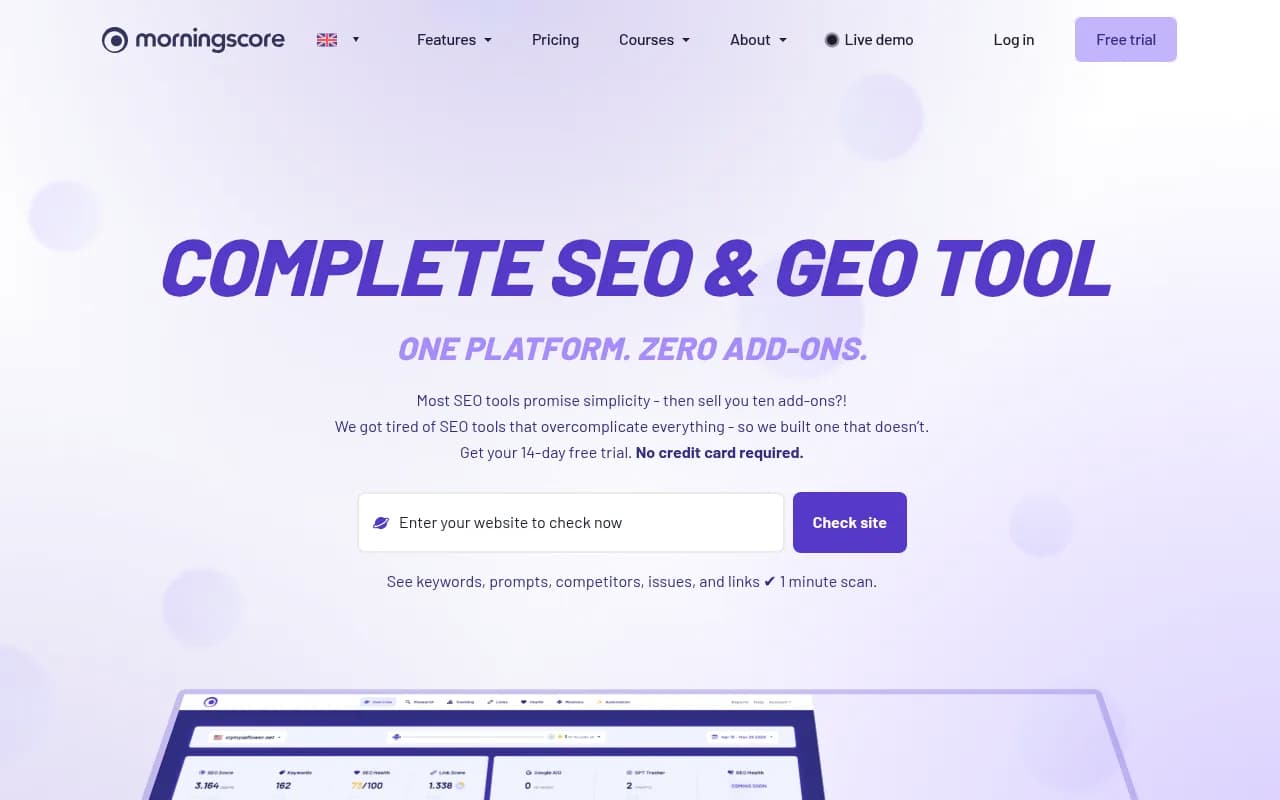
Morningscore positions itself as the antidote to bloated, complicated SEO platforms that require multiple add-ons and steep learning curves. Founded by a Danish team frustrated with tools that "overcomplicate everything," Morningscore 4 delivers keyword tracking, backlink monitoring, technical SEO audits, competitor analysis, and -- as of their latest version -- AI visibility tracking for ChatGPT and Google AI Overviews, all in one interface. The platform's defining characteristic is its approachability: colorful dashboards, plain-language explanations, and a gamified "missions" system that turns abstract SEO concepts into concrete action items.
Who built it and what problem it solves
Morningscore was created by a team based in Denmark who saw an opportunity to make SEO accessible to non-specialists. The company's stated mission is to "create 1 million growth heroes" -- marketers, small business owners, and agency teams who can drive organic growth without needing to become SEO engineers. The tool launched initially as a traditional SEO platform and added GEO (Generative Engine Optimization) capabilities in 2024 as AI search engines began reshaping how people discover content. Today it serves agencies managing client portfolios, ecommerce brands optimizing product pages, and marketing teams at small to mid-sized companies.
The core problem Morningscore addresses is paralysis by complexity. Many SEO tools dump massive amounts of data on users without clear guidance on what to do next. Morningscore flips this: it shows you the data, then tells you exactly which tasks to tackle first through its missions system. For teams without dedicated SEO specialists, this guidance is the difference between having a tool and actually using it.
Dashboard and Overview
The Morningscore dashboard is built around simplicity. When you log in, you see your "Morningscore" (a proprietary metric combining keyword rankings, traffic estimates, and backlink strength), your SEO Health score, your AI visibility score, and trend graphs showing how these metrics have changed over time. Everything is color-coded: green for improvements, red for declines, yellow for warnings. There's no hunting through nested menus to find your most important metrics.
The overview also surfaces recent changes: new keywords you're ranking for, lost backlinks, newly detected technical issues, and changes in your AI visibility. This "what's new" feed helps you spot problems or opportunities without running manual reports. For agencies managing multiple client sites, you can switch between properties from a dropdown and see each site's dashboard instantly.
Keyword Tracking and Research
Morningscore's keyword tracker lets you monitor daily rankings for your target keywords across Google search results. You add keywords manually or import them from competitor analysis, then organize them into folders (e.g. "Product Pages," "Blog Content," "Brand Terms"). The tracker shows your current rank, previous rank, rank change, search volume, and keyword difficulty. You can also see which competitors rank for the same keywords and compare your position to theirs.
The keyword research tool pulls from Morningscore's global keyword database. You enter a seed keyword, and it returns related keywords with search volume, difficulty scores, and current ranking URLs. The interface is straightforward -- no overwhelming data tables or advanced filters that require a tutorial to understand. You can export keyword lists or add promising keywords directly to your tracker.
One limitation: Morningscore's keyword database is smaller than Semrush, Ahrefs, or Moz. For highly competitive industries or obscure long-tail queries, you may find fewer keyword suggestions. The tool works well for mainstream topics and local SEO but isn't ideal for enterprise-level keyword research across dozens of markets.
Backlink Monitoring
The backlink module shows your total backlinks, referring domains, and a "Linkscore" metric that estimates your link profile's strength. You can see new links gained, links lost, and a timeline of link acquisition over time. Each backlink entry includes the source URL, anchor text, link type (dofollow/nofollow), and domain authority of the linking site.
Morningscore doesn't offer advanced link prospecting or outreach tools like Pitchbox or BuzzStream. It's purely a monitoring and analysis tool. You can identify which pages on your site attract the most links, spot toxic links that might hurt your rankings, and track competitor backlink profiles to find link-building opportunities. For agencies, this is useful for client reporting: you can show exactly how many new links you've built each month and how they've impacted the client's Linkscore.
Website Health and Technical SEO
The Health module runs a full technical audit of your site, checking for issues like broken links, missing meta descriptions, slow page load times, duplicate content, missing alt tags, and mobile usability problems. Issues are categorized as "basic," "technical," or "content-related," and each one includes a severity rating (critical, important, minor) and a plain-language explanation of why it matters and how to fix it.
This is where Morningscore's beginner-friendly approach shines. Instead of cryptic error codes, you get explanations like "Your homepage is missing a meta description. This means Google will generate one automatically, which might not accurately represent your page. Add a 150-160 character description that includes your main keyword." For each issue, there's a "Learn more" link to a help article with step-by-step instructions.
The health score is a single number (0-100) that summarizes your site's technical condition. As you fix issues, the score improves. This gamification element -- seeing your score climb from 65 to 85 -- motivates teams to actually address technical debt instead of letting it pile up.
Missions: Gamified SEO Workflow
Missions are Morningscore's standout feature. The tool analyzes your site and suggests specific tasks to improve your SEO, presented as missions you can accept or skip. Examples: "Add internal links to your top 10 pages," "Fix 5 pages with missing meta descriptions," "Build 3 new backlinks this month," "Optimize 2 blog posts for featured snippets." Each mission has a difficulty rating, estimated impact on your rankings, and XP reward.
As you complete missions, you earn XP and level up. Your profile shows your current level, total XP, and completed missions. This gamification isn't just for fun -- it solves a real problem: prioritization. Instead of staring at a list of 200 technical issues and wondering where to start, you pick a mission, complete it, and move to the next one. The tool handles the prioritization based on what will move the needle most.
You can also create custom missions for your team. For example, an agency might set up a mission for each client: "Publish 4 blog posts this quarter" or "Increase Linkscore by 10 points." Team members can see their assigned missions, mark them complete, and track progress toward shared goals.
AI Visibility Tracking (GEO Features)
Morningscore 4 introduced AI visibility tracking for ChatGPT and Google AI Overviews. You add prompts (questions or queries your target audience might ask AI models), and Morningscore checks whether your website or brand is mentioned in the AI's response, either directly in the answer text or as a cited source. You can track visibility over time, see which prompts you're visible for, and compare your AI visibility to competitors.
The AI tracking also includes a "Rank Writer" tool that generates full blog posts optimized for AI citations. You input a topic, and the tool produces a draft article designed to answer common questions AI models pull from. This is similar to the content generation features in dedicated GEO platforms like Promptwatch, though Morningscore's implementation is simpler and less data-driven (it doesn't analyze 880M+ citations or provide detailed prompt volume estimates).
For WordPress users, the RANK AI plugin automates on-page optimization. It scans your pages, suggests improvements (better meta descriptions, internal linking opportunities, keyword placement), and can push updates directly to your site. This saves hours of manual work, especially for ecommerce sites with hundreds of product pages.
The AI visibility features are a solid addition, but they're not as comprehensive as dedicated GEO platforms. Morningscore tracks ChatGPT and Google AI Overviews but doesn't cover Perplexity, Claude, Gemini, or other AI models. It also lacks advanced features like AI crawler log analysis, prompt difficulty scoring, or Reddit/YouTube citation tracking. For teams just starting with GEO, Morningscore provides a useful introduction. For brands serious about AI visibility, tools like Promptwatch offer deeper insights and optimization capabilities.
Competitor Analysis
You can add competitor websites to Morningscore and see which keywords they rank for, their backlink profiles, and their estimated organic traffic. The competitor comparison view shows side-by-side rankings for shared keywords, making it easy to spot gaps where competitors outrank you. You can also see which pages on competitor sites attract the most traffic and backlinks, giving you ideas for your own content strategy.
The competitor analysis is useful for small to mid-sized businesses competing in local or niche markets. It's less powerful than Semrush's competitive intelligence suite or Ahrefs' Site Explorer, which offer more granular data and historical trends. But for most users, Morningscore's competitor features provide enough insight to inform strategy without overwhelming you with data.
Reporting and Client Management
For agencies, Morningscore offers white-label reporting. You can generate PDF reports with your agency's branding, showing client progress on keywords, backlinks, health scores, and completed missions. Reports are customizable -- you choose which metrics to include and add your own commentary. The reports are visually clean and client-friendly, avoiding jargon and focusing on results ("Your organic traffic increased 23% this quarter").
You can manage multiple client sites from one account, switching between them via a dropdown. Each client site has its own keyword tracker, missions, and health score. Pricing scales with the number of sites you manage, making Morningscore affordable for small agencies (2-10 clients) but potentially expensive for larger agencies managing 50+ sites.
Integrations and Ecosystem
Morningscore integrates with Google Search Console to pull real traffic data and actual keyword rankings. This is essential for accurate reporting -- without GSC integration, you're relying on estimated traffic, which can be wildly inaccurate. The tool also integrates with Google Analytics for deeper traffic analysis.
The RANK AI WordPress plugin is the main automation tool. It connects your WordPress site to Morningscore and enables automatic on-page optimization, content suggestions, and health monitoring. There's also a Shopify integration for ecommerce sites. Beyond these, Morningscore doesn't offer extensive third-party integrations. There's no Zapier connection, no API for custom workflows, and no integrations with CRM or project management tools. For most users, this isn't a dealbreaker, but agencies with complex tech stacks may find it limiting.
Pricing and Value
Morningscore offers four pricing tiers:
• Lite ($69/mo): 1 website, 200 tracked keywords, basic health checks, missions, and AI visibility tracking. Good for freelancers or small businesses managing one site. • Business ($99/mo): 3 websites, 500 tracked keywords, competitor analysis, white-label reports. Best for small agencies or businesses managing multiple properties. • Pro ($159/mo): 10 websites, 1,500 tracked keywords, advanced reporting, priority support. Designed for growing agencies. • Premium ($299/mo): 25 websites, 5,000 tracked keywords, dedicated account manager. For established agencies with larger client rosters.
All plans include a 14-day free trial with no credit card required. Annual billing gets you 2 months free. Compared to competitors, Morningscore is mid-priced. Semrush starts at $139/mo, Ahrefs at $129/mo, and Moz at $99/mo, but those tools don't include AI visibility tracking. Dedicated GEO platforms like Promptwatch start at $99/mo and offer more advanced AI optimization features. Morningscore's value proposition is the all-in-one simplicity: you get traditional SEO and basic GEO in one platform at a reasonable price.
Who should use Morningscore
Morningscore is ideal for:
• Small to mid-sized agencies managing 5-25 client sites who want an intuitive tool for keyword tracking, reporting, and client communication. The missions system helps junior team members stay productive without constant supervision. • Ecommerce brands with 50-500 product pages who need to monitor rankings, fix technical issues, and optimize for AI search. The WordPress/Shopify integrations and automated on-page suggestions save time. • Marketing teams at SMBs (10-100 employees) who don't have dedicated SEO specialists. Morningscore's plain-language explanations and guided missions make it accessible to generalists. • SEO beginners who find tools like Semrush or Ahrefs overwhelming. Morningscore teaches you SEO concepts as you use it, with help articles and mission-based learning.
Morningscore is NOT ideal for:
• Enterprise SEO teams managing 100+ sites or operating in highly competitive industries. The keyword database and backlink index are smaller than enterprise-grade tools, and there's no API for custom integrations. • Brands serious about AI visibility who want deep GEO insights. Morningscore's AI tracking is a useful starting point, but dedicated platforms like Promptwatch offer more comprehensive monitoring (10+ AI models), citation analysis, crawler logs, and content optimization tools. • Technical SEO specialists who need advanced features like log file analysis, JavaScript rendering tests, or schema markup validation. Morningscore covers the basics but doesn't go deep on technical audits.
Strengths
• Intuitive interface: The dashboard is genuinely easy to navigate, even for non-technical users. Color-coded metrics, plain-language explanations, and a clean design reduce the learning curve. • Missions system: Gamification isn't just a gimmick -- it solves the real problem of prioritization and keeps teams motivated to complete SEO tasks. • All-in-one platform: Combining traditional SEO and AI visibility tracking in one tool simplifies workflows and reduces subscription costs. • WordPress automation: The RANK AI plugin saves hours of manual on-page optimization, especially for sites with hundreds of pages. • Affordable for small agencies: At $99-$159/mo for 3-10 sites, Morningscore is cheaper than managing separate subscriptions for keyword tracking, backlink monitoring, and GEO tools.
Limitations
• Smaller data sets: The keyword database and backlink index are less comprehensive than Semrush, Ahrefs, or Moz. You'll find fewer keyword suggestions and may miss some backlinks. • Basic AI visibility tracking: Morningscore tracks ChatGPT and Google AI Overviews but doesn't cover Perplexity, Claude, Gemini, or other AI models. It also lacks advanced GEO features like prompt difficulty scoring, citation analysis, or AI crawler logs. • Limited integrations: No API, no Zapier, no CRM integrations. This limits automation and custom workflows for agencies with complex tech stacks. • Not built for enterprise: The platform works well for small to mid-sized teams but doesn't scale to enterprise needs (100+ sites, multi-region tracking, advanced permissions).
Bottom Line
Morningscore is a strong choice for agencies, ecommerce brands, and marketing teams who want an approachable, all-in-one SEO platform that doesn't require a PhD to use. The missions system and WordPress automation are standout features that genuinely improve productivity. The addition of AI visibility tracking makes it a solid entry point for teams exploring GEO, though brands serious about optimizing for AI search will eventually need more advanced tools. If you're tired of bloated, complicated SEO platforms and want something you can actually use without a week of training, Morningscore delivers on its promise of simplicity. Best use case: a 5-person agency managing 10 client sites who need keyword tracking, technical audits, and client reporting in one intuitive platform.
Tags:
Similar and alternative tools to Morningscore