AlsoAsked Review 2026
AlsoAsked extracts real-time "People Also Ask" questions from Google to map search intent, uncover content gaps, and inform SEO strategy. With geo-specific targeting across 130+ countries, bulk search capabilities, and deep-dive analysis returning 150+ questions per query, it helps content creators,
Key Takeaways:
• Best for: SEO professionals, content strategists, and agencies who need to understand search intent beyond traditional keyword tools—particularly valuable for content brief creation and topical authority building • Standout capability: Real-time PAA data updates within hours of breaking news, often before Ahrefs, Semrush, or other keyword tools register new queries • Limitations: Requires manual interpretation of question clusters; no built-in content generation or automatic brief creation (you get the questions, not the answers) • Pricing sweet spot: Lite plan at $23/month (300 credits) hits the mark for most solo SEOs and small teams doing regular content planning • Bottom line: If you're still relying solely on search volume and keyword difficulty metrics, you're missing half the story—AlsoAsked shows you what Google thinks people actually want to know
AlsoAsked is a specialized keyword research tool built around a single, powerful data source: Google's "People Also Ask" (PAA) boxes. Founded by UK-based SEO consultant Rob Ousbey, the platform has grown to serve 14,000+ registered users who've collectively run 2.5 million searches. Unlike traditional keyword tools that focus on search volume and competition metrics, AlsoAsked maps the question hierarchies that Google surfaces in PAA boxes—essentially reverse-engineering Google's understanding of search intent for any topic.
The tool targets three primary user groups: SEO professionals building content strategies, content creators (including TikTok and YouTube creators) looking for topic ideas, and digital agencies managing multiple client accounts. It's particularly valuable for anyone working in competitive niches where understanding the full scope of user questions separates thin content from comprehensive resources that actually rank.
How AlsoAsked Actually Works
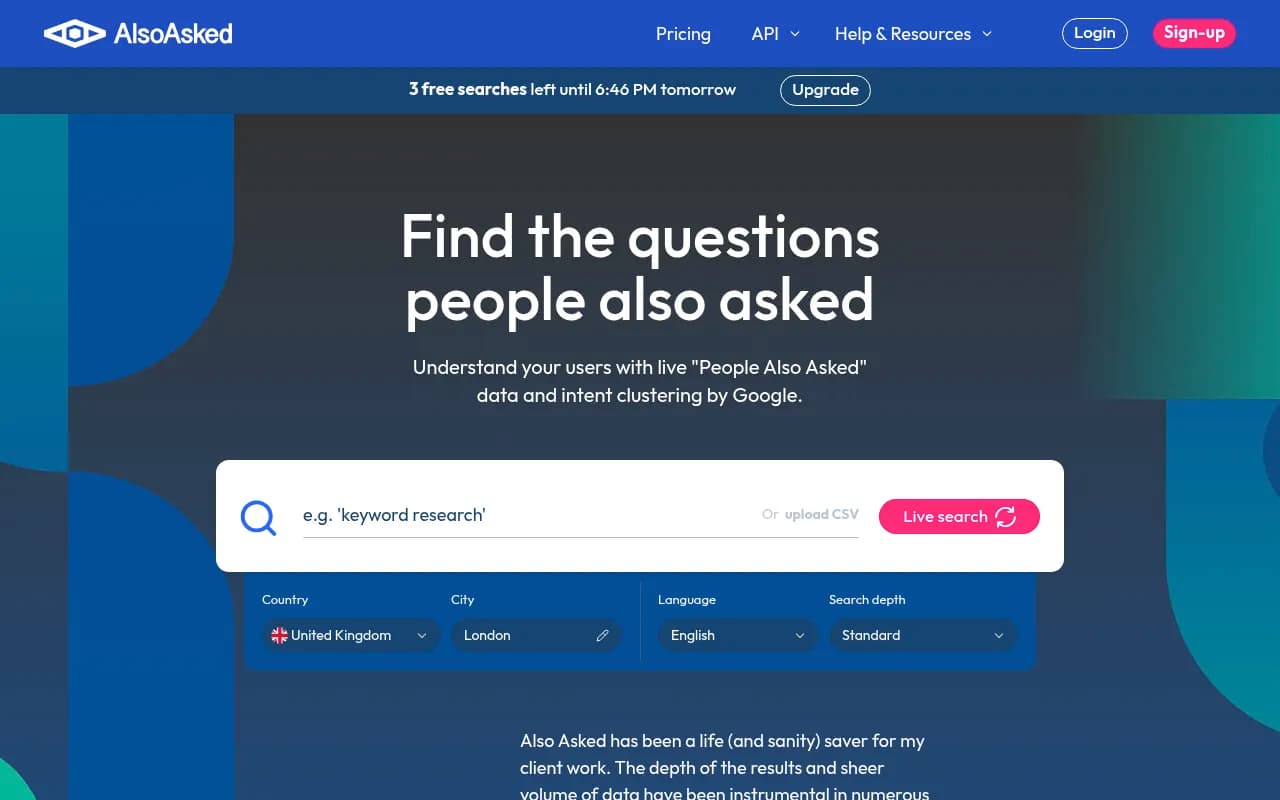
When you enter a seed keyword, AlsoAsked queries Google's live PAA data and returns a visual tree diagram showing how questions branch from your initial query. Each question can be expanded to reveal follow-up questions, creating a hierarchical map of related intent. The platform supports 130+ countries with city-level targeting (e.g., London vs Manchester vs Edinburgh) and all languages Google supports—critical for international SEO where intent shifts dramatically by geography.
Search Depth Options: Standard searches return the first layer of PAA questions (typically 8-12 questions). Deep Search mode—available on paid plans—recursively expands every branch to return an average of 150 questions per query, uncovering long-tail variations and niche subtopics that manual PAA clicking would take hours to discover.
Bulk Upload: Upload CSV files with hundreds of keywords and let AlsoAsked process them asynchronously. This is where the tool becomes genuinely powerful for agencies—you can map intent across an entire content calendar or competitive keyword set in one batch operation, something impossible with browser-based PAA scraping extensions.
Visual Exports: Every search generates a PNG tree diagram that's immediately shareable with writers, clients, or internal teams. These exports have become a staple in content briefs—they communicate intent structure far more effectively than a flat list of keywords. You can also download data as CSV or JSON for further analysis.
API Access: The asynchronous API (available on Pro and Agency plans) supports webhook callbacks, making it possible to integrate PAA monitoring into automated content workflows. Screaming Frog users can trigger AlsoAsked searches during site crawls to identify pages where intent has shifted. Some teams pipe the data into ChatGPT or Claude to generate content outlines based on the question clusters.
Historical Search Dashboard: All previous searches are cached and instantly recallable at no additional credit cost. This matters more than it sounds—you can compare how PAA questions for a topic have evolved over months, identifying when new questions emerge (signaling it's time to update content) or when old questions disappear (indicating shifting user priorities).
Real-Time Data Advantage
Here's what sets AlsoAsked apart from Ahrefs, Semrush, or any other keyword tool: PAA data updates in near real-time. When major news breaks or trends emerge, new PAA questions appear within hours—sometimes minutes. Traditional keyword tools rely on monthly search volume data that lags weeks behind actual user behavior. If you're in a fast-moving industry (crypto, AI, politics, health), AlsoAsked shows you what people are asking right now, not what they searched for last month.
Case in point: During the 2023 ChatGPT launch, AlsoAsked users saw "is ChatGPT safe" and "can ChatGPT replace programmers" questions appear within 24 hours. Ahrefs didn't register meaningful search volume for those terms for another 3-4 weeks. That window is the difference between ranking for emerging queries and arriving late to a saturated SERP.
Who This Tool Is Actually For
AlsoAsked works best for:
SEO professionals and content strategists managing 10-50 pieces of content per month who need to build topical authority, not just target individual keywords. If you're creating content briefs, AlsoAsked gives you the question framework that ensures comprehensive coverage. It's particularly valuable for programmatic SEO teams who need to understand intent patterns across hundreds of related queries.
Digital agencies handling multiple client accounts benefit enormously from bulk search and the ability to export visual reports that clients actually understand. The "here's what your audience is asking" conversation is far more compelling than "here's a list of keywords with search volumes."
Content creators beyond traditional SEO—YouTube creators, TikTok producers, podcast hosts—use AlsoAsked to identify what their audience wants to know about a topic. The question clusters often reveal angles competitors haven't covered yet.
International and multilingual teams get genuine value from city-level targeting. Intent for "best restaurants" in London differs dramatically from "best restaurants" in Mumbai or São Paulo. AlsoAsked captures those nuances.
Who should skip this tool: If you're doing basic blog writing with minimal SEO focus, or if you're only targeting a handful of keywords per year, AlsoAsked is overkill. The free tier (10 credits) lets you test it, but you won't extract real value without committing to a paid plan and integrating it into your regular workflow. Also, if you need actual search volume data or backlink analysis, you still need Ahrefs or Semrush—AlsoAsked doesn't replace those tools, it complements them.
Integrations and Workflow
AlsoAsked doesn't have native integrations with content management systems or SEO platforms, but the API and export options make it easy to build custom workflows:
Screaming Frog integration: Use the API to automatically pull PAA data during site crawls, flagging pages where Google's intent understanding has shifted since you last updated the content.
ChatGPT/Claude workflows: Export question clusters as JSON, feed them into AI writing tools with prompts like "create a content outline addressing these questions," and you have a brief in minutes. Some users report this combination (AlsoAsked for questions, AI for structure) cuts content planning time by 60-70%.
Google Sheets/Excel: CSV exports drop cleanly into spreadsheets for further analysis—clustering questions by theme, mapping them to existing content, or identifying gaps in your current coverage.
Zapier/Make: While not officially supported, users have built Zaps that trigger AlsoAsked API calls based on new keyword additions to tracking tools or content calendar updates.
No mobile app exists, and frankly, it doesn't need one—this is a desktop research tool, not something you'd use on a phone.
Pricing Breakdown
AlsoAsked uses a credit system where each search consumes credits based on depth and features:
Free tier: 10 credits (roughly 10 standard searches). Good for testing, not for regular use.
Basic - $12/month ($144 annually, saves $36): 100 credits per month. Standard and Deep Search, bulk upload, PNG/CSV exports. Best for solo content creators doing occasional research—if you're only planning 10-15 pieces of content per month, this works.
Lite - $23/month ($276 annually, saves $72): 300 credits per month. Same features as Basic. This is the sweet spot for most SEO professionals and small agencies. 300 credits typically covers 30-40 Deep Searches or 100+ standard searches, enough for regular content planning without constantly worrying about credit limits.
Pro - $49/month ($588 annually, saves $120): 1,000 credits per month, plus API access. For agencies managing multiple clients or in-house teams running bulk operations. API access is the key differentiator here—if you're building automated workflows, this is your entry point.
Agency - $99/month ($1,188 annually, saves $240): 3,000 credits per month, API access, priority support. For larger agencies or enterprise teams where AlsoAsked is a core part of the content production pipeline.
Credits roll over month-to-month (up to 2x your plan limit), which is genuinely useful—you're not penalized for lighter usage months. Compared to competitors, AlsoAsked is notably affordable. AnswerThePublic charges $99/month for similar functionality but with less granular geo-targeting. Semrush and Ahrefs include PAA data in their $100-200/month plans, but it's buried in broader toolsets and lacks AlsoAsked's depth and visualization.
What It Does Exceptionally Well
Intent mapping for AI search optimization: With ChatGPT, Perplexity, and other AI search tools becoming primary research channels, understanding conversational search patterns matters more than ever. AlsoAsked's question hierarchies mirror how users refine prompts in AI chat interfaces—the initial question branches into follow-ups, which branch into deeper specifics. This makes it valuable for optimizing content for AI visibility, not just traditional Google rankings. Tools like Promptwatch can help you track how AI models cite your content, but AlsoAsked shows you what questions to answer in the first place.
Visual communication: The tree diagrams are legitimately useful for client presentations and internal alignment. Non-SEO stakeholders immediately grasp "here's what people are asking" in a way they never do with keyword spreadsheets.
Speed and freshness: Real-time PAA data is a genuine competitive advantage. If you're in news, trending topics, or rapidly evolving industries, AlsoAsked gets you information before anyone else.
Geo-specificity: City-level targeting in 130+ countries is rare in this price range. Most tools offer country-level at best.
Bulk processing: The ability to upload 100+ keywords and get results back asynchronously is a massive time-saver for agencies and in-house teams.
Honest Limitations
No content generation: AlsoAsked gives you the questions, not the answers. You still need to write the content or use separate AI tools to generate drafts. Some competitors (like Frase or MarketMuse) bundle question research with AI writing—AlsoAsked doesn't.
Requires interpretation: The tool dumps question clusters in your lap; it doesn't automatically group them by theme or suggest content structures. You need to manually analyze which questions belong together, which are duplicates, and which represent distinct subtopics. This is fine for experienced SEOs but can be overwhelming for beginners.
No search volume or difficulty metrics: AlsoAsked doesn't tell you how many people search for each question or how hard it would be to rank. You're getting pure intent data, which is valuable, but you'll still need Ahrefs, Semrush, or similar tools to prioritize based on traffic potential.
Limited to PAA data: If Google doesn't show PAA boxes for a query (which happens for some branded, navigational, or very niche searches), AlsoAsked returns nothing. It's not a general keyword research tool—it's specifically a PAA extraction tool.
API documentation could be better: Several users report the API docs are sparse, requiring trial-and-error to build robust integrations. Not a dealbreaker, but it slows down custom workflow development.
The Verdict: When AlsoAsked Makes Sense
AlsoAsked is not a replacement for Ahrefs or Semrush—it's a specialized intent research tool that fills a gap those platforms don't address well. If your content strategy revolves around building topical authority, answering user questions comprehensively, or staying ahead of emerging search trends, AlsoAsked is one of the highest-ROI tools you can add to your stack. The Lite plan at $23/month is absurdly cheap for what you get, especially compared to enterprise SEO platforms.
Best use case in one sentence: SEO professionals and content teams who need to understand the full scope of user questions around a topic—not just high-volume keywords—to build content that actually ranks and satisfies search intent.
If you're still doing keyword research by manually clicking through PAA boxes or relying solely on search volume data, AlsoAsked will feel like a genuine upgrade. Just don't expect it to write the content for you—it shows you what to write, not how to write it.
Tags:
Similar and alternative tools to AlsoAsked