AICarma Review 2026
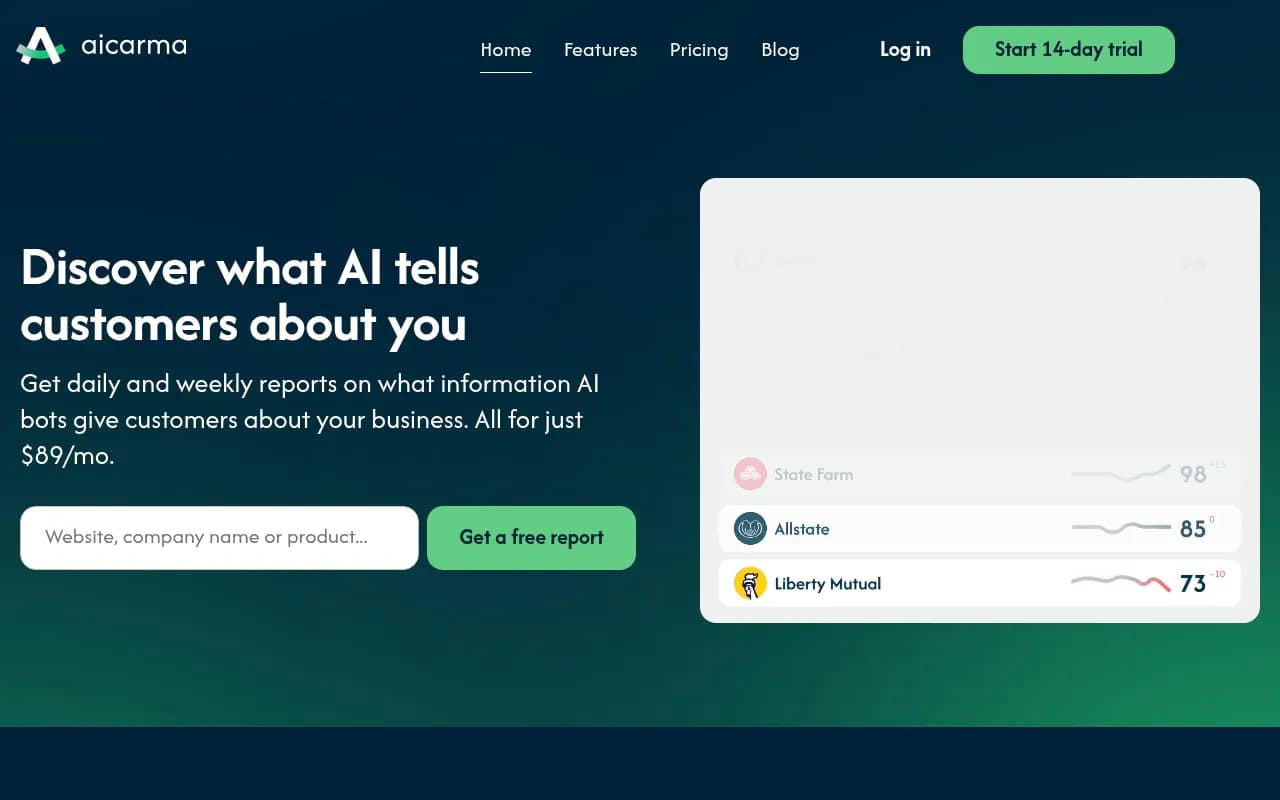
AICarma monitors how ChatGPT, Claude, Gemini, Perplexity, and 10+ other AI models represent your brand in their responses. Get daily visibility scores, weekly email reports, and competitor comparisons to understand your AI search presence. Starting at $89/month with unlimited prompts and a free instant brand report.
Key Takeaways
• Monitoring-only platform: AICarma tracks brand mentions across 14+ LLMs but lacks content optimization tools, AI crawler logs, citation analysis, and the content generation capabilities that platforms like Promptwatch offer • No action loop: Shows you visibility scores and competitor comparisons but doesn't help you fix gaps -- no Answer Gap Analysis, no AI writing agent, no page-level tracking to see which content is actually getting cited • Missing critical features: No Reddit/YouTube tracking, no ChatGPT Shopping monitoring, no prompt volume/difficulty data, no query fan-outs, no traffic attribution, no API access • Best for: Small businesses and solopreneurs who want basic brand monitoring across AI models without needing optimization tools or deep analytics • Affordable entry point: At $89/month with unlimited prompts, it's one of the cheapest AI visibility trackers available -- but you get what you pay for in terms of depth and actionability
AICarma is a brand monitoring tool built for one specific job: showing you how AI language models talk about your company when users ask questions. Launched as a lightweight alternative to enterprise GEO platforms, it targets small businesses and marketers who want to keep tabs on their AI reputation without investing in full optimization suites. The pitch is simple -- enter your brand name, get a visibility score, see how you compare to competitors, receive weekly email digests. No complexity, no learning curve, just straightforward tracking.
The platform monitors 14+ AI models including ChatGPT, Claude, Gemini, Perplexity, Grok, DeepSeek, Llama, Mistral, and Cohere. You define prompts relevant to your business ("best project management software", "top CRM for small teams", etc.), and AICarma queries each model daily to see if your brand appears in responses. Visibility scores are calculated based on mention frequency and prominence, then aggregated into a dashboard with trend lines and competitor heatmaps. Weekly email reports summarize changes so you don't have to log in constantly.
What AICarma Actually Does
Brand Visibility Scoring: The core feature is a daily visibility score for your brand across each monitored LLM. AICarma runs your custom prompts through ChatGPT, Claude, Gemini, and others, then analyzes whether your brand is mentioned, how prominently it appears (first mention vs buried in a list), and whether the tone is positive, neutral, or negative. Scores are normalized to a 0-100 scale so you can track trends over time. The dashboard shows a line graph of your score across all models combined, plus individual breakdowns per LLM. This is useful for spotting sudden drops (maybe a competitor launched a big campaign) or gradual improvements (your content strategy is working). However, the scoring methodology is opaque -- AICarma doesn't explain exactly how mentions are weighted or what factors drive score changes, making it hard to know what actions will move the needle.
Competitor Comparison: You can add up to 5 competitor brands to track alongside your own. AICarma runs the same prompts for each competitor and displays side-by-side visibility scores in a heatmap format. This shows you which brands dominate specific prompts and which LLMs favor certain competitors. For example, you might discover that a rival consistently ranks higher in Perplexity responses but you outperform them in ChatGPT. The competitive intelligence is surface-level -- you see who's winning but not why. There's no citation analysis to show which pages or sources the AI models are pulling from, no content gap identification to reveal what your competitors are doing differently, and no recommendations for closing the gap. It's purely observational.
Unlimited Custom Prompts: Unlike some competitors that lock you into predefined prompt sets, AICarma lets you create unlimited custom prompts. This is genuinely useful because every business cares about different queries. A SaaS company might track "best alternatives to [competitor]", "top tools for [use case]", and "[product category] comparison". An agency might monitor "best [service] agencies in [city]". You can organize prompts into groups (product comparisons, brand reputation, industry rankings) and assign different competitors to different prompt sets. The flexibility is a strong point, though without prompt volume data or difficulty scoring, you're guessing which prompts actually matter to your audience.
Weekly Email Digests: Every Monday, AICarma sends a summary email with your overall visibility score change, biggest movers (prompts where your score jumped or dropped significantly), and a snapshot of competitor performance. The emails are clean and scannable -- no fluff, just the numbers you need. This is perfect for busy founders or marketers who don't want to check a dashboard daily. However, the emails don't include actionable insights or recommendations. They tell you what changed but not what to do about it. If your score drops 15 points, you're left wondering whether it's a data anomaly, a competitor's new content, or a shift in how the AI models are trained.
Free Instant Report: Before you pay, AICarma offers a free one-time brand report. Enter your brand name and a few prompts, and within 5 minutes you get a snapshot of how ChatGPT, Claude, and Gemini currently represent you. This is a smart lead magnet -- it gives prospects immediate value and demonstrates the product's core functionality. The free report is limited to 3 LLMs and 3 prompts, but it's enough to see whether your brand has an AI visibility problem worth solving.
What AICarma Doesn't Do (And Why It Matters)
AICarma is a monitoring dashboard, not an optimization platform. It shows you the problem but doesn't help you fix it. Here's what's missing compared to full-featured GEO tools like Promptwatch:
No Content Gap Analysis: AICarma doesn't tell you which prompts your competitors rank for but you don't. It won't identify the specific topics, angles, or questions AI models want answers to but can't find on your site. Without gap analysis, you're flying blind -- you know your score is low, but you don't know what content to create to improve it.
No AI Content Generation: There's no built-in writing agent or content creation tools. If you discover a gap, you're on your own to research, write, and optimize content. Platforms like Promptwatch generate AI-optimized articles grounded in citation data and prompt volumes, closing the loop from insight to action. AICarma stops at insight.
No Citation or Source Analysis: You can't see which pages, domains, Reddit threads, or YouTube videos AI models are citing when they mention (or don't mention) your brand. This is critical for understanding why competitors outrank you. Are they getting cited because of a viral Reddit thread? A high-authority backlink? Better on-page content? AICarma doesn't tell you.
No AI Crawler Logs: You have no visibility into whether AI crawlers (ChatGPT, Claude, Perplexity bots) are actually visiting your website, which pages they're reading, or what errors they're encountering. Crawler logs are essential for diagnosing indexing issues and ensuring AI models can discover your content. AICarma doesn't track this at all.
No Prompt Intelligence: AICarma doesn't provide search volume estimates, difficulty scores, or query fan-outs for your prompts. You don't know which prompts are high-value (lots of users asking) vs low-value (niche queries), or which are winnable vs dominated by established brands. This makes prioritization guesswork.
No Reddit or YouTube Tracking: AI models increasingly cite Reddit discussions and YouTube videos in their responses, especially for product recommendations and how-to queries. AICarma doesn't surface these sources or help you identify influential threads to engage with. This is a major blind spot.
No ChatGPT Shopping Monitoring: ChatGPT now includes product recommendations and shopping carousels in certain queries. AICarma doesn't track whether your brand appears in these commercial results, which is a missed opportunity for e-commerce brands.
No Traffic Attribution: You can't connect AI visibility to actual website traffic or revenue. AICarma doesn't offer a tracking snippet, Google Search Console integration, or server log analysis to show whether improved visibility scores translate to more visitors or conversions. The ROI story is incomplete.
No API or Advanced Integrations: There's no API for exporting data or building custom workflows. No Looker Studio connector for custom reporting. No Slack notifications for score changes. You're locked into the AICarma dashboard and weekly emails.
Who Should Use AICarma
AICarma is best suited for small businesses, solopreneurs, and early-stage startups (1-10 employees) who want basic brand monitoring without the complexity or cost of enterprise GEO platforms. If you're a local service business (law firm, dental practice, consulting agency) or a niche SaaS with 1-2 competitors, AICarma gives you enough visibility to know whether AI models are recommending you. It's also a fit for marketers at larger companies who need a quick pulse check on AI reputation but don't own the content strategy or optimization work -- they just want to report numbers to leadership.
AICarma is NOT a good fit for: • SEO teams or agencies managing multiple clients: You need deeper analytics, content gap analysis, and optimization tools to actually improve rankings. Monitoring alone won't justify your retainer. • Content marketers responsible for AI visibility: Without citation data, prompt intelligence, or content generation, you can't take action on the insights. You'll end up supplementing AICarma with other tools. • E-commerce brands: No ChatGPT Shopping tracking, no product-level visibility, no conversion attribution. You're missing half the picture. • Enterprise companies with complex product portfolios: AICarma's simplicity becomes a limitation when you need to track dozens of products, multiple personas, regional variations, or integrate with existing martech stacks.
Integrations and Ecosystem
AICarma is a standalone tool with minimal integrations. There's no API, no Zapier support, no webhooks. You can't export raw data for analysis in other tools -- the dashboard and weekly emails are your only access points. This keeps the product simple but limits flexibility for power users or teams with existing workflows. There's no mobile app, no browser extension, no Slack bot. You log into the web dashboard or wait for the Monday email.
Pricing and Value
AICarma offers a single plan at $89/month (some sources mention $99/month for a "Basic" tier, but the official site lists $89). This includes: • Unlimited custom prompts • Daily visibility scoring across 14+ LLMs • Up to 5 competitor brands • Weekly email digests • Access to the web dashboard • Free instant report before you subscribe
There's no free trial beyond the one-time instant report, and no annual discount is advertised. At $89/month, AICarma is one of the cheapest AI visibility trackers on the market -- compare to Promptwatch Essential at $99/month (which includes 50 prompts, crawler logs, and 5 AI-generated articles), Otterly.AI at $99/month (monitoring only, limited prompts), or Peec.ai at $149/month (also monitoring-focused). The value proposition is clear: if you only need basic brand tracking and don't care about optimization features, AICarma is affordable.
However, the lack of actionable insights or content tools means you'll likely need to supplement it with other platforms if you actually want to improve your AI visibility. Paying $89/month to know you have a problem, then paying another tool to fix it, quickly erodes the cost advantage. For teams serious about AI search optimization, spending $249-579/month on a platform like Promptwatch that includes gap analysis, content generation, and crawler logs delivers better ROI because you're not just monitoring -- you're improving.
Strengths
• Simplicity: No learning curve, no complex setup. Enter your brand, add prompts, start tracking. Perfect for non-technical users. • Unlimited prompts: Unlike competitors that cap you at 50-150 prompts, AICarma lets you track as many as you want. Great for businesses with diverse product lines or multiple use cases. • Affordable: $89/month is accessible for small businesses and solopreneurs who can't justify $300-500/month tools. • Wide LLM coverage: 14+ models including newer entrants like DeepSeek and Cohere, not just the big 3-4. • Weekly digests: Saves time for busy users who don't want to log in daily.
Limitations
• No optimization tools: You see the problem but can't fix it within the platform. No content gap analysis, no AI writing agent, no citation tracking. • Opaque scoring: The visibility score methodology isn't explained, making it hard to know what actions will improve your score. • No traffic attribution: You can't prove that improved AI visibility drives actual business results. • Missing advanced features: No crawler logs, no Reddit/YouTube tracking, no ChatGPT Shopping, no prompt volume data, no API. • Limited integrations: Standalone tool with no connections to other martech platforms.
Bottom Line
AICarma is a basic brand monitoring tool for small businesses that want to keep tabs on how AI models represent them without investing in full optimization platforms. At $89/month with unlimited prompts and 14+ LLM coverage, it's an affordable entry point for AI visibility tracking. However, it's purely observational -- you get scores and competitor comparisons but no tools to actually improve your rankings. For marketers, agencies, or content teams responsible for AI search performance, the lack of gap analysis, citation tracking, content generation, and traffic attribution makes AICarma insufficient on its own. You'll need to pair it with optimization tools or upgrade to a platform like Promptwatch that closes the loop from insight to action. Best use case: a local service business or niche SaaS founder who wants a weekly pulse check on AI reputation without the complexity of enterprise GEO software.
Tags:
Similar and alternative tools to AICarma