Lumar Review 2026
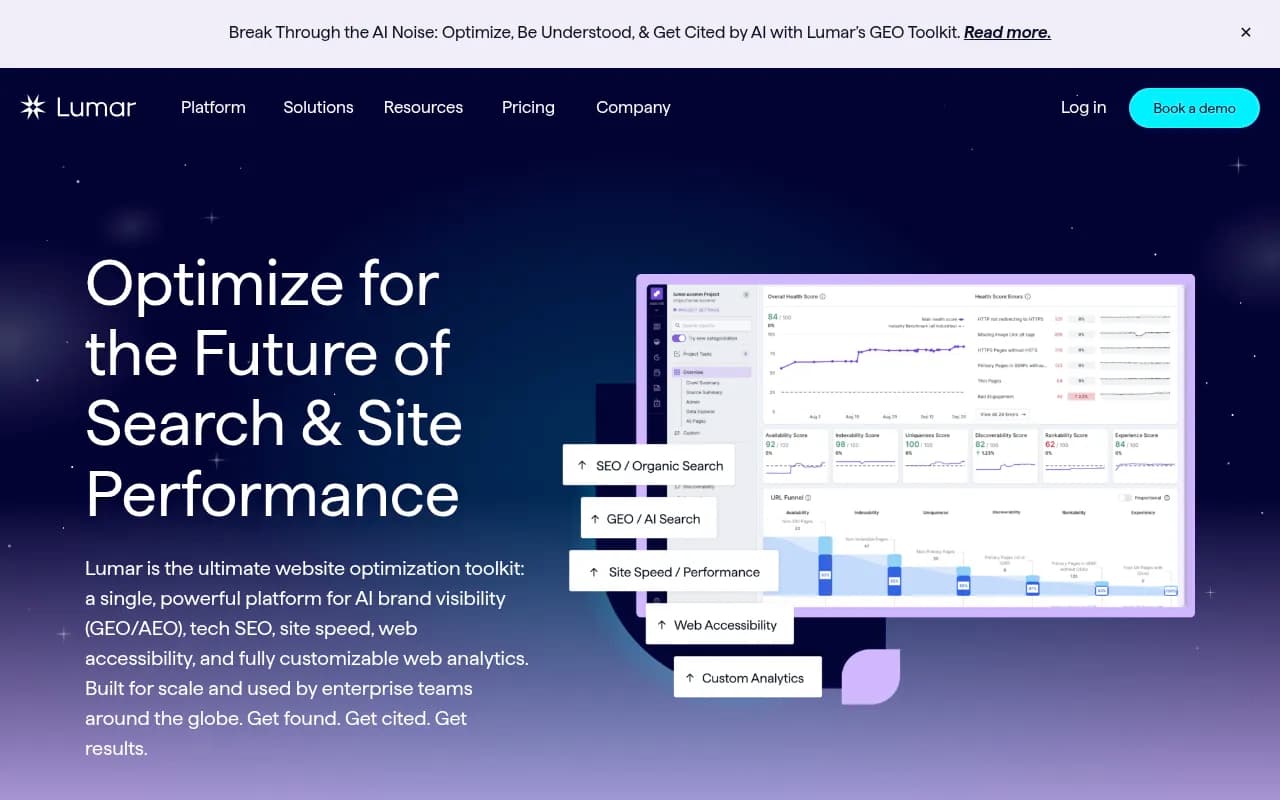
Lumar is an all-in-one website optimization platform built for enterprise teams managing large-scale sites. It combines technical SEO auditing, AI search visibility (GEO/AEO), site speed monitoring, web accessibility testing, and custom analytics in a single toolkit. Trusted by Adobe, Deloitte, and
Summary: Key Takeaways
- All-in-one enterprise platform: Lumar combines technical SEO, GEO/AEO (AI search optimization), site speed, web accessibility, and custom analytics in one place — eliminating the need for multiple tools
- Built for scale: Crawls millions of pages at high speed with 500+ built-in reports, custom data extraction, and multi-site monitoring capabilities
- Action-oriented workflow: Four core apps (Analyze, Monitor, Protect, Impact) help teams find issues, track progress, prevent regressions, and demonstrate ROI to stakeholders
- Strong on AI search: Comprehensive GEO toolkit tracks brand mentions and sentiment across major AI platforms, evaluates content for AI readiness, and provides instant optimization suggestions
- Enterprise-grade support: SOC 2 Type 2 certified, with dedicated professional services team offering hands-on SEO/GEO strategy help and regular crawl reviews
Lumar (formerly Deepcrawl) is a comprehensive website optimization platform designed for enterprise digital teams managing large, complex websites. Originally known as one of the most powerful technical SEO crawlers on the market, Lumar has evolved into a full-stack website intelligence platform that addresses the modern reality of organic visibility: success in 2026 requires optimizing not just for Google, but for AI search engines, site performance, accessibility compliance, and custom business metrics.
The platform is used by major enterprise brands including Adobe, Deloitte, Comcast, Fandom, Compare the Market, and Cox Automotive — companies managing hundreds of thousands or millions of pages where manual auditing is impossible and small technical issues can cost significant revenue. Lumar's core value proposition is bringing all website optimization disciplines under one roof with enterprise-grade scale, automation, and collaboration features.
What Makes Lumar Different: Five Optimization Pillars in One Platform
Most enterprise SEO teams juggle multiple tools — one for crawling, another for site speed, a third for accessibility, and now separate platforms for AI search monitoring. Lumar consolidates these into a unified system:
Technical SEO at Scale: Lumar's crawler is built to handle millions of URLs without choking. It provides hundreds of pre-built technical SEO reports covering everything from crawlability and indexation to structured data, hreflang, canonical tags, and JavaScript rendering. The platform integrates data from Google Search Console, Google Analytics, and other sources to show not just what's broken, but what's actually impacting traffic and revenue. Custom data extraction lets teams pull any HTML element, meta tag, or page attribute they need — critical for large sites with unique technical requirements. The AI Dev Ticket Writer tool automatically converts discovered issues into actionable development tickets with context and priority, streamlining the handoff between SEO and engineering teams.
GEO/AEO (AI Search Visibility): This is where Lumar has made significant recent investments. The GEO toolkit tracks how brands appear in AI platforms like ChatGPT, Claude, Perplexity, Gemini, and others. It monitors brand mentions, sentiment, and citation frequency across AI responses. The platform evaluates content for "AI readiness" across three dimensions: AI Discovery (can AI crawlers find and access your content?), AI Understanding (is your content structured and written in ways AI models can parse?), and AI Inclusion (does your content get cited in AI responses?). Instant AI-powered suggestions help teams optimize content for better AI visibility. This positions Lumar as one of the few enterprise platforms addressing the shift toward AI-mediated search, though competitors like Promptwatch offer more depth in prompt intelligence, content gap analysis, and AI-specific content generation.
Site Speed & Performance: Lumar provides Lighthouse reporting at scale, tracking Core Web Vitals and other performance metrics across entire sites. It includes origin-level Chrome User Experience Report (CrUX) data based on real user experiences, not just lab tests. Teams can identify performance bottlenecks by page type, template, or site section, and track improvements over time. This is particularly valuable for e-commerce sites where page speed directly impacts conversion rates.
Web Accessibility (A11y): The accessibility module tests sites against WCAG 2.2 standards (Levels A through AAA), identifying issues that prevent users with disabilities from accessing content. Lumar provides instant suggested fixes for each accessibility issue discovered, helping teams achieve compliance with regulations like the ADA (US) or European Accessibility Act. For large organizations facing legal risk or brand reputation concerns around accessibility, this built-in capability eliminates the need for separate a11y auditing tools.
Custom Website Analytics: Beyond standard metrics, Lumar lets teams create fully customizable analytics dashboards. AI-generated code simplifies the process of collecting unique data points. This flexibility is crucial for enterprise teams with specific KPIs or reporting requirements that standard tools don't address — for example, tracking how many product pages have video content, or monitoring the adoption of a new internal linking structure across regional sites.
The Four-App Workflow: Analyze, Monitor, Protect, Impact
Lumar organizes its capabilities into four interconnected applications that support the full optimization lifecycle:
Analyze: The core auditing engine. Teams run deep crawls to uncover technical SEO, GEO, accessibility, and performance issues across millions of pages. The interface prioritizes issues by severity and potential impact, with visualization tools and collaborative features (tasks, comments, sharing) that help teams coordinate fixes. Custom segmentation lets you analyze specific site sections, page types, or URL patterns in isolation.
Monitor: Continuous monitoring for large, multi-site operations. Set up ongoing crawls across multiple domains, geographies, or site sections. Custom alerts notify the right teams immediately when critical metrics drop or new issues appear. Dashboards provide at-a-glance health scores across your entire web property portfolio. This is essential for enterprise teams managing dozens or hundreds of sites who need to spot problems before they cause traffic or revenue loss.
Protect: Pre-deployment QA testing integrated into CI/CD pipelines. Create test suites that automatically check staging environments for SEO, GEO, performance, or accessibility regressions before code reaches production. Set custom thresholds that halt builds or warn developers when metrics fall below acceptable levels. This "shift left" approach prevents issues from ever reaching live sites — far more efficient than discovering problems in post-launch audits. Integration with GitHub and other development tools makes this seamless for engineering teams.
Impact: Stakeholder communication and ROI demonstration. Benchmark your site's health against industry averages to identify gaps and build business cases for optimization investments. Prioritize fixes based on potential commercial impact. Generate executive-friendly reports that show how SEO and optimization work translates to business outcomes. This addresses a common enterprise pain point: proving the value of technical work to non-technical decision-makers who control budgets.
Professional Services: More Than Just Software
Unlike pure SaaS platforms, Lumar offers dedicated professional services contracts where their expert SEO/GEO team acts as an extension of your in-house resources. This includes regular crawl reviews, strategic guidance, and hands-on optimization help. For enterprise teams stretched thin or lacking deep technical SEO expertise, this hybrid model provides both powerful tools and expert support. Customer testimonials consistently highlight the responsiveness and expertise of Lumar's support team as a key differentiator.
Integrations & Ecosystem
Lumar integrates with Google Search Console, Google Analytics, Majestic, and other SEO data sources to enrich crawl data with traffic, ranking, and backlink information. The platform offers a full API for custom integrations and data export. Looker Studio integration enables custom reporting workflows. GitHub integration supports the Protect app's CI/CD capabilities. While the integration list isn't as extensive as some competitors, it covers the essential tools most enterprise SEO teams use daily.
Who Is Lumar For?
Lumar is purpose-built for enterprise digital teams managing large, complex websites — typically 100,000+ pages, though smaller high-value sites benefit too. Primary users include:
In-house SEO teams at large brands: Companies like Adobe, Comcast, or Compare the Market with dedicated SEO teams managing massive sites across multiple markets or product lines. These teams need industrial-strength crawling, multi-site monitoring, and stakeholder reporting capabilities that consumer-grade tools can't provide.
Digital agencies managing multiple client sites: Agencies like Brave Bison use Lumar's multi-site monitoring and white-label reporting to efficiently manage dozens of client websites from a single platform. The ability to segment data by client and customize reports for different stakeholders is critical here.
E-commerce operations: Online retailers with large product catalogs (think 50,000+ SKUs) where technical issues can immediately impact revenue. Site speed monitoring, accessibility compliance, and the ability to track issues by product category or template make Lumar particularly valuable for e-commerce.
Enterprise SEO consultants: Independent consultants or small teams serving enterprise clients need tools that can handle million-page crawls and produce client-ready reports without requiring a full agency infrastructure.
Who should NOT use Lumar: Small businesses, solopreneurs, or teams managing simple websites under 10,000 pages will find Lumar overkill and expensive. The platform's complexity and enterprise focus mean there's a learning curve. Teams looking primarily for keyword research, content optimization, or rank tracking should look elsewhere — Lumar is about technical website health, not content strategy or SERP analysis. For AI search optimization specifically, teams wanting deeper prompt intelligence, content gap analysis, and AI content generation capabilities might find platforms like Promptwatch more comprehensive in that specific domain.
Pricing & Value
Lumar does not publish pricing publicly — it's custom quoted based on site size, number of sites, crawl frequency, and which apps/modules you need. Based on industry knowledge, expect enterprise-level pricing starting in the low four figures per month for smaller deployments, scaling up significantly for large multi-site operations. Annual contracts are standard. Free trials are available to qualified prospects.
For enterprise teams, the value calculation is straightforward: can Lumar prevent or fix technical issues that would otherwise cost more in lost traffic/revenue than the platform costs? For a large e-commerce site, a single undetected canonicalization issue or site speed regression can easily cost tens of thousands in lost revenue. The platform's ability to catch these issues early — especially via the Protect app's pre-deployment testing — often justifies the investment.
The professional services add-on provides additional value for teams lacking deep technical SEO expertise or needing strategic guidance, though it increases total cost.
Strengths
- Unmatched scale: Crawls millions of pages reliably and quickly, with depth and customization options that few competitors match
- Comprehensive scope: Genuinely covers technical SEO, GEO/AEO, site speed, accessibility, and custom analytics in one platform — reducing tool sprawl
- Enterprise-grade features: Multi-site monitoring, CI/CD integration, custom alerts, role-based access, SOC 2 Type 2 compliance, and API access meet enterprise security and workflow requirements
- Professional services: The hybrid SaaS + expert support model provides both powerful tools and strategic guidance
- Strong customer support: Consistently praised in testimonials for responsiveness and expertise
Limitations
- Pricing opacity: No public pricing makes it hard to evaluate fit before engaging in a sales process
- Complexity: The platform's breadth and depth mean a learning curve; smaller teams may feel overwhelmed
- GEO capabilities still maturing: While Lumar has made significant GEO investments, competitors focused exclusively on AI search optimization (like Promptwatch) offer deeper prompt intelligence, content gap analysis, and AI content generation features
- Limited content optimization: Lumar excels at technical auditing but doesn't provide content strategy, keyword research, or content creation tools beyond the GEO content evaluation features
Bottom Line
Lumar is the right choice for enterprise digital teams managing large, complex websites who need industrial-strength technical auditing, multi-site monitoring, and comprehensive optimization capabilities across SEO, AI search, performance, and accessibility. The platform's scale, depth, and enterprise features justify the investment for organizations where technical website issues can cost significant revenue. The addition of GEO/AEO capabilities positions Lumar well for the AI search era, though teams wanting to go deeper on AI visibility specifically should evaluate specialized platforms alongside Lumar. For agencies managing multiple client sites or large brands with complex web properties, Lumar's combination of powerful tools and expert support makes it a strong platform choice in 2026.
Tags:
Similar and alternative tools to Lumar