Key Takeaways
• Promptwatch leads on action: The only platform that combines monitoring with content gap analysis, AI content generation, and optimization tools—most competitors stop at tracking • LLM Pulse wins on price: Starting at €49/month for 40 prompts across 4 engines, it offers the lowest cost per tracked prompt among multi-engine platforms • Rankshift balances features and affordability: Credit-based pricing with 65% lower per-prompt costs than rigid tier competitors, plus solid coverage of major AI engines • Coverage matters more than you think: Promptwatch tracks 10 AI models including ChatGPT Shopping and Reddit/YouTube insights; LLM Pulse covers 4 engines; Rankshift focuses on core platforms • Budget doesn't mean basic: All three platforms offer crawler logs, prompt tracking, and citation analysis—features that cost 2-3x more on enterprise platforms like Profound or Evertune
The Budget AI Visibility Landscape in 2026
The AI visibility tracking market has exploded. Over 170 platforms now compete for attention, with prices ranging from free tools like ProductRank to enterprise solutions costing $2,000+ monthly. For marketing teams with limited budgets, finding a platform that delivers real value without breaking the bank is critical.
This comparison focuses on three platforms that punch above their weight class: Promptwatch, Rankshift, and LLM Pulse. Each offers comprehensive AI visibility tracking at price points accessible to mid-market brands and agencies—typically $99-$249 per month versus $500-$1,500 for enterprise alternatives.

But "budget" doesn't mean compromising on features. According to research from LLMClicks.ai, the real differentiator isn't price—it's whether a platform helps you act on visibility data or just shows you numbers. Most monitoring-only tools leave you stuck with insights but no path to improvement.
Why This Comparison Matters
Brands face a new visibility crisis in 2026. Your website might rank #1 on Google, but if ChatGPT recommends competitors when users ask for product suggestions, you're invisible where it matters most. AI search engines now handle over 40% of product research queries, and that percentage is climbing.
The challenge: tracking AI visibility requires running thousands of prompts monthly across multiple engines. Enterprise platforms like Profound or Evertune charge $1,000+ monthly for this capability. Budget platforms democratize access to the same core functionality at 70-80% lower costs.
But there's a catch. Many budget tools are monitoring-only dashboards—they show you where you're invisible but don't help you fix it. This comparison evaluates which platforms deliver actionable insights, not just data dumps.
Platform Overview: What Each Tool Does
Promptwatch: The Action-Oriented Platform
Promptwatch positions itself as an optimization platform, not just a tracker. It monitors 10 AI models including ChatGPT, Claude, Perplexity, Gemini, Meta AI, DeepSeek, Grok, Mistral, Copilot, and Google AI Overviews.
The core difference: Promptwatch's Answer Gap Analysis shows exactly which prompts competitors rank for but you don't. It then generates content specifically engineered to get cited by AI models—articles, listicles, and comparisons grounded in 880M+ analyzed citations.
Pricing starts at $99/month (Essential plan: 1 site, 50 prompts, 5 AI-generated articles). Professional tier ($249/month) adds crawler logs, state/city tracking, and 150 prompts. Business plan ($579/month) includes 5 sites and 350 prompts.
Key capabilities:
- AI crawler logs showing which pages ChatGPT, Claude, and Perplexity actually read
- Built-in AI writing agent for content creation
- Reddit and YouTube citation tracking
- ChatGPT Shopping monitoring
- Prompt volume estimates and difficulty scores
- Page-level traffic attribution
Rankshift: Credit-Based Flexibility

Rankshift offers credit-based pricing that provides 65% lower per-prompt costs compared to rigid tier structures. It tracks brand visibility across ChatGPT, Perplexity, and major AI search engines with a focus on simplicity and flexibility.
The platform emphasizes straightforward monitoring without the complexity of enterprise tools. Teams buy credits and allocate them across prompts as needed, making it ideal for agencies managing multiple clients or brands with fluctuating tracking needs.
Key features include basic crawler monitoring, citation tracking, and competitor comparison. However, it lacks content generation capabilities and advanced optimization features found in Promptwatch.
LLM Pulse: The Price Leader
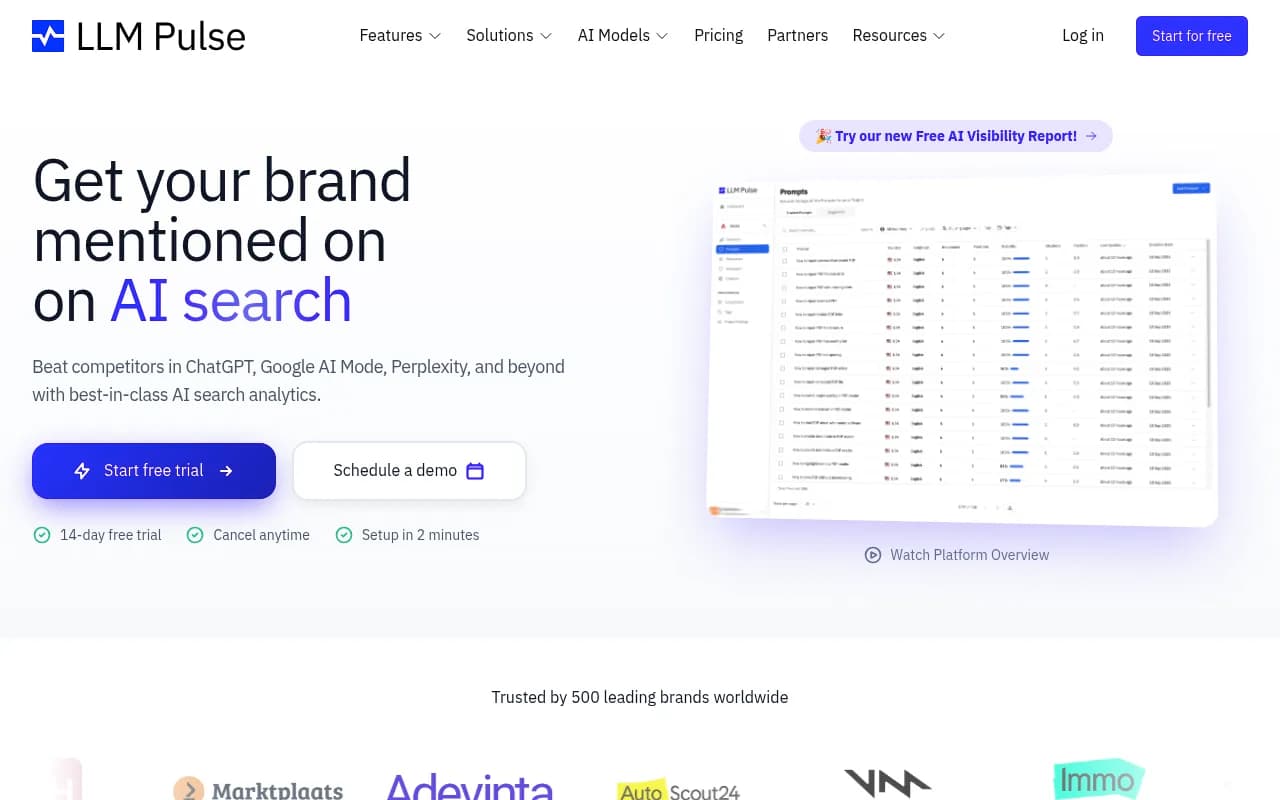
LLM Pulse delivers the lowest effective cost per tracked prompt among multi-engine platforms. At €49/month for 40 prompts across ChatGPT, Perplexity, Google AI Mode, and AI Overviews, it costs €1.23 per prompt. The Growth plan (€99/month, 100 prompts) drops that to €0.99 per prompt.
According to their own analysis, this represents 60-70% savings compared to competitors like Peec AI (€3.56 per prompt) or Omnia (€3.16 per prompt). The platform covers 4 core AI engines—fewer than Promptwatch's 10, but sufficient for most brand monitoring needs.

LLM Pulse focuses on monitoring and reporting. It tracks brand share of voice, citation patterns, and sentiment across AI responses. However, like Rankshift, it lacks content optimization and generation capabilities.
Feature-by-Feature Comparison
AI Engine Coverage
Promptwatch: 10 engines
- ChatGPT (including Shopping)
- Claude
- Perplexity
- Gemini
- Google AI Overviews
- Google AI Mode
- Meta AI/Llama
- DeepSeek
- Grok
- Mistral
- Copilot
Rankshift: 5-7 engines (exact count varies by plan)
- ChatGPT
- Perplexity
- Claude
- Gemini
- Google AI Overviews
LLM Pulse: 4 engines
- ChatGPT
- Perplexity
- Google AI Mode
- Google AI Overviews
For brands targeting comprehensive AI visibility, Promptwatch's 10-engine coverage is unmatched in this price range. LLM Pulse's 4-engine focus keeps costs low while covering the highest-traffic platforms.
Crawler Logs and Indexing
All three platforms offer crawler log analysis—a feature typically reserved for enterprise tools. This shows which pages AI engines actually read, how often they return, and errors they encounter.
Promptwatch provides real-time logs with detailed error tracking and indexing insights. The Professional plan ($249/month) includes full crawler log access.
Rankshift offers basic crawler monitoring but with less granular detail than Promptwatch.
LLM Pulse includes crawler tracking in all paid plans, making it the most accessible option for teams needing this capability.
Content Optimization and Generation
This is where the platforms diverge significantly.
Promptwatch includes a built-in AI writing agent that generates articles, listicles, and comparison content specifically engineered to get cited by AI models. The Essential plan includes 5 articles/month; Professional includes 15; Business includes 30.
The content generation is grounded in:
- 880M+ analyzed citations
- Prompt volume data
- Competitor analysis
- Persona targeting
This transforms Promptwatch from a monitoring tool into an optimization platform. You find gaps, generate content to fill them, then track results—a complete action loop.
Rankshift and LLM Pulse do not include content generation. They identify visibility gaps but leave content creation to external tools or manual processes.
For teams that want monitoring plus optimization in one platform, Promptwatch is the only option in this price range. For teams with existing content workflows, Rankshift or LLM Pulse may suffice.
Prompt Intelligence and Prioritization
Promptwatch provides volume estimates and difficulty scores for each prompt, plus query fan-outs showing how one prompt branches into sub-queries. This helps teams prioritize high-value, winnable prompts instead of guessing.
Rankshift offers basic prompt tracking without volume or difficulty data.
LLM Pulse focuses on share of voice and citation tracking without prompt prioritization features.
For data-driven optimization, Promptwatch's prompt intelligence is a significant advantage.
Reddit and YouTube Tracking
AI models increasingly cite Reddit discussions and YouTube videos in their responses. Tracking these sources reveals where to publish and what to optimize.
Promptwatch includes Reddit and YouTube citation tracking in all plans. You see which threads and videos AI models reference, allowing you to participate in high-value discussions or create competing content.
Rankshift and LLM Pulse do not track Reddit or YouTube citations.
For brands in competitive niches where Reddit and YouTube influence AI recommendations, this feature alone may justify Promptwatch's higher price.
Multi-Language and Multi-Region Support
Promptwatch supports monitoring in any language, from any country, with customizable personas matching how actual customers prompt.
Rankshift offers multi-region tracking with credit-based allocation.
LLM Pulse provides multi-language support across its 4 tracked engines.
All three platforms handle international monitoring adequately, though Promptwatch's persona customization is more advanced.
Traffic Attribution
Connecting AI visibility to actual revenue requires traffic attribution.
Promptwatch offers three attribution methods:
- Code snippet for direct tracking
- Google Search Console integration
- Server log analysis
This closes the loop from visibility to traffic to revenue.
Rankshift provides basic traffic tracking.
LLM Pulse focuses on visibility metrics without deep traffic attribution.
For teams needing to prove ROI, Promptwatch's attribution capabilities are essential.
Pricing Breakdown: Cost Per Value
Promptwatch Pricing
Essential: $99/month
- 1 site
- 50 prompts
- 5 AI-generated articles
- 10 AI engines
- Basic tracking
Professional: $249/month
- 2 sites
- 150 prompts
- 15 AI-generated articles
- Crawler logs
- State/city tracking
- All Essential features
Business: $579/month
- 5 sites
- 350 prompts
- 30 AI-generated articles
- All Professional features
Annual billing discounts available. Free trial offered.
Cost per prompt (Essential): $1.98 Cost per prompt (Professional): $1.66 Cost per prompt (Business): $1.65
When factoring in included content generation (worth $50-100 per article if outsourced), the effective cost per prompt drops significantly.
Rankshift Pricing
Credit-based model with 65% lower per-prompt costs than rigid tier competitors. Exact pricing varies by credit package purchased. Typical range: $79-$299/month depending on volume.
Estimated cost per prompt: $0.80-$1.20
Flexibility is the key advantage—teams allocate credits as needed across clients or campaigns.
LLM Pulse Pricing
Starter: €49/month
- 40 prompts
- 4 AI engines
- Basic tracking
Growth: €99/month
- 100 prompts
- 4 AI engines
- Enhanced features
Cost per prompt (Starter): €1.23 Cost per prompt (Growth): €0.99
LLM Pulse offers the lowest per-prompt cost among multi-engine platforms, making it ideal for budget-conscious teams prioritizing monitoring over optimization.
Use Case Recommendations
Choose Promptwatch If:
- You need monitoring plus content optimization in one platform
- Your team lacks dedicated content creation resources
- You want to track Reddit, YouTube, and ChatGPT Shopping citations
- You need advanced prompt intelligence (volume, difficulty, fan-outs)
- You require comprehensive coverage across 10 AI engines
- You want to prove ROI with traffic attribution
- You're willing to invest $99-$249/month for an all-in-one solution
Best for: Mid-market brands, agencies managing 2-5 clients, SaaS companies, e-commerce brands competing in AI search.
Choose Rankshift If:
- You need flexible, credit-based pricing
- You manage multiple clients with varying tracking needs
- You have existing content creation workflows
- You want solid coverage of major AI engines without paying for extras
- You prefer allocating budget dynamically across projects
- You're comfortable with monitoring-only tools
Best for: Digital agencies, freelance consultants, brands with in-house content teams, companies testing AI visibility before committing to full optimization.
Choose LLM Pulse If:
- Budget is your primary constraint
- You only need to track the 4 most important AI engines
- You want the lowest cost per tracked prompt
- You have content creation handled elsewhere
- You're focused on monitoring and reporting, not optimization
- You're a startup or small business testing AI visibility
Best for: Startups, small businesses, solopreneurs, brands with limited budgets, teams prioritizing monitoring over action.
What These Platforms Don't Tell You
The Monitoring-Only Trap
Most budget AI visibility tools—including Rankshift and LLM Pulse—are monitoring-only dashboards. They show you where you're invisible but don't help you fix it. According to research from LLMClicks.ai, this is the most common frustration among users.
You discover that competitors are cited for 50 prompts you're not. Great. Now what? You're left manually creating content, guessing at optimization strategies, and hoping AI models notice.
Promptwatch solves this with Answer Gap Analysis and built-in content generation. It shows you what's missing, then helps you create it. This action loop is what separates optimization platforms from trackers.
The Hallucination Problem
Being visible with wrong information costs more than being invisible. If ChatGPT recommends your product but hallucinates outdated pricing or non-existent features, you lose credibility with prospects.
Most budget tools—including all three in this comparison—track mentions but don't systematically detect hallucinations. According to LLMClicks.ai's testing, only one platform (LLMClicks itself) consistently flags inaccurate AI responses.
This is a gap in the market. Until platforms add hallucination detection, teams must manually verify AI responses—a time-consuming process.
The Coverage vs. Cost Tradeoff
Promptwatch tracks 10 AI engines. LLM Pulse tracks 4. Does that 2.5x difference in coverage justify Promptwatch's higher price?
It depends on your audience. If your customers primarily use ChatGPT and Perplexity, LLM Pulse's 4-engine coverage is sufficient. If you're targeting enterprise buyers who use Claude, Gemini, and DeepSeek, Promptwatch's 10-engine coverage is essential.
The research from Relixir shows that 80% of AI search traffic comes from 5 engines: ChatGPT, Perplexity, Google AI Overviews, Claude, and Gemini. LLM Pulse covers 3 of these; Rankshift covers 5; Promptwatch covers all 5 plus 5 more.
For most brands, 5-engine coverage is the sweet spot. Paying for 10 engines makes sense if you're targeting specific demographics (e.g., developers using Claude, crypto users on Grok).
Competitive Context: How These Stack Up Against Enterprise Tools
To understand the value proposition of budget platforms, compare them to enterprise alternatives:
Profound: $1,200+/month, 9+ engines, advanced analytics, no content generation Evertune: $1,500+/month, 9 engines, 1M+ prompts monthly, enterprise scale Peec AI: €89/month base + €20-30 per additional engine, limited prompt volumes Otterly.AI: $299+/month, monitoring-only, no crawler logs AthenaHQ: $500+/month, monitoring-focused, lacks optimization
Promptwatch at $99-$249/month delivers 70-80% of enterprise functionality at 1/5 the cost. The main tradeoffs:
- Fewer prompts per month (50-350 vs. 1,000-10,000)
- Less advanced analytics and reporting
- Smaller team collaboration features
But for mid-market brands, these tradeoffs are acceptable. You get the core capabilities—multi-engine tracking, crawler logs, citation analysis, and (uniquely) content generation—without enterprise overhead.
Rankshift and LLM Pulse make even deeper tradeoffs, sacrificing content optimization for lower prices. But they still deliver more value than monitoring-only tools like Otterly.AI or Goodie AI that cost 2-3x more.
Implementation and Learning Curve
All three platforms are designed for marketers, not developers. Setup typically takes 30-60 minutes:
- Connect your website
- Define prompts to track
- Configure competitors
- Set tracking frequency
Promptwatch has the steepest learning curve due to its broader feature set. The Answer Gap Analysis and content generation tools require understanding how to interpret citation data and optimize for AI visibility. Expect 1-2 weeks to become proficient.
Rankshift is straightforward—allocate credits, define prompts, review reports. Most teams are productive within days.
LLM Pulse is the simplest. The interface focuses on core metrics: share of voice, citation counts, sentiment. You can extract value immediately.
All three offer documentation and support, though Promptwatch's is most comprehensive due to the platform's complexity.
Data Accuracy and Reliability
AI visibility tracking accuracy depends on:
- How often prompts are run
- Whether the platform uses real AI models or simulations
- How citation data is extracted and verified
All three platforms run prompts against live AI models—ChatGPT, Claude, Perplexity, etc.—not simulations. This ensures accuracy but limits tracking frequency due to API costs.
Promptwatch runs prompts daily by default, with options for more frequent tracking on higher plans.
Rankshift offers flexible tracking frequency based on credit allocation.
LLM Pulse runs prompts daily on paid plans.
For most use cases, daily tracking is sufficient. AI model responses don't change hourly like Google rankings. Weekly or even monthly tracking can work for stable industries.
Integration and Workflow Compatibility
All three platforms offer:
- API access for custom integrations
- CSV/Excel export for reporting
- Webhook support for automation
Promptwatch additionally integrates with:
- Google Search Console (for traffic attribution)
- Looker Studio (for custom dashboards)
- Common CMS platforms via API
Rankshift and LLM Pulse focus on standalone functionality with basic export capabilities.
For teams with complex workflows or custom reporting needs, Promptwatch's integrations are valuable. For teams wanting a simple, standalone tool, Rankshift or LLM Pulse are sufficient.
The Verdict: Which Platform Wins?
There's no universal winner—the best platform depends on your needs and budget.
Promptwatch wins for teams that want action, not just data. If you need monitoring plus content optimization in one platform, it's the only budget option. The $99-$249/month investment pays for itself if you generate even 2-3 articles monthly that improve AI visibility.
Rankshift wins for agencies and consultants who need flexibility. Credit-based pricing lets you allocate budget dynamically across clients. It's monitoring-only, but if you have content creation handled elsewhere, that's fine.
LLM Pulse wins on pure cost efficiency. At €0.99-€1.23 per tracked prompt, it's the most affordable multi-engine platform. Perfect for budget-conscious teams that only need monitoring and reporting.
All three platforms deliver significantly more value than their price tags suggest. They democratize AI visibility tracking that was previously accessible only to enterprise brands with $1,000+ monthly budgets.
The real question isn't which platform is "best"—it's which aligns with your workflow, budget, and optimization goals. If you want to monitor and act in one platform, choose Promptwatch. If you want maximum flexibility, choose Rankshift. If you want minimum cost, choose LLM Pulse.
Getting Started
All three platforms offer free trials or demos:
- Promptwatch: Free trial available at promptwatch.com
- Rankshift: Demo and trial options on their website
- LLM Pulse: Starter plan at €49/month with no long-term commitment
Start with a 30-day trial on your top-priority prompts. Track 20-30 queries that matter most to your business. Evaluate which platform gives you the insights and actions you need.
Then scale from there. AI visibility tracking is still emerging—the platforms evolving fastest will win long-term. In 2026, all three are solid choices for budget-conscious teams. By 2027, the landscape may look very different.