Cognizo Review 2026
Cognizo is an Answer Engine Optimization (AEO) platform that helps marketing teams monitor and improve brand visibility across AI search engines like ChatGPT, Perplexity, Gemini, and Google AI Overviews. Track citations, sentiment, and AI-driven traffic while creating optimized content to increase your presence in AI-generated answers.
Key Takeaways:
• Missing critical capabilities vs Promptwatch: No AI crawler logs, no Reddit/YouTube tracking, no ChatGPT Shopping monitoring, no prompt difficulty scoring, no query fan-outs, no Answer Gap Analysis, and no page-level citation tracking -- Cognizo focuses on high-level brand monitoring rather than actionable content optimization • Monitoring-first approach: Strong at tracking brand mentions and sentiment across AI platforms, but lacks the depth needed to identify specific content gaps and create targeted fixes • Higher price point: Starts at $300/month (vs Promptwatch's $99/month Essential plan), making it less accessible for smaller teams and startups • Best for: Enterprise marketing teams and agencies that need basic AI visibility dashboards and are willing to handle content strategy and optimization separately • Not ideal for: Teams that need to close the loop from visibility insights to content creation, or brands that want to understand exactly which pages are being cited and why
Cognizo entered the Answer Engine Optimization (AEO) space as one of the early platforms focused on helping brands understand how they appear in AI-generated responses. Built by a team combining LLM expertise and marketing experience, the platform targets marketing teams at mid-sized companies, enterprises, and agencies looking to adapt to the shift from traditional search to AI-powered answer engines like ChatGPT, Perplexity, Gemini, and Google AI Overviews. The company has built a customer base that includes Automox, Inkhouse, and Hat Club, with a particular focus on serving agency partners through a dedicated program.
The core premise behind Cognizo is sound: as more users turn to AI chatbots for product research and recommendations instead of Google, brands risk becoming invisible if they don't optimize for these new discovery channels. Cognizo positions itself as an "all-in-one solution" for tracking AI visibility, analyzing competitive positioning, and optimizing content strategy. However, when compared to more comprehensive platforms like Promptwatch, Cognizo reveals itself as primarily a monitoring dashboard rather than a true optimization platform -- it shows you the problem but leaves most of the solution up to you.
Answer Engine Insights (Core Monitoring)
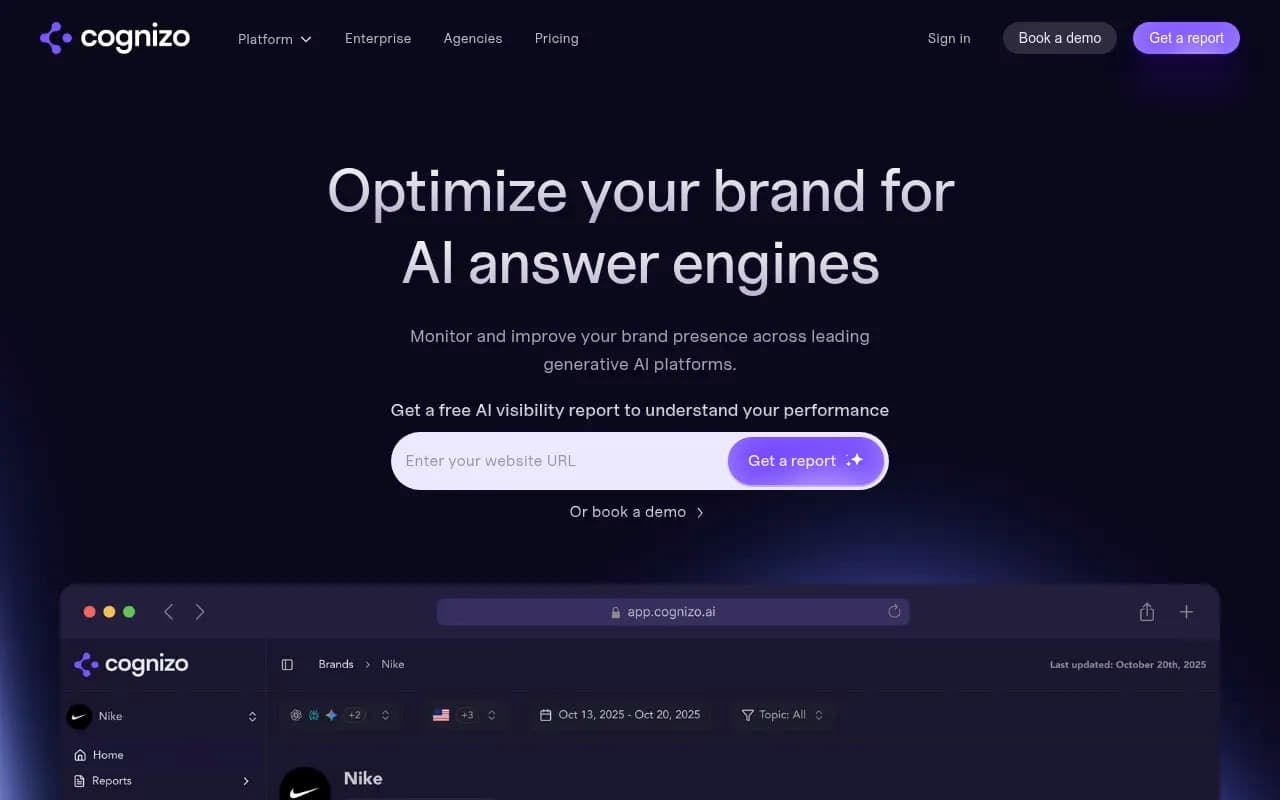
Cognizo's primary strength is its visibility tracking across major AI platforms. The platform continuously runs prompts across ChatGPT, Perplexity, Gemini, Google AI Overviews, Google AI Mode, Claude, Meta AI, Grok, and Microsoft Copilot, collecting millions of responses daily to track where and how your brand appears. You get real-time data on brand mentions, citation frequency, sentiment analysis (positive, neutral, negative), and competitive benchmarking that shows how you stack up against rivals.
The dashboard presents this data through charts showing mention trends over time, visibility scores by platform, and competitor comparison heatmaps. You can see which AI platforms mention your brand most frequently, track sentiment shifts, and identify when competitors are being cited instead of you. The interface is clean and the data visualization is straightforward, making it easy for marketing teams to present AI visibility metrics to stakeholders.
However, this is where Cognizo's limitations become apparent. Unlike Promptwatch's Answer Gap Analysis, Cognizo doesn't show you the specific prompts where competitors are visible but you're not, or identify the exact content topics and angles your website is missing. You can see that a competitor is mentioned more often, but you don't get the granular, actionable intelligence needed to close that gap. There's no page-level tracking to show which specific URLs are being cited, no citation source analysis to understand where AI models are pulling information from, and no Reddit or YouTube insights to surface the discussions that influence AI recommendations.
Prompt Volumes and Discovery
Cognizo offers a prompt generation engine that suggests relevant queries based on your industry, keywords, and topics. The platform claims to analyze "billions of real-time data signals" to identify how audiences interact with answer engines, helping you discover what people are asking AI about your category. You can customize the prompt set, add your own queries, and disable suggestions that aren't relevant.
This feature is useful for initial discovery, but it lacks the depth of Promptwatch's Prompt Intelligence. There are no volume estimates to help you prioritize high-traffic prompts, no difficulty scores to identify winnable opportunities, and no query fan-outs that show how one prompt branches into related sub-queries. You're essentially working with a list of suggested prompts without the strategic context needed to focus your efforts on the queries that will move the needle. For teams trying to prioritize content creation or optimize existing pages, this gap makes it difficult to know where to start.
Content Optimization and Creation
Cognizo markets its "Content Optimization" module as a way to "turn visibility insights into AI-ready content" through automated workflows. The platform offers technical audits, content briefs, drafts, FAQs, and update suggestions designed to improve your AI visibility. According to the website, the system identifies content opportunities, generates briefs, and produces drafts that are "ready to be ingested by answer engines."
In practice, this module is more of a content assistant than a true optimization engine. The technical audits check for basic structured data and schema markup, and the content workflows can generate outlines and drafts based on your target keywords. However, the system doesn't ground its recommendations in the same depth of citation data that powers Promptwatch's AI writing agent (which analyzes 880M+ citations to understand what actually gets cited by AI models). You don't get specific guidance on which content gaps to fill based on competitor analysis, and there's no integration with real prompt volume data to prioritize high-value topics.
The content creation workflows are serviceable for teams that already know what they need to write, but they don't solve the core problem: identifying exactly what content is missing and why AI models aren't citing you. Most customers will still need to do significant manual research and strategy work to figure out what to create, then use Cognizo's tools to execute on that plan.
AI Traffic Analytics
Cognizo's AI Traffic Analytics module tracks AI crawler activity and referral traffic from AI platforms. You can see which AI bots are visiting your site, monitor traffic trends over time, and identify which pages are being accessed. The platform categorizes crawlers into AI Indexing bots, AI Citations bots, and AI Training bots, giving you visibility into how different AI systems interact with your content.
This is a useful feature for understanding the technical side of AI visibility -- whether AI models can access your content, how often they return, and which pages they prioritize. However, it's a surface-level implementation compared to Promptwatch's AI Crawler Logs, which provide real-time, detailed logs showing exactly which pages were accessed, any errors encountered, response times, and patterns in crawler behavior. Cognizo's analytics are more of a high-level traffic report than a diagnostic tool for fixing indexing issues.
The referral traffic tracking shows visits coming from AI platforms, but there's no deep attribution to connect AI visibility to actual revenue or conversions. You can see that traffic is coming from Perplexity or ChatGPT, but you can't trace it back to specific prompts or understand which content is driving the most valuable visitors.
Platform Coverage and Integrations
Cognizo monitors 9 AI platforms: ChatGPT, Perplexity, Gemini, Google AI Overviews, Google AI Mode, Claude, Meta AI, Grok, and Microsoft Copilot. This is solid coverage of the major players, though it's missing DeepSeek and Mistral (both tracked by Promptwatch). The platform doesn't offer ChatGPT Shopping tracking, which is a significant gap for e-commerce brands trying to appear in product recommendations.
Integration options are limited. There's no mention of API access, Looker Studio integration, Google Search Console connection, or server log analysis capabilities. For agencies and enterprises that need to incorporate AI visibility data into custom reporting dashboards or existing analytics workflows, this is a major limitation. You're essentially locked into Cognizo's interface and reporting tools.
Who Is Cognizo For?
Cognizo is best suited for enterprise marketing teams and agencies that need a basic AI visibility dashboard and are comfortable handling content strategy and optimization through other tools or internal resources. If your primary goal is to track brand mentions across AI platforms, monitor sentiment, and present high-level metrics to stakeholders, Cognizo delivers on that use case. The platform works well for teams that already have strong content operations and just need visibility data to inform their strategy.
It's particularly appealing to agencies through its dedicated partner program, which offers white-label reporting and support for managing multiple client accounts. Agencies that want to add AI visibility monitoring as a service offering without building deep optimization capabilities will find Cognizo's agency-focused features useful.
Cognizo is not ideal for teams that need to close the loop from insights to action. If you're a lean marketing team trying to improve AI visibility without a large content production budget, or if you need specific guidance on which content to create and how to structure it for AI citations, Cognizo will leave you doing most of the strategic work manually. The platform shows you the problem but doesn't provide the tools to systematically fix it.
It's also not the right fit for e-commerce brands focused on product recommendations (no ChatGPT Shopping tracking), technical SEO teams that need deep crawler diagnostics (limited crawler log detail), or data-driven organizations that want to integrate AI visibility into custom analytics workflows (no API or advanced integrations).
Pricing and Value
Cognizo's pricing starts at $300/month for the Starter plan, which includes 350 prompts and basic monitoring features. This is significantly higher than Promptwatch's Essential plan at $99/month (50 prompts, 1 site, 5 AI-generated articles) or Professional plan at $249/month (150 prompts, 2 sites, 15 articles, crawler logs, state/city tracking). Given that Cognizo lacks several key features that Promptwatch includes at lower price points -- Answer Gap Analysis, page-level tracking, Reddit/YouTube insights, ChatGPT Shopping, prompt difficulty scoring, and AI content generation grounded in citation data -- the value proposition is questionable.
For enterprise teams with large budgets and a primary focus on high-level monitoring, the price may be justified by the clean interface and agency support. But for most marketing teams trying to maximize ROI on AI visibility efforts, platforms like Promptwatch offer significantly more capability per dollar spent.
There is a free trial available, and the onboarding process is described as "instant" with a premade prompt set to get started immediately. A customer success partner sets up an onboarding call to help with strategy and answer questions, which is a nice touch for teams new to AEO.
Strengths
• Clean, stakeholder-friendly dashboards: The interface is polished and makes it easy to present AI visibility metrics to executives and clients who want high-level insights without technical complexity • Broad platform coverage: Monitoring 9 major AI platforms gives you a comprehensive view of your brand's presence across the AI search landscape • Agency program: Dedicated support for agencies managing multiple clients, with white-label reporting and partner resources • Fast time to value: The instant onboarding and premade prompt sets mean you can start seeing data within hours of signing up • Sentiment tracking: The ability to monitor whether AI mentions are positive, neutral, or negative adds a qualitative dimension to visibility metrics
Limitations
• No Answer Gap Analysis: You can see that competitors are mentioned more often, but you don't get specific prompts where they're visible and you're not, or actionable guidance on what content to create to close those gaps • Missing critical tracking features: No AI crawler logs (detailed), no Reddit/YouTube insights, no ChatGPT Shopping monitoring, no page-level citation tracking, no prompt difficulty scoring, no query fan-outs • Surface-level content optimization: The content creation tools generate briefs and drafts but aren't grounded in deep citation analysis or integrated with prompt volume data to prioritize high-value topics • Limited integrations: No API, no Looker Studio connector, no Google Search Console integration, no server log analysis -- you're locked into Cognizo's interface • Higher price point: Starting at $300/month makes it less accessible than competitors offering more features at lower prices • Monitoring-first approach: The platform excels at showing you the problem but provides limited tools to systematically fix it, leaving most optimization work to manual effort
Bottom Line
Cognizo is a solid monitoring dashboard for enterprise marketing teams and agencies that need to track brand visibility across AI platforms and present high-level metrics to stakeholders. If your primary goal is understanding how often your brand is mentioned in AI responses and how sentiment trends over time, Cognizo delivers clean data visualization and broad platform coverage. The agency program and white-label reporting make it particularly appealing for consultancies adding AI visibility as a service offering.
However, for teams that need to move from insights to action -- identifying specific content gaps, understanding which pages are being cited, tracking Reddit and YouTube discussions, monitoring ChatGPT Shopping, and creating content grounded in real citation data -- Cognizo falls short. Platforms like Promptwatch offer a more complete optimization loop at a lower price point, combining monitoring with Answer Gap Analysis, AI content generation, detailed crawler logs, and integrations that let you incorporate AI visibility into existing workflows. Cognizo shows you the problem; Promptwatch helps you fix it.
Best use case in one sentence: Enterprise marketing teams and agencies that need a polished AI visibility dashboard for stakeholder reporting and are comfortable handling content strategy and optimization through other tools or internal resources.
Tags:
Similar and alternative tools to Cognizo