Key Takeaways
- Three capability tiers exist: Monitoring tools (track mentions), Intelligence platforms (analyze gaps and provide insights), and Execution systems (generate optimized content and guarantee results)
- AI referral traffic converts at 4.4x traditional organic rates despite representing only 1.08% of total traffic—making visibility in ChatGPT, Perplexity, and Claude increasingly critical
- Most tools ($29-99/mo) only monitor where your brand appears but leave you stuck without actionable next steps
- Mid-tier platforms ($249-579/mo) like Promptwatch close the action loop: they show content gaps, generate AI-optimized articles, and track results with page-level attribution
- Enterprise solutions ($1,000+/mo) offer white-glove services but may be overkill unless you're managing 50+ locations or need custom integrations
Why AI Visibility Matters in 2026
Search has fundamentally changed. Your brand's reputation now lives inside algorithms powering ChatGPT, Claude, Gemini, and Perplexity—not just Google's traditional blue links. When someone asks "What's the best project management tool for remote teams?" these AI engines synthesize answers from millions of sources. If your brand isn't cited, you're invisible.
The numbers tell the story: AI referral traffic accounts for 1.08% of all website visits in 2026, with 87.4% originating from ChatGPT alone (Conductor, 13,770 domains analyzed). That 1% is deceptive—AI search converts at 4.4x the rate of traditional organic traffic and is growing faster than any other referral channel.
Traditional SEO metrics like Google rankings don't reveal the full picture anymore. You need to know:
- Which AI models cite your brand and how often
- What prompts trigger your competitors but not you
- Which content gaps are costing you citations
- Whether AI crawlers can even access your pages
That's where AI visibility tools come in. But with 27+ platforms on the market and prices ranging from free to $5,000/month, choosing the right one requires understanding what each tier actually delivers.
The 3-Level AI Visibility Framework
Most comparison articles sort tools by price. That tells you nothing about what the tool actually does for your business. A more useful framework categorizes AI visibility solutions by capability level.
Level 1: Monitoring (Do I Show Up?)
Monitoring tools answer one question: does your brand appear in AI-generated responses? They track citations, mentions, and position across platforms like ChatGPT, Perplexity, and Google AI Overviews. Most tools on the market operate at this level.
You enter prompts, the tool checks responses, and you get a report showing where your brand was mentioned and where it was not. This level is valuable for establishing a baseline—you cannot improve what you do not measure.
What you get:
- Brand mention tracking across 3-10 AI models
- Citation position and frequency data
- Competitor comparison dashboards
- Email alerts for new mentions
What you don't get:
- Explanation of why competitors rank higher
- Content recommendations to improve visibility
- Tools to create optimized content
- Traffic attribution or revenue impact
Best for: Small businesses and solopreneurs who need basic awareness of their AI presence. If you're just starting to explore GEO and want to understand the landscape without major investment, monitoring tools provide a low-risk entry point.
Price range: $0-99/month
Representative tools:
Otterly.AI


Cognizo
Level 2: Intelligence (Why Am I Invisible?)
Intelligence platforms go beyond tracking to explain the gap between your current visibility and where you should be. They analyze competitor content, identify missing topics, score prompt difficulty, and surface the specific questions AI models want answered but can't find on your site.
This tier is where monitoring becomes actionable. Instead of just showing you that a competitor ranks for "best CRM for startups," intelligence tools reveal what content elements (schema markup, specific features mentioned, user testimonials, comparison tables) are driving those citations.
What you get (in addition to Level 1):
- Content gap analysis showing missing topics
- Prompt volume estimates and difficulty scores
- Citation source analysis (which pages, Reddit threads, YouTube videos AI models reference)
- AI crawler logs showing indexing issues
- Query fan-outs revealing how prompts branch into sub-queries
What you still don't get:
- Automated content generation
- Publishing workflows
- Guaranteed results or done-for-you services
Best for: Marketing teams and agencies with in-house content creators who need strategic direction. If you have the resources to produce content but need data-driven insights on what to create, intelligence platforms provide the roadmap.
Price range: $99-579/month
Representative tools:

Profound

This is where Promptwatch stands out from monitoring-only competitors. Beyond tracking citations across 10 AI models, it closes the action loop: Answer Gap Analysis shows exactly which prompts competitors rank for but you don't, the built-in AI writing agent generates articles grounded in 880M+ citations analyzed, and page-level tracking connects visibility improvements to actual traffic and revenue.
Unlike tools that stop at dashboards (Otterly.AI, Peec.ai, AthenaHQ), Promptwatch includes crawler logs showing how ChatGPT and Claude bots interact with your site, Reddit and YouTube insights revealing discussions that influence AI recommendations, and ChatGPT Shopping tracking for e-commerce brands. The platform also offers prompt intelligence with volume estimates and difficulty scores, plus multi-language and multi-region monitoring with customizable personas.
Level 3: Execution (Fix It For Me)
Execution platforms don't just tell you what's wrong—they fix it. These are full-service solutions combining monitoring, intelligence, and content production. Some operate as agencies with dedicated account teams. Others use AI agents to automate the entire workflow from gap identification to content publishing.
The value proposition is simple: you pay for results, not reports. Instead of receiving a list of 50 missing topics and figuring out how to address them, execution platforms deliver the optimized content, publish it to your CMS, and guarantee visibility improvements.
What you get (in addition to Levels 1 & 2):
- Automated content generation at scale
- Direct CMS publishing integrations
- White-glove account management
- Performance guarantees or SLAs
- Custom API integrations
- Multi-location management for enterprises
Best for: Enterprise brands managing 50+ locations, agencies serving multiple clients, or businesses where internal content production is a bottleneck. If your team lacks bandwidth or expertise to execute on intelligence insights, execution platforms handle the heavy lifting.
Price range: $1,000-5,000+/month
Representative tools:
Search Party
Detailed Tool Comparison by Tier
Free and Budget Monitoring Tools ($0-99/mo)
These tools provide basic visibility tracking without advanced analytics or optimization features. They're ideal for small businesses testing the AI visibility waters or solopreneurs who need simple dashboards.
Otterly.AI ($29-99/mo) comes highly recommended in SEO circles as one of the most affordable options. It tracks brand mentions across ChatGPT, Perplexity, and Google AI Overviews with basic sentiment analysis. The interface is clean and reports are easy to understand, but you won't get content recommendations or crawler logs. Best for bloggers and small businesses establishing a baseline.
Otterly.AI
Peec AI ($49-149/mo) adds smart suggestions to basic monitoring. Beyond tracking citations, it flags potential content opportunities based on competitor analysis. The suggestions are helpful but generic—you'll still need to figure out how to execute. Good for solo marketers who want a bit more guidance than pure monitoring.
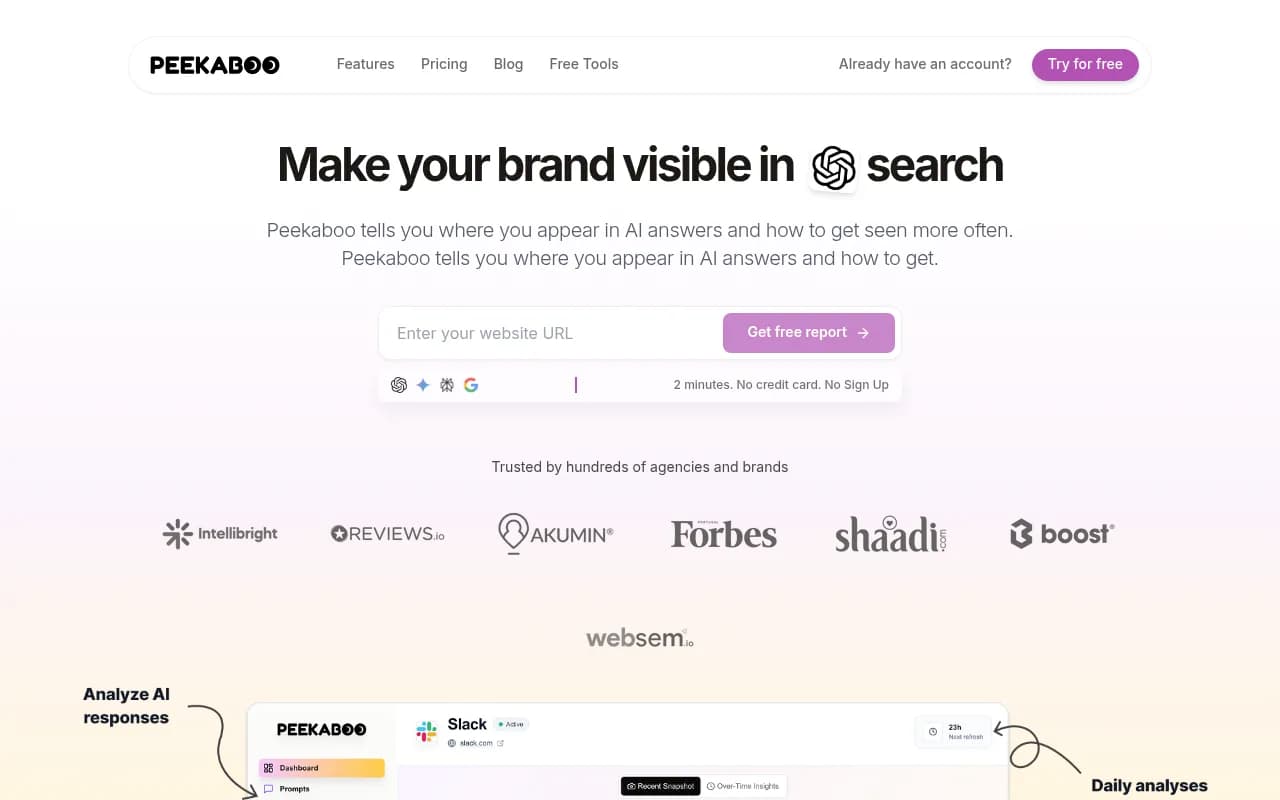
AI Peekaboo (free tier available, $39/mo paid) offers one of the few genuinely free options for tracking brand mentions in ChatGPT and Perplexity. The free tier is limited to 10 prompts and weekly checks, but it's enough to understand whether AI visibility matters for your business before investing. Paid plans add daily tracking and competitor monitoring.
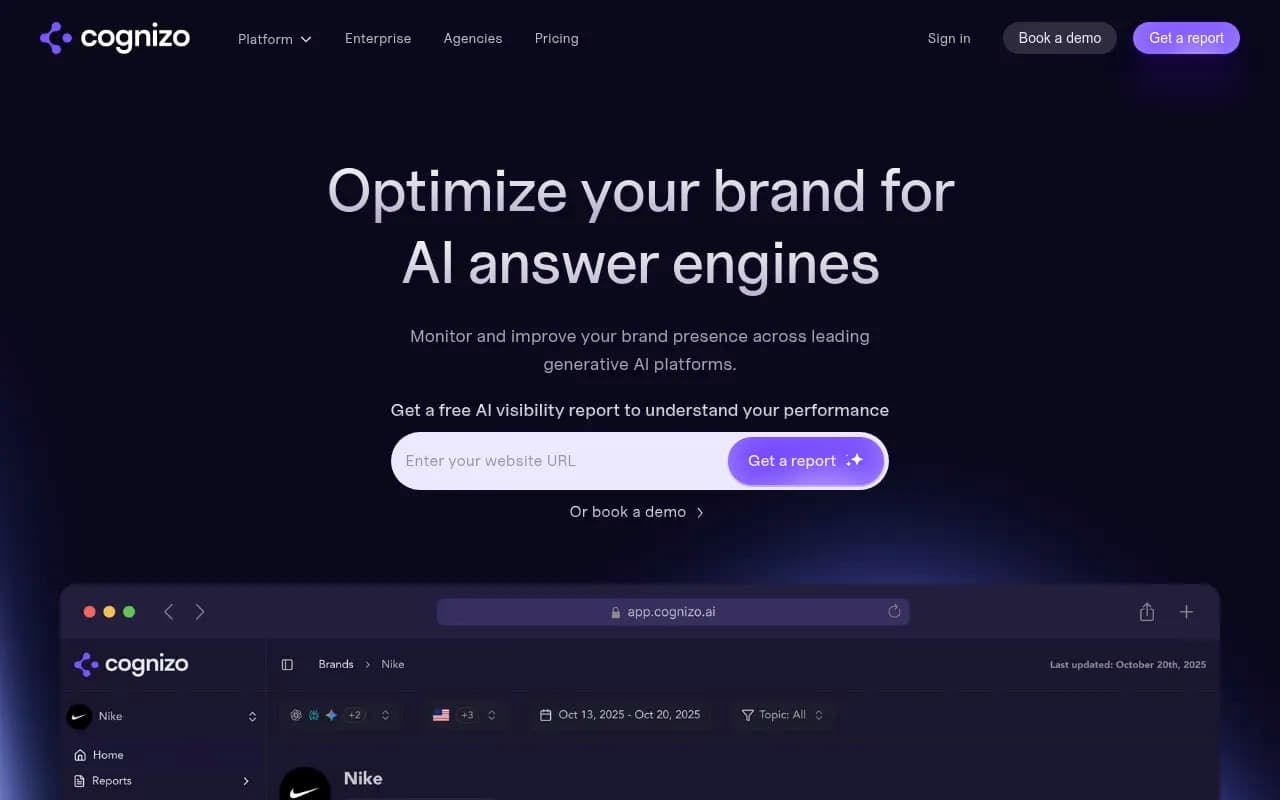
Cognizo ($79/mo) focuses on multi-model tracking with a simple interface. It monitors ChatGPT, Perplexity, Claude, and Gemini but lacks the depth of intelligence platforms. Reports show where you appear but not why competitors outrank you. Suitable for small teams needing basic cross-platform visibility.
Cognizo
Limitations of this tier: You'll know where you stand but not what to do about it. These tools are diagnostic, not prescriptive. If a competitor ranks for 50 prompts and you rank for 5, monitoring tools show the gap but leave you to figure out the solution.
Intelligence Platforms ($99-579/mo)
This tier transforms data into strategy. Intelligence platforms analyze why competitors rank higher, identify content gaps, and provide actionable recommendations. They're built for teams with content production capabilities who need direction on what to create.
Promptwatch ($99-579/mo) is the only platform rated as a "Leader" across all categories in a 2026 comparison of 12 GEO tools. The core difference: most competitors stop at monitoring, but Promptwatch closes the action loop.
The workflow is simple:
- Find the gaps: Answer Gap Analysis shows exactly which prompts competitors rank for but you don't, revealing the specific content your website is missing
- Create content that ranks: The built-in AI writing agent generates articles grounded in 880M+ citations analyzed, prompt volumes, persona targeting, and competitor analysis
- Track results: Page-level tracking shows which pages get cited, how often, and by which models. Traffic attribution (code snippet, GSC integration, or server logs) connects visibility to revenue.
Additional capabilities include AI crawler logs (real-time monitoring of ChatGPT, Claude, and Perplexity bots hitting your site), prompt intelligence with volume estimates and difficulty scores, citation source analysis, Reddit and YouTube insights, ChatGPT Shopping tracking for e-commerce, and multi-language/multi-region monitoring.
Pricing: Essential $99/mo (1 site, 50 prompts, 5 articles), Professional $249/mo (2 sites, 150 prompts, 15 articles, crawler logs), Business $579/mo (5 sites, 350 prompts, 30 articles). Free trial available.
Profound ($299-999/mo) is an enterprise-focused platform with strong feature sets but higher price points. It tracks 9+ AI engines and provides detailed competitor heatmaps. The interface is polished and reporting is comprehensive, but it lacks Reddit tracking and ChatGPT Shopping monitoring. Best for mid-market companies with dedicated SEO teams.
Profound
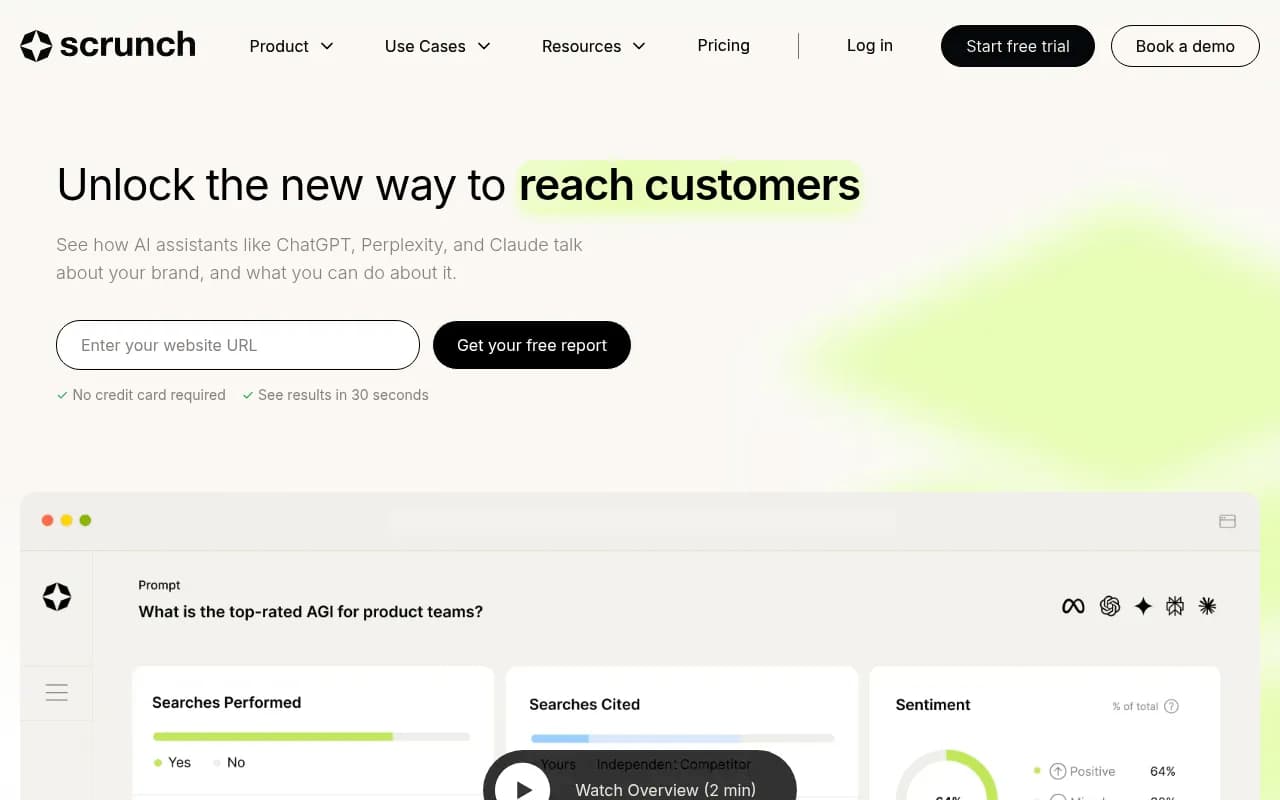
Scrunch AI ($249-749/mo) emphasizes citation source analysis, showing exactly which pages, domains, and content types AI models reference. This is valuable for understanding what content formats (listicles, comparisons, how-to guides) perform best in AI search. The platform includes basic content gap analysis but no built-in content generation.
Semrush ($139.95-499.95/mo) added AI visibility tracking to its traditional SEO platform in 2025. If you're already a Semrush user, the AI features integrate seamlessly with existing keyword research and rank tracking workflows. However, the AI tracking uses fixed prompts rather than customizable queries, and there's no traffic attribution to connect visibility to actual revenue. Best for existing Semrush customers who want AI monitoring as an add-on.
Key differentiator: Intelligence platforms show you what's missing and help you prioritize. Tools like Promptwatch go further by generating the content for you, while others (Profound, Scrunch) provide insights but leave content creation to your team.
Enterprise Execution Platforms ($1,000+/mo)
Execution platforms handle the entire process from strategy to content production to publishing. They're designed for enterprises managing multiple brands, agencies serving clients, or organizations where internal content production is a bottleneck.
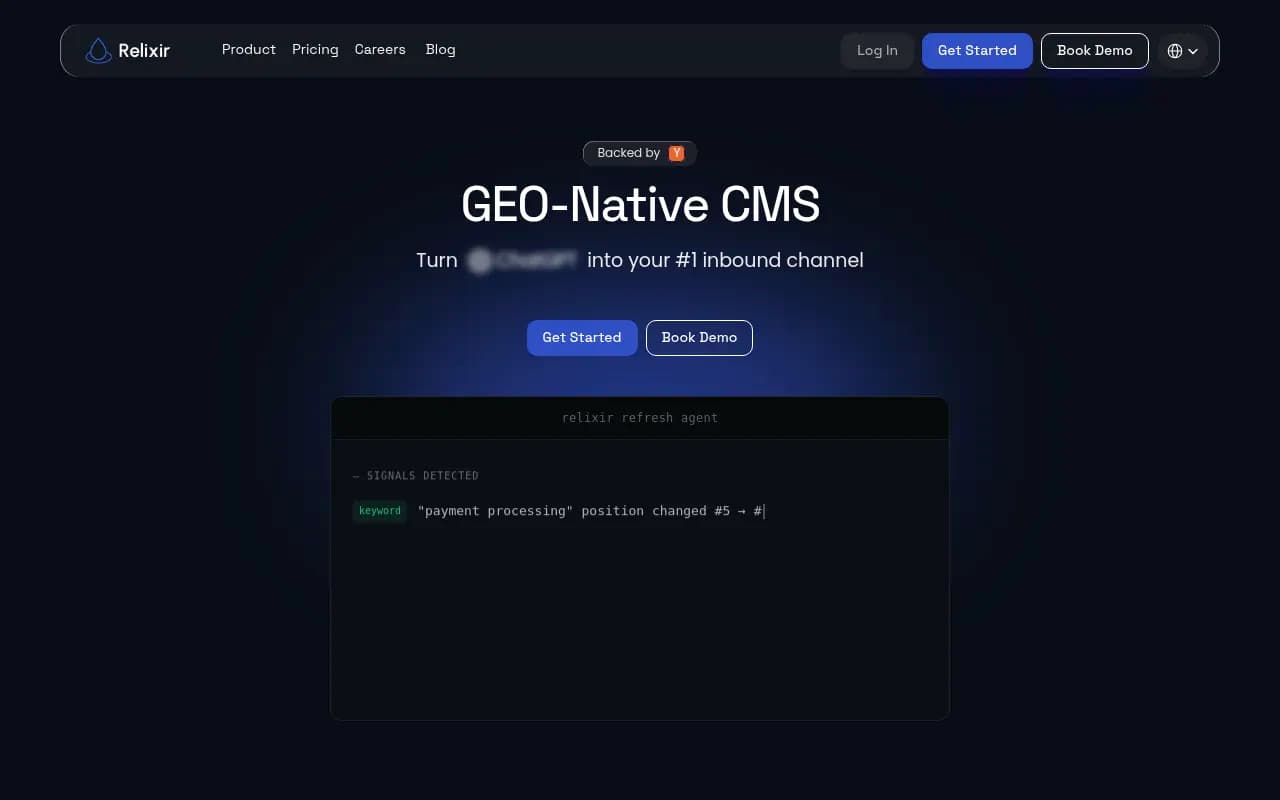
Relixir ($2,500+/mo) is an end-to-end GEO engine built for enterprise brands. It combines monitoring, intelligence, and automated content generation with direct CMS publishing. The platform includes dedicated account management and performance SLAs. Best for Fortune 500 companies or brands managing 50+ locations.
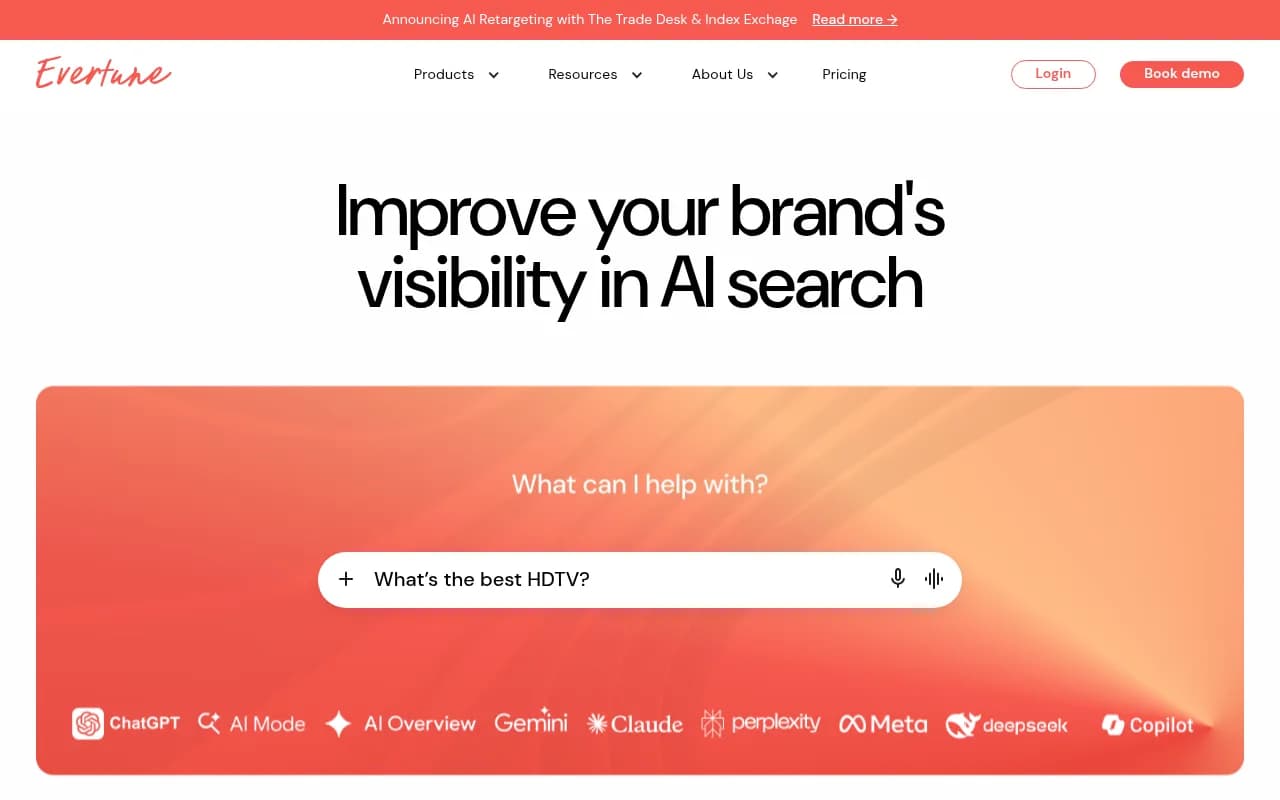
Evertune (custom pricing, typically $3,000+/mo) is the most comprehensive platform for Fortune 500 brands. It offers white-glove service with dedicated strategists who analyze your AI visibility, create content strategies, and manage execution. The platform includes custom API integrations and multi-location management. Overkill for most businesses but essential for enterprises with complex needs.
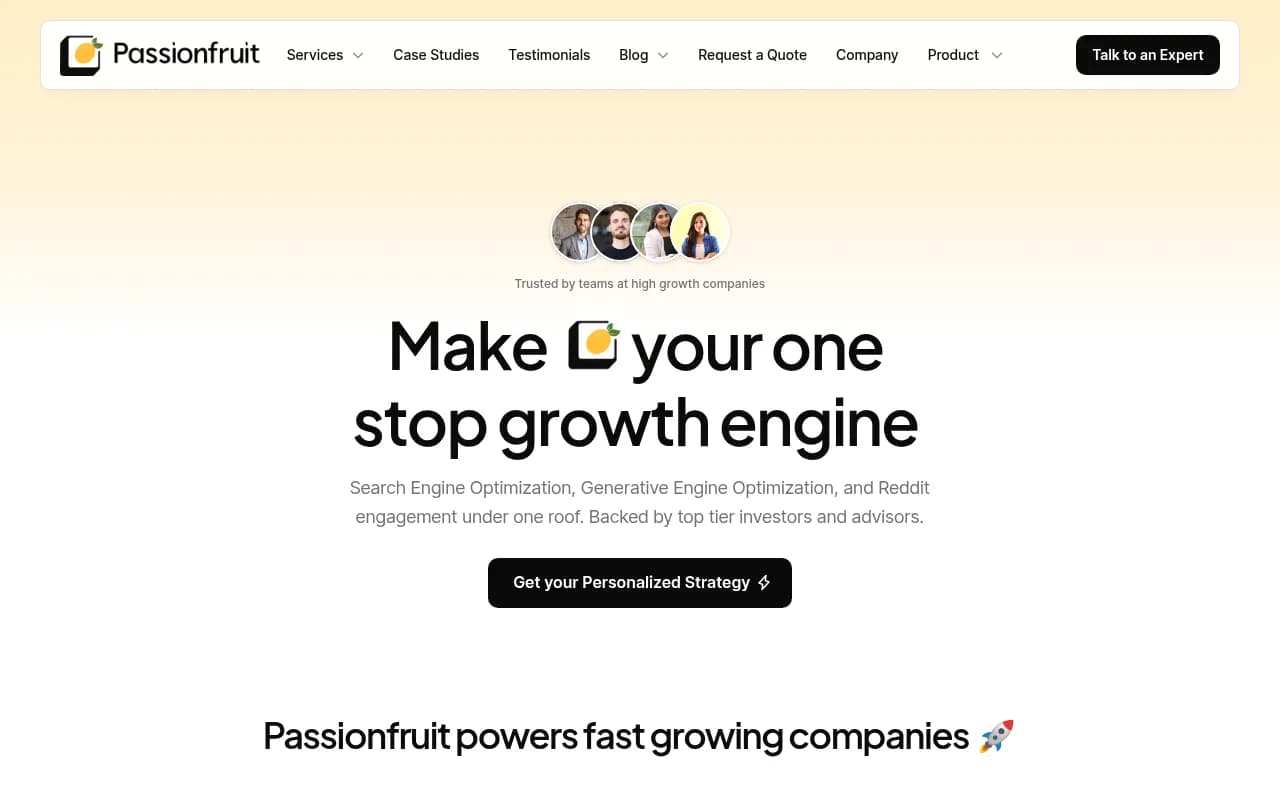
Passionfruit Labs (custom pricing) operates as a full-service AI-native marketing agency combining SEO, GEO, and content production. They handle everything from keyword research to content creation to distribution. Best for brands that want to outsource the entire AI visibility function rather than managing it in-house.
Search Party (custom pricing) is an AI automation consultancy that engineers custom workflows to eliminate busywork. They build bespoke solutions for enterprise clients, integrating AI visibility tracking with existing martech stacks. Best for large organizations with unique requirements that off-the-shelf platforms can't address.
Search Party
When to choose this tier: If your internal team lacks bandwidth or expertise to execute on intelligence insights, or if you're managing multiple brands/locations at scale, execution platforms justify their premium pricing. For most businesses, however, an intelligence platform like Promptwatch provides the right balance of insights and tools without the enterprise price tag.
How to Choose the Right Tier for Your Business
The decision framework is simpler than it appears. Ask yourself three questions:
1. Do you have content production capacity?
If no: Choose an execution platform (Level 3). You need a solution that not only identifies gaps but fills them. Paying for intelligence you can't act on is wasted money.
If yes: Move to question 2.
2. Do you need strategic direction or just awareness?
If you're exploring AI visibility for the first time and want to understand the landscape before committing resources, start with a monitoring tool (Level 1). Tools like Otterly.AI or AI Peekaboo provide enough data to determine whether AI search matters for your business.
If you already know AI visibility is important and need actionable insights on what content to create, choose an intelligence platform (Level 2). Tools like Promptwatch show exactly what's missing and help you prioritize.
3. What's your monthly content output?
If you publish fewer than 5 articles per month: A monitoring tool is probably sufficient. You don't have the volume to capitalize on detailed intelligence.
If you publish 5-20 articles per month: An intelligence platform maximizes ROI by ensuring every piece targets high-value prompts. Promptwatch's content generation features can also help scale production.
If you publish 20+ articles per month or manage multiple sites: Consider an execution platform or a robust intelligence tool with API access for workflow automation.
Budget Reality Check
At the industry average of $337/month per tool, choosing the wrong tier is expensive. Here's how to think about ROI:
- Monitoring tools cost $29-99/mo. If they help you identify even one high-value content opportunity per month, they pay for themselves.
- Intelligence platforms cost $99-579/mo. If they help you create content that captures 10-20 additional citations per month, the traffic and conversion uplift justifies the investment.
- Execution platforms cost $1,000-5,000+/mo. They make sense when internal content production costs exceed the platform fee or when you're managing scale that requires automation.
Most businesses should start with Level 2 (intelligence platforms). They provide the insights needed to improve without the overhead of full-service execution.
Common Mistakes to Avoid
Mistake 1: Choosing Based on Price Alone
The cheapest tool isn't always the best value. A $29/mo monitoring tool that shows you're invisible but provides no path forward wastes time and money. A $249/mo intelligence platform that identifies 50 content opportunities and helps you capture them delivers far more value.
Mistake 2: Ignoring Traffic Attribution
Many tools track citations but can't connect visibility to actual traffic or revenue. Promptwatch's traffic attribution features (code snippet, GSC integration, server log analysis) close this loop. If you can't measure ROI, you can't justify continued investment.
Mistake 3: Overlooking Crawler Access
AI models can't cite content they can't access. Tools with crawler log monitoring (like Promptwatch) show whether ChatGPT, Claude, and Perplexity bots are successfully indexing your pages. Without this, you might optimize content that AI engines never see.
Mistake 4: Focusing Only on ChatGPT
ChatGPT drives 87.4% of AI referral traffic today, but Perplexity, Claude, and Gemini are growing fast. Choose tools that monitor multiple models to future-proof your strategy. Promptwatch tracks 10 AI engines; many competitors track only 3-4.
Mistake 5: Treating AI Visibility as a Side Project
AI search converts at 4.4x traditional organic rates. This isn't a nice-to-have—it's a competitive necessity. Allocate real budget and resources, not leftover scraps from your SEO budget.
The Future of AI Visibility Tools
The market is consolidating around three trends:
1. Intelligence is becoming table stakes. Pure monitoring tools are losing ground to platforms that combine tracking with actionable insights. Expect more tools to add content gap analysis and optimization recommendations in 2026.
2. Automation is accelerating. The gap between intelligence and execution is narrowing. Platforms like Promptwatch already generate AI-optimized content; expect more tools to add publishing workflows and CMS integrations.
3. Attribution is the new battleground. The next wave of competition will focus on proving ROI. Tools that connect AI visibility to traffic, conversions, and revenue will win. Those that only track citations will fade.
For most businesses in 2026, the sweet spot is a Level 2 intelligence platform that shows content gaps, helps create optimized content, and tracks results with attribution. Promptwatch leads this category by combining monitoring, intelligence, and content generation in one platform—without the enterprise price tag of execution services.
Final Recommendations by Business Type
Solopreneurs and bloggers: Start with Otterly.AI ($29/mo) or AI Peekaboo (free tier) to establish a baseline. Upgrade to Promptwatch Essential ($99/mo) when you're ready to act on insights.
Small businesses (1-10 employees): Promptwatch Professional ($249/mo) provides the right balance of insights and tools. The built-in content generation helps scale production without hiring.
Mid-market companies (10-100 employees): Promptwatch Business ($579/mo) or Profound ($299-999/mo) depending on whether you prioritize content generation (Promptwatch) or enterprise reporting (Profound).
Agencies managing multiple clients: Promptwatch Business for most clients, with Relixir or Evertune for enterprise accounts requiring white-glove service.
Enterprise (100+ employees or 50+ locations): Evertune, Relixir, or Passionfruit Labs for full-service execution. Consider Promptwatch's API for custom integrations if you have engineering resources.
The AI visibility market is maturing fast. The tools that win will be those that don't just show you data—they help you act on it. Choose the tier that matches your capacity to execute, not just your budget. And remember: in AI search, being invisible is the same as not existing.