Passionfruit Labs Review 2026
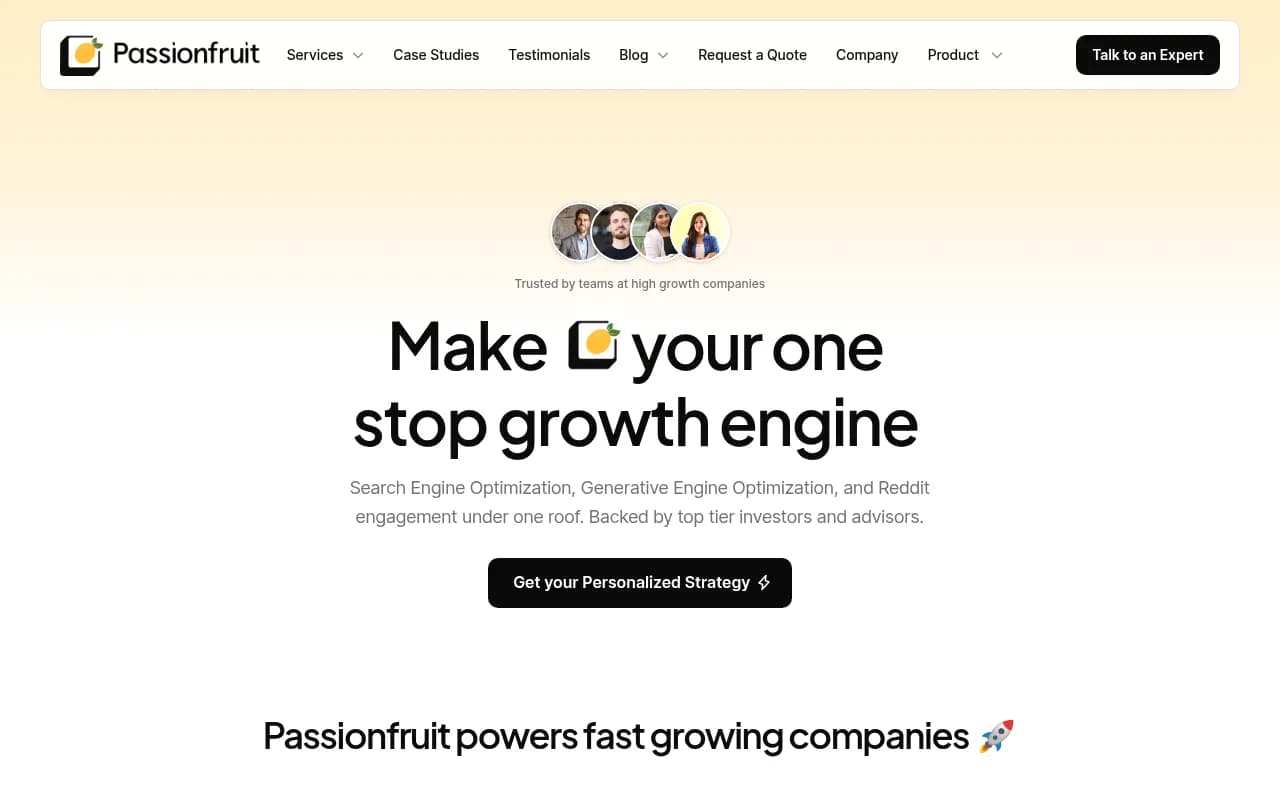
Passionfruit Labs is a venture-backed digital marketing agency founded by Stanford and CMU alumni that combines traditional SEO, Generative Engine Optimization (GEO), and paid advertising under one roof. Built for high-growth companies, it delivers hands-on marketing execution with an engineering-fi
Key Takeaways:
• Full-service agency model combining SEO, GEO (AI search optimization), Reddit engagement, and paid ads with done-for-you execution • Founded by Stanford and CMU alumni, backed by top-tier investors including Y Combinator • Targets high-growth startups and e-commerce brands, particularly Shopify stores and B2C companies • Custom pricing based on scope -- not a self-serve SaaS product but a managed service with dedicated teams • Strong results focus: clients report 14x ROI increases, 750% lift in AI search visibility, 120% organic traffic growth
Passionfruit Labs positions itself as an "AI-native digital marketing agency built for the future of search." Founded by alumni from Stanford and Carnegie Mellon University and backed by Y Combinator and other top-tier investors, the company takes a fundamentally different approach than most marketing agencies: it combines world-class engineering talent with marketing expertise to deliver integrated growth strategies across traditional search, AI search engines, and paid advertising channels.
The agency launched with a thesis that the future of search is fragmenting across traditional Google results, AI-powered answer engines like ChatGPT and Perplexity, and community platforms like Reddit. Rather than treating these as separate channels requiring different vendors, Passionfruit bundles SEO, Generative Engine Optimization (GEO), Reddit engagement, and omnichannel ad management into a single service offering. This integrated approach is designed for high-growth companies that need coordinated execution across channels without managing multiple agency relationships.
Revenue-Focused SEO
Passionfruit's SEO service emphasizes what it calls "zero vanity metrics" -- a rejection of traditional agency reporting focused on keyword rankings and traffic numbers in favor of tracking actual revenue, signups, and conversions. The team conducts product-led keyword research that prioritizes commercial and transactional search terms over informational content that doesn't convert. Technical audits cover site speed, Core Web Vitals, crawlability, and structured data implementation. Content strategies are built around buyer intent mapping and conversion funnel optimization rather than generic blog topics. One client (Necesera) reported a 31% increase in purchases and 42% boost in ranked keywords within the first engagement period.
Generative Engine Optimization (GEO)
The GEO offering focuses on increasing brand visibility in AI-powered search engines including ChatGPT, Claude, Perplexity, Google AI Overviews, and Gemini. Passionfruit's approach involves analyzing how these models surface information, then optimizing content structure, citation-worthy facts, and authority signals to increase the likelihood of being referenced in AI-generated responses. The team uses what it describes as "proprietary query fan out programmatic content strategies" -- creating content clusters that address the many variations and sub-questions AI models consider when formulating answers. Clients have seen 750% lifts in AI search visibility and 8x growth in citations across AI engines within six months.
Reddit Engagement Strategy
Recognizing that Reddit has become a major source for AI training data and increasingly appears in both traditional and AI search results, Passionfruit includes Reddit engagement as a core service. This involves identifying relevant subreddits where target customers gather, participating authentically in discussions, and strategically positioning client brands as helpful resources. The goal is building organic brand mentions and backlinks that feed into both traditional SEO authority and AI model training data.
AI-Powered Ad Optimization
The paid advertising service uses proprietary algorithms for real-time bidding and budget optimization across Google Ads, Meta (Facebook/Instagram), and other platforms. Rather than manual campaign management, the system continuously adjusts bids, budgets, and targeting based on performance data to maximize Return on Ad Spend (ROAS). Clients report 4x surges in ad click-through rates, 30% decreases in average cost-per-click, and 2x improvements in ROAS within the first six months. The real-time optimization approach is designed to respond faster than human campaign managers can, capturing opportunities and cutting losses within hours rather than days.
Real-Time Performance Tracking
All clients receive customized dashboards that track SEO metrics (rankings, traffic, conversions), GEO metrics (AI engine visibility, citation counts), and ad performance (ROAS, CPC, CTR) in a single view. The emphasis is on full transparency -- clients can see exactly where budget is going and what results it's producing at any time. This contrasts with traditional agency reporting that arrives monthly in static PDFs.
Content That Drives Citations
Passionfruit's content team focuses on creating what it calls "citation-worthy" content -- articles, guides, and resources structured to be referenced by AI models and linked to by other sites. This involves deep research, original data or insights, clear factual statements, and formatting that makes information easy for both humans and AI systems to extract and cite. The content strategy emphasizes thought leadership and demand generation over keyword stuffing or thin affiliate content.
Who Is Passionfruit For
The agency primarily serves high-growth startups and e-commerce brands, with a particular concentration in Shopify stores, direct-to-consumer brands, B2C SaaS companies, and consumer tech products. Client logos include Vitality (wellness supplements), Typsy Beauty (cosmetics), Global Resources Direct (wholesale), ButtChique (apparel), and various other emerging brands. The ideal client is typically a company with $500K-$10M in annual revenue that's ready to scale aggressively and needs integrated marketing execution without building an in-house team. Founders and marketing leaders who understand the importance of AI search visibility and want a partner that can execute across multiple channels simultaneously are the best fit.
Passionfruit is less suitable for enterprise companies with established in-house marketing teams (who typically prefer point solutions they can control), local businesses with purely geographic focus, or early-stage pre-revenue startups without budget for comprehensive marketing services. The agency model also doesn't work well for companies that want to own and operate their own marketing stack -- this is a done-for-you service, not a software platform you license.
Pricing & Engagement Model
Pricing is custom and based on scope, with no publicly listed rates. The agency emphasizes "service at product cost" -- positioning itself as comparable in price to self-serve SaaS tools but with full execution included. Based on typical agency economics and the client base, engagements likely start around $3,000-$5,000 per month for smaller brands and scale up to $10,000-$25,000+ per month for comprehensive multi-channel programs. There's no self-serve option -- all work is done by Passionfruit's team of engineers, marketers, and content specialists. Initial engagements typically involve a strategy phase followed by ongoing execution and optimization.
Team & Backing
The founding team includes alumni from Stanford and Carnegie Mellon University with backgrounds in engineering and growth marketing. The agency is backed by Y Combinator (the prestigious startup accelerator behind Airbnb, Stripe, and Dropbox) and other top-tier investors, which is unusual for a services business and signals ambitions beyond traditional agency models. The team describes itself as bringing an "engineering mindset" to marketing -- building systematic, data-backed strategies rather than relying on intuition or best practices.
Integrations & Technology Stack
While specific tools aren't detailed publicly, the agency works with standard marketing platforms including Google Search Console, Google Analytics, Google Ads, Meta Ads Manager, and various SEO tools for tracking and reporting. The proprietary elements appear to be the algorithms for ad optimization and the methodologies for GEO and content strategy rather than a standalone software platform. Clients receive dashboard access but don't get direct access to the underlying tools and systems.
Results & Case Studies
Published results include: 120% increase in organic traffic within three months, 750% lift in AI search visibility within six months, 40% boost in organic revenue within four months, 8x growth in AI citations, 4x surge in ad CTR with 30% lower CPC, and 2x improvement in ROAS within six months. Client testimonials emphasize the team's technical depth, systematic approach, and focus on metrics that matter. Steve Dilk from Vitality gave the team 5/5 ratings across quality, collaboration, schedule, budget, and results. Kairavi Bharat Ram from Typsy Beauty reported 14x ROI increase on organic channels.
Strengths
Integrated approach across SEO, GEO, and ads: Most agencies specialize in one channel. Passionfruit's ability to coordinate strategy and execution across traditional search, AI search, and paid advertising eliminates the coordination overhead and channel conflicts that arise when working with multiple vendors.
Engineering-first methodology: The Stanford/CMU pedigree and VC backing suggest a more systematic, data-driven approach than typical marketing agencies. The focus on building algorithms and proprietary systems rather than just following playbooks differentiates the execution quality.
Early mover in GEO: While many agencies are still figuring out AI search optimization, Passionfruit has made it a core offering with documented results (750% visibility lifts, 8x citation growth). This positions them well as AI search continues growing.
Full transparency with real-time dashboards: The emphasis on live performance tracking and "zero vanity metrics" addresses a common complaint about agency relationships -- opaque reporting and metrics that don't tie to business outcomes.
Strong client results: The published case studies show meaningful business impact (14x ROI, 31% purchase increases, 40% revenue growth) rather than just traffic or ranking improvements.
Limitations
No self-serve option: Companies that want to own their marketing execution or have in-house teams looking for tools rather than services can't use Passionfruit. It's purely a done-for-you agency model.
Custom pricing lacks transparency: Without published rates, it's impossible to know if Passionfruit fits your budget without going through a sales conversation. This creates friction for companies doing initial research.
Limited to high-growth companies: The focus on startups and e-commerce brands means Passionfruit may not have deep expertise in other verticals like B2B enterprise, healthcare, finance, or local services where the marketing playbook differs significantly.
Bottom Line
Passionfruit Labs is best for high-growth startups and e-commerce brands (particularly Shopify stores) that need integrated execution across SEO, AI search optimization, and paid advertising without building an in-house team. The engineering-first approach, VC backing, and focus on revenue metrics over vanity numbers make it a strong fit for founders who want systematic, data-driven marketing and are willing to pay for full-service execution. Companies wanting self-serve tools, transparent pricing, or specialized expertise in non-consumer verticals should look elsewhere. Best use case in one sentence: venture-backed consumer brands scaling from $1M to $10M in revenue who need a single partner to own their entire digital acquisition strategy across traditional and AI search.
Similar and alternative tools to Passionfruit Labs