Statusbrew Review 2026
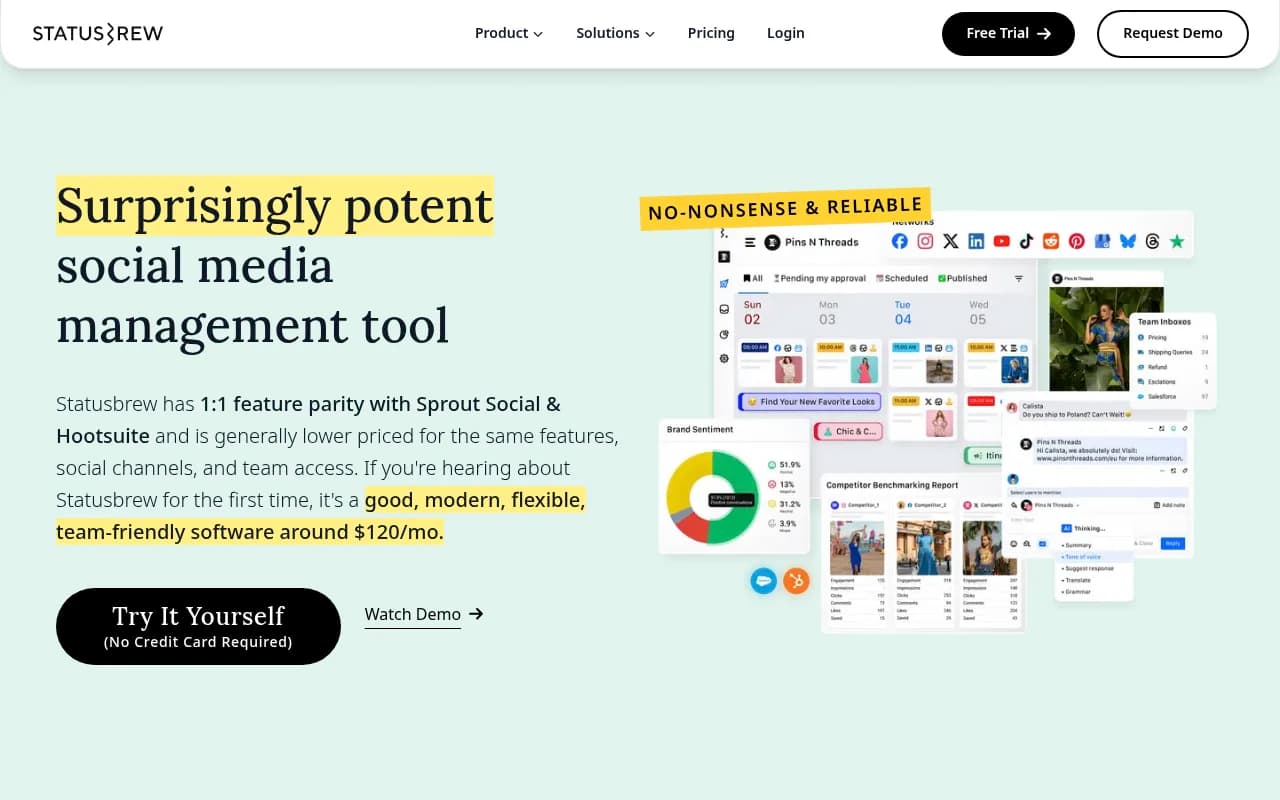
Full-featured social media management platform designed for businesses of all sizes, offering scheduling, analytics, and team collaboration.
Key Takeaways:
- Feature parity with Sprout Social and Hootsuite at 40-50% lower cost -- starts at $69/month vs $249+ for competitors
- Unified inbox handles organic and paid social interactions across 20+ channels including Instagram, Facebook, Twitter, LinkedIn, TikTok, YouTube, Google My Business, and review platforms
- 18-month historical data backfill and lifetime retention -- most competitors limit you to 12 months or charge extra for historical data
- Advanced approval workflows and shareable calendars make it ideal for agencies and teams managing client accounts
- Best for agencies managing 10-50+ client profiles, enterprise social teams, and multi-location brands -- not ideal for solopreneurs or single-profile users
Statusbrew is a social media management platform that positions itself as the value alternative to enterprise tools like Sprout Social and Hootsuite. Used by over 5,500 teams daily including Hilton, Spotify, Ford, Samsung, and Papa John's, it delivers the full feature set of platforms costing 2-3x more. The company has been operating since 2015 and is SOC 2 and GDPR compliant, with servers distributed globally for performance and data residency requirements.
The platform targets agencies managing multiple client accounts, enterprise social media teams coordinating across departments, multi-location brands (restaurants, hotels, retail chains), and growing companies that have outgrown basic tools like Buffer or Later but can't justify Sprout Social's $249+/user/month pricing. If you're a solo creator or managing just 1-2 profiles, Statusbrew is overkill -- you'd be better served by simpler tools. But if you're coordinating a team, managing clients, or running social for a brand with multiple locations or markets, Statusbrew delivers serious value.
Publishing & Content Planning
Statusbrew's composer supports every major content format across platforms: Instagram Reels, Stories, and carousel posts; YouTube Shorts; TikTok videos; Twitter/X threads; Facebook and LinkedIn polls; Pinterest pins; and Google Business Profile posts. The visual calendar view lets you drag-and-drop posts, color-code by campaign or client, and see your entire content pipeline at a glance. You can schedule posts weeks or months in advance with optimal posting time suggestions based on historical engagement data.
The platform includes shareable calendars that let you give view-only or comment access to clients, stakeholders, or external team members without requiring them to have a Statusbrew account. This is huge for agencies -- clients can review the content calendar, leave feedback directly on scheduled posts, and approve content without logging into yet another platform. The approval workflow system supports multi-level approvals with customizable rules (e.g., all client posts require approval, internal posts auto-publish). Approvers get notifications via email or the mobile app and can approve/reject with comments directly from their phone.
The AI Composer generates captions, hashtag suggestions, and content ideas based on your brand voice and past performance. It's not revolutionary -- similar to what you'd get from ChatGPT with a good prompt -- but having it built into the composer saves time. You can also use AI to rephrase existing captions, translate to other languages, or adjust tone (professional, casual, humorous). The BrewLink in Bio feature turns your Instagram bio link into a clickable grid mirroring your feed, with each post linking to a unique URL. It's a solid Linktree alternative that's included free with your subscription.
One standout feature: Statusbrew supports bulk scheduling via CSV upload. If you're managing dozens of profiles or planning months of content, you can prepare everything in a spreadsheet and upload it in one go. This is a massive time-saver for agencies and enterprise teams that most competitors don't offer.
Engagement & Community Management
The unified inbox aggregates comments, mentions, direct messages, reviews, and ad comments from all connected profiles into a single stream. You can filter by sentiment, keyword, profile, unread status, or custom tags. The platform supports auto-routing rules that assign conversations to specific team members based on keywords, profile, or message type. For example, messages containing "refund" or "complaint" can auto-route to your customer service team, while "pricing" or "demo" goes to sales.
Auto-moderation is where Statusbrew really shines for brands dealing with high comment volumes. You can set rules to automatically hide comments containing specific keywords, phrases, or patterns (profanity, competitor mentions, spam). The platform maintains a hidden comments queue where you can review and unhide legitimate comments that got caught by filters. You can also auto-hide all new comments on a post with one click, then manually unhide only the ones you want visible -- useful for controversial posts or product launches where you expect trolls.
The AI-powered reply suggestions analyze incoming messages and generate response drafts based on your brand voice and previous replies. It's helpful for handling repetitive questions ("What are your hours?" "Do you ship internationally?") but still requires human review for anything nuanced. The translation feature lets you reply to customers in their language even if your team doesn't speak it -- critical for global brands.
Review management consolidates reviews from Google My Business, Facebook, Trustpilot, and other platforms into the same inbox. You can respond to reviews, track sentiment trends, and set up alerts for negative reviews. For multi-location brands, you can filter by location and assign review responses to local managers.
Statusbrew integrates with Salesforce, HubSpot, and Zendesk to sync contact data and conversation history. When a customer messages you on Instagram, your team sees their CRM profile, purchase history, and support tickets right in the Statusbrew interface. This is a major differentiator -- most social tools treat every interaction as isolated, but Statusbrew gives you full customer context.
Analytics & Reporting
Statusbrew offers 18-month historical data backfill when you connect accounts, and it retains your data forever (even after you cancel). Sprout Social limits you to 12 months of history and charges extra for data retention. Hootsuite only backfills 30 days. If you're switching from another tool or need to analyze long-term trends, this is a huge advantage.
The platform includes 230+ metrics covering profile performance, post engagement, audience demographics, paid ad performance, competitor benchmarking, and team productivity. You can build custom dashboards using the widget builder -- drag in the metrics you care about, set date ranges and filters, and save as a template. Pre-built templates cover common use cases: monthly client reports, executive summaries, competitor analysis, paid vs organic performance, and team performance reviews.
Paid performance reporting tracks ad spend, conversions, CPC, CTR, ROAS, and cost per conversion across Facebook, Instagram, LinkedIn, and Twitter ads. You connect your ad accounts and Statusbrew pulls in campaign data alongside organic metrics. This is critical for agencies and brands running paid campaigns -- you can see the full picture of social performance (organic + paid) in one report instead of switching between platforms.
Competitor analysis lets you track up to 10 competitors per profile. The platform monitors their follower growth, posting frequency, engagement rates, and top-performing content. Heatmaps show which competitors are winning on which platforms, and you can drill down to see their best posts and content strategies. This is more robust than what you get from native platform analytics and saves hours of manual competitor research.
Reports can be auto-exported as PDF, CSV, or Google Sheets and delivered on a schedule (daily, weekly, monthly, custom) to any email address. You can also generate shareable links that let clients or stakeholders view live dashboards without logging in. The PDF reports are white-label ready with custom branding, logos, and color schemes.
Team collaboration reports track individual and team performance: response times, messages handled, posts published, approval turnaround times. This is invaluable for managers overseeing social teams or agencies tracking billable hours and productivity.
Mobile App & Notifications
The Statusbrew Companion app (iOS and Android, 4.1 stars on App Store) is designed for on-the-go engagement and approvals, not full content creation. You get push notifications for new messages, comments, mentions, and approval requests. You can reply to messages, approve posts, and triage your inbox with swipe gestures. The app is fast and reliable -- better than Hootsuite's mobile experience, though not as full-featured as Sprout Social's app.
Integrations & Ecosystem
Statusbrew connects to 20+ social and reputation platforms: Facebook, Instagram, Twitter/X, LinkedIn, TikTok, YouTube, Pinterest, Google My Business, Threads, Mastodon, Trustpilot, Yelp, Tripadvisor, and more. It also integrates with Salesforce, HubSpot, Zendesk, Slack, Microsoft Teams, Google Analytics, Google Search Console, and Zapier for workflow automation.
The platform offers a REST API for custom integrations and data exports. Developer documentation is available, though not as extensive as what you'd get from enterprise-focused tools like Sprout Social.
Pricing & Value
Statusbrew uses per-user pricing with three main tiers:
- Lite ($69/user/month): 10 social profiles, basic scheduling and inbox, 12 months data retention, 1 report. Good for small teams or agencies just starting out.
- Standard ($129/user/month): 25 profiles, approval workflows, 18-month backfill, unlimited reports, competitor tracking, team performance reports, CRM integrations. This is the sweet spot for most agencies and mid-sized teams.
- Premium ($229/user/month): 50 profiles, advanced automation, custom roles and permissions, priority support, dedicated account manager. For larger agencies and enterprise teams.
- Enterprise (custom pricing): Unlimited profiles, white-label options, custom SLAs, on-premise deployment options.
All plans include unlimited scheduled posts, unlimited users (you pay per seat, not per profile), and access to all features in your tier. There's a 14-day free trial with no credit card required. Nonprofits get a discount (contact sales for details).
Compared to competitors: Sprout Social starts at $249/user/month for similar features. Hootsuite Professional is $99/month but only includes 1 user and 10 profiles, and you have to pay extra for advanced analytics and team features. Agorapulse is $69/user/month but limits data retention and doesn't include CRM integrations. Statusbrew delivers enterprise features at mid-market pricing.
One major differentiator: Statusbrew guarantees your price forever. If you sign up at $129/month, that's your price even if they raise rates for new customers. Most SaaS companies reserve the right to increase prices annually -- Statusbrew doesn't.
Migration & Onboarding
If you're switching from Sprout Social, Hootsuite, or another platform, Statusbrew offers free migration assistance on all plans. Their team will import your historical data, scheduled posts, and conversation history. They also provide onboarding and training for your entire team via video calls and documentation. This is a big deal -- most tools make you figure it out yourself or charge extra for onboarding.
Strengths
- Exceptional value -- enterprise features at 40-50% less than Sprout Social and Hootsuite
- 18-month data backfill and lifetime retention -- competitors charge extra or limit history
- Unified inbox handles organic, paid, and review platforms -- most tools only do organic social
- Advanced approval workflows and shareable calendars -- critical for agencies and enterprise teams
- CRM integrations (Salesforce, HubSpot, Zendesk) provide full customer context in the inbox
- Bulk scheduling via CSV upload -- huge time-saver for agencies and large teams
- Price lock guarantee -- your rate never increases
- Free migration and onboarding -- makes switching painless
Limitations
- No native social listening or brand monitoring -- you can track mentions and hashtags, but it's not a dedicated listening tool like Brandwatch or Talkwalker. For deep social listening, you'd need a separate tool.
- AI features are good but not groundbreaking -- the AI composer and reply suggestions are helpful but not significantly better than using ChatGPT directly
- Mobile app is engagement-focused -- you can't create complex posts or build reports from the app, only handle inbox and approvals
- Learning curve for advanced features -- the platform is powerful, which means there's a lot to learn. Simpler tools like Buffer are easier to onboard, but they also do less.
Bottom Line
Statusbrew is the best value in social media management for agencies, enterprise teams, and multi-location brands that need Sprout Social-level features without the Sprout Social price tag. If you're managing 10+ social profiles, coordinating a team, running approval workflows, or need deep analytics and CRM integration, Statusbrew delivers everything you need at half the cost of competitors. The 18-month data backfill, lifetime retention, and price lock guarantee are icing on the cake. Solo creators and single-profile users should look at simpler tools, but for everyone else, Statusbrew is a no-brainer.
Tags:
Similar and alternative tools to Statusbrew