The SEO Framework Review 2026
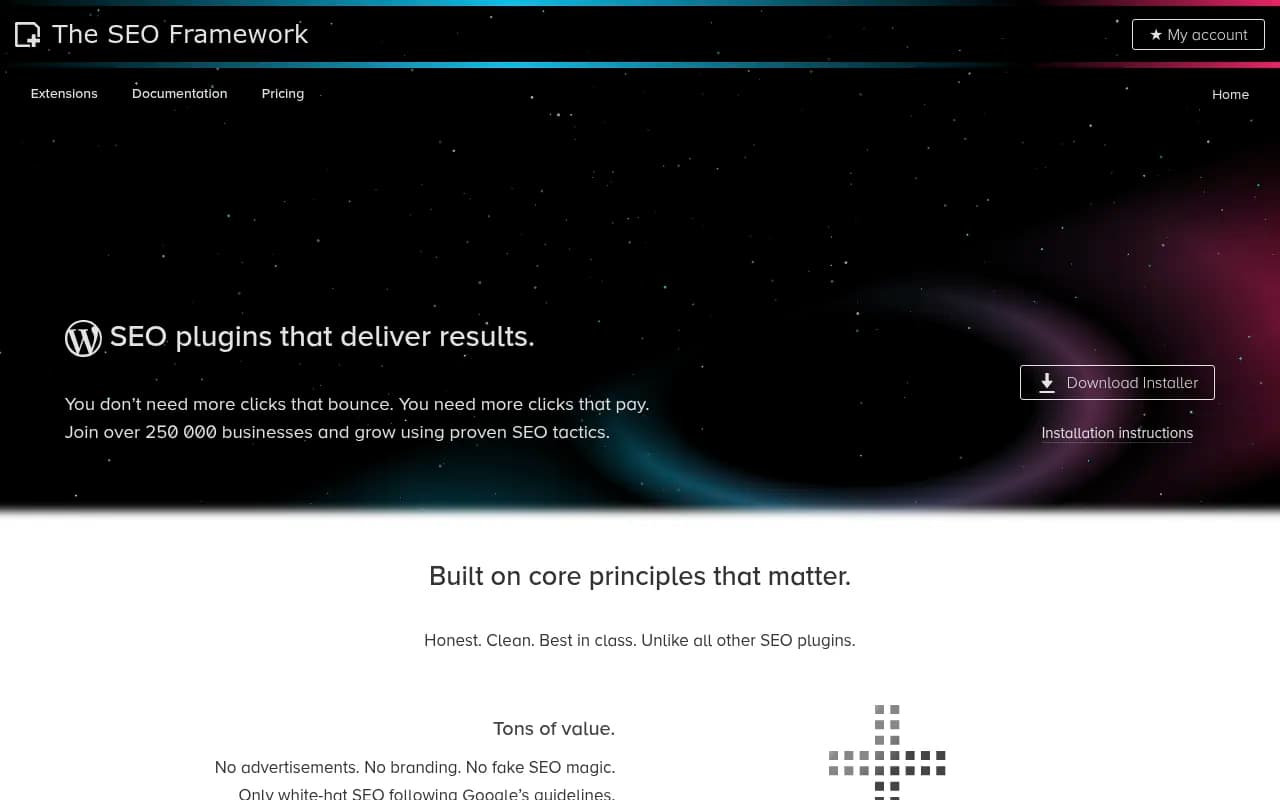
The SEO Framework is a lightweight, privacy-focused WordPress SEO plugin used by 250,000+ sites. Unlike bloated alternatives, it auto-generates meta tags intelligently, runs 12x faster with zero database overhead, includes 70+ real-time SEO checks, and has a perfect security record. Free core plugin
Key Takeaways:
• Fastest WordPress SEO plugin with intelligent automation that generates meta tags by reading your WordPress environment—no manual configuration needed for most sites • 12x faster than competitors (Yoast, Rank Math) with zero database bloat, real-time caching, and no slow queries that drag down page load times • Completely ad-free and unbranded with no upsells, fake SEO scores, or scare tactics—just clean, white-hat SEO following Google's guidelines • Perfect security track record as the only WordPress SEO plugin with zero reported vulnerabilities since launch • Free core plugin handles everything most sites need; premium extensions ($7/mo for 2 sites) add analytics, content analysis, structured data, and anti-spam
The SEO Framework is a WordPress SEO plugin built for professionals who are tired of bloated, naggy alternatives that slow down their sites and bombard them with upsells. Developed by Sybre Waaijer and used by over 250,000 websites worldwide, it takes a radically different approach: intelligent automation, zero bloat, and a focus on what actually matters for search rankings. Where Yoast SEO and Rank Math have become feature-bloated marketing platforms, The SEO Framework remains a precision tool that does one thing exceptionally well—technical SEO for WordPress.
Launched in 2015, The SEO Framework was built from the ground up to solve the performance and usability problems plaguing other WordPress SEO plugins. It's the only plugin in the category with a perfect security record (zero CVEs, zero exploits reported), and independent benchmarks consistently show it running 12x faster than Yoast SEO with significantly lower database overhead. The core plugin is free and open source, with optional premium extensions available through the Extension Manager for users who need advanced features like visitor analytics, content optimization scoring, or structured data markup.
Intelligent Automation That Actually Works
The SEO Framework's standout feature is critical automation—it's the only WordPress SEO plugin that can intelligently generate all essential meta tags (titles, descriptions, Open Graph, Twitter Cards, canonical URLs, robots directives) by analyzing your WordPress environment. It reads your site structure, post types, taxonomies, theme settings, and content to auto-generate optimized metadata without requiring manual input on every page. For most sites, you can install it and immediately have production-ready SEO with zero configuration. This is fundamentally different from Yoast or Rank Math, which require you to manually fill in fields for every post and page or rely on generic templates that produce mediocre results.
SEO Attack Protection is another critical differentiator. WordPress allows every page to be accessed via unlimited URL variations (query parameters, pagination endpoints, feed URLs, attachment pages). Hackers and negative SEO attacks exploit this by getting search engines to index thousands of duplicate or low-quality versions of your pages, which can trigger Panda penalties and tank your rankings. The SEO Framework automatically forces search engines to index only the canonical version of each page, blocking all the junk endpoints that could harm your site. Yoast and Rank Math don't handle this comprehensively—they rely on you to manually configure canonical tags and hope for the best.
Real-Time SEO Bar with 70+ Checks runs on every page and post edit screen, showing you at a glance whether your content has SEO issues. It checks title length, description length, duplicate content, missing images, broken internal links, indexability conflicts, Open Graph completeness, schema markup validity, and 60+ other factors. The checks run in real-time as you type, with results cached to avoid redundant database queries. The visual SEO Bar uses color coding (green/yellow/red) so you can see problems instantly without scrolling through tabs or reading lengthy explanations. Unlike Yoast's traffic light system (which often flags non-issues to push premium upgrades), The SEO Framework's checks are based on actual Google guidelines and technical best practices.
Zero Database Bloat is a core design principle. The SEO Framework stores all metadata in WordPress's native post meta and term meta tables using efficient data structures. It doesn't create custom database tables, doesn't log every action you take, and doesn't store redundant data. Real-time caching mechanisms ensure that expensive operations (like generating breadcrumbs or calculating SEO scores) are computed once and reused. Independent performance tests show The SEO Framework adds less than 5ms to page generation time, while Yoast SEO adds 50-100ms and Rank Math can add 150ms+ due to excessive database queries and poorly optimized code.
No Advertisements, No Branding, No Upsells means the admin interface is clean and distraction-free. There are no banners pushing premium upgrades, no fake SEO scores designed to make you feel inadequate, no "SEO analysis" features that flag imaginary problems to justify their existence. The plugin doesn't inject branding into your site's source code or meta tags. It doesn't nag you to connect social accounts, sign up for newsletters, or rate the plugin. This makes it ideal for agencies and freelancers who need to hand off sites to clients without worrying about confusing upsells or support requests triggered by aggressive marketing.
Privacy by Design means zero data collection, zero tracking, and zero third-party integrations in the core plugin. The SEO Framework doesn't phone home, doesn't send usage analytics to the developer, and doesn't require you to create an account or connect external services. All processing happens locally on your server. This is critical for GDPR compliance and for sites in regulated industries (healthcare, finance, legal) where data privacy is non-negotiable. Yoast SEO, by contrast, includes Google Search Console integration that requires OAuth authentication and sends data to Yoast's servers for processing.
Premium Extensions (Optional)
The core plugin is free and handles everything most sites need. For advanced use cases, The SEO Framework offers premium extensions through the Extension Manager plugin:
Focus provides content analysis and keyword optimization scoring similar to Yoast's content analysis, but without the bloat. It analyzes keyword density, readability, internal linking, and content structure, giving you actionable suggestions to improve each post. Unlike Yoast's traffic light system (which often contradicts itself or flags non-issues), Focus uses a more nuanced scoring system based on actual ranking factors.
Articles adds structured data markup for articles, blog posts, and news content. It automatically generates JSON-LD schema that helps Google display rich snippets (author info, publish date, featured images) in search results. This is particularly valuable for publishers, news sites, and content-heavy blogs that want to maximize click-through rates from search.
Local generates LocalBusiness schema markup for brick-and-mortar businesses. It adds structured data for your business name, address, phone number, opening hours, service areas, and more—helping you appear in Google's local pack and Maps results. Essential for restaurants, retail stores, service businesses, and any company with a physical location.
Monitor provides uptime monitoring and crawl error detection. It pings your site every few minutes and alerts you via email if it goes down or if Google encounters crawl errors. This helps you catch hosting issues, plugin conflicts, or security breaches before they tank your rankings.
Honeypot is an anti-spam solution that blocks comment spam, form spam, and registration spam without CAPTCHAs or user friction. It uses invisible honeypot fields and behavioral analysis to catch bots while letting real users through unimpeded. Much more effective than Akismet (which requires sending data to Automattic's servers) and more user-friendly than reCAPTCHA.
Cord provides visitor analytics and traffic insights directly in your WordPress dashboard. It tracks page views, referrers, popular content, and user behavior without requiring Google Analytics or sending data to third parties. Useful for sites that want basic analytics without the privacy concerns or complexity of GA4.
Extensions are sold as a bundle through the Extension Manager. You don't buy them individually—you subscribe to a tier that unlocks all extensions on a set number of sites.
Who Is The SEO Framework For?
The SEO Framework is built for WordPress professionals who value performance, security, and clean code over flashy dashboards and fake SEO scores. Primary users include:
Freelance developers and agencies managing 10-100+ client sites. The lack of branding and upsells means you can install it on client sites without triggering support requests or confusion. The performance benefits are critical when you're managing dozens of sites on shared hosting—every plugin that adds 50ms to page load time compounds across your client base. The perfect security record means you're not introducing vulnerabilities that could get client sites hacked.
In-house marketing teams at SaaS companies, e-commerce brands, and content publishers who need technical SEO handled correctly without wasting time on busywork. If you're running a WooCommerce store with 10,000 products or a content site with 50,000 posts, The SEO Framework's performance advantages are massive. Yoast SEO on a large site can add 2-3 seconds to admin page load times; The SEO Framework adds milliseconds.
Privacy-conscious site owners in regulated industries (healthcare, finance, legal, education) where GDPR compliance and data sovereignty are critical. The zero-tracking, zero-third-party-integration approach means you're not introducing privacy risks or compliance headaches.
Experienced SEOs and developers who understand technical SEO and don't need hand-holding or fake content analysis scores. If you know what a canonical tag is, understand how robots.txt works, and can write meta descriptions without a traffic light telling you whether they're "good," The SEO Framework gets out of your way and lets you work.
Who should NOT use The SEO Framework:
Complete beginners who have never done SEO before and need extensive tutorials, tooltips, and guided workflows. While The SEO Framework includes helpful documentation, it assumes you understand basic SEO concepts. Yoast SEO's onboarding wizard and content analysis might be more appropriate for true beginners, despite the performance trade-offs.
Content teams that rely heavily on real-time content scoring to guide their writing. If your writers are accustomed to Yoast's traffic light system and write to optimize for green lights, switching to The SEO Framework (which doesn't include content analysis in the free version) will require retraining. The Focus extension adds this functionality, but it's not free.
Sites that need extensive schema markup for complex content types (recipes, events, products, courses, FAQs, how-tos). While The SEO Framework handles basic schema well and the Articles extension adds article markup, it doesn't have the breadth of schema options that Rank Math or Schema Pro offer. For sites where rich snippets are a primary traffic driver, you might need to supplement with a dedicated schema plugin.
Integrations & Ecosystem
The SEO Framework integrates seamlessly with WordPress core features: custom post types, taxonomies, multisite networks, Gutenberg blocks, and the REST API. It's built to spec, meaning it works correctly with any well-coded theme or plugin without requiring special compatibility patches.
WooCommerce integration is native and automatic. The SEO Framework detects WooCommerce and generates appropriate metadata for products, product categories, and shop pages. It handles WooCommerce's unusual permalink structure correctly and prevents duplicate content issues caused by WooCommerce's multiple product views.
Page builder compatibility is excellent. The SEO Framework works correctly with Elementor, Beaver Builder, Divi, Oxygen, Bricks, and other page builders. It reads content from page builder fields (not just the main post content) when generating auto-descriptions and running SEO checks.
Migration tools are available for importing SEO data from Yoast SEO, All in One SEO, Rank Math, and other plugins. The migration process preserves your titles, descriptions, canonical URLs, robots settings, and Open Graph data, so you don't lose rankings when switching.
Developer-friendly features include extensive filter and action hooks for customizing behavior, a well-documented API for programmatic access, and clean, readable code that follows WordPress coding standards. The plugin is actively maintained on GitHub (sybrew/the-seo-framework) where developers can submit issues, contribute patches, and review the codebase.
The SEO Framework does NOT integrate with Google Search Console, Google Analytics, or other third-party services in the core plugin. This is intentional—the developers believe SEO plugins should handle on-site optimization, not try to be all-in-one marketing platforms. If you need GSC data or analytics, use the native tools or dedicated plugins.
Pricing & Value
The core plugin is completely free with no feature limitations, no time limits, and no forced upsells. You can use it on unlimited sites forever. This is genuine freemium—the free version is production-ready and handles everything most sites need.
Premium extensions are sold through the Extension Manager subscription:
Free tier ($0/year): Extension Manager installed, but no extensions activated. Useful if you want to try the interface before subscribing.
Essentials tier ($7/month, billed annually at $84/year): All extensions unlocked on up to 2 sites. Includes 500 API requests per month (for Monitor uptime checks and Cord analytics). Access to private level-1 support (email-based, 48-hour response time).
Pro tier (custom pricing, contact sales): All extensions on 5+ sites, higher API limits, priority support. Designed for agencies and larger businesses.
Compared to competitors:
Yoast SEO Premium costs $99/year for 1 site, $199/year for 5 sites. You get content analysis, internal linking suggestions, redirect manager, and support. But you're paying for features that don't improve rankings (like the readability analysis) and you're stuck with the performance overhead.
Rank Math Pro costs $59/year for unlimited sites, which seems like better value. But Rank Math's codebase is significantly less secure (multiple vulnerabilities reported), performance is worse, and the free version is so naggy with upsells that it's borderline unusable on client sites.
All in One SEO Pro costs $99/year for 1 site. Similar feature set to Yoast but with even worse performance and a clunkier interface.
For most users, The SEO Framework's free version offers better value than any competitor's paid version because it handles technical SEO correctly without the bloat. If you need the premium extensions, $84/year for 2 sites is competitive, especially considering the performance and security advantages.
Strengths
Performance is unmatched. Independent benchmarks consistently show The SEO Framework running 10-15x faster than Yoast SEO and 8-10x faster than Rank Math. On large sites (10,000+ posts), the difference is dramatic—admin pages load in under 1 second instead of 3-5 seconds.
Security track record is perfect. Zero CVEs, zero exploits, zero vulnerabilities reported since launch in 2015. This is extraordinary in the WordPress ecosystem, where even popular plugins regularly have security issues. The developer (Sybre Waaijer) is a security-focused engineer who audits every line of code.
Intelligent automation actually works. The auto-generated titles and descriptions are better than what most people write manually, and they're generated instantly based on your content and site structure. This saves hours of busywork on large sites.
Clean, distraction-free interface makes it ideal for client sites. No upsells, no branding, no confusing options. Clients can use it without needing training or generating support requests.
Privacy-first approach means zero compliance headaches. No data leaves your server, no third-party integrations, no tracking. Critical for GDPR, CCPA, HIPAA, and other privacy regulations.
Limitations
No content analysis in the free version. If your team relies on real-time content scoring to guide their writing, you'll need the Focus extension ($84/year) or stick with Yoast. This is a dealbreaker for some content teams.
Limited schema markup options. The core plugin handles basic schema (Organization, WebSite, WebPage) and the Articles extension adds article schema, but you don't get the breadth of schema types that Rank Math or Schema Pro offer. For sites that rely heavily on rich snippets (recipes, events, products, FAQs), you might need a supplemental schema plugin.
Smaller community and ecosystem. Yoast has 5 million active installs and a massive community; The SEO Framework has 250,000+ installs. This means fewer third-party integrations, fewer tutorials, and a smaller support community. If you run into an edge case issue, you might have to figure it out yourself or wait for developer support.
No redirect manager. Yoast Premium and Rank Math include redirect managers for handling 301 redirects when you change URLs. The SEO Framework doesn't include this—you'll need a separate plugin like Redirection or Simple 301 Redirects.
Bottom Line
The SEO Framework is the best WordPress SEO plugin for professionals who value performance, security, and clean code over flashy dashboards and fake SEO scores. If you're managing client sites, running a high-traffic WordPress site, or working in a regulated industry where privacy matters, it's the obvious choice. The free version handles technical SEO better than any competitor's paid version, and the premium extensions ($84/year for 2 sites) add genuinely useful features without bloat.
Best use case in one sentence: Agencies and developers managing multiple WordPress sites who need bulletproof technical SEO without the performance overhead, security risks, or naggy upsells of Yoast and Rank Math.
Tags:
Similar and alternative tools to The SEO Framework