Chatmeter Review 2026
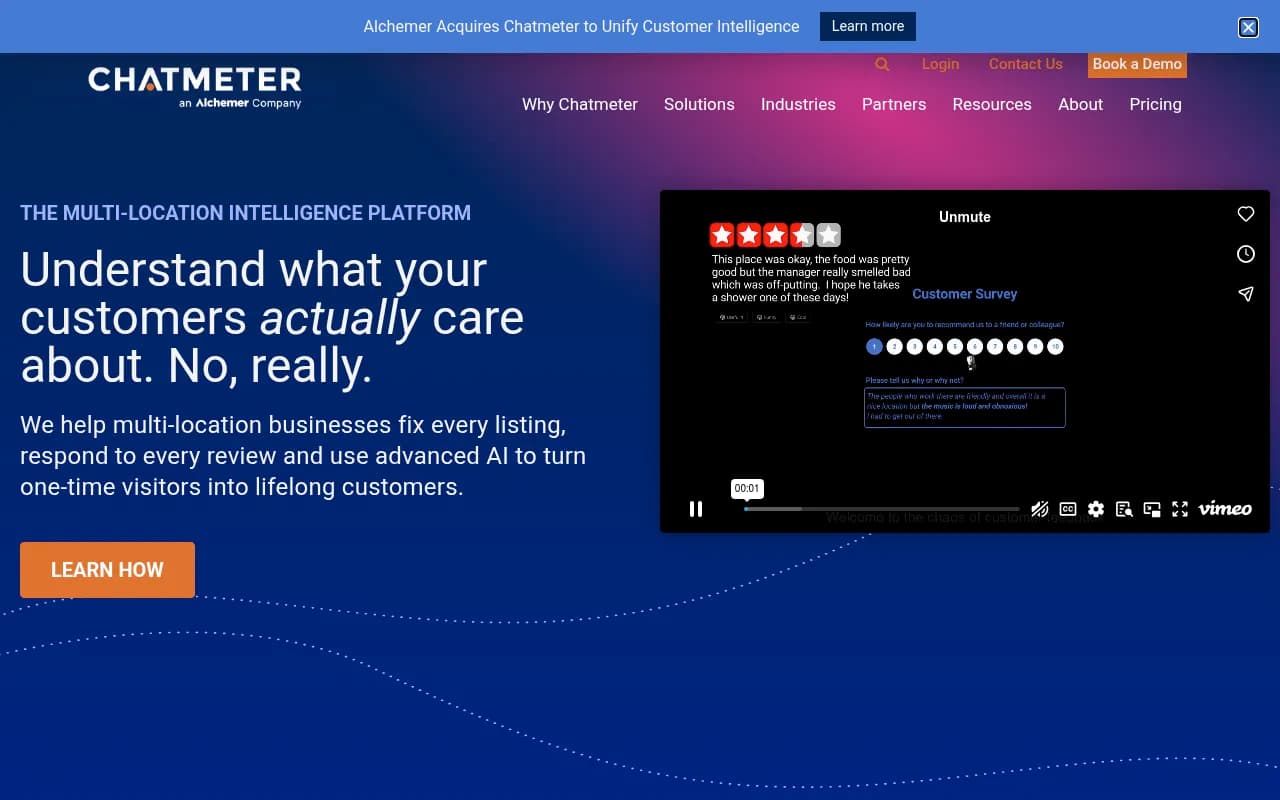
Specializes in reputation management and search visibility for multi-location brands using AI to analyze reviews, listings, and social content.
Summary
• Best for: Multi-location brands (restaurants, retail, automotive, healthcare, financial services) managing 10+ locations that need centralized reputation management, listings control, and competitive intelligence • Standout strength: Pulse AI analyzes every review, survey response, and social mention to surface actionable insights—what customers care about, how locations compare, competitive gaps, and PR risks before they escalate • Key limitation: Enterprise pricing (starts around $16,000/year) puts it out of reach for small businesses or single-location operators • Bottom line: The most comprehensive multi-location intelligence platform in 2026, but overkill unless you're managing dozens of locations and need AI-driven insights at scale
Chatmeter is an AI-powered reputation management and local search visibility platform designed specifically for multi-location businesses. Founded in 2009 and acquired by Alchemer (the survey and feedback platform) in 2024, it's used by major brands including Taco Bell, Pizza Hut, Volvo, Century 21, AutoTrader, and Meineke to manage online reputation, local listings, social media, and customer feedback across hundreds or thousands of locations. The platform's core value proposition: give corporate teams a single dashboard to monitor, analyze, and optimize every customer touchpoint across every location—while surfacing the insights that actually matter through its Pulse AI engine.
The target audience is enterprise marketing teams, digital marketing directors, operations leaders, and CMOs at multi-location brands in verticals like quick-service restaurants, retail chains, automotive dealerships, healthcare networks, financial services (banks, credit unions), and local professional services (gyms, salons, real estate). If you're managing 50+ locations and drowning in review notifications, inconsistent Google Business Profile data, and scattered social media accounts, Chatmeter is built for you. If you're a single-location business or managing fewer than 10 locations, the platform is overpowered and overpriced—tools like BirdEye, Podium, or Yext would be better fits.
Listings Management Across 60+ Directories Chatmeter syncs and manages business listings across Google Business Profile, Apple Maps, Bing Places, Facebook, Yelp, TripAdvisor, Foursquare, and 50+ other directories. You can bulk-update hours, addresses, phone numbers, categories, and attributes across all locations from a single interface. The platform monitors listing accuracy in real time, flags errors (duplicate listings, incorrect hours, missing photos), and shows you exactly which directories have outdated data. For brands with franchisees or regional managers, you can set permissions so local teams can update their own listings while corporate retains approval rights. Integration with Google Business Profile API means updates push live within minutes, not days. Chatmeter also generates local landing pages (location-specific SEO pages) optimized for "near me" searches, complete with schema markup, reviews widgets, and driving directions.
AI-Powered Review Management at Scale The review management module aggregates reviews from Google, Facebook, Yelp, TripAdvisor, Healthgrades, Cars.com, and dozens of other platforms into a unified inbox. Chatmeter's AI suggests responses based on review sentiment, keywords mentioned (food quality, wait time, cleanliness), and brand voice guidelines you configure. You can respond to individual reviews or use bulk response templates to reply to 50+ similar reviews in one click. The AI flags reviews that mention discrimination, harassment, safety issues, or legal risks (slip-and-fall, food poisoning) so you can escalate them immediately. Review response rate, average rating, and sentiment trends are tracked at the location, region, and brand level. Notifications go out via email, Slack, or SMS when a new review comes in, and you can set escalation rules (e.g. any 1-star review mentioning "manager" gets flagged for the district manager within 15 minutes).
Pulse AI: The Intelligence Engine Pulse AI is Chatmeter's differentiator—it's the layer that turns raw data (reviews, surveys, social comments) into strategic insights. It analyzes every customer interaction across all locations to answer four questions: (1) What do customers actually care about? Pulse AI surfaces the topics, keywords, and pain points mentioned most frequently, broken down by location, region, or brand. (2) How do your locations compare? It benchmarks each location's performance (rating, sentiment, response rate) against regional and brand averages, highlighting top performers and underperformers. (3) How do you stack up against competitors? Pulse AI tracks competitor ratings, review volume, and sentiment in each local market, showing you where you're winning and where competitors have an edge. (4) What are the risks? It flags reviews and feedback indicating PR crises in the making—discrimination complaints, safety hazards, harassment allegations—so you can intervene before they go viral. The AI generates executive summaries, trend reports, and location scorecards automatically, saving hours of manual analysis.
Social Media Management for Multi-Location Brands Chatmeter includes social media scheduling, publishing, and monitoring for Facebook, Instagram, and Twitter across all locations. You can create posts at the corporate level and push them to all locations, or let local managers customize posts for their market. The platform tracks engagement (likes, comments, shares), sentiment, and response times. Social listening monitors brand mentions, hashtags, and competitor activity in each local market. You can respond to comments and DMs directly from the Chatmeter dashboard. For franchises, corporate can set approval workflows so local posts get reviewed before going live. Social performance is rolled up into the same analytics dashboard as reviews and listings, giving you a complete view of online reputation.
Survey and Feedback Collection Through the Alchemer acquisition, Chatmeter now integrates survey capabilities directly into the platform. You can send post-purchase surveys, NPS surveys, or custom feedback forms via email, SMS, or QR code. Survey responses feed into Pulse AI alongside reviews and social comments, giving you a more complete picture of customer sentiment. You can trigger surveys based on specific events (e.g. send a survey 24 hours after a service appointment) and route negative feedback to the right team member for follow-up. Survey data is segmented by location, region, and customer demographics, and you can compare survey sentiment to public review sentiment to spot discrepancies (e.g. customers tell you one thing privately but say something else on Google).
Competitive Intelligence and Benchmarking Chatmeter tracks your competitors' online reputation in every local market where you operate. You define your competitors (national chains, local independents, or both), and the platform monitors their Google ratings, review volume, sentiment trends, and keyword mentions. Competitive reports show you where competitors are outperforming you (e.g. "Competitor A has a 4.6 rating vs your 4.2 in the Dallas market") and what customers are saying about them that they're not saying about you. You can see which locations are losing ground to competitors and which are dominating their local market. This data feeds into Pulse AI's insights, so you get actionable recommendations like "Customers mention 'fast service' in 40% of Competitor B's reviews but only 12% of yours—consider highlighting speed in your messaging."
Risk Monitoring and Crisis Prevention One of Chatmeter's most valuable (and underrated) features is its risk monitoring system. The AI scans every review, survey response, and social comment for keywords and phrases that indicate potential PR crises: discrimination (race, gender, disability), harassment (sexual, verbal), safety issues (slip-and-fall, food poisoning, security), legal threats, or violent incidents. When flagged, these are escalated immediately to designated team members via email, SMS, or Slack. You can set custom risk keywords based on your industry (e.g. "mold" for healthcare, "data breach" for financial services). The system tracks how quickly risks are acknowledged and resolved, and generates risk reports for executive review. For brands with hundreds of locations, this is the difference between catching a problem at one store and letting it become a national news story.
Integrations and Ecosystem Chatmeter integrates with Google Business Profile API, Facebook Business Manager, Yelp for Business, TripAdvisor Management Center, and 60+ other listing platforms. It connects to Salesforce, HubSpot, and other CRMs to sync customer data and trigger surveys based on CRM events. Slack and Microsoft Teams integrations send real-time notifications for new reviews, risk alerts, and performance milestones. Zapier support allows custom workflows (e.g. create a Trello card when a 1-star review comes in). The platform offers a REST API for custom integrations and data exports. Reporting integrates with Google Data Studio (Looker Studio) and Tableau for custom dashboards. There's no mobile app, which is a notable gap—review response and monitoring happen via web browser only.
Reporting and Analytics Chatmeter's reporting is built for executives and corporate teams. You get pre-built dashboards for reputation score (aggregate rating across all platforms), review volume and velocity, response rate, sentiment trends, competitive benchmarking, and listings accuracy. Reports can be filtered by location, region, franchise group, or time period. Automated reports go out weekly or monthly via email, and you can schedule custom reports for specific stakeholders (e.g. send district managers a weekly scorecard of their locations). The platform tracks ROI by correlating reputation metrics (rating improvements, review volume) with business outcomes (foot traffic, revenue, customer retention) if you integrate sales data. Pulse AI generates natural-language summaries of key trends, so executives get the story, not just the numbers.
Who Should Use Chatmeter Chatmeter is purpose-built for multi-location brands managing 10+ locations (though most customers have 50-500+ locations). Ideal users include quick-service restaurant chains (QSR), retail chains, automotive dealership groups, healthcare networks (urgent care, dental, vision), financial services (banks, credit unions), real estate franchises (Century 21, RE/MAX), fitness chains, and local professional services (salons, spas, car washes). The platform shines when you have a corporate team that needs centralized control and visibility, but also local managers or franchisees who need to manage their own locations. If you're a single-location business, a small business with 2-5 locations, or a startup, Chatmeter is overkill—you'd be better served by BirdEye, Podium, Grade.us, or ReviewTrackers.
Who Should NOT Use Chatmeter Small businesses, single-location operators, and startups should look elsewhere—the pricing and feature set are designed for enterprise scale. If you don't have a dedicated marketing or operations team to manage the platform, you won't extract its full value. Brands that only care about review monitoring (not listings, social, or surveys) might find Chatmeter too broad—tools like Reputation.com or Birdeye offer more focused review management. If you need a mobile app for on-the-go review response, Chatmeter's web-only interface is a limitation. And if you're looking for a DIY tool with no onboarding or support, Chatmeter's enterprise sales process and account management model won't fit.
Pricing and Value Chatmeter pricing is custom and based on the number of locations you manage. According to Vendr transaction data, pricing ranges from around $16,000/year (minimum) to $42,000+/year (maximum), with most mid-market customers paying in the $20,000-$30,000 range. Pricing includes unlimited users, so your entire corporate team, regional managers, and franchisees can access the platform. There's no self-serve pricing or free trial listed on the website—you have to book a demo and get a custom quote. This is standard for enterprise reputation management platforms (Yext, SOCi, and Reputation.com all use custom pricing), but it's a barrier for smaller businesses. The value proposition is strong if you're managing 50+ locations and currently using multiple tools (one for listings, one for reviews, one for social)—Chatmeter consolidates everything and adds AI-powered insights on top. For smaller brands, the ROI is harder to justify.
Strengths • Pulse AI delivers genuinely useful insights: Most reputation platforms just show you data—Chatmeter's AI tells you what it means, what to do about it, and what risks to watch for. The competitive intelligence and location benchmarking are particularly strong. • Built for multi-location complexity: Permissions, approval workflows, regional rollups, franchise management—Chatmeter handles the organizational complexity that breaks simpler tools. • Risk monitoring is a differentiator: Automated flagging of discrimination, harassment, and safety issues is something most competitors don't offer, and it's invaluable for brands with hundreds of locations. • Comprehensive platform: Listings, reviews, social, surveys, and competitive intelligence in one place means fewer tools to manage and a unified view of reputation. • Strong customer support: G2 reviews consistently praise Chatmeter's US-based support team, fast response times, and dedicated account managers.
Limitations • No mobile app: Review response and monitoring are web-only, which is a pain for managers who want to respond on the go. Competitors like BirdEye and Podium have robust mobile apps. • Enterprise pricing is a barrier: Starting at $16,000/year, Chatmeter is out of reach for small businesses and single-location operators. There's no freemium tier or low-cost entry point. • Limited SMS/messaging features: While Chatmeter handles reviews and social, it doesn't offer the SMS marketing and customer messaging features that platforms like Podium and Birdeye provide. If you want to text customers directly, you'll need a separate tool. • Reporting can be overwhelming: The depth of data and customization options are great for enterprise teams, but smaller teams may find the reporting interface complex and hard to navigate without training.
Bottom Line Chatmeter is the most comprehensive multi-location reputation and local search platform in 2026, and Pulse AI's insights engine is a genuine differentiator in a crowded market. If you're managing 50+ locations across restaurants, retail, automotive, healthcare, or financial services, and you need centralized control over listings, reviews, social media, and customer feedback—plus AI-powered competitive intelligence and risk monitoring—Chatmeter is the top choice. The platform consolidates what would otherwise require 3-4 separate tools, and the insights it surfaces (location benchmarking, competitive gaps, PR risks) are actionable and valuable. However, the enterprise pricing and lack of a mobile app mean it's not for everyone. Small businesses, single-location operators, and brands that only need basic review monitoring should look at BirdEye, Podium, or Grade.us instead. But for multi-location brands that need enterprise-grade reputation management with AI-powered intelligence, Chatmeter is the market leader.
Tags:
Similar and alternative tools to Chatmeter