NeuralText Review 2026
Combines AI writing assistance with keyword research and SERP analysis to create SEO-friendly content faster.
Summary
- Best for: Content teams, SEO agencies, and in-house marketers who need to produce SEO-optimized articles at scale without spending hours on manual research
- Standout strength: Tight integration between keyword research, SERP analysis, and AI writing in one workflow -- you research competitors, generate briefs, and write optimized content without switching tools
- Key limitation: AI writing quality is solid but not exceptional -- you'll still need to edit and add your own expertise for truly standout content
- Pricing sweet spot: Basic plan at $49/mo offers the best value for solo content creators or small teams producing 10-15 articles per month
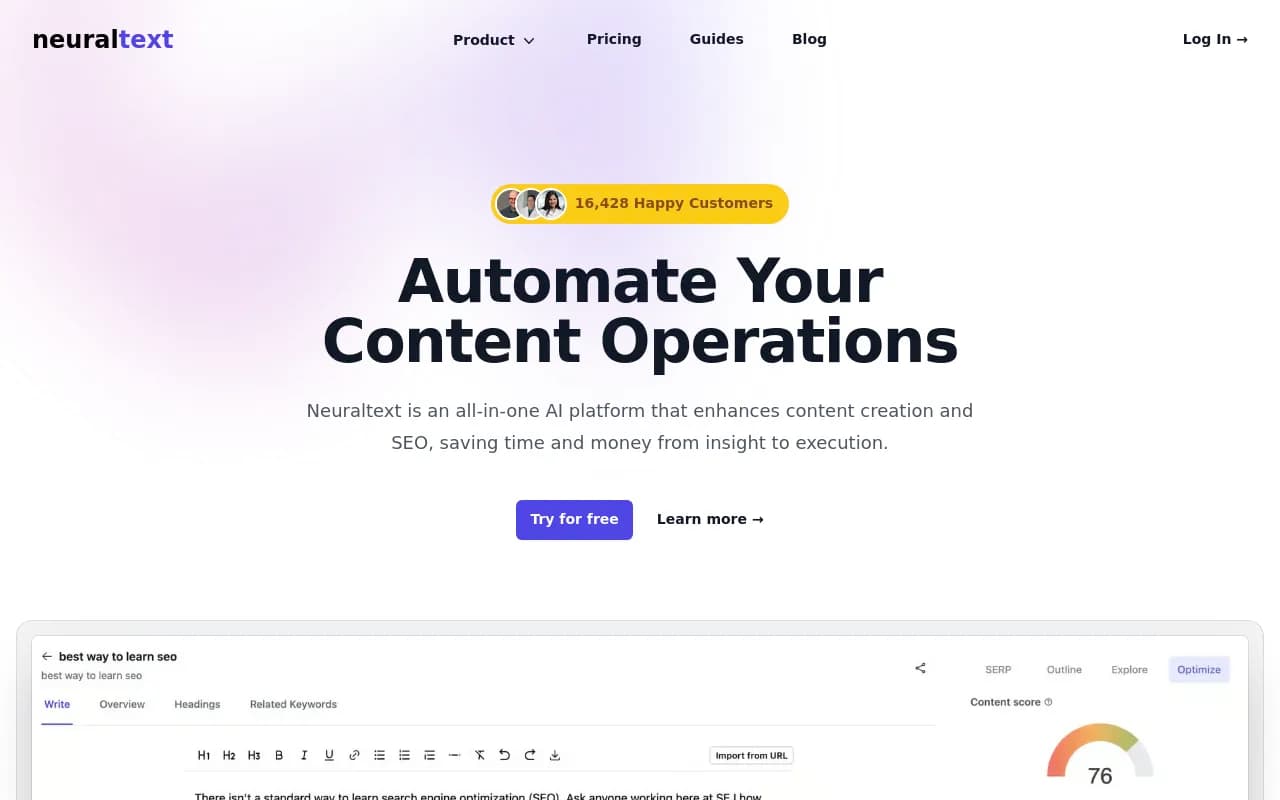
NeuralText positions itself as an all-in-one SEO content platform that takes you from keyword discovery to published article. It's built for the reality of modern content marketing: you need to produce a lot of content, it needs to rank, and you don't have unlimited time or budget. The platform combines four core capabilities -- keyword research, SERP analysis, AI writing, and performance tracking -- into a single workflow that's faster than stitching together separate tools.
The company serves 16,428 customers according to their site, including recognizable brands like eBay, Ray-Ban, Forbes, and Maersk. That customer base spans freelance writers, digital agencies, in-house marketing teams, and even students doing research. The common thread is people who need to understand what Google wants and then create content that delivers it.
Keyword Discovery and Clustering
NeuralText's keyword research starts with generating hundreds of long-tail suggestions for any seed term. You get search volume, trends, and related queries -- standard stuff, but executed cleanly. Where it gets more interesting is the clustering feature. Instead of manually grouping related keywords, NeuralText automatically identifies topic clusters and shows you how many pages you need to comprehensively cover a subject. This is genuinely useful for content planning. If you're targeting "project management software," the tool might cluster that into separate groups for "best project management tools," "project management for remote teams," "free project management software," etc. You can see at a glance that you need four distinct articles, not one mega-post trying to rank for everything.
The clustering uses semantic similarity and search intent to group keywords, which works well most of the time but occasionally lumps together queries that really deserve separate treatment. You'll want to review the clusters manually rather than blindly following the suggestions. Limits vary by plan: Starter gets 2,000 keyword suggestions and 5,000 clustering credits per month, Basic jumps to 20,000 and 10,000, Pro offers 50,000 and 30,000.
Live SERP Analysis and Content Briefs
This is where NeuralText separates itself from pure AI writing tools. Before you write anything, you analyze the top-ranking pages for your target keyword. The SERP analysis pulls in real-time data on what's currently ranking: article length, readability scores, topics covered, questions answered, and semantic keywords used. You see exactly what Google is rewarding right now, not what worked six months ago.
The content brief feature takes this analysis and packages it into a document you can hand to a writer (or use yourself). It includes recommended word count, key topics to cover, questions to answer, and semantic keywords to include. For agencies managing multiple writers, this is a huge time-saver. Instead of spending 30 minutes researching and writing a brief for each article, you generate one in a few clicks. The quality is good enough that most writers can work from it directly, though you'll want to add your own strategic direction and brand voice guidelines.
NeuralText supports SERP analysis in 17 languages including English, Spanish, German, French, Italian, Portuguese, and several others. This makes it viable for international content teams, though the AI writing quality varies more in non-English languages.
AI Writing Assistant
The AI writer works inline as you type, similar to how GitHub Copilot works for code. You get autocompletion suggestions that you can accept or ignore, plus a contextual menu with options to expand, rephrase, summarize, or simplify selected text. It's not trying to write entire articles from scratch (though you can generate drafts if you want). Instead, it's designed to keep you moving when you hit writer's block or need to flesh out a section.
The quality is decent but not magical. The AI understands context and can generate relevant paragraphs, but the writing tends toward generic and needs editing to add personality or deep expertise. Think of it as a competent junior writer who can draft sections that you then refine. For listicles, how-to guides, and informational content, it works well. For thought leadership or highly technical content, you'll do more rewriting.
Word limits are generous: 100,000 AI words per month on Starter and Basic, 300,000 on Pro. That's enough for most teams unless you're running a content farm. The editor itself is Google Docs-style with real-time collaboration, so multiple team members can work on the same document.
Search Console Integration
NeuralText connects directly to Google Search Console to show you which pages are performing, which keywords are gaining traction, and where you have opportunities to optimize existing content or create new articles. You can send keywords from Search Console directly into NeuralText's research tools, creating a closed loop: see what's working in GSC, research how to improve it, optimize the content, track the results.
This integration is genuinely useful for identifying "quick win" optimization opportunities -- pages ranking on page 2 that could jump to page 1 with some targeted improvements. The Starter and Basic plans include one GSC property, Pro includes five. If you're managing multiple client sites or a portfolio of your own properties, you'll need Pro or higher.
Who Should Use NeuralText
NeuralText makes the most sense for content teams producing 10+ SEO articles per month who want to speed up the research and drafting process. Specific personas:
- SEO agencies managing 5-15 client sites need the Pro plan for multiple GSC properties and enough content briefs to support all clients. The brief generation alone saves hours per week.
- In-house content teams at SaaS companies, ecommerce brands, or media sites benefit from the integrated workflow. If you're currently using Ahrefs for keywords, Clearscope for optimization, and a separate AI writer, NeuralText consolidates that stack.
- Freelance writers who do SEO content can use the Basic plan to research and write faster, delivering more articles per month without working more hours.
- Solo bloggers and affiliate marketers on tight budgets can start with the Starter plan at $19/mo, though you'll quickly hit the 5 content briefs per month limit if you're publishing weekly.
You should NOT use NeuralText if you're writing highly creative content (brand storytelling, narrative journalism), deeply technical content that requires subject matter expertise the AI doesn't have, or if you only publish 1-2 articles per month (the subscription cost won't justify itself).
Integrations and Workflow
Beyond Google Search Console, NeuralText is fairly self-contained. There's no Zapier integration, no WordPress plugin for direct publishing, no API for custom workflows. You work inside the NeuralText editor and then copy-paste to your CMS. For some teams this is fine, for others it's a friction point. The lack of a WordPress plugin in particular feels like a missed opportunity given how many content sites run on WordPress.
The platform does support team collaboration with multiple seats on the Pro plan (3 seats) and higher. You can assign content briefs to specific writers, leave comments on drafts, and track who's working on what. It's not as robust as a dedicated project management tool, but it covers the basics.
Pricing and Value
NeuralText offers a 5-day free trial with limited usage (5,000 AI words, 3 SERP analyses, 1,000 keyword suggestions). No credit card required, which is nice. After that:
- Starter: $19/mo -- 100k AI words, 5 content briefs, 2k keyword suggestions, 1 GSC property, 1 seat
- Basic: $49/mo -- 100k AI words, 40 content briefs, 20k keyword suggestions, 1 GSC property, 1 seat
- Pro: $119/mo -- 300k AI words, 100 content briefs, 50k keyword suggestions, 5 GSC properties, 3 seats
The jump from Starter to Basic is the best value upgrade -- you go from 5 to 40 content briefs per month, which is the difference between hobbyist and professional use. The Pro plan makes sense for agencies or larger in-house teams that need multiple seats and GSC properties.
Compared to competitors, NeuralText is mid-priced. Surfer SEO charges $89/mo for similar SERP analysis features but doesn't include AI writing. Jasper AI charges $49/mo just for the AI writing without any SEO research tools. Clearscope starts at $170/mo for content optimization. NeuralText bundles all these capabilities for less than buying them separately, which is its main value proposition.
Strengths
- Integrated workflow from keyword research to published content eliminates tool-switching and saves time
- Keyword clustering automatically identifies topic groups and content gaps, making content planning faster
- Content briefs based on live SERP data give writers clear direction and reduce back-and-forth
- Google Search Console integration creates a closed loop for identifying opportunities and tracking results
- Multi-language support for SERP analysis (17 languages) makes it viable for international teams
- Generous word limits -- even the cheapest plan includes 100k AI words per month
Limitations
- AI writing quality is average -- you'll spend significant time editing and adding your own expertise. The AI helps you draft faster but doesn't produce publish-ready content.
- No WordPress integration or API -- you have to copy-paste content to your CMS, which adds friction for teams publishing frequently
- Limited integrations overall -- no Zapier, no connection to other SEO tools, fairly closed ecosystem
- Keyword clustering occasionally groups unrelated queries -- you need to review clusters manually rather than trusting them blindly
- Starter plan limits are too restrictive -- 5 content briefs per month isn't enough for anyone publishing weekly, forcing most users to Basic
Bottom Line
NeuralText is best for content teams and agencies that need to produce SEO-optimized articles at scale and want to consolidate their tool stack. The integrated workflow from keyword research to content brief to AI-assisted writing genuinely saves time compared to using separate tools. The AI writing itself is solid but not exceptional -- think of it as a productivity boost, not a replacement for human expertise. If you're currently paying for Surfer SEO plus an AI writer plus a keyword tool, NeuralText at $49-119/mo consolidates that spend. If you only publish occasionally or need truly exceptional AI writing quality, look elsewhere.
Tags:
Frequently asked questions
What is NeuralText and what does it do?
How much does NeuralText cost?
Is NeuralText free to use?
Who is NeuralText best for?
What are the main features of NeuralText?
What is the quality of NeuralText's AI writing?
What companies use NeuralText?
Does NeuralText include keyword research tools?
Similar and alternative tools to NeuralText