Relevance AI Review 2026
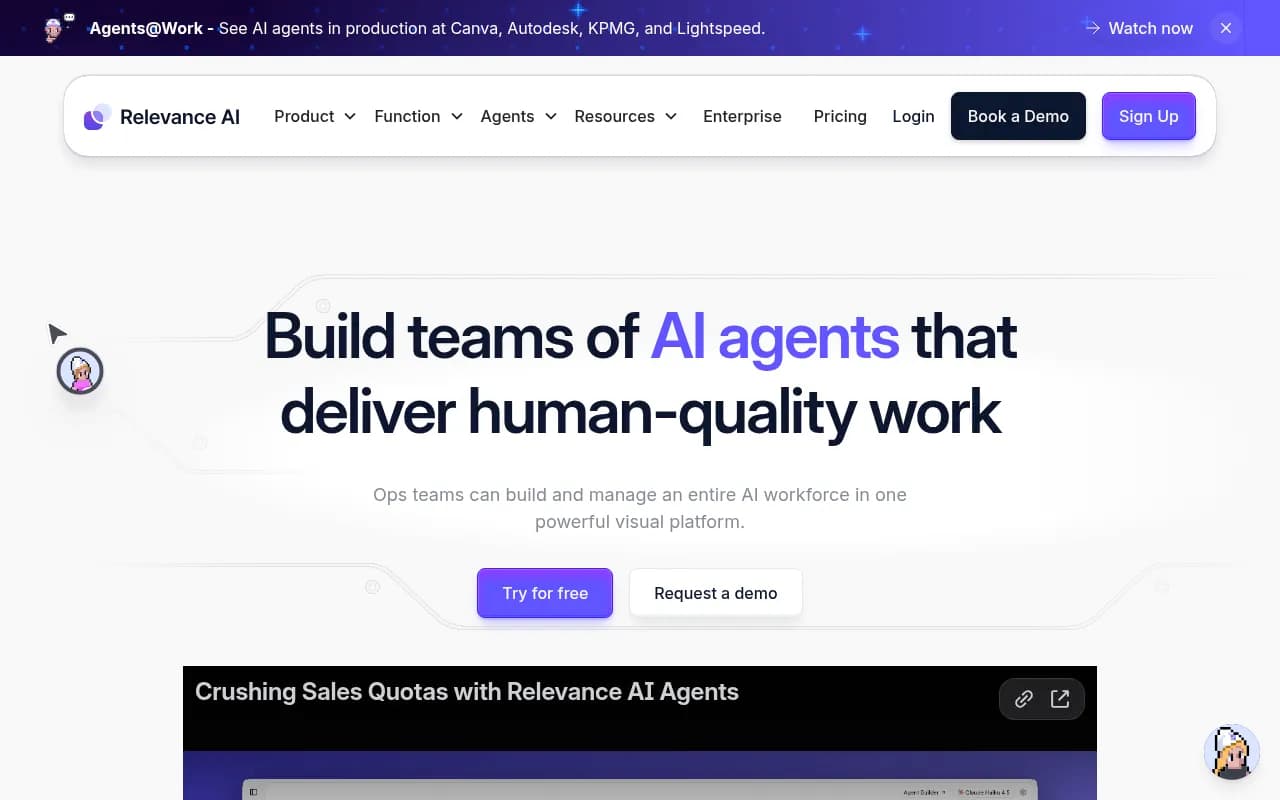
Relevance AI is a no-code multi-agent platform that lets ops teams build, deploy, and manage entire AI workforces. Used by Canva, Autodesk, and KPMG, it enables non-technical teams to create custom AI agents for sales, marketing, research, and support—complete with tools, integrations, and triggers—without writing code.
Key Takeaways:
- No-code multi-agent platform trusted by 6,000+ companies including Canva, Autodesk, KPMG, and Lightspeed for building AI workforces
- Pre-built specialist agents (Bosh AI BDR, Apla Research Agent) plus full customization via visual builder—no coding required
- 100+ expert templates covering sales, marketing, research, support, and ops workflows to get started fast
- Enterprise-grade deployment with SOC 2 Type II compliance, multi-LLM support (OpenAI, Claude, Gemini, Meta), and deep integrations
- Pricing starts free with 200 credits/month; Team plan at $234/month, Business at $599/month (300K credits)
- Best for: RevOps teams, marketing ops, sales ops, and agencies managing 10-500+ employees who need AI agents that deliver human-quality work at scale
Relevance AI is a multi-agent platform built for operations teams who need to automate complex, business-critical workflows without relying on developers. Founded in Sydney, Australia, the company has raised $10M in Series A funding and is used by major enterprises like Canva, Databricks, Confluent, and Autodesk. The platform's core promise is simple: enable non-technical subject-matter experts to build, deploy, and manage entire AI workforces that operate autonomously 24/7.
Unlike basic chatbot builders or single-purpose automation tools, Relevance AI is designed for multi-step, multi-agent workflows where AI agents collaborate, use tools, access knowledge bases, and make decisions independently. It's positioned as the "home of the AI Workforce"—a single platform where you recruit specialized agents, equip them with capabilities, and deploy them across sales, marketing, research, support, and operations.
Pre-Built Specialist Agents
Relevance AI offers ready-to-deploy specialist agents that handle specific high-value tasks:
Bosh AI BDR Agent is an autonomous sales development agent that engages leads instantly, qualifies prospects, conducts research, personalizes outreach, handles follow-ups, and updates your CRM—all without human intervention. It adapts to any sales motion and playbook, ensuring speed-to-lead is instant and no cold lead goes uncontacted. Sales teams use Bosh to automate the entire top-of-funnel motion, from initial contact through to meeting booking.
Apla AI Research Agent handles pre-call research for sales and account management teams. It pulls insights from LinkedIn, company websites, news sources, and internal data to build comprehensive prospect profiles in minutes. Every sales call becomes fully prepped with the right context, competitive intelligence, and talking points. Teams report significant increases in call effectiveness and win rates because reps walk into every conversation armed with deep account knowledge.
Both agents are fully customizable—you can adjust their behavior, data sources, triggers, and outputs to match your exact processes. They're not rigid templates; they're starting points that adapt to how your business actually works.
Build Your Own Custom Agents
The real power of Relevance AI is the visual agent builder. Non-technical users can create custom agents from scratch by:
- Defining the agent's identity: Name, avatar, description, role, and personality
- Equipping AI Tools: Tools are modular capabilities like API calls, data processing, web scraping, document analysis, email sending, CRM updates, and more. Relevance has a library of pre-built tools, plus you can build custom tools using LLM chains, code snippets, or third-party integrations.
- Setting triggers: Agents activate based on conditions—new lead in HubSpot, form submission, Slack message, scheduled time, webhook, or manual invocation.
- Adding knowledge: Upload documents, connect databases, or link to internal wikis so agents have context-specific information.
- Choosing LLM providers: Switch between OpenAI (GPT-4, GPT-4o), Anthropic (Claude 3.5 Sonnet), Google (Gemini), and Meta (Llama) models depending on task requirements and cost.
The builder uses natural language configuration—you describe what the agent should do, and the platform translates that into executable workflows. No code required, but developers can drop into custom code blocks if needed for advanced logic.
100+ Expert Templates
Relevance AI offers 100+ pre-built agent templates across Research, Marketing, Support, Sales, and Operations categories. Each template is designed by domain experts and can be cloned, customized, and deployed in minutes. Examples include:
- Lima, the Lifecycle Marketer: Automates email campaigns, lead nurturing, and content personalization
- Elli, the Enrichment Agent: Enriches contact records with firmographic, technographic, and intent data
- Suni, the Intercom Support Agent: Handles tier-1 support queries, escalates complex issues, and updates tickets
Templates are fully editable—you're not locked into a rigid workflow. They serve as starting points that show what's possible and accelerate time-to-value.
Multi-Agent System (MAS) Architecture
Relevance AI supports multi-agent systems where multiple agents collaborate on complex workflows. For example, a sales workflow might involve:
- Research Agent (Apla) pulls prospect data and competitive intel
- Personalization Agent writes custom email copy and creates tailored pitch decks
- Outreach Agent (Bosh) sends emails, tracks responses, and books meetings
- CRM Agent updates HubSpot or Salesforce with activity logs and next steps
Agents can hand off tasks, share context, and operate in parallel or sequence. This mirrors how human teams work—specialists collaborating on a shared goal—but at machine speed and scale.
Integrations & Ecosystem
Relevance AI integrates deeply with the tools businesses already use:
- CRMs: HubSpot, Salesforce, Pipedrive
- Communication: Slack, Intercom, Discord, email (SMTP/IMAP)
- Data sources: Google Sheets, Airtable, SQL databases, REST APIs
- Automation: Zapier, Make, webhooks
- AI models: OpenAI, Anthropic, Google AI, Meta AI
- File storage: Google Drive, Dropbox, OneDrive
The platform also offers a REST API and SDK for developers who want to embed agents into custom applications or trigger workflows programmatically. Browser extensions and mobile app support are in development.
Tools: The Agent's Capabilities
Tools are what give agents their abilities. Relevance AI's tool library includes:
- LLM chains: Multi-step prompts with conditional logic
- Web scraping: Extract data from websites, LinkedIn, news sources
- API calls: Connect to any REST API (Clearbit, Apollo, ZoomInfo, etc.)
- Data processing: Transform, filter, merge, and analyze datasets
- Document analysis: Extract insights from PDFs, Word docs, spreadsheets
- Email & messaging: Send emails, Slack messages, SMS
- CRM operations: Create/update records in HubSpot, Salesforce
- Custom code: Write Python or JavaScript for advanced logic
You can chain tools together to build complex workflows. For example, a research agent might: scrape a company's website → extract key info with an LLM → call Clearbit API for firmographics → write a summary → save to HubSpot.
Who Is It For
Relevance AI is built for operations teams in mid-market and enterprise companies (50-5,000 employees) who need to automate complex, multi-step workflows without developer resources. Primary user personas include:
- RevOps teams at B2B SaaS companies managing 100-500 sales reps who need to automate lead enrichment, research, and CRM hygiene
- Marketing Ops teams running lifecycle campaigns, content personalization, and lead scoring for 10,000+ contacts
- Sales Ops teams supporting AEs and SDRs with automated prospecting, account research, and deal intelligence
- Customer Success Ops automating onboarding workflows, health score monitoring, and renewal outreach
- AI consultancies and agencies building custom AI solutions for clients across industries
The platform is designed for non-technical users—no coding background required. If you can describe a process in plain English, you can build an agent. However, it's powerful enough for technical teams who want full control via APIs and custom code.
Who Should NOT Use This
Relevance AI is overkill for:
- Solo founders or very small teams (1-5 people) who don't have repeatable processes to automate yet
- Teams looking for a simple chatbot—this is a full workflow automation platform, not a customer-facing chat widget
- Companies needing real-time voice AI—Relevance focuses on asynchronous workflows (email, CRM, research), not live phone calls
- Teams with zero AI/automation experience—there's a learning curve to designing effective agents and workflows
Pricing & Value
Relevance AI uses a credit-based pricing model:
- Free Plan: $0/month, 200 credits/month, unlimited agents and tools, community support. Good for exploring the platform and building proof-of-concept agents.
- Team Plan: $234/month, includes more credits, priority support, and collaboration features for teams building agents for multiple stakeholders.
- Business Plan: $599/month, 300,000 credits/month, dedicated support, SLA, and advanced security features for enterprise deployments.
As of September 2025, Relevance is splitting credits into Actions (what agents do—API calls, tool runs, etc.) and Vendor Credits (AI model costs from OpenAI, Anthropic, etc.). This gives more transparency into where costs come from.
Compared to hiring a full-time SDR ($60K-$80K/year), a research analyst ($50K-$70K/year), or a marketing coordinator ($45K-$65K/year), Relevance AI delivers ROI quickly. One Bosh AI BDR agent can handle the workload of 2-3 human SDRs at a fraction of the cost. One Apla research agent can prep 50+ accounts per day—work that would take a human analyst a week.
The free plan is genuinely usable for small-scale testing. The Team plan is competitive with tools like Zapier ($240/month for advanced automation) but offers far more AI-native capabilities. The Business plan is priced for companies running agents at scale across multiple teams.
Strengths
- No-code multi-agent builder that non-technical ops teams can actually use—rare in the AI agent space
- Pre-built specialist agents (Bosh, Apla) that deliver immediate value without custom configuration
- 100+ expert templates that show what's possible and accelerate deployment
- Deep integrations with CRMs, communication tools, and data sources businesses already use
- Multi-LLM support lets you choose the best model for each task (GPT-4 for reasoning, Claude for writing, Gemini for cost)
- Enterprise-grade security with SOC 2 Type II compliance and ephemeral data handling (inputs/outputs not stored)
- Active community of 6,000+ users sharing templates, best practices, and use cases
- Proven at scale by major enterprises like Canva, Autodesk, KPMG, and Lightspeed
Limitations
- Learning curve for designing effective agents—requires understanding of prompts, tools, and workflow logic
- Credit-based pricing can be hard to predict costs upfront, especially for high-volume workflows
- Not ideal for real-time voice AI—focused on asynchronous workflows, not live phone or video interactions
- Limited pre-built integrations compared to Zapier (5,000+ apps)—you'll often need to use webhooks or APIs for niche tools
- Agent performance varies by LLM choice—cheaper models (Gemini Flash) may produce lower-quality outputs than GPT-4 or Claude
Bottom Line
Relevance AI is the best multi-agent platform for ops teams who need to automate complex, multi-step workflows without relying on developers. If you're a RevOps, Marketing Ops, or Sales Ops team at a B2B company managing 50-500+ employees, and you're tired of manual research, data entry, and repetitive tasks eating up your team's time, Relevance AI will deliver immediate ROI. The pre-built agents (Bosh, Apla) alone justify the cost, and the ability to build custom agents for any workflow makes it a long-term platform for scaling AI across your organization.
Best use case in one sentence: RevOps teams at B2B SaaS companies (100-500 employees) automating lead research, CRM enrichment, and sales outreach to free up reps for high-value conversations.
Tags:
Similar and alternative tools to Relevance AI