Evertune Review 2026
Evertune is a Generative Engine Optimization platform designed for Fortune 500 brands and agencies to monitor brand mentions across ChatGPT, Google AI Overviews, Gemini, Claude, and other AI models. Starting at $3,000/month, it offers AI brand monitoring, website optimization audits, content strategy insights, and AI retargeting capabilities through partnerships with The Trade Desk and Index Exchange.
Summary
• Best for: Fortune 500 brands and large agencies with $36K+ annual budgets who need enterprise-grade AI visibility tracking and retargeting capabilities • Strengths: Direct partnerships with The Trade Desk and Index Exchange for AI retargeting, proprietary EverPanel consumer data, white-glove service model, trusted by major brands like Miro, Roku, and WPP • Limitations: High price point ($3K/mo minimum), lacks technical depth like crawler logs and page-level tracking, more monitoring-focused than optimization-focused, limited self-service capabilities • Bottom line: Premium positioning for brands prioritizing brand safety and retargeting over hands-on optimization tools
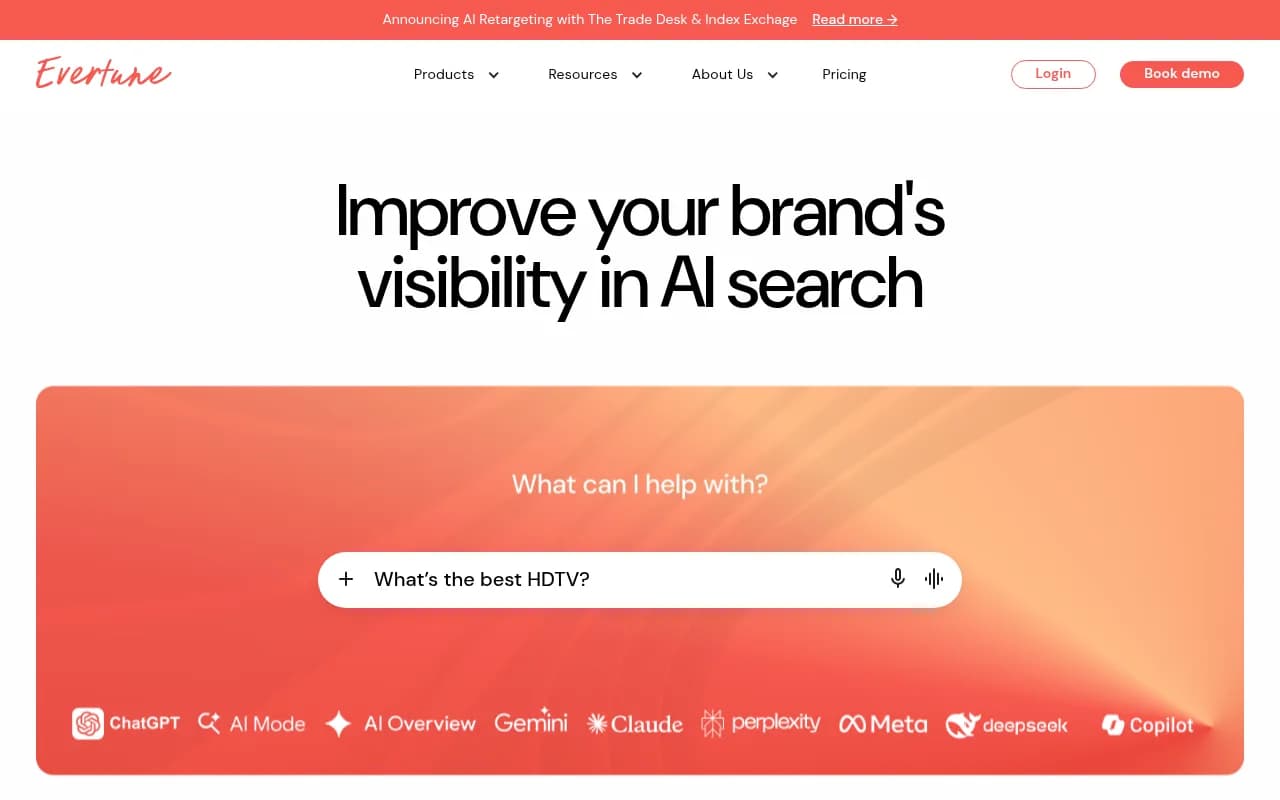
Evertune positions itself as the enterprise-grade Generative Engine Optimization platform for Fortune 500 brands looking to understand and improve their visibility across AI search engines like ChatGPT, Google AI Overviews, Gemini, Claude, Perplexity, Meta AI, DeepSeek, and Copilot. Founded as an AI marketing analytics company, Evertune has raised $4 million in seed funding and counts major brands like Miro, Roku, Virgin Voyages, Athenahealth, HexClad, and WPP among its clients. The platform has been featured in The Wall Street Journal, Forbes, Business Insider, Axios, and The Economist as one of the key players shaping the AI search optimization space.
The company targets enterprise marketing teams, Fortune 500 brands, and large agencies across verticals including finance, retail/e-commerce, automotive, pharma, tech, travel, food/beverage, entertainment, CPG, and B2B. With pricing starting at $3,000 per month, Evertune is explicitly positioned as a premium solution for brands with significant marketing budgets who want white-glove service and strategic guidance rather than self-service optimization tools.
AI Brand Monitoring
Evertune's core offering is comprehensive brand tracking across major AI platforms. The platform monitors how your brand is mentioned, described, and recommended across ChatGPT, Google AI Mode, Google AI Overviews, Claude, Gemini, Perplexity, Meta AI, DeepSeek, and Copilot. You get an AI Brand Index that shows your visibility score compared to competitors, sentiment analysis of how AI models describe your brand, and competitive intelligence showing where competitors are winning.
The platform claims to provide "the most comprehensive and statistically significant AI brand analytics available" by combining three data sources: AI consumer app data (tracking real user behavior), direct LLM integration (querying models directly), and EverPanel (their proprietary consumer research panel). This multi-source approach is designed to provide more reliable data than competitors who rely solely on API queries.
You can track brand mentions across different product categories, see which attributes AI models associate with your brand, and understand why competitors might be getting recommended instead of you. The competitive benchmarking shows your share of voice in AI responses compared to up to 10+ competitors in your category.
AI Website Optimization
Evertune provides website audits specifically focused on how AI crawlers interpret your site. The platform analyzes your website's structure, content, and metadata to identify optimization opportunities that will improve discoverability by AI models. You receive a detailed audit report with specific recommendations for improving how bots that power AI recommendations understand your brand.
This includes technical SEO elements like schema markup, content structure, internal linking, and metadata optimization -- but tailored specifically for AI crawler behavior rather than traditional search engines. The audit identifies gaps in your content that prevent AI models from accurately representing your brand and provides prioritized action items.
However, unlike more technical platforms, Evertune does not provide real-time AI crawler logs showing which AI bots are actually hitting your site, when they visit, which pages they read, or errors they encounter. This means you're working from audit recommendations rather than live data on AI crawler behavior.
AI Content Strategy
Evertune's content strategy module provides insights into what content will improve your AI visibility. The platform analyzes which product attributes drive recommendations in your category, identifies the most influential sources that shape AI's perception of your brand, and provides data-driven content recommendations.
The attribute analysis uses radar charts to show which features, benefits, or characteristics AI models prioritize when making recommendations in your category. For example, if you're a luxury SUV brand, it might show that AI models weight safety ratings, interior space, and technology features most heavily when recommending vehicles.
The source analysis identifies which websites, publications, Reddit threads, YouTube videos, and other sources have the most influence on AI responses in your category. This helps you prioritize where to publish content, which partnerships to pursue, and which platforms to focus your content distribution efforts.
Evertune also offers content creation services through their team, turning insights into ready-to-publish blog posts and articles optimized for AI visibility. However, the platform does not include a built-in AI writing agent or self-service content generation tools -- content creation is handled as a managed service by their team.
AI Retargeting (Partner Connect)
Evertune's most distinctive feature is AI Retargeting through Partner Connect, launched in partnership with The Trade Desk and Index Exchange. This addresses a key problem: if your brand isn't mentioned in AI responses, you can still reach users when they click through to validate sources.
Research shows 12% of users click citations in AI responses to fact-check before making decisions. Evertune identifies the exact URLs AI models cite most frequently in your category, then connects you directly to The Trade Desk and Index Exchange to run programmatic ad campaigns on those URLs. When users click through from ChatGPT or Perplexity to verify information, your ads appear on those validation pages.
Any Trade Desk or Index Exchange customer can activate AI retargeting on Evertune's pre-built source lists and PMP deals covering 250+ product categories -- no Evertune subscription required. For Evertune customers, the platform provides category-specific source lists and handles the technical integration with ad platforms.
This is a creative solution for brands struggling to get mentioned in AI responses, effectively turning AI search into a retargeting channel. However, it's a workaround rather than a solution to the core problem of improving your actual AI visibility.
Data Sources and Methodology
Evertune differentiates itself through its multi-source data approach:
• AI Consumer App Data: Tracking real user behavior and queries in AI applications • Direct LLM Integration: Querying AI models directly via APIs to test specific prompts • EverPanel: Proprietary consumer research panel providing human validation and sentiment data
This combination is designed to provide more statistically significant results than competitors who rely solely on API queries. The platform emphasizes statistical confidence in its reporting, though specific sample sizes and confidence intervals are not publicly disclosed.
Evertune monitors 9 major AI platforms: ChatGPT, Google AI Mode, Google AI Overviews, Claude, Gemini, Perplexity, Meta AI, DeepSeek, and Copilot. The platform does not currently track Grok, Mistral, or some smaller AI models that competitors monitor.
Who Is Evertune For
Evertune is explicitly designed for Fortune 500 brands and large agencies with substantial marketing budgets. The $3,000/month starting price point (minimum $36,000 annual commitment) immediately excludes small businesses, startups, and most mid-market companies. This is a strategic positioning choice -- Evertune is competing on white-glove service, brand safety, and enterprise features rather than self-service tools or affordability.
Ideal customers include:
• Enterprise marketing teams at Fortune 500 companies who need executive-level reporting on AI brand visibility and have budget for premium tools • Large digital agencies (like WPP, which is a customer) managing AI visibility for multiple enterprise clients and need a platform that can handle complex multi-brand tracking • Brands in regulated industries (pharma, finance) where brand safety and accurate representation in AI responses is critical and worth premium pricing • Companies prioritizing retargeting who want to activate AI citation data through programmatic advertising and already use The Trade Desk or Index Exchange
Evertune is NOT a good fit for:
• Small businesses or startups with limited budgets -- the $36K+ annual cost is prohibitive • Hands-on SEO teams who want to dig into technical details like crawler logs, page-level tracking, or self-service content optimization • Agencies managing many small clients where per-client costs need to be under $500/month • Technical users who want API access, custom reporting, or granular data exports for their own analysis
Integrations and Ecosystem
Evertune's primary integrations are with advertising platforms:
• The Trade Desk: Direct integration for AI retargeting campaigns on cited sources • Index Exchange: PMP deals and programmatic access to AI citation sources
The platform does not publicly advertise integrations with Google Search Console, analytics platforms, CMS systems, or other marketing tools. There is no mention of an API for custom integrations or data exports. The platform appears designed as a standalone reporting and strategy tool rather than part of an integrated martech stack.
Evertune provides a Help Center (docs.evertune.ai) for customer support and documentation, but the extent of self-service capabilities is unclear from public information.
Pricing and Value
Pricing starts at $3,000 per month according to the pricing page. No free trial is advertised. The pricing structure is not transparent -- you must book a demo to get detailed pricing information. Based on the enterprise positioning and Fortune 500 client base, expect custom pricing for larger deployments, likely with annual contracts required.
For context, this pricing is 12x higher than Promptwatch's Professional plan ($249/mo) and 5x higher than Promptwatch's Business plan ($579/mo). Evertune is competing with enterprise platforms like Profound and Scrunch rather than mid-market tools.
What you're paying for at this price point:
• White-glove service and strategic guidance from Evertune's team • Access to proprietary EverPanel consumer research data • Direct partnerships with The Trade Desk and Index Exchange for retargeting • Enterprise-grade reporting and brand safety features • Managed content creation services
What you're NOT getting compared to more technical platforms:
• Real-time AI crawler logs showing bot activity on your site • Page-level tracking of which specific pages get cited • Self-service content generation tools • Granular prompt-level data and difficulty scoring • API access for custom integrations
Strengths
• Enterprise credibility: Trusted by Fortune 500 brands like Miro, Roku, WPP, Virgin Voyages, and Athenahealth -- strong social proof for large organizations • AI Retargeting: Unique partnership with The Trade Desk and Index Exchange provides a creative workaround for brands struggling with AI visibility • Multi-source data: Combining consumer app data, direct LLM queries, and proprietary panel research provides more robust data than API-only competitors • White-glove service: High-touch support model with strategic guidance -- customers describe Evertune as "an extension of our own team" • Comprehensive platform coverage: Monitors 9 major AI platforms including ChatGPT, Google AI Overviews, Claude, Gemini, Perplexity, and others
Limitations
• Price barrier: $3,000/month minimum ($36K+ annually) excludes 95% of potential customers -- this is explicitly enterprise-only pricing • Limited technical depth: No crawler logs, no page-level citation tracking, no real-time bot monitoring -- more strategic than tactical • Monitoring-focused: Platform emphasizes tracking and reporting over hands-on optimization tools -- you see the data but don't get tools to fix it yourself • No self-service content tools: Content creation is a managed service, not a self-service AI writing agent you can use on-demand • Lack of transparency: Pricing not public, methodology details limited, no free trial -- high barrier to evaluation • Missing technical features: No API, limited integration ecosystem, unclear data export capabilities
Bottom Line
Evertune is the premium choice for Fortune 500 brands and large agencies who want enterprise-grade AI visibility tracking with white-glove service and strategic guidance. If you have a $36K+ annual budget, need executive-level reporting on AI brand mentions, and want to activate AI citation data through programmatic retargeting, Evertune delivers a polished, high-touch experience backed by partnerships with The Trade Desk and Index Exchange.
However, if you're a hands-on marketing team that wants to dig into technical details, optimize your own content, track AI crawler behavior in real-time, or work within a more modest budget, platforms like Promptwatch offer significantly more depth at a fraction of the cost. Evertune is monitoring and strategy; Promptwatch is optimization and action.
Best use case in one sentence: Enterprise brands with $50K+ marketing budgets who need brand safety monitoring across AI platforms and want to activate retargeting campaigns on AI citation sources.
Tags:
Similar and alternative tools to Evertune