Heap Review 2026
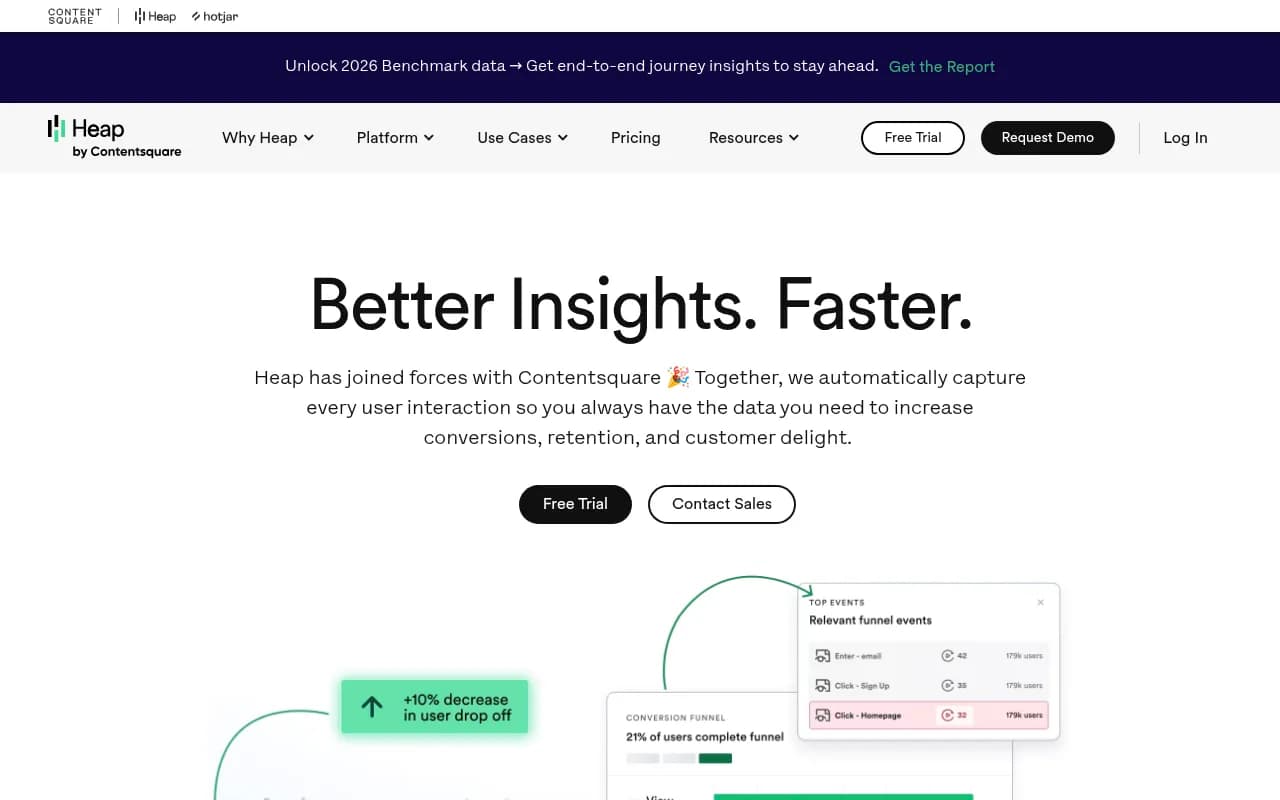
Heap is a digital analytics platform that automatically captures all user interactions on your website and mobile apps without manual event tracking. Now part of Contentsquare, it combines quantitative behavioral data with session replay and AI-powered insights to help product teams, marketers, and
Key Takeaways:
• Automatic event capture eliminates manual tracking setup -- one code snippet records every click, tap, form fill, and page view across web and mobile • Heap Illuminate uses data science to surface hidden friction points and conversion opportunities you weren't actively monitoring • Integrated session replay lets you watch exactly what users did at moments of interest, bridging quantitative and qualitative analysis • Best for: Product teams at SaaS companies, e-commerce brands, and digital businesses that need complete user journey visibility without engineering overhead • Limitations: Premium pricing targets mid-market and enterprise; smaller startups may find the Growth plan ($900+/mo based on sessions) expensive compared to Google Analytics
Heap positions itself as the analytics platform that shows you "everything users do on your site, revealing the unknown unknowns that stay invisible with other tools." After being acquired by Contentsquare in recent years, Heap now operates as the product analytics arm of a larger experience intelligence platform. The core promise remains the same: automatic data capture that eliminates the traditional analytics workflow of defining events upfront, waiting for engineering to implement tracking code, then hoping you picked the right things to measure.
The platform is used by over 10,000 companies including Dropbox Sign, Eventbrite, Northwestern Mutual, and Walmart Labs. Customer case studies cite results like 30% conversion increases (Huel), $1M+ in incremental loan volume (LendingClub), and $225k monthly savings from optimization insights (Esurance). The target audience spans product managers, growth marketers, UX researchers, and data analysts at digital-first companies -- particularly SaaS businesses, e-commerce platforms, and financial services firms where understanding the complete user journey directly impacts revenue.
Automatic Event Capture (Heap's Core Differentiator)
Heap's defining feature is autocapture: install a single JavaScript snippet on your website or SDK in your mobile app, and Heap automatically records every user interaction -- clicks, taps, form submissions, page views, element changes. No need to predefine events, write tracking code, or wait for engineering sprints. This "capture everything" approach means you can retroactively analyze user behaviors you didn't know to track when you first deployed Heap.
In practice, this works through the Heap Visual Labeler, a point-and-click interface where you select elements on your site (buttons, links, forms) and define them as events after the fact. Since Heap already captured the raw interaction data, you can instantly see historical trends for that event going back to your installation date. Competitors like Mixpanel and Amplitude require you to instrument events before you can analyze them -- if you forgot to track a button click last quarter, that data is gone forever. With Heap, you just label it now and see the full history.
The autocapture extends to user properties and session data: Heap automatically tracks device type, browser, referrer, UTM parameters, geographic location, and session duration. You can also send custom user properties via the Heap API (user ID, account tier, subscription status, etc.) to segment your analysis by customer cohorts. The platform organizes all this data into a structured event stream without requiring a data engineer to build ETL pipelines.
Heap Illuminate (AI-Powered Insights)
Heap Illuminate is the platform's data science layer that automatically surfaces insights you wouldn't find through manual exploration. It analyzes your entire event dataset to identify:
• Effort Analysis: Shows how many steps users take to complete a goal (e.g. checkout, signup) and highlights alternate paths that indicate confusion or friction. If 20% of users are taking a 7-step detour to reach a page that should be 2 clicks away, Illuminate flags it.
• Correlation Analysis: Identifies which events most strongly correlate with conversion or retention. For example, it might reveal that users who watch a product demo video are 3x more likely to upgrade, even if you never explicitly tracked "demo video views" as a conversion driver.
• Drop-off Detection: Automatically alerts you when conversion rates drop below baseline or when specific user segments start abandoning flows at unusual rates.
This is fundamentally different from traditional analytics dashboards where you have to know what question to ask. Illuminate runs continuously in the background and surfaces "unknown unknowns" -- patterns in user behavior that you didn't think to investigate. Competitors like Amplitude have some automated insights (Compass, Recommend), but Heap's approach is more tightly integrated with the autocapture data model, meaning it can analyze behaviors you never explicitly defined as events.
Session Replay Integration
Heap includes built-in session replay that records user sessions as video-like playbacks. The key integration: when you're analyzing a funnel or user segment in Heap's quantitative dashboards, you can click directly into session replays for users who exhibited that behavior. For instance, if you see a spike in cart abandonment, you can watch actual sessions of users who abandoned to see what went wrong -- a broken button, confusing copy, a hidden shipping cost.
The session replay respects privacy settings (masking sensitive form fields, PII) and integrates with Heap's event stream, so you can filter replays by specific user actions ("show me sessions where users clicked the pricing page 3+ times but didn't start a trial"). This bridges the gap between quantitative data (what happened) and qualitative context (why it happened). Most analytics platforms require separate tools for session replay (Hotjar, FullStory) that don't share the same event definitions or user segments.
CoPilot (AI-Assisted Analysis)
Heap CoPilot is a generative AI assistant that lets non-technical users query their data in natural language. Instead of learning Heap's query builder, you can ask questions like "What's our signup conversion rate for mobile users in the last 30 days?" or "Show me the most common paths users take before upgrading." CoPilot translates these into Heap queries and returns visualizations.
This lowers the barrier to entry for product managers, marketers, and executives who need answers but don't want to learn SQL or analytics syntax. It's similar to ThoughtSpot's AI search or Tableau's Ask Data, but tailored specifically to Heap's event-based data model. The feature is still relatively new (launched in 2023-2024 timeframe based on marketing materials), so it's not as mature as dedicated BI tools, but it's a clear differentiator vs traditional product analytics platforms.
Integrations & Ecosystem
Heap offers 100+ integrations spanning marketing automation, CRM, data warehouses, and customer engagement platforms:
• Marketing/CRM: Salesforce, HubSpot, Marketo, Braze, Iterable, Customer.io -- send Heap segments and event data to trigger campaigns or enrich customer profiles • Data Warehouses: Snowflake, BigQuery, Redshift, Databricks -- export raw event data via Heap Connect for custom analysis or data science modeling • Reverse ETL: RudderStack, Segment, Fivetran -- sync Heap data to downstream tools or ingest data from other sources into Heap • A/B Testing: Optimizely, VWO, Google Optimize -- analyze experiment results in Heap's funnel and retention reports • Product Tools: Jira, Slack, Zendesk -- push insights and alerts into team workflows
The platform also has a JavaScript API and REST API for custom integrations. Mobile SDKs support iOS (Swift/Objective-C) and Android (Kotlin/Java), with React Native and Flutter support via community libraries. There's no official CLI or developer-focused tooling beyond the APIs, so it's less "developer-first" than Mixpanel or Amplitude.
Pricing & Value
Heap's pricing is session-based and structured in three tiers:
• Free Plan: Up to 10,000 monthly sessions, 1 project, basic reports and funnels. Good for early-stage startups finding product-market fit, but very limited -- no session replay, no Illuminate, no integrations.
• Growth Plan: Starts around $900-$1,200/month based on session volume (exact pricing requires a quote). Includes session replay, Illuminate, integrations, and support for multiple projects. Designed for scaling startups and mid-market companies.
• Pro/Enterprise Plan: Custom pricing for high-volume businesses (500k+ sessions/month). Adds advanced features like data governance, SSO, dedicated support, SLAs, and custom contracts.
Compared to competitors: Heap is more expensive than Google Analytics (free) and Plausible ($9-99/mo), roughly comparable to Mixpanel and Amplitude at mid-market scale, but cheaper than full digital experience platforms like Contentsquare's core product (which starts at $10k+/month). The value proposition is strongest for companies that would otherwise need to hire engineers to instrument events manually -- Heap's autocapture can save weeks of dev time per quarter.
However, smaller startups often find the Growth plan pricing steep. Reddit discussions mention teams switching to open-source alternatives (PostHog, Matomo) or sticking with Google Analytics + GTM when Heap's €900/mo quote exceeded their budget. The Free plan's 10k session limit is restrictive for any site with meaningful traffic (10k sessions = ~300-500 daily active users depending on session length).
Who Should Use Heap
Heap is best suited for:
• Product teams at SaaS companies (50-500 employees) who need to understand feature adoption, activation funnels, and retention cohorts without waiting for engineering to instrument tracking. If you're constantly asking "why did users stop using Feature X?" or "what do power users do differently?", Heap answers those questions retroactively.
• E-commerce and marketplace businesses that need to optimize checkout flows, product discovery, and repeat purchase behavior. The session replay + funnel analysis combo is particularly strong for diagnosing cart abandonment.
• Growth and marketing teams who run experiments and need to analyze results across the full user journey, not just landing page conversions. Heap's ability to segment by UTM parameters, referrer, and first-touch attribution makes it useful for understanding campaign effectiveness beyond Google Analytics.
• UX researchers and designers who want quantitative validation of qualitative findings. The session replay integration lets you move fluidly between "how many users struggled here" (quantitative) and "what did the struggle look like" (qualitative).
Heap is NOT ideal for:
• Early-stage startups with <$50k MRR -- the pricing doesn't make sense until you have product-market fit and a clear conversion funnel to optimize. Use Google Analytics or PostHog's free tier instead.
• Content publishers and media sites -- Heap is built for product analytics (user actions, feature usage), not content analytics (pageviews, time on page, scroll depth). Google Analytics or Chartbeat are better fits.
• Teams that need real-time operational dashboards -- Heap's data pipeline has a ~1-2 hour delay for event processing. If you need sub-minute latency for monitoring production systems, use a dedicated observability tool (Datadog, New Relic).
Strengths
• Autocapture eliminates tracking debt: No more "we should have tracked that 6 months ago" regrets. Define events retroactively and see full historical data.
• Illuminate surfaces non-obvious insights: The automated correlation and effort analysis genuinely finds patterns you wouldn't discover through manual exploration.
• Session replay integration is seamless: Clicking from a funnel drop-off directly into relevant session replays is faster than juggling separate tools.
• Strong for non-technical users: The Visual Labeler and CoPilot make it accessible to PMs and marketers who don't write SQL.
• Contentsquare acquisition adds enterprise credibility: Being part of a larger platform (Contentsquare) means better enterprise sales support, compliance certifications, and integration with zone-based heatmaps and voice-of-customer tools.
Limitations
• Expensive for small teams: The Growth plan pricing (~$900-$1,200/mo) is a tough sell for bootstrapped startups. The Free plan's 10k session limit is too restrictive for most growing products.
• Autocapture can create messy data: Without discipline, teams end up with hundreds of unlabeled events and inconsistent naming conventions. Heap's governance tools (event taxonomies, required properties) help, but require active management.
• Limited real-time capabilities: The 1-2 hour data delay means you can't use Heap for live monitoring or instant experiment readouts. Amplitude and Mixpanel offer faster ingestion.
• Mobile SDK maturity lags web: The iOS and Android SDKs work, but lack some advanced features available on web (e.g. certain autocapture scenarios require manual instrumentation on mobile).
• No built-in A/B testing: Heap analyzes experiments but doesn't run them. You need a separate tool (Optimizely, LaunchDarkly) and integrate via API.
Bottom Line
Heap is the right choice for product-led SaaS companies, e-commerce businesses, and digital platforms that need complete user journey visibility without engineering bottlenecks. The autocapture model is genuinely differentiated -- it solves the "we didn't track that" problem that plagues traditional analytics. Combined with Illuminate's automated insights and integrated session replay, Heap delivers a more complete picture of user behavior than point solutions.
The pricing is a barrier for early-stage startups, but for mid-market companies (Series A/B SaaS, established e-commerce brands) spending $1k-$5k/month on analytics, Heap offers strong ROI by reducing time-to-insight and eliminating manual instrumentation work. If you're currently frustrated by Google Analytics' lack of user-level tracking or tired of waiting for engineers to add event tracking code, Heap is worth evaluating. Just be prepared to invest in data governance to keep your event taxonomy clean as your team scales.
Tags:
Frequently asked questions
What is Heap and what does it do?
How much does Heap cost?
Does Heap offer a free plan?
Who should use Heap analytics?
What is Heap's automatic event capture feature?
What is Heap Illuminate?
How does Heap compare to Google Analytics?
What companies use Heap?
Does Heap include session replay?
What is the relationship between Heap and Contentsquare?
Similar and alternative tools to Heap