Search Party Review 2026
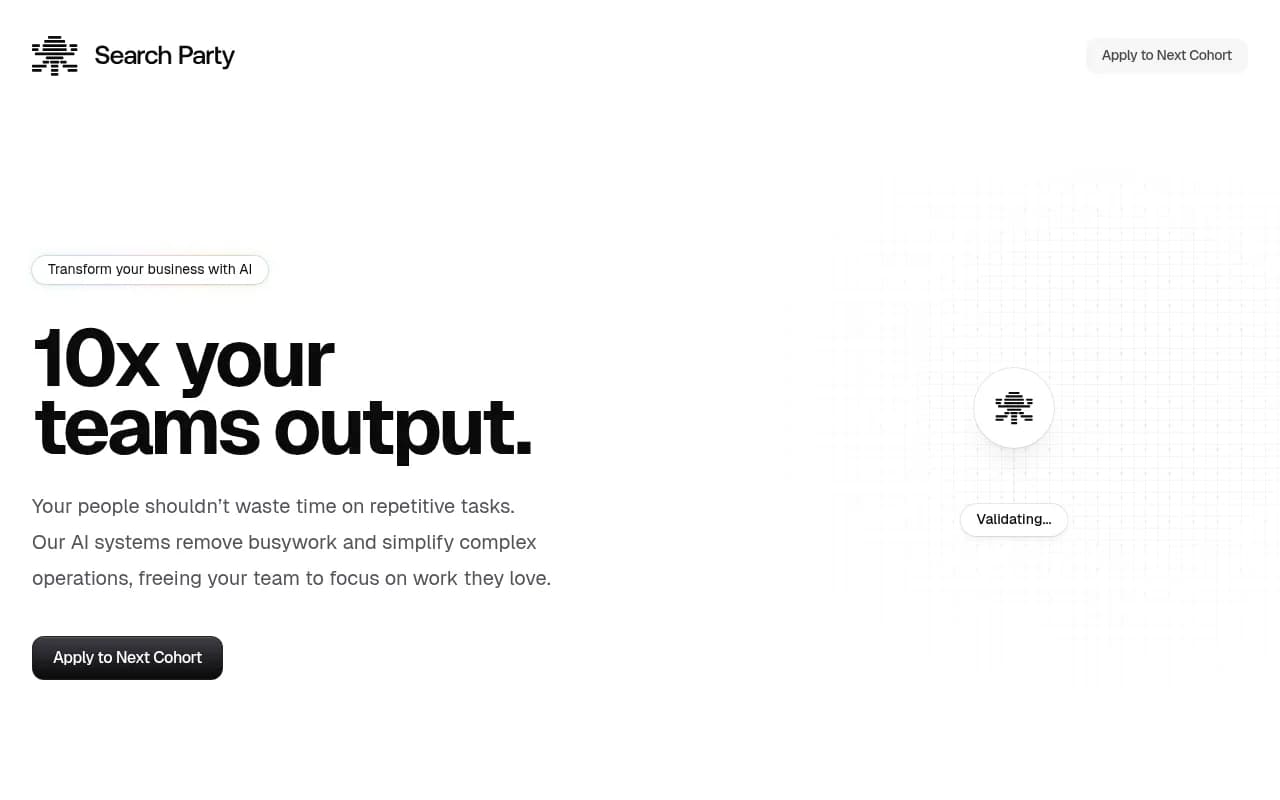
Search Party is a specialized AI consultancy that embeds directly into businesses to build custom automation systems using their proprietary DOE Framework. Through diagnostic analysis, bottleneck mining, and forward-deployed engineering teams, they design and implement AI agents that handle repetitive tasks across sales, marketing, operations, and R&D—decoupling revenue growth from headcount expansion.
Summary / Key Takeaways:
- What it is: Search Party is an AI automation consultancy that builds custom agentic workflows for businesses, not a SaaS product you subscribe to
- Core approach: Diagnostic-driven process that identifies workflow bottlenecks, then deploys embedded engineering teams to build tailored AI systems
- Best for: Mid-market to enterprise companies ($5M-$100M+ revenue) drowning in operational overhead and looking to scale without proportional hiring
- Major limitation: Appears to be shutting down or pivoting as of early 2026—prospective clients should verify current operational status before engaging
- Pricing model: Custom engagement pricing (likely $50K-$500K+ based on scope), not transparent subscription tiers
Search Party positions itself as the antidote to "AI tool fatigue"—the phenomenon where companies accumulate ChatGPT subscriptions, automation platforms, and AI point solutions without seeing meaningful productivity gains. Founded with $3.5M in funding and initially marketed as an "AI Visibility Platform" (similar to tools like Promptwatch that track brand mentions in AI search results), the company appears to have pivoted significantly toward becoming a full-service AI implementation consultancy. As of early 2026, there are indications the company may be shutting down or undergoing another strategic shift, which prospective clients should investigate before committing resources.
The core thesis is compelling: most businesses treat AI like software when it's actually intelligence that requires orchestration. Instead of selling you another dashboard or chatbot builder, Search Party embeds a "squad of elite builders" directly into your organization to diagnose inefficiencies, design custom automation systems, and transfer capabilities to your internal team. Think of it as hiring a specialized SWAT team for AI transformation rather than buying off-the-shelf tools and hoping your team figures it out.
The Search Party Protocol (Their Process)
Search Party runs a structured engagement model they call the "Search Party Protocol," broken into distinct phases:
Validation (90 minutes): A single diagnostic session where they review your current workflows, profit margins, and growth goals. They claim to only move forward if they see a clear path to ROI—specifically, they reference a "3.2x projected ROI" and "94% confidence score" in their marketing materials, though these appear to be illustrative examples rather than guaranteed outcomes. This session is designed to be a mutual filter: if the math doesn't work for a fast payback, they walk away. If it does, they start immediately.
Phase 1 - Bottleneck Mining: This is where Search Party differentiates from generic consulting firms. Instead of high-level strategy decks, they analyze your actual business metrics to identify where headcount is outpacing revenue growth. They then conduct employee surveys and interviews across departments to pinpoint the specific repetitive tasks that are "silently crushing efficiency." The output is a heat map of where your team is wasting time—not opinions, but data-driven identification of workflow friction.
Phase 2 - Solution Mapping: They categorize identified bottlenecks into three AI intervention tiers: (1) Instant knowledge systems for unlocking trapped data in documents and systems, (2) Smart tools for drafting, coding, and material preparation, and (3) Autonomous agents for fully automated or human-in-the-loop workflows. This tiering helps prioritize which problems to solve with which level of AI sophistication.
Phase 3 - The Attack Plan: Instead of leaving you with a strategy presentation, Search Party delivers a prioritized, time-phased roadmap ranked by business impact. They explicitly distinguish between "quick wins" (deployable in weeks) and "system scaling" initiatives that permanently decouple revenue growth from hiring plans. Their example roadmap shows initiatives like "Internal Company Brain," "Sales-to-Delivery Handoff Automation," "Support Ticket Triage," and "Renewal Opportunity Detector" rolled out over 9-12 months.
The DOE Framework (Their Technical Architecture)
Search Party's technical approach is built on what they call the DOE Framework—Directives, Orchestration, Execution. This is their answer to the "90% accuracy is 100% useless" problem that plagues most AI implementations:
Directives (The Rules): Your company's standard operating procedures become the "source of truth" that governs agent behavior. Instead of letting AI models improvise based on their training data, Search Party encodes your business rules, compliance requirements, and quality standards as hard constraints. This ensures agents follow your playbook, not OpenAI's.
Orchestration (The Brain): Large language models are used strictly for reasoning and routing—deciding what action to take next based on context. They're not generating final outputs or making critical decisions autonomously. Think of the LLM as a smart dispatcher, not the worker doing the actual job.
Execution (The Hands): The actual work is handled by deterministic code—traditional software that runs the same way every time. This is what delivers "high-90s% reliability" instead of the 70-80% accuracy you get from pure LLM-based systems. When an AI agent needs to update a CRM record, send an email, or generate a report, it's executing tested code, not prompting GPT-4 and hoping for the best.
This architecture is designed to make AI behave like a reliable employee rather than a creative but unpredictable intern. It's a pragmatic approach that acknowledges the current limitations of generative AI while still leveraging its strengths for reasoning and natural language understanding.
Execution Model: Forward-Deployed Teams
Search Party doesn't just hand you a roadmap and wish you luck. Their model involves embedding engineers directly into your organization to build the systems and transfer knowledge to your team. They organize work across three functional areas:
General & Administrative (G&A): Automating back-office functions across finance, operations, HR, and reporting. Examples include automated invoice processing, employee onboarding workflows, compliance reporting, and cross-system data synchronization. The goal is to keep the business running faster with fewer manual touches.
Sales & Marketing (S&M): Turning go-to-market into a machine by embedding AI into lead qualification, outbound sequences, call preparation, follow-ups, proposal generation, and competitive intelligence. The pitch is closing more deals without scaling headcount proportionally—letting AI handle the repetitive parts of the sales process while humans focus on relationship-building and closing.
Research & Development (R&D): Accelerating product development by building agentic tooling for engineering, product management, and research teams. This could include automated code review, test generation, documentation, technical research synthesis, or design iteration. The goal is freeing your best builders to focus on high-leverage creative work instead of boilerplate tasks.
The "forward-deployed" model means Search Party engineers work alongside your team, using your tools, attending your meetings, and building in your codebase. This is more akin to hiring an elite contractor team than buying a SaaS product. The knowledge transfer component is critical—they're supposed to leave your team capable of maintaining and extending the systems they build, not dependent on Search Party forever.
Who Is Search Party For?
Search Party is explicitly NOT for early-stage startups or small businesses. Their process, pricing model, and value proposition are designed for companies with significant operational complexity and the budget to invest in custom automation:
Primary audience: Mid-market to enterprise companies ($5M-$100M+ annual revenue) that have grown to the point where operational overhead is crushing margins. Think 50-500 employee companies where "we need to hire more people" is the default answer to every growth challenge, but the unit economics are starting to break down.
Specific personas: Operations leaders tired of throwing bodies at problems, CFOs watching G&A expenses balloon faster than revenue, sales leaders with teams drowning in admin work instead of selling, and engineering directors whose developers spend 40% of their time on toil instead of building product.
Industries: Professional services firms (agencies, consultancies, law firms), B2B SaaS companies with complex sales processes, financial services with heavy compliance and reporting requirements, and healthcare organizations with massive administrative overhead. Essentially, any business where knowledge work and process execution dominate the cost structure.
Who should NOT use Search Party: Early-stage startups without product-market fit (you need to figure out what to build before you automate how to build it), companies under $2M revenue (the ROI math probably doesn't work), businesses with simple, already-efficient operations (if it ain't broke, don't automate it), and organizations looking for a quick chatbot or simple automation (Search Party is overkill for basic needs—just use Zapier or n8n).
The budget requirement is significant. While Search Party doesn't publish transparent pricing, a consultancy engagement of this nature—diagnostic process, custom engineering, embedded team, knowledge transfer—likely starts at $50K for a small scope and can easily run $200K-$500K+ for comprehensive transformation programs. This is a capital investment in operational infrastructure, not a $99/month SaaS subscription.
Pricing & Engagement Model
Search Party does not operate on a transparent, published pricing model. There are no monthly subscription tiers, no per-seat pricing, no self-service signup. This is a consultative sales process where pricing is determined based on scope, complexity, and projected ROI.
Based on the positioning and comparable AI consultancy engagements in the market, expect:
- Initial diagnostic/validation: Possibly free or low-cost ($5K-$10K) as a mutual qualification step
- Pilot/Phase 1 implementation: $50K-$150K for a focused, single-department automation project (e.g., automating sales handoffs or support triage)
- Full transformation program: $200K-$500K+ for multi-department, multi-quarter engagements with embedded engineering teams
- Ongoing support/retainer: Likely available for maintenance, iteration, and expansion after initial build
The value proposition is ROI-based: if they can save you $500K/year in operational costs or enable $2M in additional revenue without new hires, a $300K engagement pays for itself in 6-12 months. But this only works if you have the scale and complexity where those savings are actually achievable.
There is no free trial, no freemium tier, no "try before you buy." You're committing to a consultative engagement, not testing a product.
Competitive Landscape
Search Party competes in a crowded and confusing space that spans AI consultancies, automation platforms, and AI visibility tools (their original positioning):
vs. AI Consultancies (Accenture, Deloitte AI, smaller boutiques): Search Party is smaller and more specialized, which can be an advantage (faster, more focused) or disadvantage (less resources, narrower expertise). The DOE Framework and forward-deployed model are differentiators, but large consultancies have deeper benches and broader service offerings.
vs. Automation Platforms (Zapier, n8n, Make, UiPath): These are self-service tools that require your team to build and maintain automations. Search Party builds it for you. The trade-off: platforms are cheaper and give you control; Search Party is expensive but delivers custom, high-reliability systems without requiring internal AI expertise.
vs. AI Visibility/GEO Tools (Promptwatch, Otterly.AI, Profound): Search Party originally positioned as an AI visibility platform (tracking brand mentions in ChatGPT, Perplexity, etc.) but appears to have pivoted away from this. If you're looking for AI search monitoring and optimization, tools like Promptwatch are purpose-built for that use case and offer transparent SaaS pricing. Search Party is now focused on internal operational automation, not external AI presence.
vs. AI Agent Frameworks (LangChain, AutoGPT, CrewAI): These are developer tools for building AI agents. Search Party uses these under the hood but packages them into a done-for-you service. If you have strong engineering talent, you might build internally with these frameworks. If you don't, Search Party does it for you.
The real competition is often "do nothing" or "hire more people." Search Party's job is to prove that custom AI automation delivers better ROI than adding headcount.
Strengths
Diagnostic-driven approach: The bottleneck mining process is more rigorous than typical consulting engagements. Starting with data (where headcount outpaces revenue) and validating with employee interviews ensures you're solving real problems, not imagined ones.
DOE Framework for reliability: The architectural discipline of separating reasoning (LLMs) from execution (deterministic code) addresses the biggest complaint about AI systems—they're unreliable. High-90s% accuracy is actually usable in production.
Forward-deployed model: Embedding engineers into your team accelerates implementation and ensures knowledge transfer. You're not waiting for a vendor to prioritize your feature requests—you have dedicated resources building exactly what you need.
ROI-focused validation: The 90-minute validation session is a smart filter. If they can't see a clear path to ROI, they don't take the engagement. This aligns incentives and reduces the risk of paying for a strategy deck that never gets implemented.
Limitations & Concerns
Appears to be shutting down: Multiple sources indicate Search Party is "pivoting to something else" as of early 2026. The website is still live, but prospective clients should verify the company is still operational before engaging. This is a critical red flag—you don't want to invest in a custom system built by a vendor that disappears six months later.
High cost, long timeline: This is not a quick fix. Expect 6-12 month engagements and six-figure budgets. If you need results in 30 days or have a limited budget, this isn't the right solution.
Requires organizational buy-in: Forward-deployed teams need access to your systems, data, and people. If your organization is resistant to external consultants or protective of internal processes, the engagement will struggle.
Not a product, it's a service: You're not buying software you can cancel next month. You're committing to a multi-month engagement with custom deliverables. If priorities shift or leadership changes, you're stuck with half-built systems.
Limited transparency: No published pricing, no case studies with specific results, no customer testimonials on the website. The $3.5M funding and "AI Visibility Platform" origin story suggest the company has been through at least one major pivot, which raises questions about strategic focus.
Vendor lock-in risk: If Search Party builds your core operational systems and then shuts down (as appears to be happening), you're left maintaining custom code without the original builders. The knowledge transfer component is supposed to mitigate this, but it's still a risk.
Bottom Line
Search Party is designed for mid-market to enterprise companies that have reached the point where operational complexity is crushing margins and "hire more people" is no longer a viable growth strategy. If you're a $20M-$100M revenue company with 100-500 employees, drowning in manual processes, and willing to invest $200K-$500K in custom AI automation, Search Party's diagnostic-driven, forward-deployed model could deliver meaningful ROI.
However, the apparent shutdown or pivot in early 2026 is a major red flag. Before engaging, prospective clients should verify the company is still operational, understand what support and maintenance will look like long-term, and have a plan for maintaining custom systems if the vendor disappears.
For companies looking for AI visibility and brand monitoring in AI search engines (Search Party's original positioning), purpose-built platforms like Promptwatch offer transparent SaaS pricing and ongoing product development without the consultancy engagement model.
Best use case in one sentence: Mid-market companies ($10M-$100M revenue) with complex operations and the budget for a six-figure custom AI automation engagement—but only if you can confirm Search Party is still operational and committed to long-term support.
Tags:
Similar and alternative tools to Search Party