Summary
- AI search traffic already accounts for 1.08% of all website traffic, with IT companies seeing 2.80% -- and it's projected to reach 28% by 2027
- Most AI visibility platforms are monitoring-only dashboards that show you data but don't help you fix visibility gaps
- B2B tech companies need platforms that track citations, identify content gaps, and help create content that AI models actually cite
- The right platform depends on your use case: daily tracking for SaaS, multi-brand monitoring for agencies, or full optimization workflows for enterprise
- Early movers are securing citations before competitors, with AI search traffic converting at 4.4x the rate of traditional organic search
Why B2B tech companies need AI visibility platforms now
Your prospects are asking ChatGPT, Perplexity, and Claude for software recommendations. If your brand isn't showing up in those responses, you're invisible to a growing segment of buyers who never make it to Google.
AI search is becoming mainstream. According to Wall Street Journal reporting, the global SEO services market will grow from $81.46 billion in 2024 to $171.77 billion by 2030, with AI search optimization driving much of this 13.24% CAGR growth. For B2B tech companies specifically, this shift is happening faster than most other industries.
The problem is that most AI visibility platforms are built for monitoring, not optimization. They run prompts, count mentions, hand you a dashboard, and leave you stuck. You see that competitors are getting cited but you have no idea what content you're missing or how to fix it.
What makes B2B tech different from other industries
B2B software buyers don't impulse-purchase. They research for weeks or months. They compare features. They ask detailed technical questions. They want to understand implementation, integrations, pricing models, and support.
This means the prompts that matter for B2B tech are different:
- "Best project management software for remote teams with Jira integration"
- "How does [Your Product] compare to [Competitor] for enterprise security"
- "What CRM works best for B2B SaaS companies under 50 employees"
- "Implementation timeline for switching from [Competitor] to [Your Product]"
These aren't simple brand mention checks. They're complex buying questions where AI models synthesize information from documentation, comparison pages, case studies, and Reddit discussions. If your content doesn't answer these specific questions in the format AI models expect, you won't get cited.
The features that actually matter for B2B tech companies
Citation tracking across multiple AI engines
You need to track more than just ChatGPT. B2B buyers use ChatGPT, Perplexity, Google AI Overviews, Gemini, and Claude interchangeably during research. A platform that only monitors one or two engines gives you an incomplete picture.
Look for platforms that track at least:
- ChatGPT (OpenAI)
- Perplexity
- Google AI Overviews
- Claude (Anthropic)
- Gemini (Google)
Some platforms also monitor Grok, DeepSeek, Mistral, Meta AI, and Microsoft Copilot. More coverage is better, but the first five are non-negotiable for B2B tech.
Content gap analysis
This is where most platforms fail. Monitoring tells you where you're invisible. Gap analysis tells you why and what to do about it.
The best platforms show you:
- Which prompts competitors are visible for but you're not
- What specific content angles or topics your website is missing
- Which questions AI models want answers to but can't find on your site
- Where to publish (your blog, documentation, comparison pages, Reddit, YouTube)
Promptwatch is the only platform that combines monitoring with Answer Gap Analysis -- it shows you the exact content your website needs to get cited by AI models.

Prompt intelligence and difficulty scoring
Not all prompts are worth chasing. Some have high volume but brutal competition. Others have low volume but convert at 10x the rate.
You need platforms that provide:
- Volume estimates for each prompt
- Difficulty scores (how hard it is to get cited)
- Query fan-outs (how one prompt branches into sub-queries)
- Conversion intent signals (informational vs. comparison vs. ready-to-buy)
This helps you prioritize high-value, winnable prompts instead of guessing.
AI crawler logs
AI models discover your content by crawling your website. If they can't crawl it, they can't cite it.
Real-time crawler logs show you:
- Which pages ChatGPT, Claude, Perplexity, and other AI crawlers are reading
- Errors they encounter (404s, timeouts, blocked resources)
- How often they return to check for updates
- Which pages they're ignoring entirely
This is a technical SEO issue that most platforms ignore. If AI crawlers can't read your documentation or comparison pages, no amount of content optimization will help.
Page-level tracking
Brand-level visibility scores are interesting but not actionable. You need to know which specific pages are getting cited, how often, and by which models.
Page-level tracking shows:
- Exact URLs cited in AI responses
- Citation frequency per page
- Which AI models cite each page
- Changes over time (are citations increasing or dropping?)
This tells you what's working so you can double down on it.
Traffic attribution
Visibility is useless if you can't tie it to actual traffic and revenue. The best platforms connect AI visibility to real business outcomes.
Look for:
- Code snippet or Google Search Console integration to track AI referral traffic
- Server log analysis to see which AI crawlers are hitting your site
- Conversion tracking to understand which AI citations drive signups or demos
This closes the loop between visibility and revenue.
Comparison of leading AI visibility platforms for B2B tech
| Platform | AI engines tracked | Content gap analysis | Crawler logs | Traffic attribution | Best for |
|---|---|---|---|---|---|
| Promptwatch | 10 | Yes | Yes | Yes | B2B SaaS needing optimization, not just monitoring |
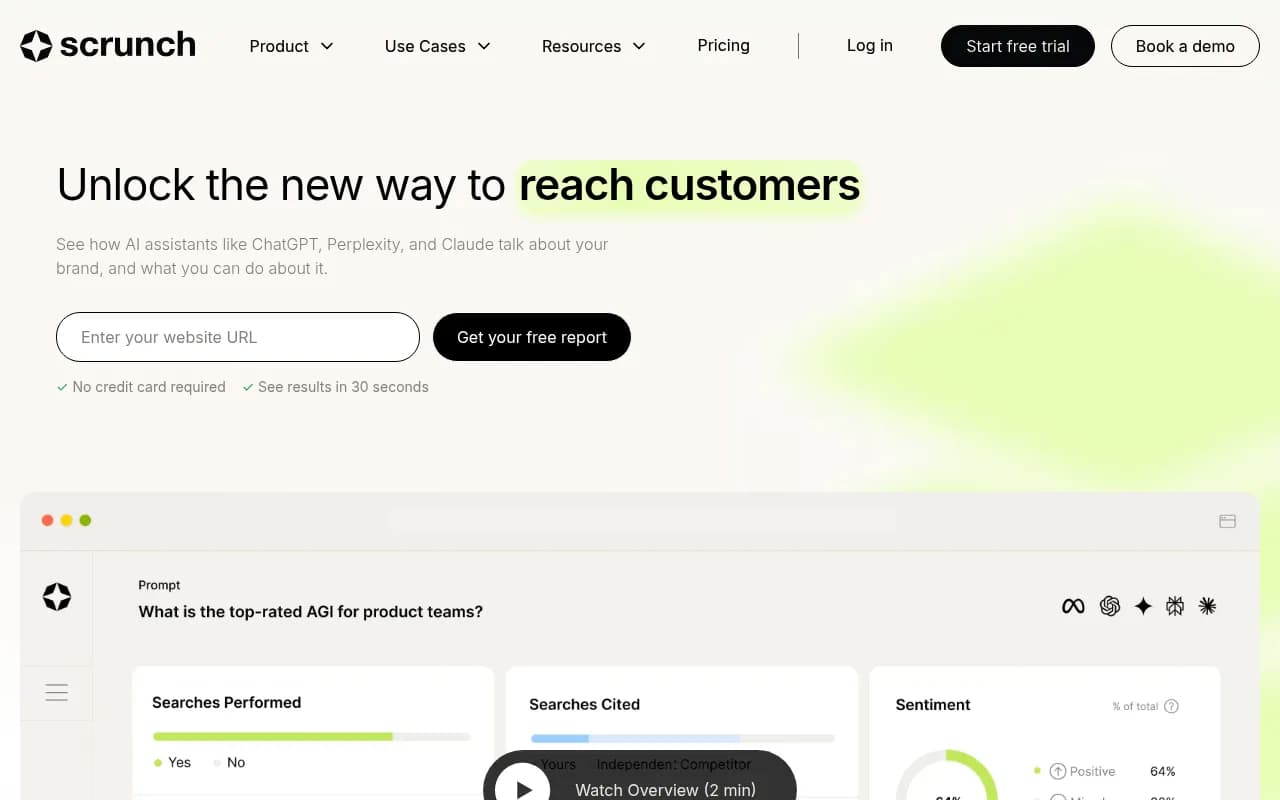
| Scrunch AI | 9+ | Limited | No | No | Agencies managing multiple clients |
| Profound | 9+ | No | No | Limited | Enterprise teams with big budgets |
| Otterly.AI | 3 | No | No | No | Budget-conscious startups wanting basic tracking |
| Semrush AI Toolkit | 3 | No | No | No | Teams already using Semrush for traditional SEO |
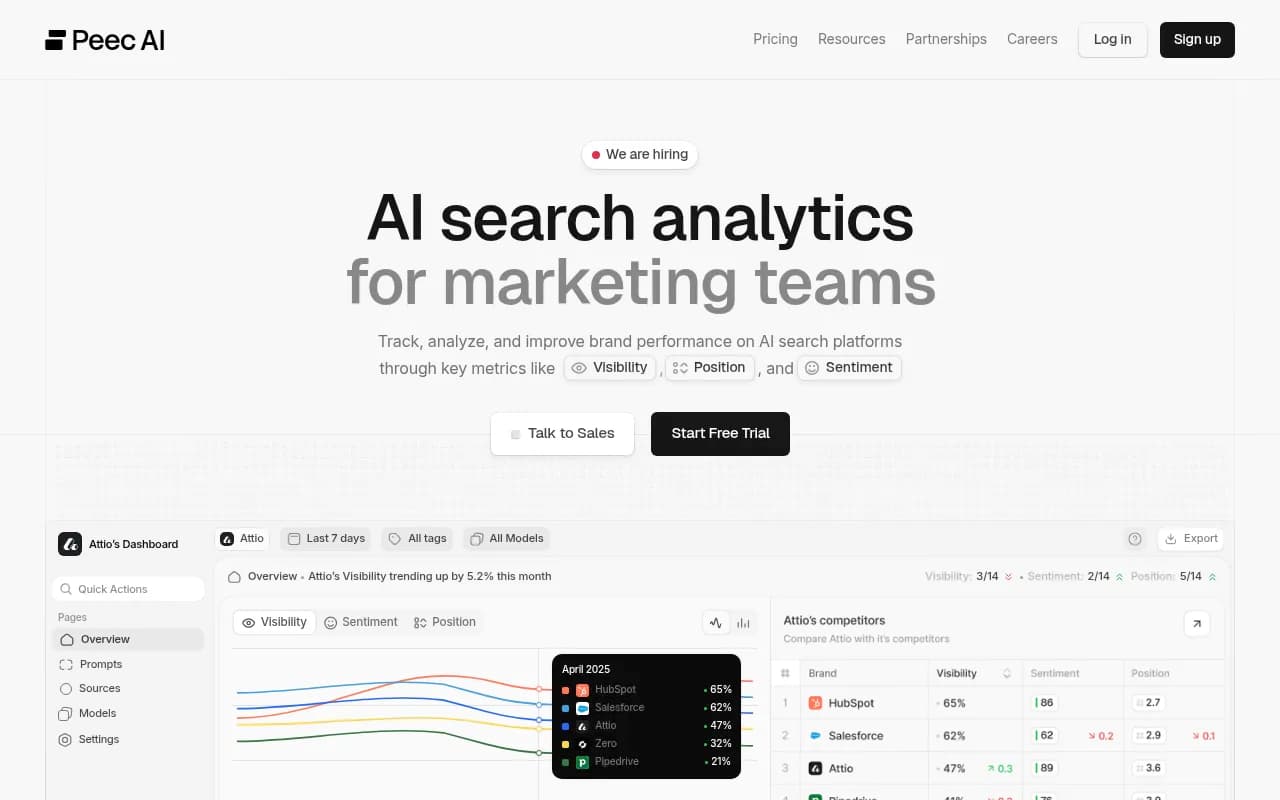
| Peec AI | 3 | No | No | No | Clean dashboards and competitor tracking |
Profound

Otterly.AI

How to choose the right platform for your B2B tech company
If you're a SaaS company under $5M ARR
You need daily tracking, attribution, and strategic intelligence without costly bells and whistles. Look for platforms that:
- Track 5+ AI engines (ChatGPT, Perplexity, Google AI Overviews, Claude, Gemini)
- Provide content gap analysis so you know what to create
- Include crawler logs to fix technical issues
- Offer traffic attribution to connect visibility to revenue
- Cost under $300/month
Promptwatch fits this profile. It's built around the action loop: find gaps, create content that ranks in AI, track results.
If you're an agency managing multiple B2B tech clients
You need multi-brand monitoring, white-label reporting, and prompt-level insights. Look for:
- Support for 5+ client sites
- Competitor heatmaps showing who's winning for each prompt
- Custom reporting and API access
- Multi-language and multi-region tracking
- Agency pricing tiers
Scrunch AI and Profound are built for agencies. Scrunch offers strong citation monitoring with prompt-level insights. Profound is enterprise-grade with sophisticated tracking across multiple brands and regions.
If you're an enterprise software company
You need comprehensive tracking, advanced analytics, and integration with existing marketing stacks. Look for:
- 10+ AI engines tracked
- Multi-brand and multi-region support
- API access for custom workflows
- Integration with Looker Studio, Google Analytics, or your data warehouse
- Dedicated support and onboarding
Promptwatch and Profound both serve enterprise customers. Promptwatch offers the most complete feature set (crawler logs, gap analysis, content generation, attribution) while Profound focuses on sophisticated monitoring at scale.
The monitoring vs. optimization divide
Most platforms stop at monitoring. They show you where you're invisible but don't help you fix it. This is the core difference between tools built for reporting and tools built for growth.
Monitoring-only platforms (Otterly.AI, Peec.ai, AthenaHQ, Search Party) are useful if you just want to track brand mentions. But if your goal is to actually improve visibility and drive traffic, you need optimization capabilities:
- Answer Gap Analysis: Shows exactly which prompts competitors are visible for but you're not, and what content you're missing
- AI Content Generation: Creates articles, listicles, and comparisons grounded in real citation data (880M+ citations analyzed), prompt volumes, and competitor analysis
- Crawler Monitoring: Real-time logs of AI crawlers hitting your website so you can fix indexing issues
- Traffic Attribution: Connect visibility to actual revenue with code snippet, GSC integration, or server log analysis
Promptwatch is the only platform that combines all four. It's built around taking action, not just watching dashboards.
Reddit and YouTube: the hidden citation sources
AI models don't just cite your website. They cite Reddit discussions, YouTube videos, and third-party reviews. If you're not tracking these sources, you're missing a huge part of the picture.
B2B software buyers ask questions on Reddit like:
- "Has anyone used [Your Product] for [specific use case]?"
- "[Your Product] vs [Competitor] -- which one should I choose?"
- "Is [Your Product] worth the price for a team of 10?"
AI models surface these discussions in responses. If your brand is mentioned positively on Reddit, you get cited. If competitors dominate those threads, they win.
The same applies to YouTube. Tutorial videos, comparison reviews, and demo walkthroughs all influence AI recommendations.
Look for platforms that track:
- Reddit threads mentioning your brand or competitors
- YouTube videos that AI models cite in responses
- Which discussions are driving the most citations
- Sentiment analysis (positive, negative, neutral mentions)
Promptwatch includes Reddit and YouTube insights. Most competitors ignore these channels entirely.
ChatGPT Shopping and product recommendations
ChatGPT now has a shopping mode that recommends products directly in responses. If you sell B2B software, this is a new channel for discovery.
When users ask "What's the best CRM for small businesses?" or "Show me project management tools under $50/month", ChatGPT can surface product recommendations with pricing, features, and direct links.
You need to track:
- When your product appears in ChatGPT Shopping results
- What prompts trigger product recommendations
- How you compare to competitors in those carousels
- Which features or pricing points ChatGPT highlights
Promptwatch tracks ChatGPT Shopping. This is a new feature (launched late 2025) that most platforms haven't caught up to yet.
Multi-language and multi-region tracking
If you sell to international markets, you need to track AI responses in multiple languages and regions. A prompt in English might return different results than the same prompt in German, Spanish, or Japanese.
Look for platforms that support:
- Custom language settings for each prompt
- Region-specific tracking (US, UK, EU, APAC, etc.)
- Persona customization (how different buyer types prompt)
- Localized competitor tracking
This matters for B2B tech companies with global sales teams. Your visibility in the US might be strong while you're invisible in Europe.
Pricing considerations for B2B tech companies
AI visibility platforms range from $99/month to $2,000+/month depending on features and scale.
Budget tier ($99-$249/month):
- 1-2 sites tracked
- 50-150 prompts monitored
- Basic monitoring without optimization features
- Good for: Startups validating AI search as a channel
Professional tier ($249-$579/month):
- 2-5 sites tracked
- 150-350 prompts monitored
- Crawler logs, state/city tracking, content gap analysis
- Good for: Growing SaaS companies optimizing for AI search
Enterprise tier ($1,000+/month):
- 10+ sites tracked
- 500+ prompts monitored
- API access, custom reporting, dedicated support
- Good for: Large software companies or agencies managing multiple clients
Promptwatch offers all three tiers with transparent pricing. Most competitors require custom quotes for anything beyond basic monitoring.
Common mistakes B2B tech companies make
Mistake 1: Only tracking brand name prompts
Tracking "[Your Product Name]" is useful but incomplete. Most buyers don't know your brand yet. They're asking "best CRM for small businesses" or "project management software with Slack integration".
You need to track:
- Category prompts ("best [product category] for [use case]")
- Comparison prompts ("[Competitor A] vs [Competitor B]")
- Feature-specific prompts ("CRM with native Salesforce integration")
- Use case prompts ("software for managing remote engineering teams")
Mistake 2: Ignoring technical SEO for AI crawlers
AI models can't cite content they can't crawl. If your documentation is behind a login wall, your comparison pages have JavaScript rendering issues, or your site blocks AI crawlers, you're invisible.
Check your robots.txt and server logs. Make sure ChatGPT, Claude, and Perplexity crawlers can access your key pages.
Mistake 3: Treating AI visibility as a vanity metric
Visibility scores are interesting but not actionable unless you tie them to traffic and revenue. Use traffic attribution to understand which AI citations drive signups, demos, or closed deals.
This turns AI visibility from a reporting exercise into a growth channel.
Mistake 4: Waiting for perfect data before taking action
You don't need six months of baseline data to start optimizing. If you see competitors getting cited for prompts you care about, create the content they're missing. Test and iterate.
Early movers are securing citations before competitors. Waiting means losing ground.
What to do after choosing a platform
- Set up tracking for your top 50-100 prompts: Start with category prompts, comparison prompts, and use case prompts that matter for your business
- Run a content gap analysis: Identify which prompts competitors are visible for but you're not, and what content you're missing
- Fix technical issues: Check crawler logs for errors, blocked resources, or pages AI models can't access
- Create content that AI models cite: Write articles, comparison pages, and documentation that answer the specific questions AI models want answers to
- Track results: Monitor citation frequency, traffic attribution, and conversion rates to understand what's working
This is the action loop that separates optimization platforms from monitoring dashboards. Find gaps, create content, track results, repeat.
The future of AI search for B2B tech companies
AI search is projected to reach 28% of total global search traffic by 2027. For B2B tech companies, this shift is happening faster. IT companies are already seeing 2.80% of their traffic from AI sources -- nearly 3x the cross-industry average.
The companies that optimize for AI visibility now will have a structural advantage. They'll own the citations, the traffic, and the buyer relationships before competitors wake up to the shift.
The right AI visibility platform is the one that helps you take action, not just watch dashboards. Look for content gap analysis, crawler monitoring, traffic attribution, and optimization features -- not just brand mention tracking.
For most B2B tech companies, that means choosing a platform built around the action loop: find gaps, create content that ranks in AI, track results. Promptwatch is the only platform rated as a "Leader" across all categories in a 2026 comparison of 12 GEO platforms. It's built for optimization, not just monitoring.