Summary
- AI visibility platforms track how your brand appears in ChatGPT, Perplexity, Google AI Overviews, and other AI search engines—showing mentions, positioning, and citations instead of traditional rankings
- In-house teams need tools that are easy to implement, provide actionable insights, and fit realistic budgets ($200–$2,000/month)—not enterprise dashboards that require data science teams
- The best platform depends on your existing stack: if you already use Semrush or Ahrefs, their AI toolkits integrate seamlessly; if you need standalone tracking with content optimization, Promptwatch offers the most complete action loop
- Most teams should start with one core tool plus Google Search Console as a free baseline, then layer specialized tools based on budget and strategy
Marketing teams at mid-market companies are dealing with something new: their brand shows up in ChatGPT answers, Google AI Overviews, and Perplexity results—but they have no idea what these AI systems are actually saying about them, how they stack up against competitors, or if their content is even working.
Here's the thing: tracking AI visibility doesn't need enterprise budgets or a data science team. This guide breaks down AI visibility platforms built for in-house marketing teams that want clear answers, not overwhelming dashboards. We're focusing on what matters: easy setup, actionable insights, team collaboration, and pricing that won't make your CFO cry.
What in-house marketing teams actually need from AI visibility tools
When evaluating AI visibility platforms, in-house marketing teams should focus on how clearly a platform shows where, when, and why their brand appears in AI-generated answers. The goal isn't raw data, but insights that can be quickly turned into content, SEO, and brand actions.
For in-house teams, the right AI visibility platform should:
- Be easy to implement without requiring engineering or data teams
- Show clear visibility and ROI signals suitable for leadership reporting
- Help teams understand brand positioning, comparisons, and recommendations in AI responses
- Support collaboration across content, SEO, and brand teams
- Integrate with existing workflows and tools like Semrush, Ahrefs, or Slack
- Provide actionable insights, not complex dashboards that slow execution
- Fit realistic marketing budgets in the $200–$2,000/month range
Choosing a platform that prioritizes clarity, speed, and execution ensures AI visibility becomes a practical growth channel, not just another metric to monitor.
The action loop: monitoring vs optimization platforms
Most AI visibility platforms fall into one of two categories: monitoring-only dashboards or optimization platforms. The difference matters.
Monitoring-only platforms show you data—which prompts your brand appears in, how often you're cited, where competitors rank. They answer "what's happening?" but leave you stuck when it comes to "what do I do about it?"
Optimization platforms close the loop. They show you what's missing, then help you fix it. This is the action loop that separates tools built for execution from tools built for reporting.
Promptwatch is the only platform rated as a "Leader" across all categories in a 2026 comparison of 12 GEO platforms. The core difference: it's built around the action loop.

Here's how the action loop works:
-
Find the gaps: Answer Gap Analysis shows exactly which prompts competitors are visible for but you're not. You see the specific content your website is missing—the topics, angles, and questions AI models want answers to but can't find on your site.
-
Create content that ranks in AI: The built-in AI writing agent generates articles, listicles, and comparisons grounded in real citation data (880M+ citations analyzed), prompt volumes, persona targeting, and competitor analysis. This isn't generic SEO filler—it's content engineered to get cited by ChatGPT, Claude, Perplexity, and other AI models.
-
Track the results: See your visibility scores improve as AI models start citing your new content. Page-level tracking shows exactly which pages are being cited, how often, and by which models. Close the loop with traffic attribution (code snippet, GSC integration, or server log analysis) to connect visibility to actual revenue.
This cycle—find gaps, generate content, track results—is what makes Promptwatch an optimization platform, not just another tracker. Most competitors stop at step one.
Comparing AI visibility platforms for in-house teams
| Platform | Key features | Best for | Approx. cost/month | AI engines covered |
|---|---|---|---|---|
| Promptwatch | Answer Gap Analysis, AI content generation, crawler logs, Reddit/YouTube tracking, ChatGPT Shopping, prompt volumes | Teams that want to optimize, not just monitor | $99–$579 | ChatGPT, Perplexity, Google AI Overviews, Claude, Gemini, Meta AI, DeepSeek, Grok, Mistral, Copilot |
| Semrush AI Toolkit | AI visibility dashboards, question discovery, competitor monitoring, SEO + AI insights | SEO-led teams already using Semrush | $199–$549 | Google AI Overviews, ChatGPT, Gemini (Pro+ tier) |
| Ahrefs Brand Radar | Basic AI search tracking, backlink analysis, keyword research | Teams with existing Ahrefs subscription | Included in Ahrefs plans | ChatGPT, Perplexity |
| Otterly.AI | AI search monitoring, brand mention tracking | Budget-conscious teams needing basic tracking | $99–$299 | ChatGPT, Perplexity, Google AI Overviews |
| Profound | Enterprise tracking, 9+ AI engines, brand positioning | Larger teams with bigger budgets | $500+ | ChatGPT, Perplexity, Claude, Gemini, Meta AI, and more |
| Scrunch AI | Multi-engine tracking, competitor analysis | Mid-market teams | $300–$600 | ChatGPT, Perplexity, Claude, Gemini |
Platform-by-platform breakdown
Promptwatch: The optimization platform
If you want to do more than just track, Promptwatch is the platform to start with. It's the only tool that combines monitoring, content gap analysis, AI content generation, and traffic attribution in one place.
What makes it different:
- Answer Gap Analysis shows exactly which prompts competitors rank for but you don't—then helps you create the missing content
- AI Crawler Logs reveal which pages ChatGPT, Claude, and Perplexity are reading, how often they return, and errors they encounter
- Built-in AI writing agent generates content grounded in 880M+ citations analyzed, not generic templates
- Reddit & YouTube Insights surface discussions that directly influence AI recommendations
- ChatGPT Shopping Tracking monitors when your brand appears in product recommendations
- Prompt Intelligence provides volume estimates and difficulty scores for each prompt
Pricing: Essential $99/mo (1 site, 50 prompts, 5 articles), Professional $249/mo (2 sites, 150 prompts, 15 articles, crawler logs), Business $579/mo (5 sites, 350 prompts, 30 articles). Free trial available.
Best for: In-house teams that want to optimize their AI visibility, not just monitor it.
Semrush AI Toolkit: For existing Semrush users
If your team already uses Semrush for SEO, the AI Toolkit is a natural extension. It adds AI visibility dashboards, question discovery, and competitor monitoring to your existing workflow.
What it does well:
- Integrates with Semrush's existing keyword research and content tools
- Question discovery helps identify topics AI models care about
- Competitor AI monitoring shows how rivals appear in AI responses
What it lacks:
- No AI content generation or optimization tools
- Limited to fixed prompts—you can't test custom queries
- No crawler logs or traffic attribution
Pricing: Starts at $199/mo (Starter), $299/mo (Pro+), $549/mo (Advanced).
Best for: SEO-led marketing teams already using Semrush who want to add AI visibility tracking to their existing stack.
Ahrefs Brand Radar: Basic tracking for Ahrefs users
Ahrefs added Brand Radar as a basic AI search tracking feature for existing customers. It monitors ChatGPT and Perplexity mentions but doesn't offer optimization tools.
What it does well:
- Included with existing Ahrefs subscription
- Simple interface for tracking brand mentions
- Integrates with Ahrefs' backlink and keyword data
What it lacks:
- Fixed prompts only—no custom query testing
- No content gap analysis or optimization features
- No traffic attribution or crawler logs
- Limited to two AI engines
Pricing: Included in Ahrefs plans ($129–$1,290/mo).
Best for: Teams with existing Ahrefs subscriptions who want basic AI visibility tracking without adding another tool.
Otterly.AI: Budget-friendly monitoring
Otterly.AI

Otterly.AI offers straightforward AI search monitoring at a lower price point than most competitors. It tracks brand mentions across ChatGPT, Perplexity, and Google AI Overviews.
What it does well:
- Affordable entry point for AI visibility tracking
- Clean, simple interface
- Covers three major AI engines
What it lacks:
- No content optimization or generation tools
- No crawler logs or traffic attribution
- Limited competitor analysis
- No Reddit or YouTube tracking
Pricing: $99–$299/mo.
Best for: Budget-conscious teams that need basic tracking and are willing to handle optimization separately.
Profound: Enterprise-grade tracking
Profound

Profound is an enterprise AI visibility platform tracking brand mentions across 9+ AI search engines. It's built for larger teams with bigger budgets.
What it does well:
- Tracks more AI engines than most competitors
- Strong brand positioning analysis
- Enterprise-grade reporting and collaboration features
What it lacks:
- No built-in content generation or optimization tools
- Higher price point
- Monitoring-focused, not optimization-focused
Pricing: $500+/mo (custom pricing).
Best for: Larger in-house teams with enterprise budgets that need comprehensive tracking across many AI engines.
Scrunch AI: Mid-market tracking
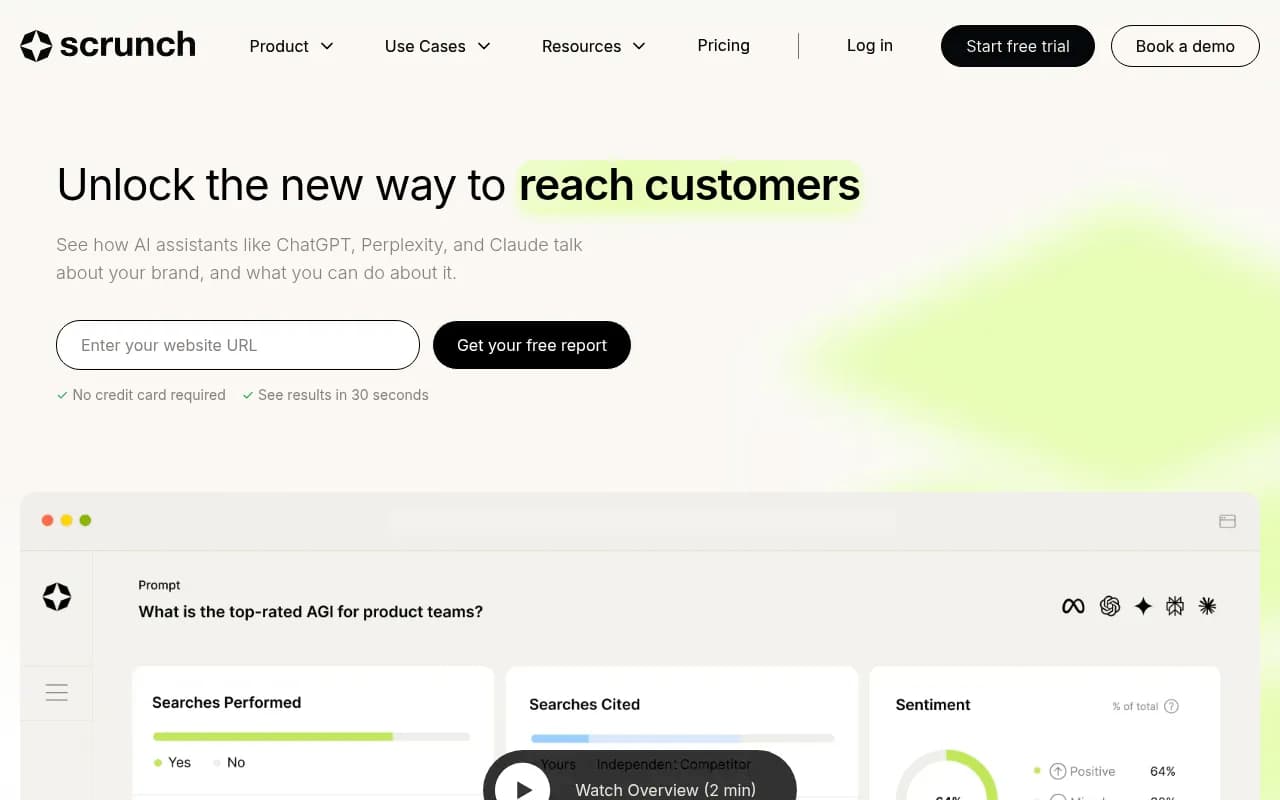
Scrunch AI offers multi-engine tracking and competitor analysis aimed at mid-market teams.
What it does well:
- Tracks ChatGPT, Perplexity, Claude, and Gemini
- Competitor analysis features
- Mid-range pricing
What it lacks:
- No content generation or optimization tools
- No crawler logs or traffic attribution
- Limited to monitoring
Pricing: $300–$600/mo.
Best for: Mid-market teams that need multi-engine tracking but don't need optimization features.
Features that matter for in-house teams
Content gap analysis
The most valuable feature for in-house teams is content gap analysis—showing exactly which prompts competitors rank for but you don't. This turns monitoring into action.
Promptwatch's Answer Gap Analysis is the most complete implementation. It shows:
- Which prompts competitors are visible for
- What content your website is missing
- Specific topics, angles, and questions AI models want answers to
- Prompt volumes and difficulty scores to prioritize
Most competitors (Otterly.AI, Peec.ai, AthenaHQ, Search Party) don't offer this feature at all.
AI crawler logs
AI crawler logs show real-time activity from ChatGPT, Claude, Perplexity, and other AI engines hitting your website. You see:
- Which pages they read
- How often they return
- Errors they encounter
- Indexing issues to fix
Promptwatch is one of the few platforms that includes crawler logs. This is critical for understanding how AI engines discover your content and fixing indexing issues.
Built-in content generation
The best optimization platforms include AI content generation grounded in citation data, not generic templates. Promptwatch's AI writing agent generates articles, listicles, and comparisons based on:
- 880M+ citations analyzed
- Prompt volumes and difficulty scores
- Competitor analysis
- Persona targeting
This is content engineered to get cited by AI models, not just rank in Google.
Traffic attribution
Tracking visibility is one thing. Connecting it to actual traffic and revenue is another. Look for platforms that offer:
- Code snippet integration
- Google Search Console integration
- Server log analysis
Promptwatch offers all three. Most competitors stop at visibility scores.
Reddit and YouTube tracking
AI models cite Reddit threads and YouTube videos heavily. Platforms that surface these discussions give you insight into what's influencing AI recommendations.
Promptwatch includes Reddit & YouTube Insights. Most competitors ignore this channel entirely.
ChatGPT Shopping tracking
For e-commerce brands, tracking when your products appear in ChatGPT's shopping recommendations is critical. Promptwatch monitors ChatGPT Shopping. Most competitors don't.
How to choose the right platform for your team
If you already use Semrush or Ahrefs
Start with their AI toolkits. They integrate with your existing workflow and don't require learning a new platform. Just know you're getting monitoring, not optimization.
If you want to optimize, not just monitor
Choose Promptwatch. It's the only platform that combines monitoring, content gap analysis, AI content generation, and traffic attribution in one place.
If budget is tight
Start with Otterly.AI for basic tracking, then layer Promptwatch when you're ready to optimize.
If you're an enterprise team
Consider Profound for comprehensive tracking across 9+ AI engines, but plan to handle optimization separately.
Implementation tips for in-house teams
Start with one core tool
Don't try to use five platforms at once. Pick one core tool that fits your needs and budget, then add specialized tools later if needed.
Use Google Search Console as a free baseline
Google Search Console now shows AI Overviews impressions and clicks. Use this as a free baseline to validate what your paid tool is showing.
Set up weekly reporting
AI visibility changes fast. Set up weekly reports that show:
- Visibility score trends
- New prompts you're appearing in
- Competitor movements
- Content gaps to address
Connect visibility to traffic
Use traffic attribution features (code snippet, GSC integration, or server log analysis) to connect visibility improvements to actual traffic and revenue. This is critical for proving ROI to leadership.
Monitor crawler logs
If your platform offers crawler logs, check them weekly. You'll catch indexing issues, see which pages AI models are reading, and understand how they discover your content.
Act on content gaps
The point of tracking AI visibility is to improve it. Use content gap analysis to prioritize which prompts to target, then create content engineered to get cited.
The future of AI visibility for in-house teams
AI visibility platforms are evolving fast. Here's what's coming:
More AI engines: Platforms will add support for more AI models as they launch. Expect coverage of Grok, DeepSeek, and others to become standard.
Better attribution: Connecting AI visibility to traffic and revenue will become table stakes. Platforms that don't offer attribution will fall behind.
Automated optimization: The next generation of platforms will automatically optimize content for AI visibility, not just show you what's wrong.
Persona targeting: Platforms will let you test how different personas (job titles, industries, use cases) affect AI responses. Promptwatch already offers this.
Multi-language support: As AI search goes global, platforms will add support for more languages and regions.
The gap between monitoring-only dashboards and optimization platforms will widen. Teams that choose optimization platforms now will have a significant advantage.
Final recommendations
For most in-house teams: Start with Promptwatch. It's the only platform that combines monitoring, content gap analysis, AI content generation, and traffic attribution. The Essential plan ($99/mo) is affordable enough to test, and the action loop means you'll see results fast.
For teams already using Semrush: Add the AI Toolkit to your existing subscription. You'll get basic tracking integrated with your SEO workflow. Just know you're getting monitoring, not optimization.
For teams already using Ahrefs: Use Brand Radar for basic tracking, but plan to add Promptwatch when you're ready to optimize.
For enterprise teams with big budgets: Consider Profound for comprehensive tracking across 9+ AI engines, but layer Promptwatch for optimization features.
The key insight: AI visibility isn't just about tracking. It's about finding gaps, creating content that ranks in AI, and connecting visibility to revenue. Choose a platform that helps you act, not just monitor.