ProductRank Review 2026
Free platform for discovering how products appear in AI-generated recommendations with basic tracking across major AI search engines.
Summary: Key Takeaways
- Free AI ranking aggregator: ProductRank queries multiple AI models (ChatGPT, Claude, Perplexity, Gemini) to show how products rank across categories, with citation sources included
- Best for: Brand managers, product marketers, and agencies who want a quick snapshot of AI visibility without paying for full monitoring platforms
- Strengths: Completely free, simple category-based search, aggregates results from 4+ AI providers, shows citation sources
- Limitations: Rankings run once and require manual refresh requests, no historical tracking, no automated monitoring or alerts, limited to category searches (not custom prompts)
- Bottom line: Great starting point for understanding AI visibility, but serious brands will outgrow it quickly and need platforms like Promptwatch for ongoing tracking, content optimization, and competitive analysis
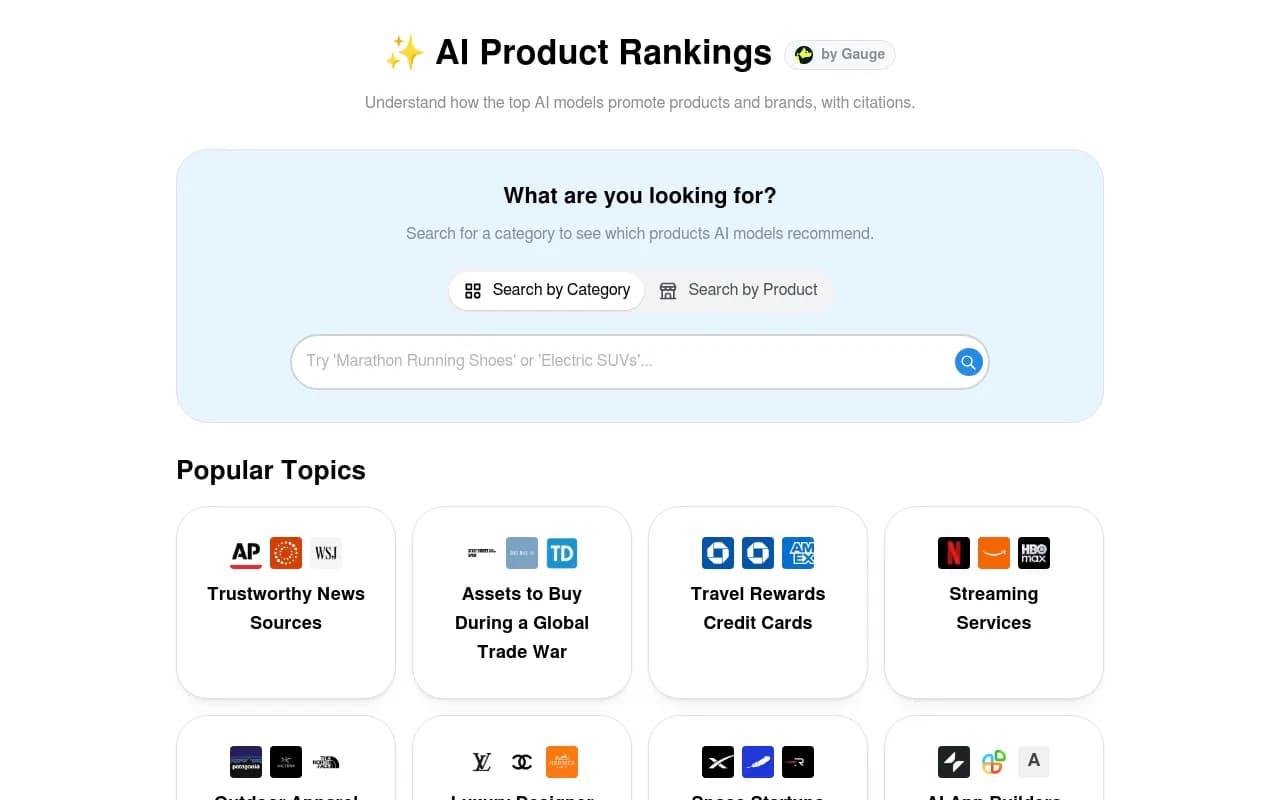
ProductRank is a free AI search discovery tool built by Gauge (withgauge.com) that answers a simple but increasingly important question: when someone asks ChatGPT, Claude, Perplexity, or Gemini to recommend products in your category, does your brand show up? The platform lets you search by category ("travel rewards credit cards", "outdoor apparel brands", "AI IDEs") and instantly see how the major AI models rank products, complete with citation sources and aggregate rankings across providers.
Launched as a free companion to Gauge's paid AI monitoring platform, ProductRank addresses the growing reality that consumers are bypassing Google and asking AI chatbots for product recommendations. If your brand isn't visible in these AI-generated lists, you're missing a significant and rapidly growing discovery channel. ProductRank gives you a quick way to check where you stand without committing to a paid monitoring platform.
How ProductRank Works
The core mechanic is straightforward: you enter a product category, and ProductRank queries the default AI models from OpenAI (ChatGPT), Anthropic (Claude), Perplexity, and Google (Gemini). Each model returns its top 10 products in that category. ProductRank then aggregates these results, ranking products first by how many providers mentioned them, then by their average ranking across providers (weighted equally).
The interface shows you:
- Overall ranking: Products sorted by consensus across AI models
- Provider breakdown: Which specific AI models recommended each product and at what rank
- Citations: When models search the web to answer (common with Perplexity and sometimes ChatGPT), ProductRank surfaces the source URLs in aggregate
- Popular topics: Pre-populated category searches like "streaming services", "luxury designer brands", "space startups", "trustworthy news sources"
You can search by category ("best project management tools") or by specific product name to see where it ranks across categories. The tool uses the API of each provider's current default chat model, which means results reflect what actual users would see when asking these questions in the real chat interfaces.
Search Modes and Coverage
ProductRank offers two search approaches:
- Search by Category: Enter any product category and see the top-ranked products across AI models. This is the primary use case -- understanding competitive positioning in AI recommendations.
- Search by Product: Enter a specific brand or product name to see which categories it appears in and how it ranks. Useful for tracking your own brand's AI visibility footprint.
The platform covers four major AI providers: OpenAI (ChatGPT), Anthropic (Claude), Perplexity, and Google (Gemini). Notably absent: Meta AI, Grok, DeepSeek, Copilot, and Mistral. For brands that need comprehensive coverage across all AI models, tools like Promptwatch track 10+ AI engines including these missing providers.
Popular topic categories on the homepage give you a sense of what's being tracked: everything from "AI app builders" and "YCombinator companies" to "car brands", "podcasts", and "assets to buy during a global trade war". The breadth is impressive, though the depth depends entirely on whether someone has run that specific search before.
Citation Analysis
One of ProductRank's most valuable features is citation aggregation. When AI models search the web to answer product recommendation queries (Perplexity does this by default, ChatGPT and Claude sometimes do), ProductRank surfaces the source URLs. You see which websites, articles, Reddit threads, and review sites are influencing AI recommendations in your category.
This is critical intelligence: if AI models are consistently citing Wirecutter, G2, or specific Reddit threads when recommending competitors, you know where to focus your content and community efforts. However, ProductRank only shows citations in aggregate at the top of results -- you don't get a breakdown of which citations came from which AI model. For that level of detail, Gauge's paid platform (or competitors like Promptwatch) provide per-model citation analysis.
Data Freshness and Update Cadence
Here's the biggest limitation: ProductRank rankings are run once and cached. The data doesn't auto-refresh. If you want updated rankings, you have to email the team and request a re-sync for your specific category. This makes ProductRank useful for one-time competitive research or quarterly check-ins, but not for ongoing monitoring.
For brands actively optimizing their AI visibility -- publishing new content, building backlinks, engaging on Reddit, updating product pages -- you need real-time or at least weekly tracking to see if your efforts are working. ProductRank won't show you that. It's a snapshot tool, not a monitoring platform.
Who Is ProductRank For
ProductRank is best suited for:
- Brand managers and product marketers doing initial research into AI visibility. If you've never checked how AI models recommend products in your category, ProductRank is a free starting point.
- Agencies pitching AI visibility services to clients. Run a quick ProductRank search during discovery calls to show clients where they rank (or don't rank) in AI recommendations. It's a compelling proof point that costs nothing.
- Founders and small teams with limited budgets who want to understand the AI search landscape before committing to paid tools. ProductRank gives you enough data to decide if AI visibility matters for your business.
- Content strategists researching which sources AI models cite in your category. The citation data helps you identify high-authority sites to target for backlinks or guest posts.
ProductRank is NOT ideal for:
- Brands actively optimizing for AI search who need ongoing tracking, historical data, and alerts when rankings change. You'll outgrow ProductRank immediately.
- SEO teams managing multiple clients who need custom prompt tracking, competitor monitoring, and detailed citation breakdowns. The lack of automation and limited provider coverage makes this impractical.
- Enterprise brands that need to track AI visibility across regions, languages, and custom personas. ProductRank doesn't support any of these.
Integration with Gauge
ProductRank is explicitly positioned as a free entry point to Gauge's paid platform. Throughout the interface, you'll see prompts like "For more accurate data pulled from the real web experiences, take a peek at Gauge" and "For realtime data, take a peek at Gauge." The message is clear: ProductRank is the free sample, Gauge is the full product.
Gauge (the parent platform) offers real-time AI monitoring, historical tracking, custom prompt creation, detailed citation analysis per model, and automated alerts. Pricing isn't publicly listed on ProductRank, but based on competitive research, Gauge likely starts around $89-119/month for basic plans. For teams serious about AI visibility, the upgrade path is obvious.
Comparison to Competitors
In the AI search monitoring space, ProductRank occupies a unique niche as the only completely free tool. Here's how it stacks up:
- vs Promptwatch: Promptwatch is a full optimization platform with content gap analysis, AI writing tools, crawler logs, and 10-model coverage. ProductRank is a free snapshot tool with 4-model coverage and no ongoing tracking. Different use cases entirely -- ProductRank for initial research, Promptwatch for active optimization.
- vs Otterly.AI / Peec.ai: These are paid monitoring dashboards ($99-249/mo) with automated tracking and historical data. ProductRank is free but requires manual refresh requests. If you need ongoing monitoring, these are better options despite the cost.
- vs AthenaHQ: AthenaHQ offers similar category-based AI ranking checks but with paid tiers for advanced features. ProductRank is completely free but more limited in scope.
- vs SE Ranking: SE Ranking ($65-259/mo) includes AI visibility tracking as part of a broader SEO suite. ProductRank is narrowly focused on product rankings and free, but SE Ranking offers more comprehensive SEO tools.
Pricing and Access
ProductRank is completely free with no account required. You can run unlimited category searches and view all results without signing up. There are no usage limits, no paywalls, and no upsells within the tool itself (though the interface heavily promotes Gauge).
This makes it an excellent resource for quick competitive research, client pitches, or one-time audits. The catch: you're limited to the data that's already been cached, and you can't customize prompts or track changes over time without upgrading to Gauge.
Strengths
- Completely free: No account, no credit card, no usage limits. Rare in the AI monitoring space.
- Multi-provider aggregation: Queries ChatGPT, Claude, Perplexity, and Gemini simultaneously and shows consensus rankings.
- Citation visibility: Surfaces the sources AI models use when recommending products, helping you identify high-authority sites to target.
- Simple interface: No learning curve -- search a category, see results. Perfect for non-technical users.
- Broad category coverage: Thousands of pre-populated topics across industries, from SaaS tools to luxury goods to financial products.
Limitations
- No automated tracking: Rankings are cached and require manual refresh requests via email. Not suitable for ongoing monitoring.
- Limited provider coverage: Only 4 AI models (ChatGPT, Claude, Perplexity, Gemini). Missing Meta AI, Grok, DeepSeek, Copilot, Mistral.
- No historical data: You can't see how rankings have changed over time or track the impact of optimization efforts.
- No custom prompts: You're limited to category-based searches. Can't track specific branded queries or custom use cases.
- No regional or language support: All queries appear to run in English from a single location. No multi-market tracking.
- Citation data lacks detail: Citations are shown in aggregate, not broken down by which model cited which source.
Bottom Line
ProductRank is an excellent free tool for understanding how AI models rank products in your category -- perfect for initial research, competitive analysis, or client pitches. The multi-provider aggregation and citation visibility give you actionable intelligence at zero cost. However, the lack of automated tracking, historical data, and custom prompt support means you'll quickly outgrow it if AI visibility becomes a priority.
For one-time audits or quarterly check-ins, ProductRank delivers exactly what you need. For ongoing optimization -- tracking ranking changes, monitoring custom prompts, analyzing citation trends, and measuring the impact of content efforts -- you'll need a full monitoring platform like Promptwatch (which adds content gap analysis and AI writing tools) or Gauge (ProductRank's paid parent platform).
Best use case in one sentence: Free competitive intelligence for brands who want to see where they rank in AI product recommendations without committing to a paid monitoring platform.
Tags:
Similar and alternative tools to ProductRank