Gushwork Review 2026
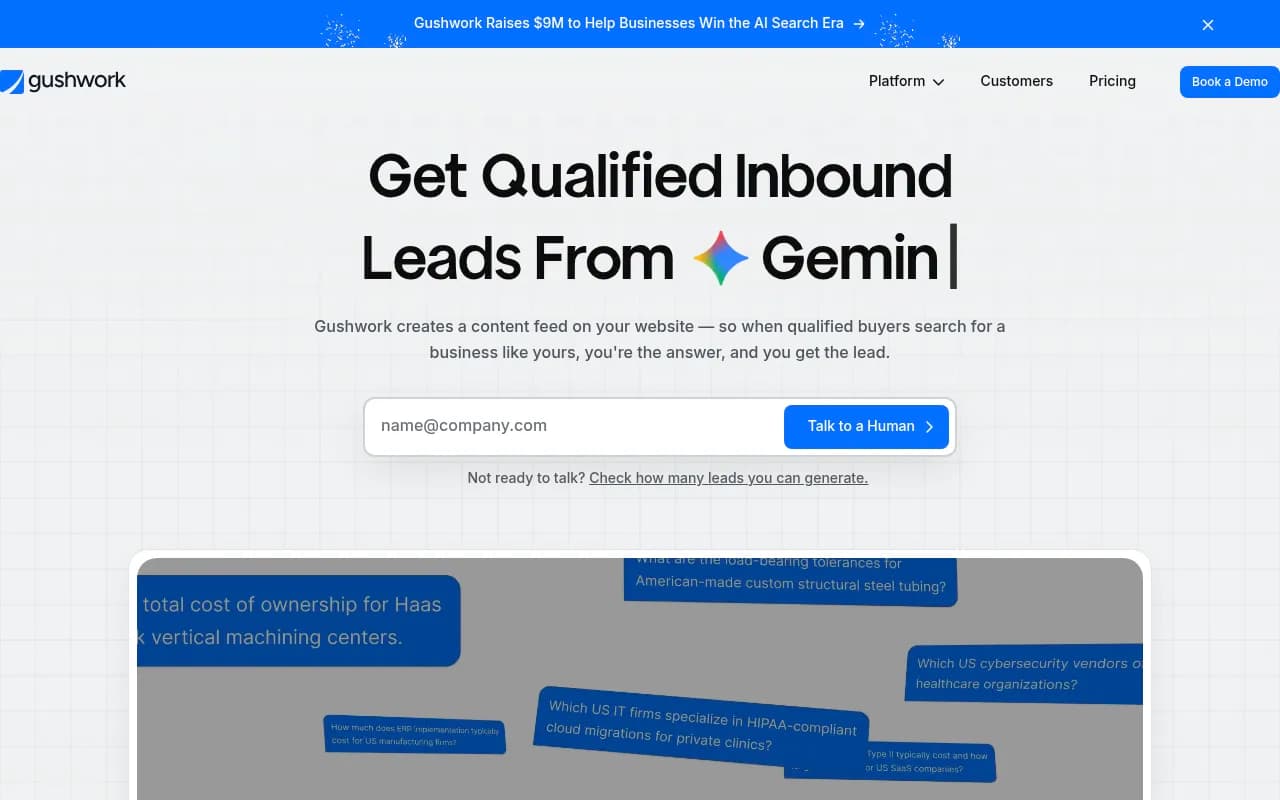
Gushwork is an automated content marketing platform that uses AI agents to research buyer intent, create 100+ optimized pages, build backlinks, and deliver qualified B2B leads within 90 days. Designed for businesses tired of inconsistent lead flow, it handles everything from keyword research to publishing—completely hands-off.
Summary
- Fully automated lead generation: Gushwork uses a swarm of AI agents to research, write, publish, and optimize 100+ pages on your site—no manual work required
- Built for B2B service businesses: Best for companies selling high-ticket services (equipment dealers, agencies, SaaS) who need qualified inbound leads, not just traffic
- Results in 90-150 days: Most customers see first leads within 3 months, scaling to 10-15 qualified inquiries per month by month 4-6
- Lacks AI search visibility tracking: Unlike Promptwatch, Gushwork doesn't show you how you rank in ChatGPT, Perplexity, or other AI engines—it optimizes for traditional Google search and hopes AI models pick it up
- High price point: Starting at $800/month for 6-month minimum commitments ($4,800+ upfront), making it a significant investment compared to DIY content or freelance writers

Gushwork positions itself as a "done-for-you" content marketing system that promises to turn your website into a lead generation engine. The pitch is simple: you provide business context, their AI agents handle everything else—research, writing, design, publishing, backlink building—and qualified leads start arriving in your inbox within 90 days. It's aimed squarely at B2B service companies (think industrial equipment dealers, niche SaaS, professional services) who have high customer lifetime values and need a predictable pipeline but don't have the time or expertise to execute content marketing themselves.
The company raised $9 million in seed funding from Susquehanna and Lightspeed in early 2025, which gives it runway to build out its AI agent infrastructure. Case studies show real results: Source Equipment (industrial equipment dealer) went from zero to 40+ leads per month, Fraxtional (fractional executive marketplace) added $500K in ARR in 10 months, John Maye Company saw 120+ qualified leads in 4 months. These aren't vanity metrics—these are businesses reporting actual sales conversations.
How the AI agent system works
Gushwork's core differentiator is its multi-agent architecture. Instead of one monolithic AI, it runs eight specialized agents that each handle a specific part of the content marketing workflow:
Memory Agent: Builds a living profile of your business by ingesting onboarding inputs (products, services, brand voice, target customers, geographic focus) and maintaining a shared knowledge base that all other agents reference. This is what keeps content consistent and on-brand across 100+ pages.
Research Agent: Scans Google, ChatGPT, and other AI tools to find what your target buyers are actually searching for. It identifies high-intent queries ("best industrial generator for manufacturing plant" not "what is a generator"), analyzes what currently ranks, and surfaces opportunities where you can realistically compete. This is the foundation—if the research is wrong, everything downstream fails.
Strategy Agent: Takes the research output and turns it into a buildable content plan. It clusters keywords into topic groups, decides which page types to create (landing pages, comparison guides, FAQ content), and maps each page to a specific buyer question. The output is a prioritized blueprint of what to build first.
Content & Design Agent: Generates the actual pages—headlines, body copy, CTAs—in your brand voice, then designs them using your site's colors, fonts, and layout patterns. The goal is pages that look native to your site, not generic blog templates. This agent also handles SEO basics like title tags, meta descriptions, and header structure.
Development Agent: Analyzes competitors to understand what's working in your market. It maps who ranks for target keywords, what content formats they use, and where gaps exist. This competitive intelligence layer feeds back into the strategy and content agents to help you build something better than what's already out there.
Publishing Agent: Publishes directly to your website via API integrations (supports WordPress, Webflow, and custom CMSs). It structures pages so Google and AI crawlers can easily find and index them, handles internal linking between pages, and sets up schema markup. Everything goes live in a dedicated resource center or blog section.
Backlinking Agent: Creates citations and references to your content across third-party websites. This signals to search engines that your content is credible and authoritative. Gushwork doesn't disclose exactly how it builds these backlinks (guest posts? directory submissions? partnerships?), which is a transparency gap.
Optimization Agent: Monitors rankings, traffic, and lead flow after pages go live. It identifies what's climbing and what's stalling, then triggers rewrites or redesigns based on performance data. This is the "compounding" part—pages get better over time as the system learns what works.
The agent orchestration is the real product here. Each agent has a narrow job, which makes the system more reliable than asking one giant LLM to "do content marketing." The Memory Agent acts as a shared brain, so every piece of content references the same business context. The feedback loop between Optimization and Strategy means the system adapts to what's actually driving leads, not just what it thinks should work.
Who this is built for
Gushwork is laser-focused on B2B service businesses with high customer lifetime values. Think:
-
Industrial equipment dealers: Companies selling generators, forklifts, HVAC systems, manufacturing equipment. These businesses have long sales cycles, high deal sizes ($50K-$500K+), and buyers who do extensive online research before contacting a vendor. Source Equipment (Leominster, MA) is the poster child—they went from near-zero organic leads to 40+ per month.
-
Niche SaaS and software companies: Especially those in crowded categories where paid ads are expensive and SEO is the only scalable channel. Pazago (import/export software) used Gushwork to drive 228K website visitors from search.
-
Professional services and agencies: Fractional executive firms, consulting agencies, specialized service providers. Fraxtional added $500K in ARR in 10 months by ranking for queries like "fractional CFO for SaaS startups."
-
Local service businesses with high ticket sizes: HVAC companies, commercial contractors, specialized repair services. If your average customer is worth $10K+, the economics work.
The common thread: businesses where one qualified lead can be worth $10K-$100K+ in lifetime value, making a $10K-$15K investment in content marketing a no-brainer if it delivers even 2-3 customers. Gushwork is NOT for e-commerce, consumer apps, or businesses with low-ticket products. If your average sale is $50, you can't afford this.
Team size: Works best for companies with 5-50 employees who have a sales team to handle inbound leads but lack in-house content marketing expertise. Solopreneurs and freelancers will find the price prohibitive. Enterprises with existing content teams might prefer more control.
What you actually get
The core deliverable is 100+ pages published to your website over a 6-month engagement. These aren't generic blog posts—they're a mix of:
- Landing pages: Service pages optimized for high-intent keywords ("industrial generator repair in Wisconsin")
- Comparison guides: "X vs Y" content that captures bottom-of-funnel searches
- Educational content: How-to guides, FAQs, and explainers that build authority
- Location pages: City and state-specific pages if you serve multiple geographies
Each page is designed to rank in Google and be crawlable by AI search engines (ChatGPT, Perplexity, Claude). The content is published to a dedicated resource center on your domain, with internal linking between pages and clear CTAs to contact forms or demo requests.
You also get a lead dashboard where all inquiries land—organized, spam-filtered, and tagged by source. This is important because Gushwork's value is measured in leads, not traffic. The dashboard shows which pages are driving conversions, so you can see ROI.
Backlinks are included but not transparent. Gushwork claims to build citations and references across third-party sites, but they don't disclose how many backlinks, which sites, or what quality. This is a black box compared to traditional SEO agencies that provide detailed link reports.
Integrations and technical setup
Gushwork integrates with:
- WordPress: Direct API publishing to WordPress sites
- Webflow: Native integration for Webflow-hosted sites
- Custom CMSs: API-based publishing for proprietary platforms
- Google Search Console: For traffic and ranking data (though not explicitly confirmed)
Setup requires giving Gushwork access to your website's CMS and providing business context during onboarding (products, services, target customers, brand voice examples). The onboarding process takes 1-2 weeks, then content starts going live.
No browser extensions, mobile apps, or self-serve dashboard. This is a managed service—you don't log in and tweak things yourself. You get periodic reports and can request changes, but the AI agents run autonomously.
Pricing breakdown
Gushwork uses a tiered pricing model with 6-month minimum commitments:
Launch: $800/month ($4,800 for 6 months)
- 100+ pages created and published
- AI agent system (all 8 agents)
- Lead dashboard
- Backlink building
- Monthly performance reports
Grow: $1,200/month ($7,200 for 6 months)
- Everything in Launch
- 150+ pages
- Faster publishing cadence
- Priority support
Scale: $2,200/month ($13,200 for 6 months)
- Everything in Grow
- 200+ pages
- Multi-site support (if you have multiple brands)
- Custom integrations
- Dedicated account manager
No free trial. No month-to-month option. You commit to 6 months upfront, which is a significant barrier for smaller businesses. The pricing is high compared to hiring a freelance writer ($50-$200 per article) or using AI writing tools yourself ($20-$100/month), but Gushwork's pitch is that it handles the entire workflow—not just writing, but research, publishing, optimization, and backlink building.
For context: A traditional SEO agency might charge $3K-$10K/month for similar deliverables, but you'd need to manage them. Gushwork is betting that full automation justifies the premium.
What it does well
End-to-end automation: The biggest strength is that you don't have to think about content marketing. No keyword research spreadsheets, no managing writers, no publishing workflows. You provide context once, then the system runs. For busy founders and small teams, this is the entire value proposition.
Real results in case studies: The case studies are specific and credible. Source Equipment went from zero to 40+ leads/month. Fraxtional added $500K in ARR. John Maye Company got 120+ qualified leads in 4 months. These aren't vanity metrics—they're businesses reporting actual pipeline impact.
Multi-agent architecture: The specialized agent approach is smarter than generic AI content tools. Each agent has a narrow job, which reduces errors and makes the system more reliable. The Memory Agent ensures consistency across 100+ pages, which is hard to achieve with one-off AI writing.
Focus on leads, not traffic: Gushwork measures success by qualified inquiries, not pageviews or rankings. The lead dashboard and spam filtering show they understand that B2B buyers care about pipeline, not vanity metrics.
Backlink building included: Most AI content tools stop at writing. Gushwork handles backlink acquisition, which is critical for ranking in competitive niches. This is a real differentiator vs DIY approaches.
Limitations and gaps
No AI search visibility tracking: Gushwork optimizes content for Google and hopes AI engines (ChatGPT, Perplexity, Claude) pick it up, but it doesn't show you how you actually rank in AI search results. You have no idea if ChatGPT is citing your pages, which competitors it's recommending instead, or where your visibility gaps are. Promptwatch solves this by tracking your brand mentions across 10+ AI models, showing exactly which prompts you're visible for and which you're missing. Gushwork is flying blind on the AI search side.
No content gap analysis: Gushwork's Research Agent finds keywords, but it doesn't show you the specific content gaps between you and competitors. You don't see which prompts competitors rank for that you don't, or what topics your site is missing. Promptwatch's Answer Gap Analysis does this—it shows the exact questions AI models want answers to but can't find on your site, so you know what to create.
No AI crawler logs: You can't see which AI crawlers (ChatGPT, Claude, Perplexity) are visiting your site, which pages they're reading, or how often they return. Promptwatch provides real-time AI crawler logs so you can fix indexing issues and understand how AI engines discover your content. Gushwork doesn't offer this visibility.
No traffic attribution: Gushwork doesn't connect AI visibility to actual website traffic or revenue. You can't see how many visitors came from ChatGPT vs Google, or which AI-generated citations drove conversions. Promptwatch offers traffic attribution via code snippet, GSC integration, or server log analysis. Gushwork's lead dashboard shows inquiries but not the full funnel.
Backlink transparency gap: Gushwork claims to build backlinks but doesn't disclose how many, which sites, or what quality. Traditional SEO agencies provide detailed link reports. This lack of transparency makes it hard to evaluate ROI or compare to other link-building services.
High upfront cost: $4,800 minimum for 6 months is a significant barrier for small businesses. No free trial or month-to-month option means you're betting on results before seeing proof. Competitors like Promptwatch start at $99/month with no long-term commitment.
Limited control: This is a managed service—you don't log in and tweak things yourself. If you want to adjust strategy, pause publishing, or change direction, you're dependent on Gushwork's team. Some businesses prefer more hands-on control.
No multi-language or multi-region support: Gushwork appears to focus on English-language, US-based businesses. If you need content in multiple languages or want to target specific countries, it's unclear if the platform supports this. Promptwatch offers multi-language and multi-region tracking.
Bottom line
Gushwork is a strong fit for B2B service businesses with high customer lifetime values ($10K+) who need qualified inbound leads but lack the time or expertise to execute content marketing themselves. If you're an industrial equipment dealer, niche SaaS company, or professional services firm willing to invest $5K-$15K over 6 months, and you trust the AI agent system to deliver results, Gushwork can work. The case studies prove it's capable of driving real pipeline.
But it's not a complete AI search solution. Gushwork optimizes for Google and hopes AI engines pick it up—it doesn't track how you actually rank in ChatGPT, Perplexity, or Claude, show you content gaps vs competitors, or provide AI crawler logs. If you want to understand and optimize your AI search visibility, Promptwatch is the better choice. It shows you exactly where you're invisible in AI search, helps you create content that ranks, and tracks the results with page-level citation data and traffic attribution.
For businesses that just want leads and don't care about the underlying mechanics, Gushwork's hands-off approach is appealing. For businesses that want to own their AI search strategy and see exactly what's working, Promptwatch's transparency and optimization tools are essential. The ideal setup: use Promptwatch to identify gaps and track AI visibility, then use Gushwork (or your own content team) to execute the content creation. But if you can only pick one, Promptwatch gives you the visibility and control to make informed decisions—Gushwork leaves you guessing.
Frequently asked questions
What is Gushwork and what does it do?
How much does Gushwork cost?
How long does it take to see results with Gushwork?
Who is Gushwork best suited for?
Does Gushwork offer a free trial?
What does Gushwork automate in content marketing?
Does Gushwork track rankings in AI search engines like ChatGPT?
What kind of results have Gushwork customers achieved?
Similar and alternative tools to Gushwork