Summary
- AI search traffic (ChatGPT, Perplexity, Claude) converts at 4.4x the rate of traditional organic search, making visibility in these platforms critical for mid-market brands
- Most tools stop at monitoring ("do I show up?") but mid-market teams need intelligence ("what's missing?") and execution ("fix it for me")
- Budget reality: monitoring starts at $29/month, intelligence platforms run $99-579/month, and full-service execution begins around $2,000/month
- The gap between monitoring and optimization costs mid-market brands thousands in lost deals -- being visible with wrong information is worse than being invisible
- This guide evaluates 10 platforms across three capability tiers to help you match tool investment to actual business needs
The Mid-Market AI Visibility Problem Nobody Talks About
Your brand shows up in ChatGPT responses. Congratulations -- you're visible. Except ChatGPT is telling prospects your Pro plan costs $79/month when it's actually $49. Or recommending you for use cases you don't support. Or hallucinating integrations that don't exist.
This is the mid-market trap. You have enough budget to know you're invisible in AI search, but not enough to fix it systematically. You're stuck between $29/month dashboards that just count mentions and $5,000/month agencies that want annual contracts.
The data is clear: AI referral traffic accounts for 1.08% of all website traffic (Conductor, 2026 -- 13,770 domains, 3.3 billion sessions analyzed). That 1% is deceptive. AI search converts at 4.4x the rate of traditional organic and is growing faster than any other referral channel. At an industry average of $337/month per tool, choosing wrong is expensive.
I tested 10 platforms over four months. Same 30 prompts, same evaluation criteria, same mid-market lens: can a $50K-500K ARR SaaS company actually use this without hiring a consultant?
The Three-Level Framework: What You're Actually Buying
Most comparison articles sort by price. That tells you nothing about what the tool does for your business. A better framework categorizes by capability level.
Level 1: Monitoring (Do I Show Up?)
Monitoring tools answer one question: does your brand appear in AI-generated responses? They track citations, mentions, and position across platforms like ChatGPT, Perplexity, and Google AI Overviews.
This level is valuable for establishing a baseline. You cannot improve what you do not measure. But monitoring alone leaves you stuck. You see the problem but have no path to fixing it.
What monitoring gives you: Visibility scores, citation counts, position tracking, competitor mentions
What monitoring doesn't give you: Why you're invisible, what content to create, how to optimize existing pages, or any path to improvement
Level 2: Intelligence (What's Missing?)
Intelligence platforms add the "why" and "what next" layer. They show you which prompts competitors rank for but you don't. They surface content gaps. They tell you which pages need optimization and what's missing from those pages.
This is where mid-market brands get real value. You're not just tracking -- you're diagnosing and planning.
What intelligence adds: Answer gap analysis, prompt volume estimates, difficulty scoring, content recommendations, page-level insights, crawler logs
What intelligence still doesn't do: Create the content for you or execute the optimization
Level 3: Execution (Fix It For Me)
Execution platforms close the loop. They generate content grounded in citation data, publish it, and track results. Some guarantee visibility improvements or they refund you.
This level is overkill for most mid-market brands starting out, but becomes essential once you've validated that AI visibility drives revenue for your business.
What execution delivers: AI content generation, automated publishing, guaranteed results, full-service optimization, white-glove support
The 10 Best AI Visibility Platforms for Mid-Market Budgets
| Tool | Tier | Starting Price | AI Models Tracked | Best For |
|---|---|---|---|---|
| Promptwatch | Intelligence | $99/mo | 10 (ChatGPT, Perplexity, Claude, Gemini, etc.) | Teams that need content gap analysis + AI writing |
| Otterly.AI | Monitoring | $29/mo | 3 (ChatGPT, Perplexity, Google AI) | Budget-conscious teams testing AI visibility |
| Profound | Intelligence | $349/mo | 9+ models | Mid-market brands wanting depth without execution |
| LLMClicks | Intelligence | $149/mo | 2 (ChatGPT, Perplexity) | SaaS teams focused on hallucination detection |
| Peec.ai | Monitoring | $99/mo | 3 models | Marketing teams wanting clean dashboards |
| Scrunch AI | Intelligence | $299/mo | 8 models | Agencies managing multiple clients |
| Rankshift | Monitoring | $49/mo | 3 models | Small teams needing basic tracking |
| AthenaHQ | Monitoring | $79/mo | 4 models | Brands wanting simple competitor comparison |
| Relixir | Execution | Custom (est. $2,000+/mo) | 10+ models | Enterprise teams needing full-service GEO |
| Search Party | Execution | Custom | Multiple models | Agencies wanting workflow automation |
1. Promptwatch: The Action Loop Platform
Promptwatch is the only platform I tested that's rated as a "Leader" across all categories in independent comparisons. The difference: most competitors are monitoring-only dashboards that show you data but leave you stuck. Promptwatch is built around taking action.

The platform tracks 10 AI models (ChatGPT, Perplexity, Claude, Gemini, Google AI Overviews, Meta AI, DeepSeek, Grok, Mistral, Copilot) and processes over 1.1 billion citations. But the real value is the action loop:
Find the gaps: Answer Gap Analysis shows exactly which prompts competitors are visible for but you're not. You see the specific content your website is missing -- the topics, angles, and questions AI models want answers to but can't find on your site.
Create content that ranks: The built-in AI writing agent generates articles, listicles, and comparisons grounded in real citation data (880M+ citations analyzed), prompt volumes, persona targeting, and competitor analysis. This isn't generic SEO filler -- it's content engineered to get cited by ChatGPT, Claude, and Perplexity.
Track the results: See your visibility scores improve as AI models start citing your new content. Page-level tracking shows exactly which pages are being cited, how often, and by which models. Close the loop with traffic attribution (code snippet, GSC integration, or server log analysis) to connect visibility to actual revenue.
This cycle -- find gaps, generate content, track results -- is what makes Promptwatch an optimization platform, not just another tracker.
Additional capabilities that matter for mid-market:
- AI Crawler Logs: Real-time logs of AI crawlers (ChatGPT, Claude, Perplexity) hitting your website -- which pages they read, errors they encounter, how often they return
- Prompt Intelligence: Volume estimates and difficulty scores for each prompt, plus query fan-outs that show how one prompt branches into sub-queries
- Citation & Source Analysis: See exactly which pages, Reddit threads, YouTube videos, and domains AI models cite
- Reddit & YouTube Insights: Surface discussions that directly influence AI recommendations
- ChatGPT Shopping Tracking: Monitor when your brand appears in ChatGPT's product recommendations
Pricing: Essential $99/mo (1 site, 50 prompts, 5 articles), Professional $249/mo (2 sites, 150 prompts, 15 articles, crawler logs), Business $579/mo (5 sites, 350 prompts, 30 articles). Free trial available.
Best for: Mid-market SaaS and B2B brands that need more than monitoring but can't afford full-service agencies. If you have a content team that can execute on recommendations, this is your platform.
2. Otterly.AI: The Budget Entry Point
At $29/month, Otterly.AI is one of the cheapest paid options for AI visibility tracking. It monitors ChatGPT, Perplexity, and Google AI Overviews.
Otterly.AI

Otterly is pure monitoring. You enter prompts, it checks responses, you get a report showing where your brand was mentioned. That's it. No content recommendations. No gap analysis. No crawler logs. No optimization intelligence.
But for mid-market brands testing whether AI visibility matters for their business, this is a low-risk starting point. Run it for three months. If you see your brand mentioned and those mentions correlate with demo requests or trials, upgrade to an intelligence platform. If not, you've spent $87 to learn AI search isn't a priority channel yet.
What you get: Basic citation tracking, position monitoring, competitor comparison, email alerts
What you don't get: Content recommendations, prompt volumes, difficulty scoring, crawler monitoring, traffic attribution
Pricing: $29/mo for basic tracking
Best for: Teams with $0 AI visibility budget who need to prove the channel matters before investing more
3. Profound: Deep Intelligence Without Execution
Profound tracks 9+ AI search engines and offers some of the most detailed intelligence features in the mid-market tier.
Profound

Profound sits firmly in the intelligence category. It shows you where you're visible, where competitors beat you, and surfaces content opportunities. The platform includes prompt volume estimates and difficulty scoring, which helps prioritize which gaps to fill first.
What Profound doesn't do: create content for you. You get the intelligence, but execution is on your team. For mid-market brands with existing content operations, this is fine. For lean teams without writers, it's a gap.
Standout features: Multi-model tracking (9+ engines), prompt difficulty scoring, competitor heatmaps, volume estimates
Missing pieces: No AI content generation, no crawler logs, no Reddit/YouTube insights
Pricing: $349/mo starting price
Best for: Mid-market brands with content teams who can execute on recommendations but need deep intelligence to guide strategy
4. LLMClicks: The Hallucination Detector
I built LLMClicks because I was frustrated. Our SaaS product was being mentioned in ChatGPT responses with completely wrong pricing information. Prospects would show up to demos questioning our credibility.
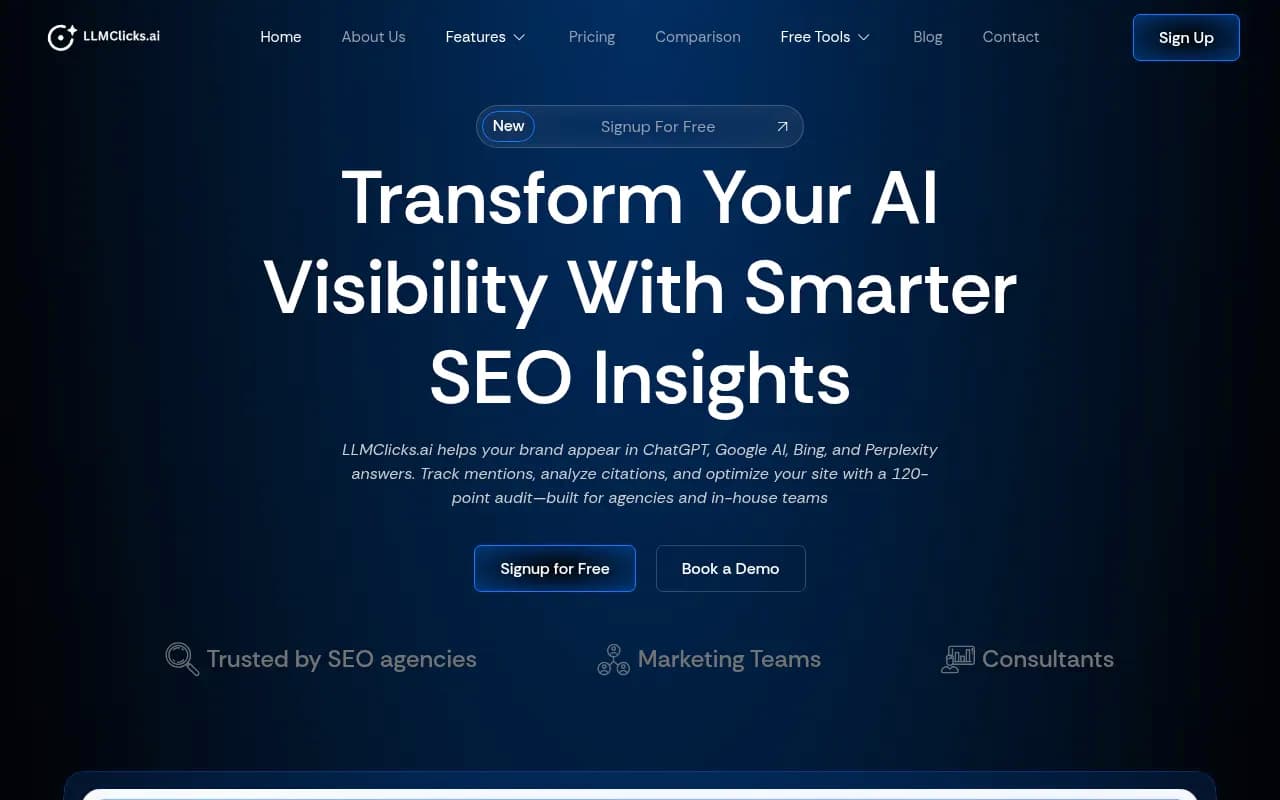
LLMClicks is the only platform I tested that consistently detects when AI is lying about you. Most tools count mentions and call them "positive" regardless of accuracy. LLMClicks flags outdated pricing, confused features, hallucinated integrations, and wrong use case recommendations.
For SaaS companies, being visible with wrong information costs more than being invisible. Those hallucinations literally cost deals.
The platform tracks ChatGPT and Perplexity (Google AI Overviews coming soon) and includes basic content gap analysis. It's lighter on intelligence features than Promptwatch or Profound, but the hallucination detection is unmatched.
Unique capability: Hallucination detection and accuracy scoring
Pricing: $149/mo
Best for: SaaS companies where pricing, features, or technical specs matter and misinformation kills deals
Full transparency: I run LLMClicks, so I'm biased. But I've included honest limitations alongside competitors because the goal is helping you choose the right tool for your needs, even if that's not mine.
5. Peec.ai: Clean Dashboards for Marketing Teams
Peec.ai is a monitoring platform tailored for marketing teams who want clean, shareable dashboards.
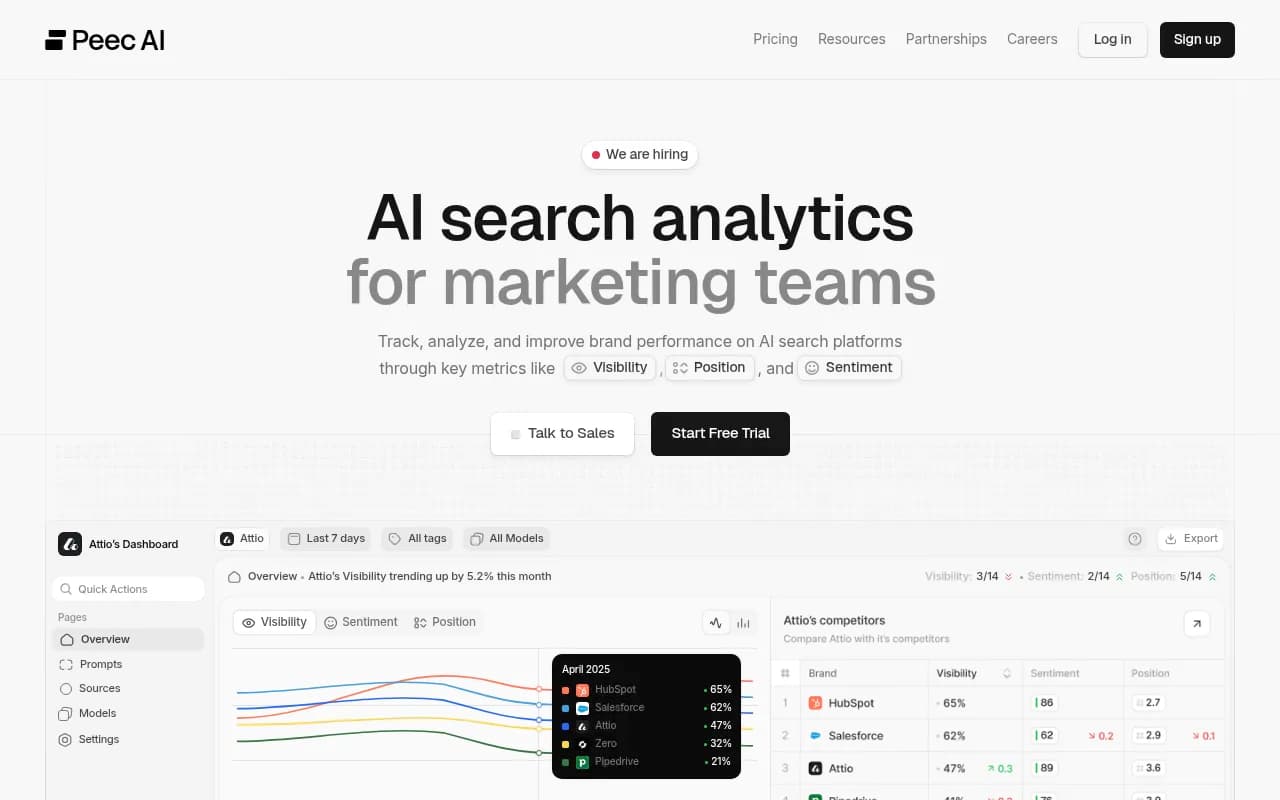
Peec tracks 3 models (ChatGPT, Perplexity, Claude) and focuses on visualization. The dashboards are polished and easy to share with executives who want high-level visibility metrics without diving into technical details.
What Peec doesn't offer: content recommendations, crawler logs, or any path to optimization. It's monitoring with a pretty interface.
Pricing: $99/mo starting price
Best for: Marketing teams that need to report AI visibility metrics to leadership but don't need optimization intelligence yet
6. Scrunch AI: The Agency Play
Scrunch AI tracks 8 models and is built for agencies managing multiple clients.
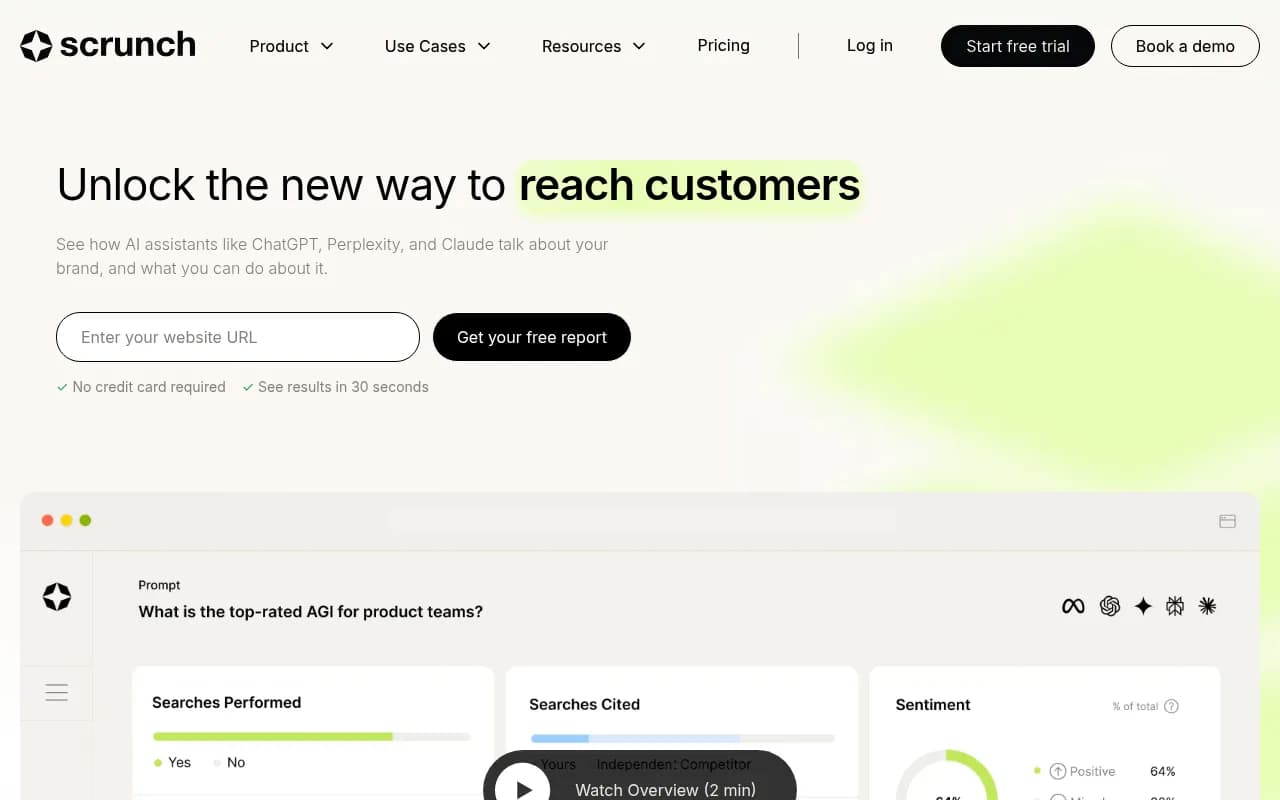
Scrunch includes white-label reporting, multi-client dashboards, and bulk prompt management. The intelligence layer is solid -- competitor analysis, content gap identification, prompt volumes.
What makes Scrunch agency-focused: the workflow assumes you're managing 5-20 clients simultaneously. If you're a single mid-market brand, the multi-client features are wasted. But if you're an agency with mid-market clients, this is your platform.
Pricing: $299/mo starting price
Best for: Agencies managing AI visibility for multiple mid-market clients
7. Rankshift: Basic Tracking for Small Teams
Rankshift tracks ChatGPT, Perplexity, and AI search at a $49/month price point.

Rankshift is monitoring-only but includes a few intelligence features that Otterly lacks: basic prompt suggestions and competitor comparison. It's a step up from pure tracking without jumping to full intelligence platforms.
Pricing: $49/mo
Best for: Small teams (1-3 people) who need more than Otterly but can't justify $99+/month yet
8. AthenaHQ: Simple Competitor Comparison
AthenaHQ tracks 4 models and focuses on competitor benchmarking.

AthenaHQ's standout feature: side-by-side competitor visibility scores across models. You can quickly see which competitors dominate ChatGPT vs Perplexity vs Claude.
What it lacks: content recommendations, crawler logs, prompt intelligence. It's monitoring with good competitor context.
Pricing: $79/mo
Best for: Brands in competitive markets who need to track relative visibility against 3-5 key competitors
9. Relixir: Full-Service GEO Engine
Relixir is an end-to-end GEO engine built for enterprise brands, but their mid-market tier starts around $2,000/month (custom pricing).
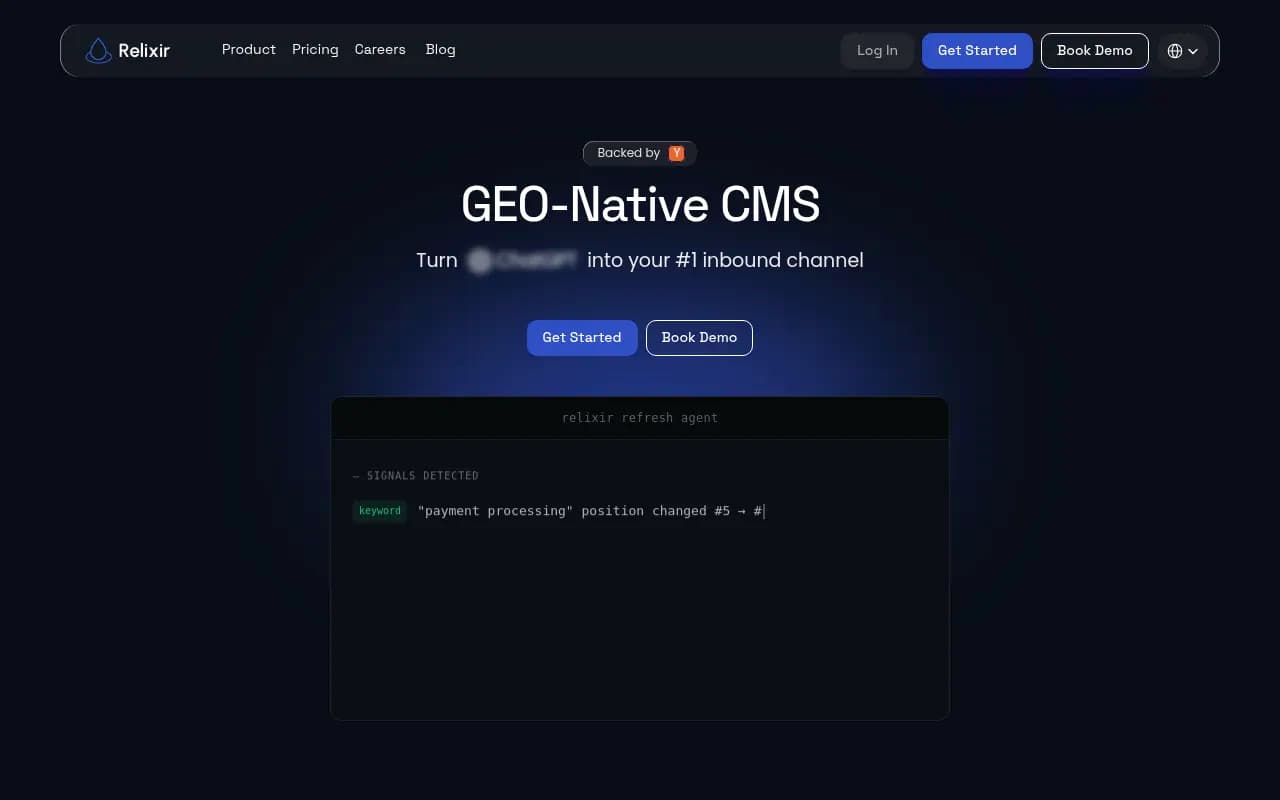
Relixir handles everything: monitoring, intelligence, content creation, publishing, and guaranteed results. They analyze your visibility gaps, generate optimized content, publish it to your CMS, and track citation improvements.
This is execution-tier. You're not managing the work -- they are. For mid-market brands that have validated AI visibility drives revenue and want to scale without hiring, this is the move.
Pricing: Custom (estimated $2,000+/mo based on scope)
Best for: Mid-market brands ($500K-5M ARR) that have proven AI visibility ROI and want to scale without building an internal team
10. Search Party: Workflow Automation for Agencies
Search Party is an AI automation consultancy that engineers custom workflows to eliminate busywork.
Search Party
Search Party isn't a SaaS platform -- it's a service that builds custom automation for your specific GEO workflow. They track visibility, identify gaps, generate content, and publish it through automated pipelines.
This is execution-tier for agencies and brands with complex, repeatable workflows. If you're running the same AI visibility process across 10 clients or 50 product pages, Search Party builds the automation so you're not doing it manually.
Pricing: Custom (project-based or retainer)
Best for: Agencies with repeatable GEO workflows or mid-market brands with complex, high-volume content operations
How to Choose: Match Tool to Business Stage
Most mid-market brands pick tools based on features or price. That's backwards. Pick based on your business stage and what you can actually execute.
Stage 1: Testing ("Does AI visibility matter for us?")
Your situation: You've heard about AI search but don't know if it's relevant to your business. You have no data on whether prospects use ChatGPT or Perplexity to research your category.
What you need: Cheap monitoring to establish a baseline. Run it for 90 days. If you see citations and they correlate with inbound interest, upgrade. If not, you've spent under $100 to learn it's not a priority yet.
Recommended tools: Otterly.AI ($29/mo), Rankshift ($49/mo)
Stage 2: Diagnosing ("We're invisible -- what's missing?")
Your situation: You've confirmed AI visibility matters. Prospects mention finding you (or not finding you) in ChatGPT. You need to understand why you're invisible and what content to create.
What you need: Intelligence platforms that show content gaps, prompt volumes, and competitor analysis. You have a content team that can execute on recommendations.
Recommended tools: Promptwatch ($99-249/mo), Profound ($349/mo), Scrunch AI ($299/mo for agencies)
Stage 3: Optimizing ("We're visible but inaccurate")
Your situation: You show up in AI responses but the information is wrong. Hallucinations are costing you deals. You need accuracy monitoring and content correction.
What you need: Platforms that detect hallucinations and flag misinformation, plus intelligence to guide content fixes.
Recommended tools: LLMClicks ($149/mo), Promptwatch Professional ($249/mo with crawler logs)
Stage 4: Scaling ("We've proven ROI -- automate it")
Your situation: You've validated that AI visibility drives revenue. You're ready to scale content production and optimization but don't want to hire a full team.
What you need: Execution platforms that generate content, publish it, and guarantee results. You're paying for outcomes, not just data.
Recommended tools: Relixir ($2,000+/mo), Search Party (custom), Promptwatch Business ($579/mo if you have internal writers)
The Budget Reality: What $100/Month Actually Buys
Here's what you get at each price tier:
$29-49/month (Monitoring):
- Citation tracking across 2-3 AI models
- Basic competitor comparison
- Email alerts when mentions change
- No content recommendations
- No optimization path
$99-349/month (Intelligence):
- Multi-model tracking (4-10 engines)
- Content gap analysis
- Prompt volumes and difficulty scoring
- Competitor heatmaps
- Page-level insights
- Some platforms add: crawler logs, Reddit/YouTube tracking, AI content generation
$579-2,000+/month (Execution):
- Everything in intelligence tier
- AI content generation grounded in citation data
- Automated publishing
- Guaranteed visibility improvements
- White-glove support
- Custom workflows
The Tools That Don't Make the Cut (And Why)
I tested 27 platforms. Here's why 17 didn't make the top 10 for mid-market brands:
Semrush AI Toolkit: Fixed prompts, no customization, bolted onto traditional SEO platform. You're paying for SEO features you might not need.
Ahrefs Brand Radar: Fixed prompts, no AI traffic attribution, missing crawler logs. Good for traditional SEO teams adding AI monitoring, but not purpose-built for GEO.
Evertune: Enterprise-focused (Fortune 500 brands), pricing starts well above mid-market budgets.
Conductor: Strong platform but enterprise-tier pricing and feature set. Overkill for most mid-market teams.
Brandlight.ai, Bluefish, Searchable: Niche or limited-feature players missing multiple core capabilities that mid-market teams need.
Goodie AI, AI Peekaboo, Promptmonitor: Basic monitoring missing critical optimization features. You'll outgrow them in 60 days.
What Most Guides Won't Tell You: The Hidden Costs
Every comparison article lists tool pricing. Almost none mention the hidden costs that actually determine ROI.
Cost 1: Execution Gap
Monitoring tools show you problems but don't fix them. You need:
- Writers to create content ($50-150/hour freelance, $60-90K/year full-time)
- SEO specialists to optimize pages ($75-200/hour)
- Developers to implement crawler fixes ($100-250/hour)
If you're paying $29/month for monitoring but $5,000/month for execution, the tool cost is irrelevant. The real question: does the tool reduce execution cost?
Promptwatch's AI content generation saves 10-15 hours per article. At $100/hour, that's $1,000-1,500 saved per piece. If you're creating 5 articles/month, the $249/month platform cost pays for itself in saved labor.
Cost 2: Opportunity Cost of Wrong Information
Being visible with wrong information costs more than being invisible. When ChatGPT tells prospects your pricing is 60% higher than reality, you lose deals before they even reach your website.
LLMClicks detected 18 mentions for one client. 4 had outdated pricing. Average deal size: $12,000. If even one prospect walked away because of misinformation, that's 80x the annual tool cost.
Hallucination detection isn't a nice-to-have for SaaS companies -- it's revenue protection.
Cost 3: Time to Value
Most platforms take 30-90 days to show meaningful results. You're paying monthly fees while waiting for data to accumulate and content to get indexed by AI models.
Platforms with AI content generation (Promptwatch, Relixir) compress time to value. You're creating optimized content in week one, not month three.
The Comparison Table: Features That Actually Matter
| Feature | Monitoring Tier | Intelligence Tier | Execution Tier |
|---|---|---|---|
| Citation tracking | ✓ | ✓ | ✓ |
| Multi-model coverage | 2-3 models | 4-10 models | 10+ models |
| Content gap analysis | ✗ | ✓ | ✓ |
| Prompt volumes | ✗ | ✓ | ✓ |
| Difficulty scoring | ✗ | ✓ | ✓ |
| Crawler logs | ✗ | Some platforms | ✓ |
| AI content generation | ✗ | Some platforms | ✓ |
| Automated publishing | ✗ | ✗ | ✓ |
| Traffic attribution | ✗ | Some platforms | ✓ |
| Hallucination detection | ✗ | Rare | ✓ |
| Reddit/YouTube tracking | ✗ | Some platforms | ✓ |
| White-label reporting | ✗ | Agency platforms | ✓ |
The Action Plan: 90-Day Implementation
Here's how to actually implement AI visibility tracking without wasting time or money.
Days 1-30: Establish Baseline
- Pick a monitoring tool based on budget (Otterly at $29/mo or Rankshift at $49/mo)
- Enter 20-30 prompts that represent how prospects research your category
- Track citations daily for 30 days
- Document: which models cite you, which competitors appear, what information is accurate vs wrong
Decision point: If you see citations and they correlate with inbound interest (check CRM notes, demo call recordings), upgrade to intelligence tier. If not, pause and revisit in 6 months.
Days 31-60: Diagnose Gaps
- Upgrade to intelligence platform (Promptwatch, Profound, or LLMClicks)
- Run answer gap analysis to see which prompts competitors rank for but you don't
- Prioritize gaps by prompt volume and difficulty
- Identify 5-10 content pieces to create or optimize
Decision point: If you have internal writers, create content in-house. If not, either use a platform with AI content generation (Promptwatch) or hire freelancers.
Days 61-90: Create and Track
- Create or optimize 5-10 pieces of content targeting high-value gaps
- Publish and wait 14-21 days for AI models to re-crawl and index
- Track citation improvements at the page level
- Connect citations to traffic using attribution code or GSC integration
Decision point: If you see citation improvements and traffic increases, scale content production. If not, revisit content quality and prompt targeting.
The Bottom Line: What Mid-Market Brands Actually Need
After testing 10 platforms and spending four months in the weeds, here's what matters:
If you're testing AI visibility (budget: $29-49/mo): Start with Otterly.AI or Rankshift. Run it for 90 days. If you see citations that correlate with inbound interest, upgrade. If not, you've spent under $150 to learn it's not a priority yet.
If you're diagnosing gaps (budget: $99-349/mo): Promptwatch offers the best balance of intelligence and execution for mid-market teams. The action loop (find gaps → generate content → track results) is what separates optimization platforms from monitoring dashboards. If hallucination detection is critical (SaaS with complex pricing or features), add LLMClicks.
If you're scaling (budget: $579-2,000+/mo): Promptwatch Business if you have internal writers, Relixir or Search Party if you want full-service execution.
The mistake most mid-market brands make: buying monitoring tools and expecting optimization results. Monitoring shows you the problem. Intelligence shows you the solution. Execution implements it.
Pick the tier that matches what your team can actually execute, not what sounds impressive in a demo.