LLMClicks Review 2026
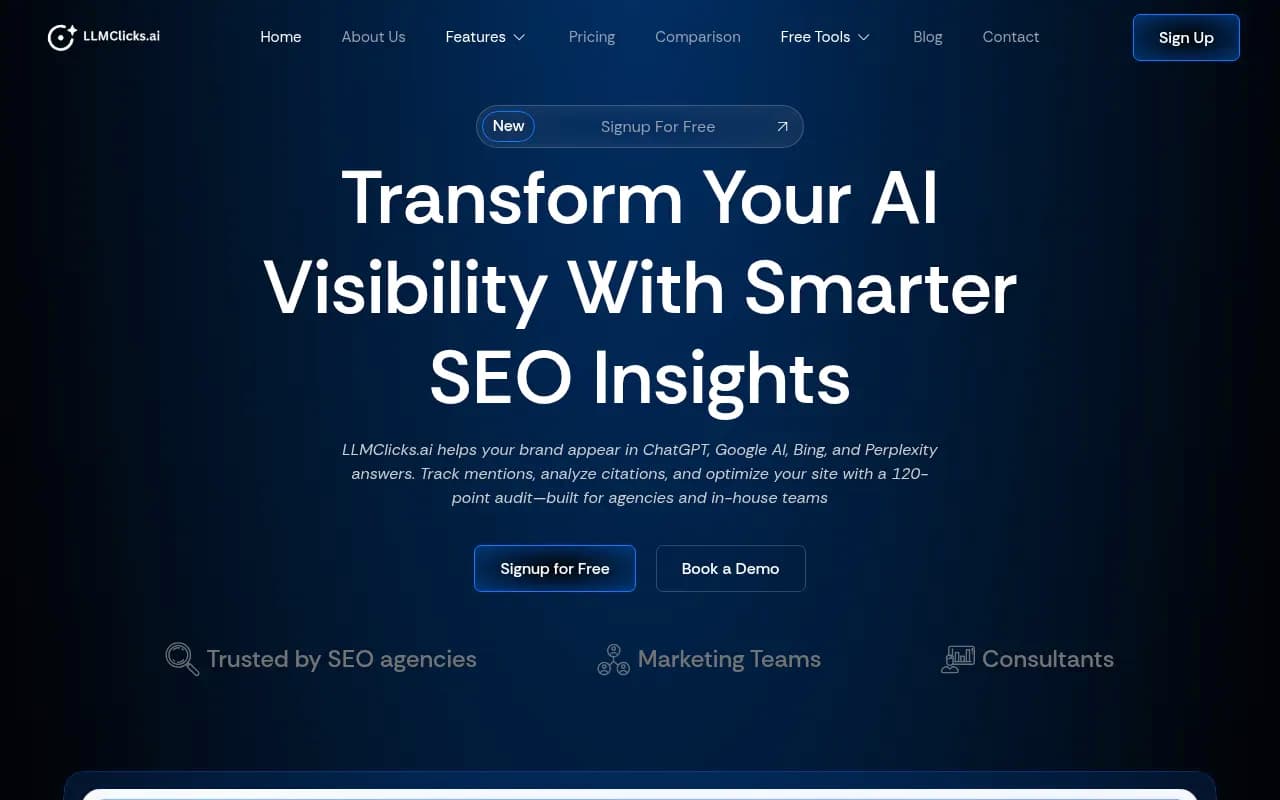
Monitor AI visibility and detect hallucinations across ChatGPT and other LLMs with accuracy testing and tracking features.
Key Takeaways:
- What it does: LLMClicks monitors your brand's visibility across ChatGPT, Perplexity, Google AI, and Bing Copilot, showing exactly which queries trigger mentions and how you compare to competitors
- Best for: SEO agencies managing multiple clients, in-house marketing teams tracking AI search performance, and consultants diagnosing visibility issues
- Standout features: 120-point AI readiness audit, daily visibility tracking, citation analysis, query fan-out coverage, and white-label reporting for agencies
- Pricing: Starts at $49/mo with 14-day free trial; all plans include multi-LLM tracking and competitor benchmarking
- Limitations: Newer platform with smaller dataset than established competitors, no content generation tools, limited integrations compared to enterprise platforms
What LLMClicks Is and Who Built It
LLMClicks is an AI visibility tracking platform launched in 2025 that helps brands understand and improve how they appear in AI-powered search results. While traditional SEO tools focus on Google rankings, LLMClicks addresses a newer challenge: getting your brand mentioned when users ask ChatGPT, Perplexity, Google AI, or Bing Copilot for recommendations. The platform targets SEO agencies, in-house marketing teams, and consultants who need to prove ROI from AI search optimization efforts.
The tool emerged as AI search adoption accelerated in 2024-2025, with millions of users now bypassing traditional search engines entirely. If your brand doesn't appear in AI-generated answers, you're invisible to a growing segment of potential customers. LLMClicks positions itself as the solution for tracking and improving that visibility across the major LLM platforms people actually use.
The platform is built specifically for agencies and teams managing multiple clients or brands. It includes white-label reporting, lead magnet audits, and multi-client dashboards -- features that distinguish it from individual-focused tools. The company offers a 14-day free trial and claims agencies have improved AI mentions within 4 weeks of using the platform.
AI Visibility Audit: 120-Point Analysis
The core feature is the AI Visibility Audit, which analyzes how LLMs respond to queries related to your brand, competitors, and industry. The audit checks your appearance rate across hundreds of AI-generated responses, evaluates citations, highlights visibility gaps, and identifies content influencing AI rankings. You receive a detailed report showing why you are or aren't appearing in AI search results and what actions to take.
The audit covers 120 data points including schema markup implementation, EEAT signals (Experience, Expertise, Authoritativeness, Trustworthiness), meta descriptions, entity associations, and content structure. This is more comprehensive than basic mention tracking -- it diagnoses technical and content issues preventing LLMs from understanding and recommending your brand. The audit runs in under 2 minutes and provides actionable recommendations ranked by priority.
For agencies, the audit doubles as a lead generation tool. You can run audits for prospects, deliver white-label reports showing their AI visibility gaps, and use the findings to demonstrate value before signing contracts. This is particularly effective because most brands have no idea how they appear in AI search until they see the data.
AI Visibility Tracker: Daily Monitoring
The AI Visibility Tracker monitors your brand visibility daily and alerts you when your presence increases or drops in AI-generated search results. You can track appearance trends over time, monitor fluctuations, compare performance with competitors, and understand how website content and authority influence AI-driven recommendations. The tracker covers ChatGPT, Google AI Overviews, Perplexity, and Bing Copilot.
Unlike one-time audits, continuous tracking shows whether your optimization efforts are working. If you publish new content, update schema markup, or build citations, you can measure the impact on AI visibility within days. The platform tracks specific queries where your brand appears, how often you're mentioned, and your position relative to competitors. This granular data helps you prioritize which queries to target and which content to optimize.
The tracker also identifies sudden drops in visibility, which can indicate technical issues (like broken schema), content changes that confused LLMs, or competitors gaining ground. Early detection prevents prolonged invisibility that could cost you traffic and conversions.
Competitor Benchmarking and Industry Analysis
LLMClicks includes competitor benchmarking that shows your share of voice across LLMs compared to rivals. You can see which competitors appear most frequently in AI answers, what queries trigger their mentions, and which content pieces drive their visibility. This competitive intelligence reveals gaps in your strategy and opportunities to outrank competitors in AI search.
The platform also provides industry benchmarks, showing how your visibility compares to the average for your sector. If you're in healthcare, SaaS, e-commerce, or another vertical, you can see whether you're ahead or behind the curve. This context helps set realistic goals and justify budget allocation for AI search optimization.
Benchmarking is particularly valuable for agencies pitching new clients. You can show prospects exactly where they rank versus competitors in AI search, creating urgency and demonstrating the opportunity cost of inaction.
Citation Analyzer: Understanding AI Source Selection
The Citation Analyzer shows which sources AI models trust and cite when answering queries. You can see which websites, articles, and content types LLMs reference most frequently in your industry. This reveals patterns in what AI considers authoritative and helps you replicate successful citation strategies.
For example, if LLMs consistently cite industry reports, case studies, or specific publication formats, you know what content to create. If certain domains dominate citations, you can pursue backlinks or partnerships with those sites. The analyzer also shows which of your own pages are being cited, helping you double down on what's working and fix pages that aren't getting traction.
This feature addresses a critical question most brands struggle with: why do LLMs recommend some brands but not others? The Citation Analyzer provides data-driven answers instead of guesswork.
On-Page Optimizer: Technical and Content Fixes
The On-Page Optimizer analyzes your website's content and structure to improve AI-driven search rankings. It checks schema markup implementation, meta descriptions, heading structure, entity associations, internal linking, and EEAT signals. The tool identifies specific issues preventing LLMs from understanding your brand and provides step-by-step fixes.
Key sub-features include:
- Query Fan-out Coverage: Shows how one core query branches into related sub-queries, helping you create comprehensive content that covers all angles LLMs might explore
- Content Comparison: Compares your content against top-cited competitors, highlighting gaps in depth, structure, or entity coverage
- Content Embedding Analyzer: Evaluates how well your content aligns with the semantic patterns LLMs use to understand topics and entities
These tools go beyond traditional SEO optimization. They're specifically designed to help LLMs parse, understand, and trust your content enough to cite it in AI-generated answers.
AI Query Mapper and LLM Traffic Tracker
The AI Query Mapper identifies which queries related to your brand, products, or industry are being asked in AI search. It shows query volume, difficulty, and which competitors appear for each query. This helps you prioritize optimization efforts on high-value, winnable queries instead of guessing what to target.
The LLM Traffic Tracker measures actual traffic coming from AI search platforms. While most tools only track visibility, LLMClicks connects visibility to real business outcomes by showing how many visitors, leads, or conversions originated from AI-generated recommendations. This attribution is critical for proving ROI and justifying continued investment in AI search optimization.
Tracking actual traffic requires implementation of a tracking code snippet or integration with Google Search Console. The platform can also analyze server logs to identify AI crawler activity and understand how LLMs are discovering and indexing your content.
Optimization Wizard: Guided Improvement Process
The Optimization Wizard walks you through a step-by-step process to improve AI visibility. It prioritizes recommendations based on impact and effort, helping you focus on changes that will move the needle fastest. The wizard covers technical fixes (schema, meta tags, site structure), content improvements (entity coverage, depth, formatting), and authority building (citations, backlinks, brand mentions).
This guided approach is particularly helpful for teams new to AI search optimization. Instead of being overwhelmed by dozens of recommendations, you get a clear roadmap with specific tasks, expected impact, and implementation instructions.
Free Tools for Lead Generation and Quick Checks
LLMClicks offers three free tools that don't require signup:
- AI Readiness Analyzer: Quick scan of your website's readiness for AI search, covering basic schema, EEAT signals, and content structure
- AI Domain Profiler: Shows how LLMs currently perceive your domain and what entities they associate with your brand
- AI Visibility Checker: One-time check of your brand's appearance in AI search results for a handful of queries
These free tools serve as lead magnets for the platform and provide value for users who aren't ready to commit to a paid plan. Agencies can also use them as prospecting tools to demonstrate value to potential clients.
Who Should Use LLMClicks
LLMClicks is built for three primary audiences:
SEO agencies managing 5-50 clients: The white-label reporting, multi-client dashboards, and lead magnet audits make this a strong fit for agencies selling AI search optimization services. If you're pitching AI visibility as a new service line or trying to differentiate from competitors still focused only on traditional SEO, LLMClicks provides the data and reporting infrastructure you need. The platform works best for agencies with clients in competitive industries where AI search visibility directly impacts lead generation or sales.
In-house marketing teams at mid-market and enterprise companies: If you're responsible for SEO, content marketing, or digital strategy at a company with 50-500 employees, LLMClicks helps you benchmark visibility versus competitors, validate optimization efforts, and track ROI from AI search initiatives. It's particularly valuable if you're being asked to prove the value of investing in AI search optimization or if you're seeing traffic shifts that suggest users are bypassing traditional search.
Independent consultants and fractional CMOs: If you advise multiple clients on digital strategy, LLMClicks helps you quickly diagnose AI visibility issues and provide data-driven recommendations. The audit and tracking features let you demonstrate expertise and deliver tangible value without spending hours manually checking AI search results.
Who should NOT use this tool: Individual bloggers, small local businesses, or companies in industries where customers don't use AI search (highly regulated sectors, niche B2B markets) won't see enough value to justify the cost. If your target audience is still primarily using traditional search or finding you through other channels, focus your budget elsewhere. Also, if you need content generation capabilities or deep integrations with marketing automation platforms, LLMClicks lacks those features -- tools like Promptwatch offer more comprehensive optimization workflows.
Integrations and Ecosystem
LLMClicks integrates with Google Search Console for traffic attribution and can analyze server logs to identify AI crawler activity. The platform also offers a tracking code snippet for direct traffic measurement from AI search platforms. However, the integration ecosystem is limited compared to enterprise platforms. There's no native integration with content management systems, marketing automation tools, or analytics platforms beyond GSC.
The platform is web-based with no mobile app or browser extensions. API access is not mentioned in available documentation, which may limit custom reporting or workflow automation for larger teams. For agencies needing to pull data into client dashboards or reporting tools, this could be a constraint.
Pricing and Value
LLMClicks offers three pricing tiers:
- Starter: $49/mo (exact feature limits not specified on public pricing page)
- Professional: $99/mo (exact feature limits not specified)
- Agency: $199/mo (exact feature limits not specified)
All plans include a 14-day free trial with no credit card required. You can cancel anytime. The pricing is competitive with other AI visibility tools -- lower than enterprise platforms like Promptwatch ($249-579/mo) but higher than basic monitoring tools. However, the lack of transparent feature breakdowns on the pricing page makes it difficult to evaluate which plan fits specific needs without contacting sales or starting a trial.
For agencies, the value proposition is strong if you can charge clients $500-2000/mo for AI search optimization services while paying $199/mo for the tool. The white-label reporting and lead magnet audits help justify the cost. For in-house teams, the value depends on whether AI search is driving meaningful traffic in your industry -- if it is, even the $99/mo plan could pay for itself by capturing a few additional leads per month.
Strengths
- Agency-focused features: White-label reporting, multi-client dashboards, and lead magnet audits are rare in this category and directly address agency needs
- Comprehensive audit: The 120-point AI readiness audit covers more ground than basic mention tracking, providing actionable technical and content recommendations
- Multi-LLM coverage: Tracking across ChatGPT, Perplexity, Google AI, and Bing Copilot gives a complete picture of AI search visibility
- Competitor benchmarking: Seeing your share of voice versus rivals provides context and helps prioritize optimization efforts
- Free trial and free tools: Low barrier to entry for testing the platform and generating leads
Limitations
- No content generation: Unlike platforms like Promptwatch that help you create optimized content, LLMClicks only identifies gaps -- you still need to produce the content yourself or use separate tools
- Limited integrations: No CMS, marketing automation, or analytics integrations beyond Google Search Console constrains workflow automation
- Newer platform: Launched in 2025, so the dataset and historical tracking are less mature than established competitors with years of citation data
- Unclear pricing tiers: Public pricing page doesn't specify feature limits for each plan, requiring trial or sales contact to understand what you're getting
- No API access: Lack of API limits custom reporting and integration with existing marketing stacks
Bottom Line
LLMClicks is a solid choice for SEO agencies and in-house marketing teams that need to track and prove AI search visibility but don't require content generation or deep workflow integrations. The agency-focused features (white-label reporting, lead magnet audits) and comprehensive 120-point audit provide clear value for service providers. The 14-day free trial makes it easy to test whether the platform delivers insights worth the monthly cost.
However, if you need an end-to-end AI search optimization platform that helps you not just track visibility but also create content that ranks in AI search, platforms like Promptwatch offer more complete workflows. LLMClicks is a monitoring and diagnostic tool -- valuable for understanding the problem, but you'll need other tools or resources to implement the solutions it recommends.
Best use case in one sentence: SEO agencies managing 10-30 clients who need white-label AI visibility reporting and lead generation audits to sell and deliver AI search optimization services.
Tags:
Similar and alternative tools to LLMClicks