Key Takeaways
- AI search visibility requires a full stack: You need tools for tracking citations, monitoring crawler behavior, generating optimized content, analyzing competitors, and proving ROI with traffic attribution
- Monitoring alone isn't enough: Most platforms only show you where you're invisible—the real value comes from tools that help you fix gaps and create content that ranks in AI engines
- Connect visibility to revenue: The best stacks include traffic attribution tools that tie AI citations directly to actual website visits and conversions
- Start with tracking, then optimize: Begin with a visibility tracker to understand your baseline, then add content generation and optimization tools to close gaps
- Enterprise vs startup needs differ: Large brands need multi-site tracking and API access; smaller teams can start with affordable all-in-one platforms
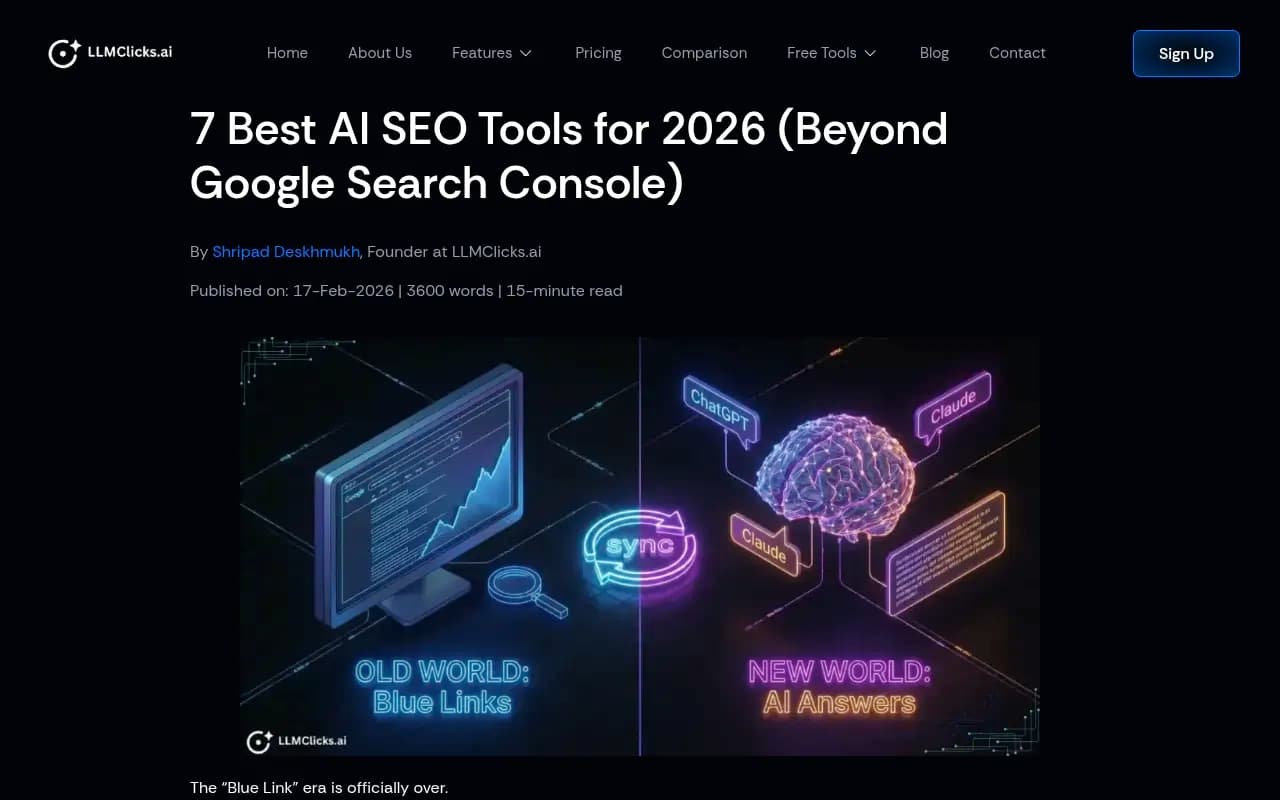
The rules of search have changed. For 25 years, SEO meant optimizing for Google's blue links. In 2026, over 60% of searches end without a click because AI engines like ChatGPT, Perplexity, Claude, and Google AI Overviews answer questions directly. If your brand isn't cited in those responses, you're invisible to a massive segment of your audience.
Traditional SEO tools like Google Search Console, Ahrefs, and Semrush are excellent at tracking rankings and backlinks. But they're completely blind to what matters now: which AI models are citing your content, how often, and whether those citations drive actual traffic.
This is where the AI search visibility stack comes in. It's a layered approach that combines tracking, optimization, content generation, and attribution into a unified workflow. Think of it as the 2026 equivalent of the classic SEO stack—except instead of chasing keyword rankings, you're engineering content to get cited by AI models.
This guide breaks down the seven essential layers of the AI visibility stack, explains what each tool does, and shows you how to connect them into a system that doesn't just monitor—it optimizes and proves ROI.
Layer 1: AI Search Visibility Tracker (The Foundation)
What it does: Monitors which AI models cite your brand, how often, and in what context. Tracks share-of-voice vs competitors across ChatGPT, Perplexity, Claude, Gemini, Google AI Overviews, and other LLMs.
Why you need it: You can't optimize what you don't measure. A visibility tracker is the foundation of your stack—it tells you where you stand today and surfaces the gaps you need to fix.
Key features to look for:
- Multi-model tracking (at least ChatGPT, Perplexity, Claude, Gemini, AI Overviews)
- Prompt volume estimates and difficulty scoring
- Share-of-voice metrics vs competitors
- Citation source analysis (which pages/domains AI models reference)
- Page-level tracking (see exactly which URLs get cited)
- Multi-language and multi-region support
Top recommendation: Promptwatch is the only platform rated as a "Leader" across all categories in 2026 comparisons. Unlike monitoring-only tools, it combines tracking with content gap analysis and AI-powered content generation—making it an optimization platform, not just a dashboard. It tracks 10 AI models, provides prompt intelligence with volume estimates, and includes crawler logs so you can see exactly how AI engines discover your content.

Other strong options include LLMrefs for keyword-centric workflows, Profound for agency teams managing multiple brands, and Otterly.AI for basic monitoring (though it lacks optimization features).
Layer 2: AI Crawler Log Monitoring
What it does: Tracks real-time logs of AI crawlers (ChatGPT, Claude, Perplexity, etc.) hitting your website—which pages they read, how often they return, and any errors they encounter.
Why you need it: AI models can't cite content they haven't crawled. Crawler logs reveal indexing issues, show which pages AI engines prioritize, and help you diagnose why certain content isn't getting picked up.
Key features to look for:
- Real-time crawler activity logs
- Error tracking (404s, timeouts, access blocks)
- Crawl frequency analysis
- Page-level visibility (which URLs are being read)
- Historical data to track changes over time
Top recommendation: Promptwatch includes AI crawler logs as part of its Professional and Business plans. Most competitors (Otterly.AI, Peec.ai, AthenaHQ) don't offer this at all, making it a major differentiator.
Alternatively, Scriptbee offers unlimited domain tracking with crawler monitoring, though it lacks the content optimization features of Promptwatch.
Layer 3: Content Gap Analysis
What it does: Identifies the specific prompts and topics where competitors are visible but you're not. Shows exactly what content your website is missing—the questions, angles, and topics AI models want answers to but can't find on your site.
Why you need it: This is the bridge between monitoring and action. Instead of guessing what to write, gap analysis tells you precisely which content to create to close visibility gaps.
Key features to look for:
- Competitor visibility comparison
- Prompt-level gap identification
- Topic clustering and prioritization
- Difficulty scoring (find winnable opportunities)
- Query fan-outs (see how prompts branch into sub-queries)
Top recommendation: Promptwatch's Answer Gap Analysis is purpose-built for this. It shows you the exact prompts competitors rank for but you don't, then feeds that data directly into its AI writing agent to generate the missing content. This closed-loop workflow—find gaps, generate content, track results—is what separates optimization platforms from monitoring-only tools.
LLMClicks also offers strong gap analysis features, though it requires more manual work to turn insights into action.
Layer 4: AI Content Generation Engine
What it does: Creates articles, listicles, comparisons, and guides specifically engineered to get cited by AI models. Uses real citation data, prompt volumes, and competitor analysis to generate content that ranks in AI search.
Why you need it: Writing for AI engines is different from writing for Google. AI models prioritize structured, authoritative, citation-rich content. A good content generation engine understands these patterns and creates content optimized for LLM consumption.
Key features to look for:
- Citation data integration (learns from 880M+ analyzed citations)
- Prompt-aware content generation
- Persona targeting (matches how real users prompt AI)
- Structured output (headings, lists, tables)
- Source attribution and fact-checking
Top recommendation: Promptwatch's built-in AI writing agent generates content grounded in real citation data from 880M+ analyzed responses. It's not generic SEO filler—it's content engineered to answer the specific questions AI models receive, formatted the way they prefer to cite.
Alternatives include Jasper for general marketing content (though it's not optimized for AI search), Surfer SEO for traditional SEO content, and Koala AI for bulk article generation.
Layer 5: Reddit & YouTube Intelligence
What it does: Surfaces discussions on Reddit and YouTube that directly influence AI recommendations. AI models frequently cite these platforms, so understanding what's being said about your brand (and competitors) is critical.
Why you need it: Reddit threads and YouTube videos often outrank official brand websites in AI responses. If you're not monitoring these channels, you're missing a major piece of the visibility puzzle.
Key features to look for:
- Reddit thread tracking and sentiment analysis
- YouTube video citation monitoring
- Competitor mention tracking
- Trending topic identification
- Integration with main visibility dashboard
Top recommendation: Promptwatch includes Reddit and YouTube insights as part of its core platform—a feature most competitors ignore entirely. It shows you which threads and videos AI models cite, helping you identify opportunities to engage or create competing content.
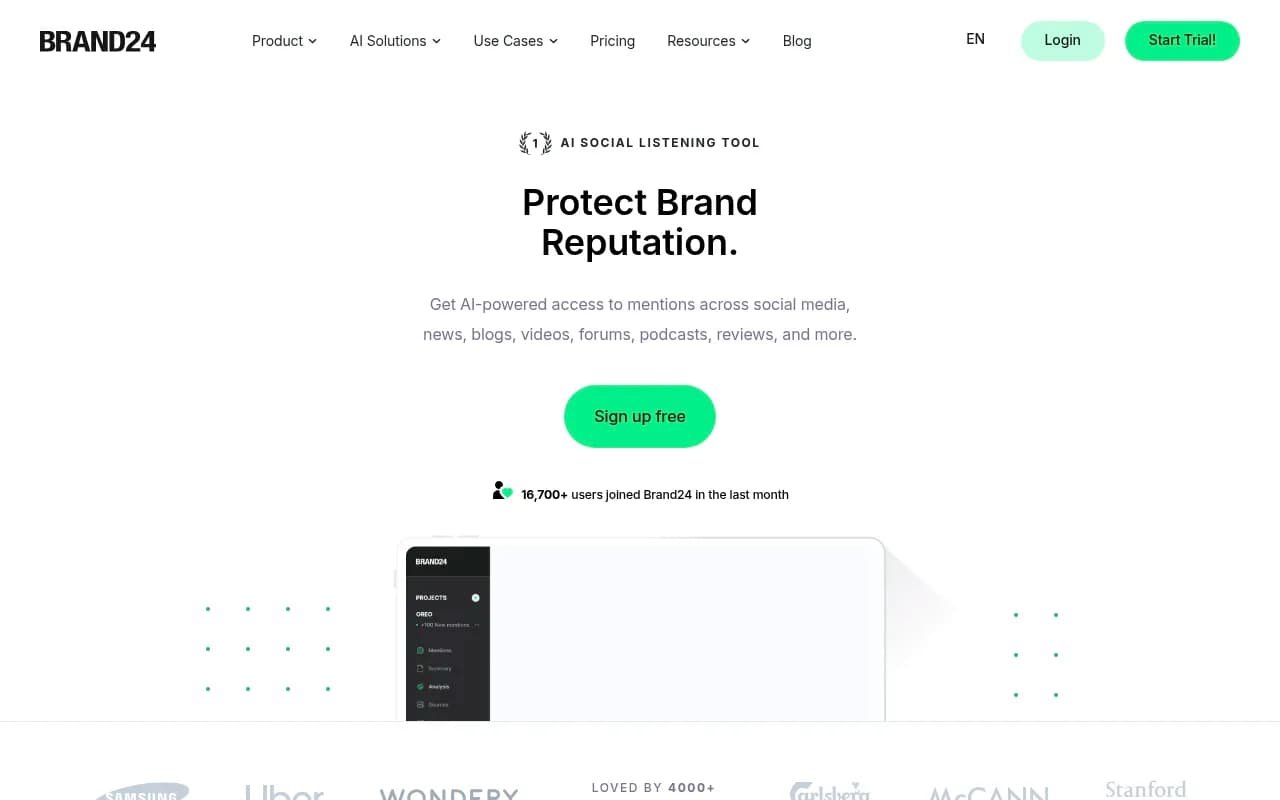
Brand24 offers strong social listening across multiple platforms, though it's not specifically built for AI search optimization.
Layer 6: Competitor Heatmaps & Benchmarking
What it does: Compares your AI visibility vs competitors across LLMs. Shows who's winning for each prompt, which models favor which brands, and where you have opportunities to gain ground.
Why you need it: AI search is a zero-sum game—if a competitor gets cited, you don't. Heatmaps reveal exactly where you're losing and help you prioritize which prompts to target first.
Key features to look for:
- Multi-competitor tracking
- Model-by-model comparison (ChatGPT vs Perplexity vs Claude, etc.)
- Prompt-level win/loss analysis
- Historical trending (see who's gaining/losing visibility)
- Exportable reports for stakeholders
Top recommendation: Promptwatch's competitor heatmaps show visibility across all tracked LLMs in a single view. You can drill down to see exactly which prompts each competitor dominates and why.
Profound offers similar features with a focus on agency workflows, while Semrush provides basic AI tracking (though with fixed prompts and limited customization).
Profound

Layer 7: Traffic Attribution & ROI Tracking
What it does: Connects AI visibility to actual website traffic and revenue. Shows which AI citations drive real visits, how users behave after arriving from AI engines, and the business impact of your optimization efforts.
Why you need it: Visibility metrics are meaningless if they don't translate to business outcomes. Attribution tools close the loop by proving that AI search optimization drives measurable ROI.
Key features to look for:
- Code snippet or GSC integration for tracking AI referrals
- Server log analysis to identify AI-driven traffic
- Conversion tracking (see which AI sources drive revenue)
- Multi-touch attribution (understand the full customer journey)
- Reporting integration with GA4, Looker Studio, etc.
Top recommendation: Promptwatch offers three methods for traffic attribution—code snippet, Google Search Console integration, or server log analysis. This flexibility lets you choose the approach that fits your technical setup. Page-level tracking shows exactly which pages are being cited and how often, then ties that data to actual traffic.
For enterprise teams, Dreamdata and Adobe Marketo Measure provide advanced multi-touch attribution, though they're not specifically built for AI search.
How to Build Your Stack: Three Approaches
Approach 1: All-in-One Platform (Best for Most Teams)
Start with a comprehensive platform that covers layers 1-4 and parts of 5-7. This gives you tracking, optimization, and content generation in a single tool.
Recommended stack:
- Core platform: Promptwatch (Essential $99/mo or Professional $249/mo)
- Traffic attribution: Built-in via code snippet or GSC integration
- Reporting: Looker Studio integration or API for custom dashboards
Total cost: $99-249/mo
Best for: Marketing teams, SEO teams, and small-to-mid-sized brands that want a complete solution without managing multiple tools.
Approach 2: Best-of-Breed Stack (For Advanced Teams)
Combine specialized tools for each layer to get maximum depth and flexibility.
Recommended stack:
- Visibility tracking: Promptwatch or LLMrefs
- Content generation: Jasper or Surfer SEO
- Social listening: Brand24
- Attribution: Dreamdata or Ruler Analytics
- Reporting: Looker Studio + custom API integrations
Total cost: $500-1,500/mo
Best for: Enterprise teams, agencies managing multiple clients, or brands with dedicated GEO specialists.
Approach 3: Budget Stack (For Startups)
Start with free and low-cost tools to prove value before investing in premium platforms.
Recommended stack:
- Visibility tracking: Promptwatch Essential ($99/mo) or free tools like AI Rank Checker
- Content generation: ChatGPT Plus ($20/mo) + manual optimization
- Attribution: Google Analytics 4 (free) + manual tagging
Total cost: $99-119/mo
Best for: Startups, solopreneurs, and teams testing AI search optimization before committing to larger budgets.
Common Mistakes to Avoid
1. Monitoring without optimizing: Most teams start with a visibility tracker, see they're invisible, then... do nothing. The tracker is just step one. You need content gap analysis and generation tools to actually fix the problem.
2. Ignoring crawler logs: If AI models aren't crawling your site properly, no amount of content optimization will help. Check crawler logs first to ensure your content is even being discovered.
3. Treating AI search like traditional SEO: AI models don't care about keyword density or backlinks. They prioritize structured, authoritative, citation-rich content. Writing for AI requires a different approach.
4. Not tracking ROI: Visibility metrics are vanity metrics if they don't connect to business outcomes. Always implement traffic attribution to prove that AI optimization drives real results.
5. Using fixed prompts: Some platforms (Semrush, Ahrefs Brand Radar) only track a fixed set of prompts. This gives you a narrow, incomplete view. Look for tools that let you customize prompts or generate them automatically from your keywords.
The Action Loop: How the Stack Works Together
Here's how a complete AI visibility stack operates in practice:
Step 1: Track your baseline Use your visibility tracker to understand where you stand today. Which AI models cite you? How often? What's your share-of-voice vs competitors?
Step 2: Identify gaps Run content gap analysis to see which prompts competitors rank for but you don't. Prioritize based on prompt volume and difficulty.
Step 3: Check crawler health Review crawler logs to ensure AI models can access your content. Fix any errors or indexing issues.
Step 4: Generate optimized content Use your AI content generation engine to create articles, guides, and comparisons that answer the prompts you're missing. Structure content for AI consumption—clear headings, lists, tables, citations.
Step 5: Monitor Reddit/YouTube Check if competitors are being cited from Reddit threads or YouTube videos. Consider creating or engaging with relevant discussions.
Step 6: Track results Watch your visibility scores improve as AI models start citing your new content. Use page-level tracking to see exactly which pages are working.
Step 7: Prove ROI Connect visibility gains to actual traffic and conversions using attribution tools. Report on business impact, not just vanity metrics.
Step 8: Iterate Repeat the cycle. AI search is dynamic—new prompts emerge, competitors publish new content, and model behavior changes. Continuous optimization is essential.
Platform Comparison: Key Differentiators
Here's how the major platforms stack up across the seven layers:
| Platform | Tracking | Crawler Logs | Gap Analysis | Content Gen | Reddit/YouTube | Heatmaps | Attribution |
|---|---|---|---|---|---|---|---|
| Promptwatch | ✅ 10 models | ✅ Real-time | ✅ Built-in | ✅ AI agent | ✅ Included | ✅ Full | ✅ 3 methods |
| LLMrefs | ✅ 9 models | ❌ No | ✅ Strong | ❌ No | ❌ No | ✅ Good | ⚠️ Basic |
| Profound | ✅ 9+ models | ❌ No | ⚠️ Limited | ❌ No | ❌ No | ✅ Good | ❌ No |
| Otterly.AI | ✅ 3 models | ❌ No | ❌ No | ❌ No | ❌ No | ⚠️ Basic | ❌ No |
| Semrush | ⚠️ Fixed prompts | ❌ No | ❌ No | ❌ No | ❌ No | ❌ No | ❌ No |
| AthenaHQ | ✅ 5 models | ❌ No | ⚠️ Limited | ❌ No | ❌ No | ⚠️ Basic | ❌ No |
The pattern is clear: most platforms stop at monitoring. Promptwatch is the only tool that covers all seven layers, making it a true optimization platform rather than just a tracker.
Getting Started: Your First 30 Days
Week 1: Establish baseline
- Sign up for a visibility tracker (Promptwatch Essential is a good starting point)
- Run your first audit to see current AI visibility
- Identify your top 3 competitors
- Export initial share-of-voice metrics
Week 2: Diagnose issues
- Review crawler logs to check for indexing problems
- Run content gap analysis to find missing topics
- Prioritize 5-10 high-value prompts to target
- Check Reddit/YouTube for competitor mentions
Week 3: Create content
- Generate 3-5 articles targeting your priority prompts
- Structure content for AI consumption (clear headings, lists, citations)
- Publish and submit to AI crawlers if possible
- Monitor initial crawler activity
Week 4: Track results
- Check visibility scores for new content
- Implement traffic attribution (code snippet or GSC)
- Set up weekly reporting dashboard
- Plan next round of content based on results
The Future of AI Search Visibility
The AI search landscape is evolving rapidly. Here's what to watch in 2026 and beyond:
More AI models: Expect new entrants beyond ChatGPT, Claude, and Perplexity. Your stack needs to be flexible enough to add new models as they gain traction.
Deeper personalization: AI models are getting better at tailoring responses to individual users. This means visibility will become more context-dependent—your stack needs to support persona-based tracking.
Shopping integration: ChatGPT Shopping and similar features are turning AI engines into transaction platforms. Tracking product recommendations will become as important as tracking citations.
Voice and multimodal search: As AI search expands beyond text to voice and images, your stack will need to track visibility across these new formats.
Regulatory changes: AI citation practices may face regulation, especially around attribution and compensation. Stay informed about policy developments.
Final Thoughts
Building an AI search visibility stack isn't optional anymore—it's table stakes for competing in 2026. The brands that win will be those that move beyond monitoring to optimization, connecting visibility to revenue with a complete, integrated stack.
Start with a strong foundation (visibility tracking), add optimization layers (gap analysis, content generation), and close the loop with attribution. The tools exist today to do this effectively—you just need to assemble them into a coherent system.
The blue link era is over. The citation era is here. Build your stack accordingly.